
EPSOM CYCLING CLUB (est. 1891)
THE EARLY YEARS

The Club’s present logo, and some members in Club kit.
Images with thanks to Epsom Cycling Club.
Epsom Cycling Club was established in 1891 and, at the time of writing (in early 2022), is now in its 131st year.
This article sets out the interesting circumstances of the Club’s foundation and its development to the late 1920s. Those years set the pattern for the range of activities (group cycle outings and competitive events together with non-cycling social activities) which continues today. Details of the Club’s current activities are available on its website.
As general background, there is an interesting Wikipedia article about the bicycle’s evolution. In summary, the first machine that enabled the rider to travel at a good speed was the 1870s “high-wheel bicycle”. This became known as the “Penny Farthing” (after two coins of the time) because of the difference between the large front wheel (directly driven by pedals on its axle) and the much smaller stabilising rear wheel. While fast, the “Penny Farthing” was difficult to ride and, indeed, generally seen as a dangerous toy for sporting young men. All changed during the 1880s with the development of the “Safety Bicycle”. This had two wheels of the same size, with the rider’s input suitably magnified by a geared chain drive from the pedals to the rear wheel. The bicycle quickly became an everyday means of transport – and not least for leisure purposes.
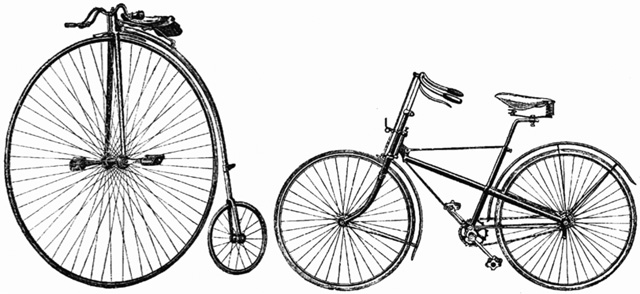 An 1880 penny-farthing (left), and a 1886 Rover safety bicycle (right).
Public domain images via Wikipedia.
In the Spring of 1891, a keen Epsom cyclist – 22 year old Harry William Absalom – convened a meeting of fourteen other like-minded individuals and they agreed to establish the Epsom Cycling Club. Harry took on the role of Hon Sec and Edmund G Wilson, then Clerk of the Urban Council, was its President.
Below is a very early photograph of the Club’s members – among whom, it will be noted, are five with “Penny Farthings”. Note also that almost all the bicycles have thin solid tyres: the now ubiquitous pneumatic tyre was then a very recent innovation.

An early 1890s photograph of Epsom Cycling Club.
(For the key to the numbers, see the following paragraph.)
Photograph with thanks to Bourne Hall Museum.
The photograph was taken in front of the Rising Sun in Heathcote Road, Epsom, which the Club was using as its meeting place. This was probably because two of the members (Walter and Henry Busbridge – at 1 and 3) were sons of the landlord, Alfred Busbridge (at 6) alongside his wife Amelia (at 7). Membership of the club was not yet open to women, but Alfred and Amelia’s young daughter, Eleanor (on the tricycle at 4) was allowed to join in here. The only other members here who can be named with confidence are Henry Saunders (at 2) and, at 5, Jack Williams who ran a cycle shop in Kingston Road, Leatherhead.
Most of the cyclists in that photograph are wearing the Club’s first badge – as below – on their caps.
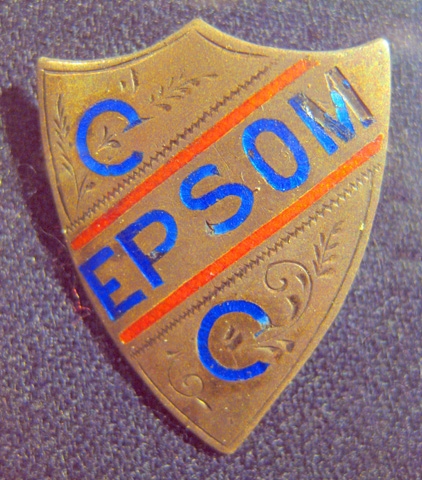
The Club’s early badge.
Photograph with thanks to Epsom Cycling Club.
Harry Absalom also had an interest in the Epsom Harriers, and the two Clubs held occasional joint sports and social meetings. In 1893, the Club joined with Epsom Harriers in inviting people to their “Second Annual Ball”. This was held on Thursday 15 January at the then Epsom Public Hall (in The Quadrant at the corner of Church Street and Station Road – now the Upper High Street).
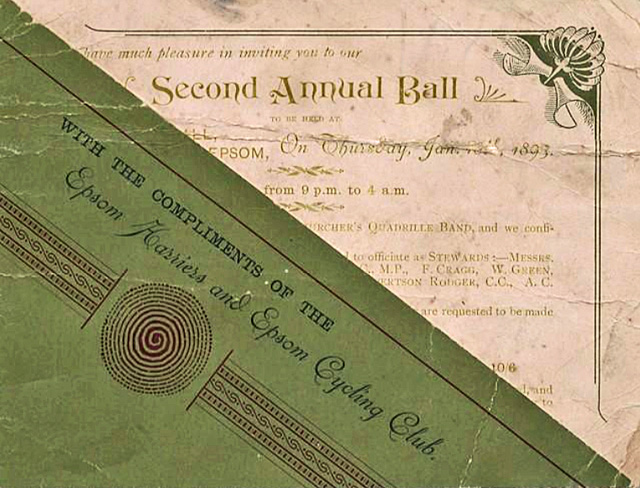
The Epsom Cycling Club and Epsom Harrier’s invitation to their second annual ball.
Photograph with thanks to Bourne Hall Museum.
The invitation offered “Dancing from 9pm to 4am” to the music of “Mr Churcher’s Quadrille Band“. Tickets were 5/- (25p) for Ladies, 7/6 (37½p) for Gentlemen and 10/- (50p) for a Double Ticket – each including “Light refreshments“. The invitation issued in the names of Harry Absalom (of South Street) and H C Ottaway (of High Street) as Hon Secs of the Cycling Club and Harriers respectively, who confidently expected that “the great success that attended our Ball last year . . . will be repeated“. The invitation also confirms that Edmund Wilson remained the Club’s President and lists the following as the Club’s Vice-Presidents: R Applegarth; A Boyd; J R Harding; A E Harter; E A Rudall; and R Norman.
Sadly, few of the Club’s own records have survived. However, we know the following from various sources.
- For 1893, the Club’s Captain was A E Bradley.
- For 1894, the Club’s membership stood at 50 and its uniform was “Black & Amber”.
- For 1895, Fred Wood of Ewell and R W Norman had succeeded A E Bradley and Harry Absalom as, respectively, Club Captain and Hon Sec – and membership had grown to 60.
- For 1898, the Club’s HQ had followed Club member Walter Busbridge (son of Alfred Busbridge, landlord of the Rising Sun) as he took on the Wellington Hotel in Epsom High Steet; W H Wood of East Street, Epsom had taken over as Hon Sec; the Club’s Captain was F Cragg; and membership (now open to ladies) stood at 165.
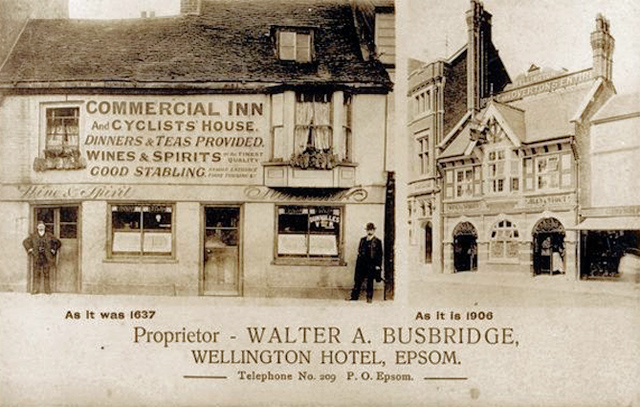
A publicity card for the Wellington Hotel as rebuilt in 1906.
(Note, in its previous incarnation, the promotion of the hotel as a “Cyclists’ House”.)
Image with thanks to the Bourne Hall Museum.
Although membership of the Club had been open to ladies for a decade, the 1908 photograph below of some of the members was an all male affair. (And note that the bicycles on show here are now all fitted with pneumatic tyres.)

Some Club members in about 1908.
(For the key to the numbers, see the following paragraphs.)
Photograph with thanks to Epsom Cycling Club.
As for the 1890s photograph, the identity of only a few of the individuals is known. The first (at 1) is Henry Saunders, also identified in the earlier picture. In the centre (at 2) is Thomas Hersey, proprietor of what began as the Epsom Cycle Works but extended into motor cars and, in about 1910, rebuilt as the still recognisable building (see the two incarnations below), the formal address of which is 155-163 High Street, but is normally thought of as being in South Street. Thomas is pictured above sitting on a motorised tricycle – presumably one of the products available through his business.
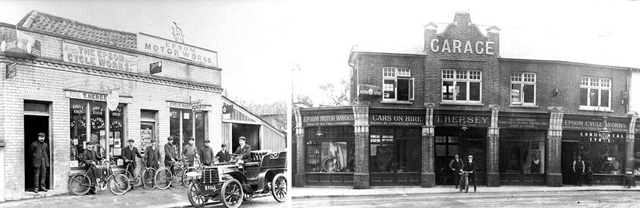
Thomas Hersey’s Cycle & Motor Works before and after the circa 1910 rebuilding.
Photographs with thanks to Bourne Hall Museum.
At 3 in the c.1908 photograph is Harry Skelton, a builder in the family firm run by his widowed mother. At 4 and 5 are Walter Busbridge (proprietor of the Wellington Hotel) and his brother, Henry, (now an architect). Finally, it is pretty certain that the individual at 6 is Thomas Snow, who went on to run a cycle shop in East Street.
It is understood that one of those shown in the c.1908 photograph is Thomas Edwards who went on to run a cycle shop at 2 East Street, Epsom. (From 1947 to 1951, Thomas served as the Club’s President.)
Like many other essentially social organisations, the Club went into abeyance during WW1. To mark its resumption in 1924, the Club adopted a new logo. As shown below, this harked back to the Club’s origins by not only specifying its foundation year but also featuring a now long-overtaken “Penny Farthing”.

The Club’s 1924 logo.
On re-starting in 1924, the Club had Sir Arthur Glyn (the local dignitary after whom Glyn School is named) as its President – a position he held until 1939, when the Club again went into abeyance for WW2. Sir Arthur (arrowed) was at the centre of a May 1927 gathering of Epsom and Redhill Club members at the Abinger Hatch pub.

Sir Arthur Glyn surrounded by members of Epsom and Redhill Cycling Clubs
at Abinger Hatch, May 1927.
Photograph with thanks to Epsom Cycling Club.
The following roughly contemporaneous photograph is of some members on a break during some pleasure ride. (Note that the two bicycles seen here now have full drop handlebars.)

A group of Club members in about 1927.
(For the key to the numbers, see below.)
Photograph with thanks to Epsom Cycling Club.
The names and some details of those numbered above are, from the Club’s records, as below.
1: Thomas Snow (who was also at 6 of the c.1908 photograph above), owner of a cycle shop in East Street. His teenage son, Jonathan, won the Club’s Hill Climb in 1924 and 1925.
2: Cyril Osborne, younger brother of WW2 casualty Charles Osborne (and who was involved in the family firm famous for “Chossy” saddlebags). Cyril was Club Secretary when it re-started after WW1. He was later awarded honorary life membership of the Club.
3: George Childs, who donated the Club’s “Childs trophy” for the Club Champion over 25, 30 and 50 miles – which, after three consecutive wins, was won outright in 1937 by Jack Howe. (After WW2, he ran a cycle shop in Carshalton).
4: Percy Vaughan who, in 1929, set the record for the Pebble Hill Climb – an annual event that was last held in 1958. (Increasing motor traffic made racing on main roads – not least what is now the A24 – increasingly problematic.)
5: Bill Jamieson who, in 1938, donated a distance trophy to replace the one won outright by Jack Howe in 1937. This second trophy was won outright in 1951 by Harry Mays after three wins. (Harry gave the trophy back to the Club in the 1990s, and it is now used for the Women’s Championship.) Bill Jamieson later moved to Selsey, (where he was landlord of the Fisherman’s Joy pub) and, for a time, was a Club Vice-President.
The Club began to award – and continues to award – small (inch-high) medals to members placed in its competitive events. As shown below, these have the Club’s “Penny Farthing” logo on the front. (The reverse is engraved with relevant details for each winner.)
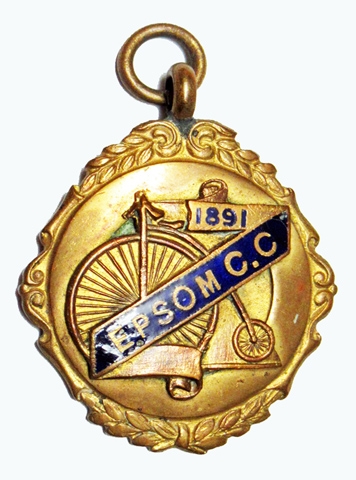
A typical Epsom Cycling Club medal.
Photograph by Roger Morgan © 2021 of an item in Bourne Hall Museum.
As noted above, the Club went into abeyance during WW1. That was also the case – as for many other activities – during WW2. The Cub resumed activities in the late 1940s and, as shown in the picture at the head of this article continues in good form today.
Roger Morgan © 2022
with special thanks to ECC’s Brian Hill