
Martyrs/Marters in Ewell and Epsom:
their tragic loss of Edward Hall from accidental death in Illinois
Tolworth Court Farm, formerly a medieval manor house, stood in fields beside the Bonesgate stream between the present A240 Kingston Road and Cox Lane, Chessington. During the 18th century it was occupied by John Martyr, otherwise Marter, and his wife Catherine, formerly Crutcher, nee Seymor, and their 7 children. These included, Sarah, born c. 1752, John born c. 1755 & Edward born 14 April 1759.
Sarah Marter/ Mrs Willam Hall (1752 – 1833)
William HALL of the Parish of Ewell, Widower, and Sarah MARTYR, Spinster were married [at Long Ditton] by Licence on the 26th Day of March in the Year One Thousand seven Hundred and Seventy two. Sarah signed herself MARTER.
Headstones on graves in St Mary’s churchyard Ewell commemorated the passing of this couple:-
-
- In Memory of Mr William Hall who departed this life the 24th of August 1785 Ætat 40 years.
- Sacred To the Memory of Mrs Sarah Hall relict of the late Mr. William Hall of this Parish who died February 19th 1833 aged 81 years.
Willliam Hall, the migrant (1733 – 1837)
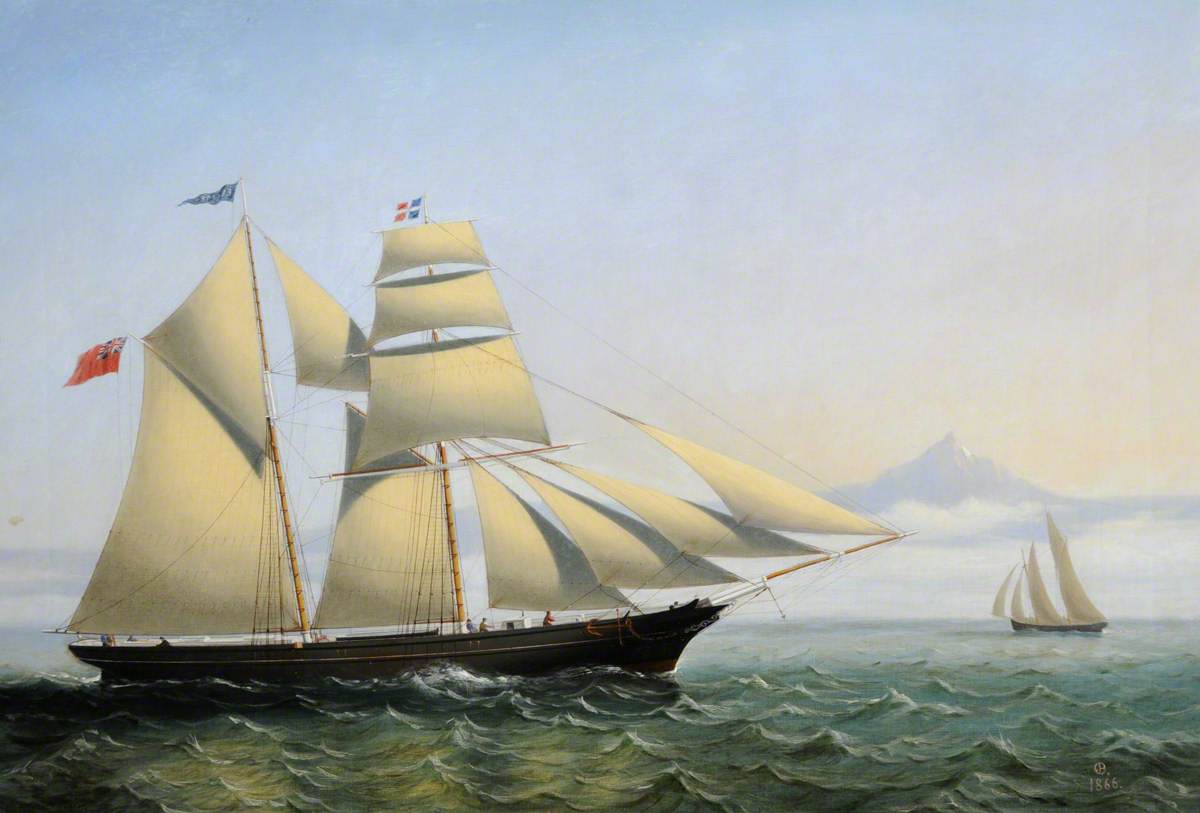 Possibly the Electra that William & Elizabeth sailed on
The ‘Electra’ off a Mountainous Coast;
Painting by Ouless, Philip John Courtesy of Jersey Heritage;
The godfather of William Hall, eldest son of William and Sarah (nee Marter) Hall, born in Ewell, Surrey, 20 February 1773, had been William Jubb of Ewell Mill and Hall became the miller there before 1796. On 25 February 1821 he embarked in the ship Electra, at the Port of London, with his wife, nine children, and a young man, Thomas Ayres, to arrived, by way of Philadelphia, at Pittsburgh, 21 May 1821.
William’s stated reasons for quitting England
“1st. The difficulty of providing for the numerous Family with which God has blessed me & the prospect of removing that load of Care & Anxiety which fills the Breasts of Parents on that Account.
2nd. To escape with them from that Aggregation of Oppression, Tyranny, Hypocrisy, & Misery which prevailed in England, which I left with its prisons crowded with Debtors & Criminals, its Workhouses filled with Paupers, its Roads covered with Mendicants & Persons begging for employment, its Farmers & Tradesmen daily sinking into poverty owing to the imense burden of taxation & Labor which crushes them to the very ground while their insolent Oppresors were revelling in every Species of Luxury & treating with contempt & derision those Classes from whose Labour they derived all their means of enjoyment.
3rd. The proud hope of establishing my family in Freedom & Independence, of enjoying the fruits of our industry in peace & Security certain of having no part of them taken from us us without our consent in short of living in the complete enjoyment of Civil & religious Liberty.
4th. The gratifying prospect of pointing out the same road to my distressed Friends & relations by which they might also make their escape from the same Oppression under which I groaned shoud I be fortunate enough to establish myself according to my own expectation.
5th. That as there could be no prospect of amelioration in England without a total subversion of all the existing relations of society & Government, the convulsion caused by such a change woud almost to a certainty involve persons in my situation in total destruction & all the Horrors of civil war, my sons woud be pressed for Soldiers, & My Daughters, for altho some inviduals might rise to Glory & Eminence in the Contest should it prove successful yet the prosecution of it must be destructive to everything like domestic virtue & Religion in the rising Generation & these are the only bases upon which either present or future happiness can be found & should the issue prove unfortunate the complete Slavery & degradation of all the inferior Orders of Society must be the consequence until we literally presented what we are very fast approaching to, the prospect of a Land of tyrants & a den of slaves.”
Plus ça change, plus c’est la même chose !
(Rough translation ‘what goes around comes around’)
The Tragedy
Eventually the party arrived in Edwards County, Illinois, USA, without accident to settle in Albion as explained on other pages. In the succeeding spring, his journal for 21- 28 April contains a record: ‘This week has been marked to us by one of the severest afflictions that can befall a parent – the death of a beloved child’.
In a long letter to his uncle John Marter despatched on 28 April 1822 he described his house, garden of five acres, orchard, and opening farm, his present satisfaction and bright prospects of the future On the other side of the final sheet was a postscript:
“Preserve this letter, dear John, as a memento of the instability of all human felicity. The very day after I wrote it, on the fatal morning of the 24th of April, 1822, I heard the sound of my two sons passing through the porch, into which my bed-room opens. One of them I knew, by his light step and cheerful voice, to be my beloved Ned, the other was unfortunate Robert. About half-an-hour after, I heard the report of a rifle in the woods. I lay about a quarter-of-an-hour longer, until it was light enough to dress. When I went out of the door it was just five o’clock. Upon going to the back of the house, where I heard a most unearthly bellowing, I saw poor Robert rolling on the ground and writhing in the utmost agony. I immediately concluded he was dreadfully wounded, and it was some time before he could speak. He exclaimed, ‘Oh, father, I have killed Ned, and I wish I was dead myself.’
I uttered an involuntary exclamation, and sank down myself upon him. The noise brought out his mother, and the scene which followed can not be described. Two of the neighbors, aroused by Robert’s cries, assisted me in conveying him and his mother and laying them on the bed. I went with them in search of the body, which was not found for some time. At length it was brought in, and buried in a spot which my poor boy had selected for his own garden. It seems they had found a turkey. Robert dispatched his brother one way, and lay down himself behind a log, to endeavor to call up the bird to him with his turkey-call. After a little while, he heard a rustling within shot, and soon after saw what he concluded to be the turkey, took aim, fired, and leaped up, shouting for Ned, and ran in triumph to pick up his game. Think of his feelings when he found it to be the corpse of his brother. So close does sorrow stand to joy in all situations in life”.
It is not known how long Robert, born 5 October 1805 in Ewell,Surrey, survived his younger brother Edward who was only 12 at his untimely death.
John Marter recipient of the sad news
As noted in the opening paragraph above, John had been born about 1755, brother to Sarah, later Mrs William Hall.
For a Marriage Bond & Allegation, John MARTER of the Parish of Long Ditton in the County of Surrey and a Bachelor of the age of 21 years and upwards appeared personally on 24th December 1782 to declare that he intended to marry Jane MOGG of the Parish of Epsom in the said County & Diocese, Spinster of the age of 21 years and upwards …..”. Their wedding duly took place at Long Ditton two days later.
He became a farmer in Horton and was a Churchwarden at St Martin of Tours, Epsom by 1792 also an Executor in the Will of William Jubb, paper maker; Millbank House, Ewell Common Field, dated 20 April 1796
A headstone in Epsom Parish churchyard records:-

Headstone – West.
To
the Memory of
MR. JAMES MOGG
(Late of this Parish)
who died 19th July 1792
Aged 59 Years.
Also of
JANE MARTER
Niece of the above and wife of
MR. JOHN MARTER
(of Horton)
who died 9th February 1800
Aged 39 Years.
Also of the above named
MR. JOHN MARTER
who died 27th April 1826
Aged 71 Years.
Headstone East & Footstone West – Blank
Footstone – East. J.M. 1792
J.M. 1800
J.M. 1826.
Edward Marter (1759 – 1833)
He was another uncle who engaged in regular correspondence with William Hall in Illinois, apparently from Chenies in Oxfordshire. He traded, however, as keeper of the Licensed State Lottery Office, Great Piazza, Covent-Garden, and No. 227 High Holborn, London.
Edward was buried on 4 June 1833, aged 74 years, at the Parish Church of St Mary, Long Ditton, Surrey having been brought there from Ewell.
William Hall, bereaved father of ‘beloved Ned’, and ‘unfortunate Robert’, was finally laid to rest in Albion, Wanborough, Cemetery, Edwards County, Illinois, having died on 2 August 1837.
His eldest son William, 15 October 1804 – 21 October 1884, was also interred there.
Wanborough had, however, been abandoned about 1840 in favour of Albion, and the Cemetery is all that remains of the village.
William’s relict Elizabeth [James, nee Coquhoun] survived him to be enumerated for 1850 Population Census of the USA, aged 78. She died on 11 October 1859.
Brian Bouchard 2023