
An Index to Wills
This is an index to the older wills made by residents of Epsom, Ewell and Cuddington ‒ nearly 1500 wills from over six centuries, made between 1239 and
1857. The index identifies who made the will, where, and when, with details of the courts with which the wills were originally registered and the repositories where they can be found now.
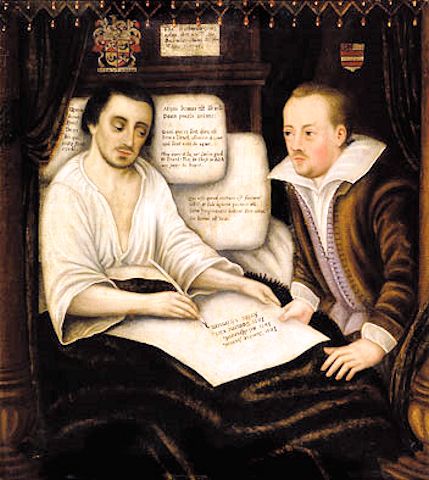 Making a will in 1607
(Thomas Braithwaite of Ambleside)
The wills file has been sorted in three different ways, to view them please click the links below:
We’ve used abbreviations to summarise much of this information, and these are explained in the list at the end. The index doesn’t give the content of the wills
themselves, but most of these can be accessed online. Many of them can be found in a series prepared for Surrey genealogists by Cliff Webb, Archdeaconry Court and Commissary Court Will Abstracts and Indexes. These volumes were originally published by the West Surrey Family History Society. They are still available on disk from the Society, but can also be accessed by a subscription to British Origins (http://www.origins.net/bowelcome.aspx). A full printed version is available at Surrey History Centre. The column ‘Webb’ in the index quotes the reference numbers used in his books.
The second main source is the National Archives. We have used their online indexes at http://www.nationalarchives.gov.uk/records/wills.htm which are comprehensive, or nearly so, in listing the place where a will was made. If you get in touch with them through the website you can request a copy of the will.
In addition, many wills have been transcribed by local researchers, and often published in full or in abstract. A note in the Comments column will tell you if these
are accessible for research at Bourne Hall Museum.
How Wills Were Made
Nowadays the registration and execution of wills belongs to the civil authorities, and is dealt with by the Probate Registry. But until 1858 these matters were in the hands of the Church. This practice went back to the Middle Ages, when it seemed the natural thing to do. People did not make their wills until they were faced with the imminent prospect of death, and then – ‘being sick in body but sound in mind, thanks be to God’, as the old formula has it – they prepared their souls: partly by settling up worldly affairs so that there would be harmony among the survivors, and partly by making bequests for supportive prayer in their future state. The document would most likely be drawn up by the parish priest, who knew the right sort of things to say, and was good with documents.
So, because the whole business of wills formed part of the duties of the Church, it used the Church’s administrative framework. As far as Epsom, Ewell and Cuddington were concerned, this was fairly simple. We were in the Diocese of Winchester, which covered Hampshire and Surrey. For local management, the diocese was divided into two archdeaconries corresponding with the counties. So for our local area the business of probate – the ‘proving’, or validation, of wills – belonged to the Archdeaconry Court of Surrey. When a will was to be proved, it would be sent to the Court, who had it copied into a Register. When this was full, they would start a new volume, and as time passed it became necessary to tell the volumes apart: this was done by naming them after the first will to be enrolled in each volume.
Simple enough. But the Archdeaconry Court dealt only with matters relating to its own jurisdiction in Surrey. If somebody had owned land in Hampshire as well, and bequeathed it in his will, the document became a diocesan matter, and was dealt with by the Consistory Court of Winchester. Sometimes people used the Consistory court anyway, because they thought it was better managed. John Fisher’s will (proved 1587) was registered twice, at Winchester and in Surrey. Furthermore, there was a courtesy arrangement by which the archdeacon, who was the bishop’s delegate, didn’t exercise his powers while the bishop was present in person. This meant that when the bishop went on visitation to review the churches of Surrey, all testamentary business was dealt with by his delegate or commissary, in the Commissary Court of Surrey. The wills of the Archdeaconry survive in the original 13 registers of the Archdeaconry Court (Spage to Harding, 1480‒1649) with several supplementary volumes of wills which were originally unregistered, and the successor volumes after 1660. The wills of the Commissary Court survive from 1662 onwards.
Ah, but what if the deceased had bequeathed land, not just in the other archdeaconry of Winchester, but in another diocese altogether? In that case the will moved another rung up the ecclesiastical ladder: it was dealt with by the Archbishop of Canterbury, who had prerogative rites over the jurisdictions of his junior bishops. Major landowners, who would have held property scattered all over England, therefore enrolled their wills at the Prerogative Court of Canterbury. There was also a longstanding tradition for the Archbishop to exercise direct control over a few parishes – called the peculiars – one of which was Cheam. Its wills were therefore enrolled in a separate court, based on another Surrey peculiar, the Deanery of Croydon.
These were the arrangements in place under the late medieval church; surviving registers date from the 15th century. The system continued after the Reformation, although its original religious motives were gone, and it remained valid, at least in theory, until the State took over in 1858. The one disruption came in 1653 when the Commonwealth government, having abolished bishops and their functionaries, retained the Prerogative Court under the name of the Court of Civil Commission and gave it powers to handle all wills. This lasted until 1660, when the Restoration brought the old system back again. But the Interregnum had broken the power of church courts to adjudicate on matters of what was increasingly thought to be private life – morals and such. Probate was left as one of their few areas of jurisdiction, and gradually this was simplified, in practice if not in theory. Testators – the people actually making the wills – wanted their bequests to be dealt with by a regular body with well-trained staff, and that prejudiced them against the smaller bodies. The Consistory Court of Winchester stopped handling Surrey business after the 1630s. The Archdeaconry/ Commissary Courts of Surrey continued in use, but fewer people used them; the last local will was registered with them in 1787. Their business gradually slipped away to the Prerogative Court of Canterbury, which had now ceased to be a jurisdiction of last resort for special cases, and was instead the standard probate body for the country.
Procedure for Wills
The procedure for dealing with wills was the same in all courts. It was assumed that the testator wrote, or more likely had written by someone with literacy and a little legal sense, a testament naming an executor and signed by witnesses. If this had not been written – if the testator, already at death’s door, had simply expressed his wishes before witnesses – this was called a nuncupative will. In January 1612 Thomas Cuddington of Ewell ‘an aged man some 76 years old… sitting by the fire in his house some days before his death’ made a simple verbal bequest, and this was duly registered.
But usually there would be a written will, sent off after the testator’s death to the appropriate court, who would have it copied into their Register. The court also kept the original wills and sometimes, if a volume of the Register has gone missing, these remain as the only evidence. After the death, the court would grant probate, which meant that it accepted the will as valid and authorised the executor to carry it out. It might also grant letters of administration to the next of kin or whoever was in charge of the estate, so that they could manage it while the process of probate was under way. Grants of probate and administration (usually abbreviated to admon) were recorded, not in the Register, but in a separate Act Book. If a will was disputed, the court would issue its judgement in the form of a sentence, also enrolled in the Act Book.
Until the 1740s, it was standard practice for executors to compile an inventory of the personal goods left by the deceased. Many of these inventories have survived (usually the ones from the Archdeaconry court) and they make a fascinating source for local history, but are not listed here, as they are going to be dealt with elsewhere on this website.
Studying Wills
More than any other formal document, wills give us access to the thoughts and feelings of people from the past. At the same time they are – unlike, say, letters or
diaries – a consistent body of documents, rather than a set of chance survivals. This means that by examining all the wills from one decade we can get a representative idea of what the whole community did and thought in those years.
Things are never quite that simple, though. First, a word on geography. This index is confined to local testators: that is, to people who, when making their will, said that they were ‘of Ewell’ or ‘of Epsom’. Usually they’d lived in the parish all their life but sometimes they’d just retired here, usually from London, so it’s not always clear how representative of the local community an individual may be. The Registers and Act Books do not always agree about what someone’s parish was. There were also a few people from other parishes who are set down as having died in Epsom, presumably on a visit to the Spa.
In those days Kingswood was part of the parish of Ewell, but Kingswood testators are not included in the index, although one or two may have slipped in unnoticed.
Although Horton was part of the parish of Epsom, testators normally stated in their wills that they were ‘of Horton in Epsom’; they are indexed under Epsom but identified as Horton people in the Comments column. Here, also, some Horton testators may not have been identified as such. The village of Cuddington was demolished in 1538 but the parish continued to exist and some people farming in the area, right into the 19th century, say they are ‘of Cuddington’. More frequently, however, they identify themselves as coming from Nonsuch Park or Worcester Park, and are indexed as such.
The date given for the will is that when it was proved – not the year when the will was made, or that when the testator died. Normally these three events came within about twelve months of each other, but not necessarily: some contested wills were not proved until long after the death of the person who made them. Until 1752, the Church used the Old Style year which ended on 25th March. In the index, all these dates have been converted to New Style, the one we are used to nowadays, where the year begins on 1st January.
Wills and Occupations
Like other legal documents, wills were expected to feature not only a person’s name and their parish, but also their ‘style’ – the place they held into society. 80% of testators provided this information, which reveals either their rank, their marital status, or their trade and occupation. The wording given in the column for Style is usually that of the original will, although sometimes this is inconsistent. For instance, doctors may appear either as ‘Doctor in Physic’ or ‘Doctor of Medicine’. In these case we have standardised the style but recorded the original wording in the column for Comments.
At the head of society come the people who style themselves according to their social rank: the 9 Knights (and 2 Dames), 17 Esquires, 116 Gentleman (and 1
Gentlewoman). From the same social sector come the clergy, 20 of them featured as Clerk, together with 2 Rectors and 3 Vicars. Then there are the people who simply record themselves by marital status: the 92 spinsters (and 6 bachelors), 10 wives, 268 widows (and 4 widowers). Note how this listing is the opposite of those for rank (and trades as well) when it comes to gender. Women normally identified themselves by their marital status, men by profession.
The few bachelors and widowers may have been making a point about their family status because of arrangements for inheritance.
In a kind of halfway ground between ranks and occupations are the great trading corporations – principally the London livery companies, whose members featured themselves as ‘Citizen and…’. Evidently these men had done well in the City and had come to retire in Epsom. We have two from the barber-surgeons and two from the haberdashers, with one each from the blacksmiths, the brewers, the clothworkers, the cooks, the cordwainers, the feltmakers, the goldsmiths and the merchant tailors. In addition there is a member of the English Factory at St. Petersburg, two employees of the East India Company (a retired clerk and a humble Third mate on the outbound ships) and someone from the Bank of England.
Public employment of one kind or another accounts for an Officer of the Excise, the Master of the Poorhouse, the Parish Clerk, the Postmaster, a schoolmaster and a retired policeman. The armed forces are represented by five Naval officers (one on half pay and one retired), together with three marines and a clerk from the Navy. There is also a retired Army officer.
The trades and occupations recorded by local people in the wills are varied, but can be taken under a few rough headings:
General retail: Shopkeeper 16, Merchant 4, Chapman 2
Agriculture: Yeoman 128, Farmer 27, Husbandman 43, Labourer 24
Costume (manufacture): Silk thrower 1, Weaver 1, Framework knitter 1, Tailor 12, Collar maker 3, Shoemaker 9, Glover 2
Costume (retail): Draper 3, Mercer 1
Food (manufacture): Miller 7 (and Millwright 1), Mealman 1, Baker 8, Pastrycook 1, Butcher 10, Dairyman 1, Maltster 9, Brewer 7, Distiller 1
Food (retail): Cornchandler 8, Grocer 7, Coffeeman 1, Victualler 22, Innkeeper 15,Vintner 3
Goods (manufacture): Blacksmith 9, Whitesmith 1, Fellmonger 1, Tanner 1, Cooper 1, Broom maker 2
Goods (retail): Ironmonger 1, Pewterer 1, Leather seller 1, Tallow chandler 11,Upholsterer 3
Speciality goods (manufacture): Painter 5, Herald painter 1, Papermaker 2, Clockmaker 1, Watchmaker 3, Gunpowder merchant 2, Powder man 1
Speciality goods (retail): Bookseller 1, Musician 1
Hairdressing: Barber 2, Hairdresser 1, Peruque maker 1
Health services: Doctor of medicine 6, Apothecary 5, Surgeon 8
Horticulture: Gardener 19, Nurseryman 2
Housing (building): Builder 3, Stonemason 2, Limeburnmonger 1, Brickmaker 1, Bricklayer 14, Timber merchant 2, Sawyer 2, Carpenter 28, Joiner 3, Glazier 7, Plumber 5, Locksmith 1
Housing (sales): Auctioneer 2
Housing (service): Servant 12, Chimney sweeper 1
Racing: Trainer 3, Jockey 1
Transport (manufacture): Coachmaker 3, Wheelwright 8, Saddler 4
Transport (services): Carrier 2, Coachman 9, Coachmaster 1, Ostler 1, Stable keeper 1, Farrier 3
Wills and Social History
Analysis by trades and status lets us compare people in roughly matching groups.
As long as the samples are of representative size ‒ this requires a dozen or so people ‒ we can compare the value of the estate left by, say, innkeepers with that of tailors or cooks or builder/ bricklayers, and that will give us an insight into the hierarchy of trades within the town and the networks of relations which underwrote their business ventures. The largest groupings – the gentlemen and yeomen – can also be analysed over time to get an idea of changing levels of prosperity.
There is a useful introduction to this resource in Barbara Abdy, Ewell Wills of the 16th–20th Centuries (Epsom & Ewell Hist. & Arch. Soc. OP43, 2004). This was largely based on a project by the society to transcribe 16th and 17th century wills from Ewell (though this was confined to the Archdeaconry Court).
Like other documents, wills have their limitations. They were not made by everyone; at the beginning of our period, testamentary disposition was only of interest to a few clergy and landowners, and although the numbers get larger as time goes by, they are still a minority. The men who made wills were not a representative sample of society, and not just because the poor didn’t have much to leave. Many quite wealthy men held their assets in copyhold property, which would descend by the custom of the manor and didn’t need to be bequeathed. As for women, only spinsters and widows normally made a will, and the very large number of widows drawing up testaments is not necessarily a sign of wealth. They may not have had much to leave, but at last they could spend their declining years thinking over who to leave it to. These factors all warn against us taking wills as a direct report on society, but then that’s true of any class of document, and at least in probate records ‒ however constrained by conventional and legal wording ‒ we are hearing the direct voices of our ancestors.
Searching for Wills
The index of wills was based on two main sources. The first is Cliff Webb’s Archdeaconry Court Will Abstracts and Indexes and Commissary Court Will
Abstracts and Indexes, as noted above. For this, the online index of search terms at British Origins was used to look for the place-names Epsom, Ewell, Cuddington and their variants. The second main source, for wills proved in the Prerogative Court of Canterbury, was the online index provided by the National Archives, using their place-name search. Cross-checks from other sources have shown that neither of these two search engines is infallible, but they have a high rate of accuracy.
For early wills, we have collated our results with Cliff Webb’s Union Index of Surrey Probate Records which Survive from before the Year 1650 (British Record Soc. 99, 1990). This is an immensely thorough work – sometimes over-thorough: completists might like to know that Webb has listed, and we have left out, the following people who left land in Epsom and Ewell but were not local testators: Thomas Hayton 1396, William Belloge 1405, William Churcheman 1451, John Quyxley 1477, Nicolas Mynne 1528, Alen Hord 1554, Thomas Arundell 1571, Margaret Willate 1579, and Thomas Perry alias Curtis 1596. Juliana Lastney 1575 was not of Ewell but of Swell in Chipstead – see Administrations in the Prerogative Court of Canterbury 1559–1580, ed. Reginald M. Glencross (William Pollard, Exeter, 1912–17) 2 p52.
It is possible that more Epsom and Ewell wills remains to be discovered in sources which have not yet been indexed, such as the original wills at the PCC which were never entered in the surviving registers, or the administrations after 1660. But that is a task for another day.
Barbara Meredith
Jeremy Harte
Abbreviations and Sources
The following abbreviations are used in the index:
ACS Archdeaconry Court of Surrey
APA Abstracts of the Probate Acts in the Prerogative Court of Canterbury 1630–53, ed. J. & G. Matthews (Chancery Lane, 1909).
BRS10 Index of Wills Proved in the Prerogative Court of Canterbury, ed J. Challenor C. Smith et al (British Record Society 10–11, 18, 25, 43–4, 54, 61, 67, 71, 77 & 80, 1893–1959).
BRS68 Index to Administrations in the Prerogative Court of Canterbury and Now Preserved in the Principal Probate Registry, Somerset House, London, ed John Ainsworth, C. Harold Ridge and Marc Fitch (British Record Society 68, 72, 74–6, 81, 83 & 100, 1944–86).
BRS82 Testamentary Records in the Commissary Court of London (London Division) ed. Marc Fitch (British Record Soc. 82, 86, 97, 102, 108 & 111, 1969–98).
BRS99 Union Index of Surrey Probate Records Which Survive from before the Year 1650, ed Cliff Webb (British Record Soc 99, 1990)
CCL Commissary Court of London
CCS Commissary Court of Surrey
CCW Consistory Court of Winchester
CU Cuddington
CYS The Register of Henry Chichele, Archbishop of Canterbury 1414‒1443, ed. E.F. Jacob (Canterbury & York Society 42 & 45‒7, 1937‒47)
EP Epsom
EW Ewell
HRO Hampshire Record Office
HRS Wykeham’s Register, ed. T.F. Kirby (Hampshire Record Soc., 1896–9)
LMA London Metropolitan Archives
LPL Lambeth Palace Library
NP Nonsuch Park
PCC Prerogative Court of Canterbury
PLA Prerogative Court of Canterbury Letters of Administration 1620–30 (Inclusive), ed. J.H. Morrison (Privately, 1935).
PWS Prerogative Court of Canterbury Wills, Sentences and Probate Acts 1661–1670 (Inclusive), ed. J.H. Morrison (Privately, 1935).
SAC12 Frederick Arthur Crisp, ‘Surrey wills: III’, Surrey Arch. Coll. 12 (1895) pp85‒107
SAC28 Mill Stephenson, ‘A list of monumental brasses in Surrey: IV’, Surrey Arch. Coll. 28 (1915) pp51‒110.
SAC35 Ethel Stokes, ‘Surrey wills proved in the Prerogative Court of Canterbury in 1611’, Surrey Arch. Coll. 35 (1924) pp30‒48.
SHC Surrey History Centre
SRS04 Surrey Wills: Archdeaconry Court, Herringman Register, ed. Ethel Stokes (Surrey Record Soc. 4, 1915–20).
SRS05 Surrey Wills: Archdeaconry Court, Spage Register, ed. Charles Lethbridge Kingsford (Surrey Record Soc. 5, 1922).
SRS42 The Register of John de Stratford, Bishop of Winchester, 1323–1333, ed. Roy Martin Haines (Surrey Record Soc. 42–3, 2010–11)
SYH Alan Crocker, Mary Day and Peggy Bedwell, ‘The will and probate inventory of William Jubb, 1697-1739, papermaker of Ewell’, Surrey History 9 (2010) pp1‒11.
TNA The National Archives
WP Worcester Park
Also consulted were:
Administrations in the Prerogative Court of Canterbury 1559–1580, ed. Reginald M. Glencross (William Pollard, Exeter, 1912–17).
Abstracts of Wills in the Prerogative Court of Canterbury at Somerset House, London, England: Register Soane, 1620, ed. J. Henry Lee (New-England Historic Genealogical Soc., 1904).
Calendar of Wills Proved and Enrolled in the Court of Husting, London, AD 1258–AD 1688, ed. Reginald R. Sharpe (John C. Francis, London, 1889–90).
Wills, Administrations and Inventories with the Winchester Diocesan Records, ed. Arthur J. Willis (Privately, 1968).
Sentences and Complete Index Nominum (Probates and Sentences) for the Years 1630–1639, ed. John and George Matthews (Chancery Lane, 1907).
Abstracts of Probates and Sentences in the Prerogative Court of Canterbury, 1620–4, ed. John and George Matthews (Chancery Lane, 1911).