
William Hall (1773 – 1837)
Miller at Ewell, migrant to Illinois in 1821.
Parentage
Dated 4 May 1770, an Allegation for a marriage licence declared that William Hall [possibly William Wood Hall, christened at St Martin’s Parish Church on 4 August 1745] of Epsom was to marry Ann Challener (sic) of Ewell – at St Mary’s Ewell.
The married couple appear to have taken up residence in what became 70 Kingston Road, Ewell, and William became employed at Ewell Flour Mill.
Monuments in the old churchyard of St. Mary’s Ewell include: –
 315. Head and foot stone, the headstone with scrollwork,
hourglass, pine cone, cherub face and medallion with
a portrait supposedly of Jane Challoner.
Image Courtesy of Bourne Hall Museum
Sacred to the Memory of Jane Challoner, widow, who died Jan the 17th 1769 aged 66 years also Ann Hall wife of William Hall of this place & daughter of the above Jane Challoner who died Nov. the 4th 1770 aged 24 years
Ann Hall, nee Challener, having died tragically only 6 months after her wedding, left no issue.
The Register of Marriages Parish Church of Long Ditton, Surrey, subsequently recorded for the Year 1773:-
‘William HALL of the Parish of Ewell, Widower, and Sarah MARTYR of this Parish, Spinster were married in this Church by Licence on the 26th Day of March in the Year One Thousand seven Hundred and Seventy two.’
Sarah signed herself MARTER.
Other graves in St Mary’s churchyard commemorated the passing of this couple:-
314. Head coffin and foot stone, the coffin slab resting on 6 courses of brickwork
In Memory of Mr. William Hall who departed this life the 24th of August 1785 Ætat 40 years also Catherine Hall [spinster] daughter of William & Sarah Hall departed this life Janry. 13th 1801 aged 19 years.
321. Head coffin and foot stone, the coffin stone a flat slab on 3-inch brickwork
Sacred To the Memory of Mrs. Sarah Hall relict of the late Mr. William Hall of this Parish who died February 19th 1833 aged 81 years
also Mr. Robert Hall and other members of the family.
Their union had resulted in 8 children including the eldest, William, junior, born 20 February 1773.
William Hall, the younger
Sometime after his father’s premature death in 1785, this William became the operator of the Ewell Flour Mill.
 Upper Mill, North Elevation with Stabling on the Right, 1929
Reportedly, on 27 Decenber 1803, in Chelsea, he married Elizabeth James Colquhoun who had been born 5 June 1773 in Edinburgh, Scotland. Eleven children emanated from their union.
Migration to Illinois
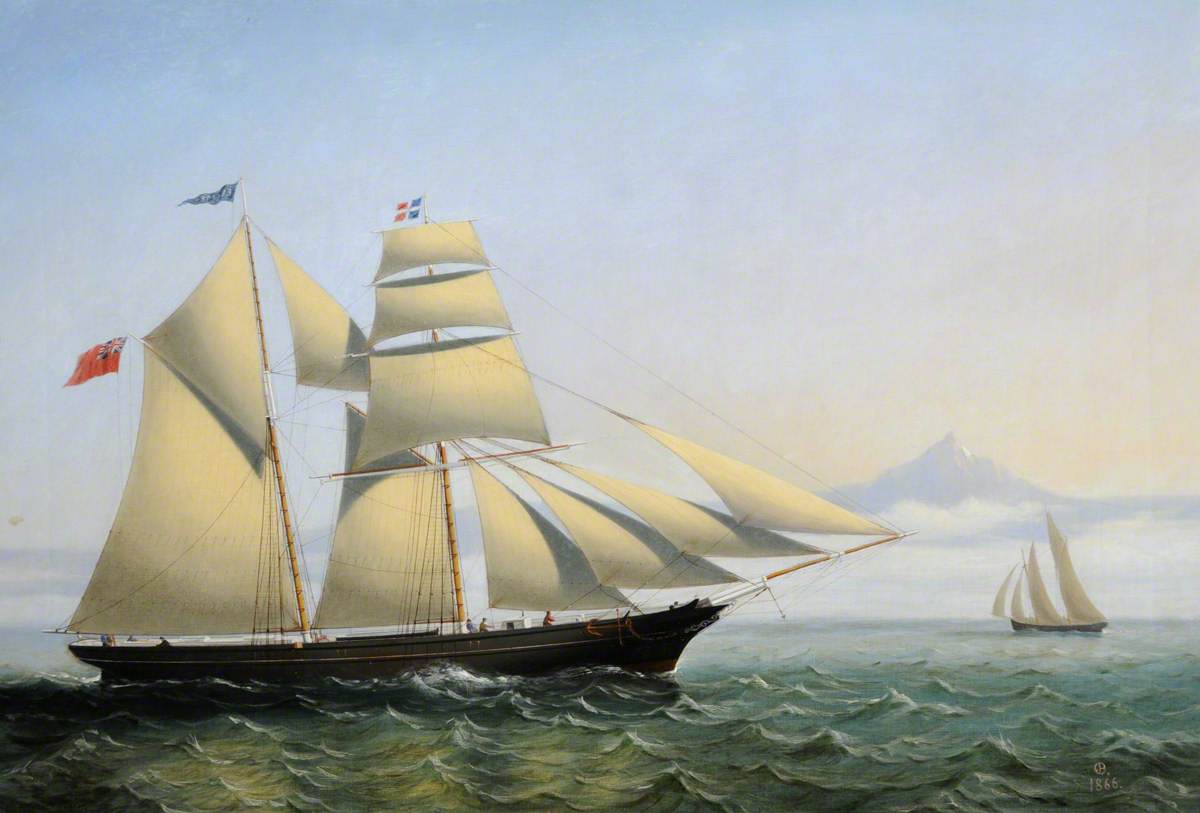 Possibly the Electra that William & Elizabeth sailed on
The ‘Electra’ off a Mountainous Coast;
Painting by Ouless, Philip John Courtesy of Jersey Heritage;
William and Elizabeth HALL and their surviving family of nine children sailed on the ship Electra from the Port of London on the 15th February 1821, by way of Philadelphia, and arriving at Pittsburg, on the 21st May 1821 and eventually settled in Edwards County, Illinois, USA.
Ewell Mill had been left in the hands of William’s younger brother Charles Hall (1783 – 1858). In 1841 he was enumerated as a Miller, living on Kingston Road, Ewell, and for 1851, a widower, residing at Ewell Mill, Kingston Road, aged 68 years, being a Miller & Farmer of 150 acres.
The Journal of William Hall from England to Illinois in 1821 was published by The Illinois State Historical Society, Springfield, Illinois in 1946 which reported :-
“WILLIAM Hall was the owner of a large water-mill in England in the early nineteenth century. God, he said, had blessed him with a wife and nine children. In 1821, the ‘Care & Anxiety’ which these same blessings brought him in thickly-populated Britain influenced him to remove to America. In the Illinois of 1817 and 1818 an “English Settlement” had been started in Edwards County by two Englishmen, Morris Birkbeck and George Flower. Most of the settlers were people of moderate means and more than average intelligence…”
On shipboard the Halls travelled in steerage. They took their own supplies — meat, fowl, cereals, sweets, beverages, etc. – and cooked their meals as best they could in the vessel’s hold. When the provisions in steerage ran low the captain sent down a pig and other foodstuffs”.
William himself starts with his departure at the end of February 1821 from Gravesend , being seen off by Mr Everest, the prominent Solicitor from Epsom. Eventually he arrived in Albion, Edwards County, Illinois, and wrote to his friends at Ewell informing them that he had made a purchase of 85 Acres of land in Little Prairie.
As an Episcopalian he was a founding member of Little Prairie Church established during 1823.
In 1826, he wrote at length of his horticultural activities since arriving in Wanborough, Illinois, as published in The Gardener Magazine, pp 327 -332.
He features in A History of the English Settlement Edwards County, Illinois, 1882, by George Flower.
William died in 1837 and was buried in the cemetery at Wanborough, Albion, Edwards County, Illinois, USA.
Brian Bouchard 2023