
HOPKINS
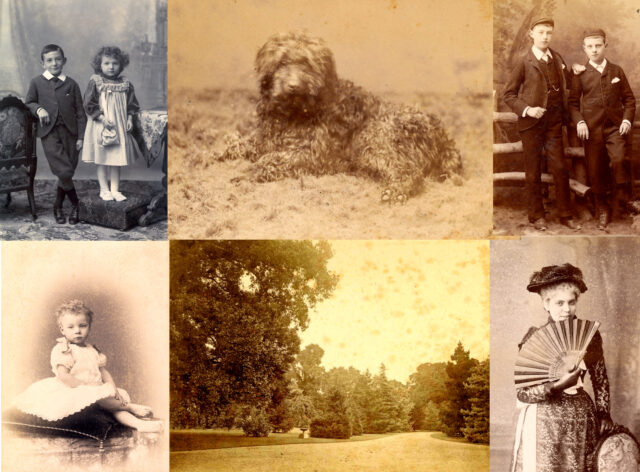 A selection of photographs by Cuthbert Hopkins
Images courtesy of Bourne Hall Museum
Introduction
Some time ago I spent many months, along with our webmaster, Peter Reed, attempting to identify as many sitters as possible from the collection of glass negatives produced by local photographer Cuthbert John Hopkins, who died in 1916, and then researching and writing up biographies for them, which Peter turned into web pages and generally organised into some kind of coherent order/plan. We had unidentified people left over, most of whom have remained unidentified, but overall this became the project entitled Victorian Studio Photos.
When I was involved in the Studio Photos project I not only marvelled at what Cuthbert had done for so many years (along with various other jobs, such as being a town centre draper and proprietor of a sewing machine warehouse) but also wondered what this man looked like, who his family were, what they did and suchlike. It’s easy enough to track the family from censuses and other records but it’s curious, isn’t it, that we don’t have any photos of them. So, if you or anyone you know has a photo of any of the people mentioned in the article that follows, please share it with us by contacting the webmaster.
Since we have no photos of Hopkins persons, I’ll try to draw you in with something else, but I’m not going to tell you exactly why it’s relevant – you’ll need to read on to the end to find out.
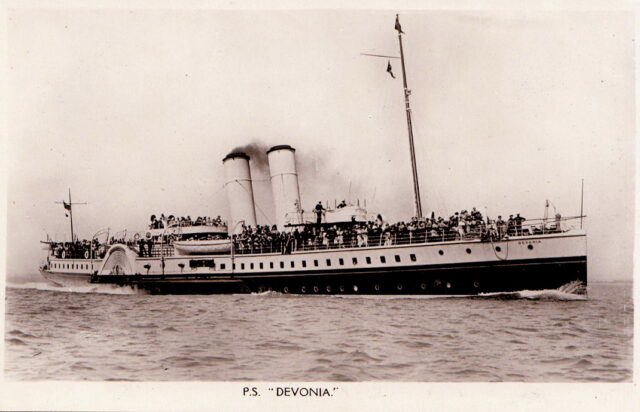
The Paddle Steamer Devonia, launched 1905, requisitioned by the Admiralty and
operated as a minesweeper in both World Wars, bombed by German aircraft during
the evacuation of Dunkirk; beached, abandoned and destroyed by the Germans in 1941.
Image source: Writer’s own collection
Cuthbert’s ancestors and siblings
John Hopkins, Cuthbert’s father, was a tailor and draper from Epsom, born in about 1815, but I’ve not been successful in identifying his forbears. Cuthbert’s mother, Maria Monger, is a different story altogether and, as her mother, Elizabeth, didn’t die until December 1853, apparently aged 80, we have a maternal foothold to cling to.
By my logic, the Epsom Mongers must have been closely connected to the Ewell Mongers – after all, how many unrelated families called Monger would you expect to find in an area the size of Epsom and Ewell back in the 18th century? None, is probably the answer, but once again I can’t tie them up For information about the Ewell Mongers, please see our articles on The Old House and Adam Pearson and The Widow’s Mites.
We are not here, however, for an archaeological dig into ancient Hopkins and Monger genealogy, so I shall just mention Mrs Elizabeth Monger, Cuthbert’s maternal grandmother, briefly and then we’ll move on to something more concrete. Mr Monger had been Thomas, who was buried at St Martin’s, Epsom on 17 January 1818, aged 43. He may well have been a cooper (a maker of wooden barrels and other such wooden containers), as his widow and son, also Thomas, were described as coopers in the 1841 census, at which point they occupied premises in the High Street. Thomas Junior expired in 1847 but in 1851 Elizabeth (née Foster, born Gravesend), now apparently aged 73, which doesn’t square with her alleged age at the time of death, was still coopering and had a son called Charles and nephew called John with her, both described as bakers. And she had a visitor – a 13-year-old lad called Cuthbert Hopkins, already described as a tailor. Since we all know by now that Cuthbert was Elizabeth’s grandson, I don’t understand why he was designated ‘visitor’, but there you are.
It’s Mrs Monger’s daughter, Maria, who interests us; there were quite a few children but another one of them was Maria’s twin sister, Eliza – both girls were born on 16 February 1812. The latter will be obliquely relevant in due course.
Maria Monger and John Hopkins were married at St George, Hanover Square on 23 July 1834. The Hopkins clan seemed to have something of an aversion to marrying in Epsom and frequently tied the knot in London for reasons best known to themselves. Also, Maria and John seemed to have at least some of the children farmed out elsewhere at census time – perhaps their premises were too small or they needed some peace and quiet. In 1851, for example, most of the kids were with tailor John Latham and his wife, Emily, although Mr Latham may well have been an employee or associate of John Hopkins.
I will list their children here, with a brief synopsis of their life statistics, but a couple of them will need to be dealt with in more detail. Some of the dates of birth are slightly approximate.
| Name | Born | Information |
| Maria Elizabeth | 1835 | Married George Edgington; died 1912 Bristol district |
| Cuthbert John | 1837/8 | Married Delilah Ford; died 1916 Epsom |
| Arthur Henry | 1839 | Married Maria Rowland; died 1912 Philadelphia USA |
| Herbert William Laidlaw | 1841 | Probably died 1860 Epsom |
| Jessie | 1843 | Married Frederick Edwin Blyth; died 1919 Bristol district |
| Lewis Charles | 1845 | Married Elizabeth Smyth and then Mary unknown; died 1911 Philadelphia |
| Christopher Edward | 1846 | Married Jemima Ann Keene; died 1903 Teddington, Middx. |
| George King | 1849 | Baptised as an adult at Holy Saviour, Croydon in 1869; died early in 1870. George was probably named after the husband of his aunt, Eliza Monger, who was married to George Kelly King |
It’s obvious from the table that nobody except Cuthbert stuck around permanently in Epsom. There are tales to tell about Maria Elizabeth and Jessie, but otherwise only Christopher Edward remained vaguely in the area, with two of the sons emigrating to the USA.
Maria Elizabeth married fairly late – in April 1874 at St Mary, Hampton, to tailor George Edgington. I am not convinced that this marriage was a great success. In the 1881 census they were residing in Victoria Street, New Windsor, but I did find a ‘lunacy’ entry for someone fitting Maria’s details, who was in an asylum in Berkshire from 5 December 1877 until discharge on 27 August 1879. We can’t be sure that it was our Maria, but I think the odds may be better than evens. By 1901, Maria, now widowed, was a lodging house keeper in Bristol and in 1911 she was an inmate at the Bristol City Workhouse and presumably died there (death registered in Q1 1912). The Workhouse, which seems to have doubled as an asylum, and I don’t know Maria’s precise status as an inmate, looks to have been a pretty grim establishment and you can read about it here. As an aside, this is depressingly reminiscent of Horton Cemetery in our area, as it seems that for a very long period the dead were simply ‘dumped’ in the ground and forgotten about. However, an organisation called the British Radical History Group established the names of many of the approx. 3,000 paupers buried – no, I will use the word ‘dumped’, because that is exactly what happened – in a mass grave and was looking to raise funds for a memorial.
Jessie didn’t seem to fare that much better than her sister. In 1866 she married Frederick Edwin Blyth, originally from Nova Scotia; they moved around quite a bit and there were several children. In 1881 they were in Brompton, with Frederick being described as clerk to a colonial broker, and by 1891 he was salesman at a sugar refinery in Clifton, Bristol. I get the impression that he may have travelled, possibly abroad, and you will see why in a moment. By the 1901 census Frederick was ‘missing’, but Jessie still described herself as a married woman, and did so again in 1911. So where was he? The answer is that he was living in South Africa with another woman, named Alice Mary Stephens. Frederick and Alice had a son called Hubert Frederick in 1898, but the child died in January 1899; the couple remained together and, after Jessie’s death in 1919, they married – he was 80 and she was 52 according to the marriage details for the ceremony, which took place on 22 January 1920. Frederick died on 21 July 1924 and both he and Hubert were interred at St Peter’s Cemetery, Observatory, Cape Town.
John Hopkins died in the summer of 1874, aged just 59, followed by his wife, Maria, in 1877. Both were buried in Epsom Cemetery (grave B11a).
Cuthbert
As I said earlier, Cuthbert had many irons in the fire, but for our purposes we are interested in his photographic career. This next photograph (date unknown) shows his High Street premises, with one of his photographic studios on top, arrowed, and the sewing machine warehouse beneath.
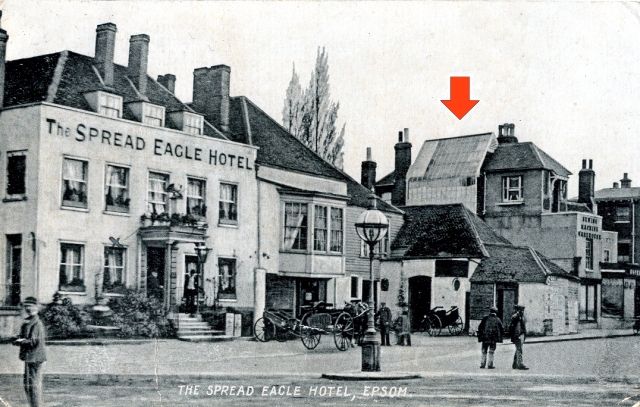 Image courtesy of Bourne Hall Museum
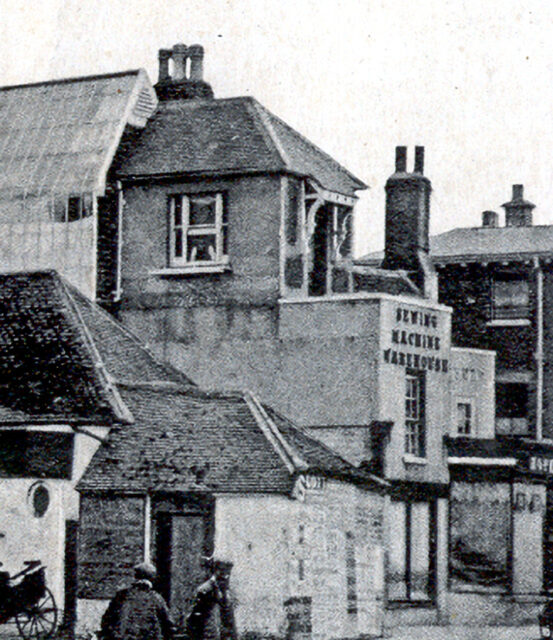 Enlarged clip from the previous image showing
the Sewing Machine Warehouse
On 20 November 1859 at Christ Church, St Marylebone Cuthbert married Delilah (or Delia) Ford, born c.1836 Dorset. I had idly wondered how the couple met, but it turned out that in the 1851 census both Delilah and her father, Edward, a farrier and groom, were living in South Street, Epsom. Mrs Ford (Priscilla) wasn’t at home, but she resurfaced in 1861, described as a nurse, and living with her husband in East Street, just a couple of doors away from Cuthbert and Delilah. By 1871 the Fords had moved to Adelphi Road; Edward died in 1874 and Priscilla the following year.
We shall now have the customary table of (Cuthbert and Delilah’s) children. More details will follow shortly.
| Name | Born | Information |
| Frederick Edward John | 1860 | Emigrated to Australia; died 1927 Brisbane |
| Ernest William Charles | 1862 | See later |
| Walter | 1863 | See later |
| Florence Jessie | 1865 | Married Charles Arthur Masters; died 1936 Kingston-upon-Thames |
| Bertha Maria | 1867 | See later |
| John Cuthbert | 1869 | See later |
Cuthbert and Delilah eventually moved their main operations (domestic, photographic and drapery) to Hampden House, which was at the High Street end of Ashley Road, Number 5, and very close to the Spread Eagle. The sewing machine warehouse was relocated to East Street.
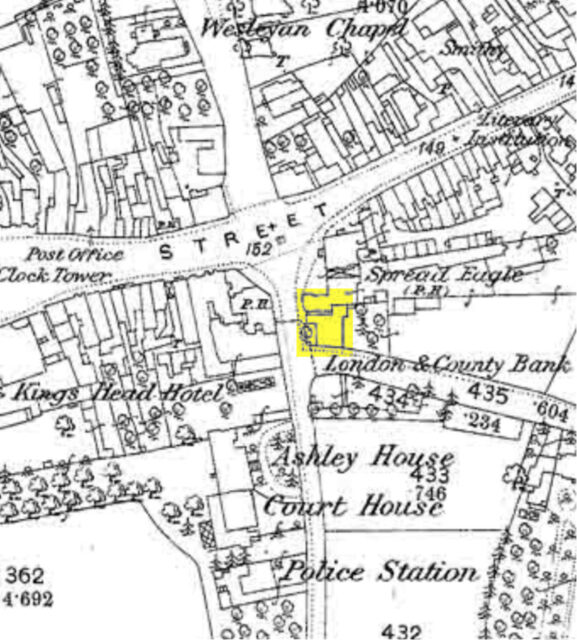 Map showing Hampden House highlighted in yellow
We know from censuses that Ernest William Charles and Walter Hopkins were photographic assistants to their father in Epsom and the intention was presumably that one or both of them would take over that aspect of the business when Cuthbert retired. It may be that Walter remained involved for some time, but Ernest didn’t – he set up on his own in Hampshire, his wife being a native of Portsmouth.
Before we follow the photographic tale to a conclusion, we shall take a look at the youngest son, John Cuthbert, who was a career soldier in the 10th Hussars – the 10th Royal Hussars (Prince of Wales’s Own, or a slightly different version thereof), a long-standing cavalry regiment which had seen frontline service in most of the well-known war theatres over the decades and would continue to do so throughout both World Wars. In 1901, John Cuthbert, then a Private in the Regiment and married to an Irish girl, was stationed at the District Engineer Barracks and Grand Depot Barracks in Woolwich and by 1911 he was at a Royal Navy establishment in Southampton as part of a large Forces contingent that looked as if it was preparing to embark for foreign climes. At that point his rank was Quartermaster Sergeant.
I have a particular interest in the Hussars, as for most of my life I lived fairly near to the big and rather forbidding Cavalry Barracks in Hounslow (once Middlesex, now subsumed into Greater London) and there was even an old pub called ‘The Hussar’ – still there but renovated/altered and turned into a bar and Indian restaurant. As it happens, John C Hopkins was stationed in Hounslow at one time, for long enough that he joined the local Freemasons. By virtue of Freemasonry membership registers we can also place him in British India during the 1900s.
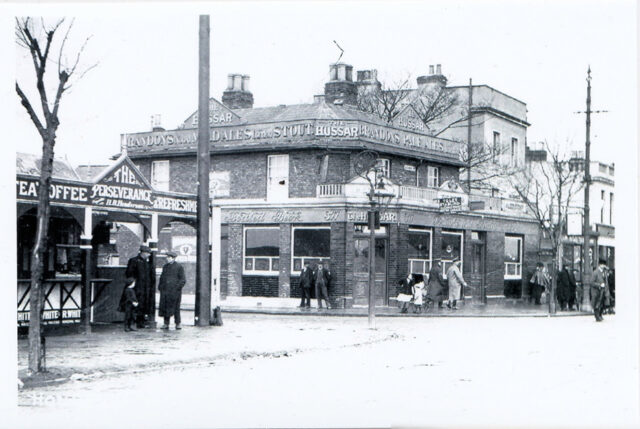 The more or less original Hussar pub in Staines Road, Hounslow, date unknown
Image source: Writer’s own collection
 The Guardroom at Hounslow Cavalry Barracks*, date unknown
Image source: Writer’s own collection
*Unfortunately, the only ‘mounts’ to be seen in the above picture are bicycles, but there once were horses
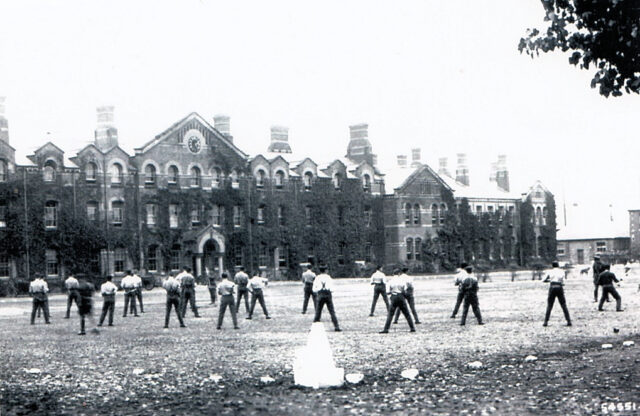 Soldiers exercising at Hounslow Barracks, date unknown
Image source: Writer’s own collection
John Cuthbert had left the Army by 1913 (I suspect that his health might have been adversely affected by his service) and settled in his wife’s native Ireland with their four children. He died in Dublin on 10 November 1931.
I ‘lost’ Walter for a large portion of his life, but he finally reappeared, after a fashion, and he was a photographer. It’s impossible to know whether he actually emigrated to the United States or not, but he did have strong links with Boston and, had circumstances turned out differently, perhaps he would have remained there.
So, Walter set off for Boston and on 24 September 1895 he married an English girl, Alice Mary Beverton, there. They then returned to England, undoubtedly because Alice was pregnant, and a son, Walter Beverton Hopkins, was born in Norwood and christened at Epsom, St Martin’s, on 12 September 1897. It appears that Alice died as a result of the birth, for she was buried in St Martin’s Churchyard (Grave C100A) on 14 October of that same year, aged only 28. I don’t know what kind of photographer Walter was, but I don’t envisage him as studio-bound in one particular place. I feel that he might have travelled a great deal, perhaps ‘on assignment’. In any event, he lodged young Walter with his brother Ernest and family (there were children of similar age in Ernest’s brood) in coastal Hampshire and presumably went about his photographic business. Sadly, Walter Beverton Hopkins died in 1904, aged just seven.
There are various shipping records showing that Walter Senior remained a photographer and returned to England off and on, but he does seem to have had Hampden House as his permanent address in the UK. He died at sea on 1 February 1923, inbound for Liverpool on the Canadian Pacific liner ‘Montclare’, of chronic bronchitis and cardiac failure.
Southsea
In order to follow the Hopkins photographic trail, we must go to Southsea, Hampshire, where Ernest William Charles Hopkins plied his trade much as Cuthbert had done. I have acquired a couple of studio portraits from the Southsea operation and you will see that these were very much in the lineage of Cuthbert’s later photographs. First of all, here’s a Cuthbert photo from the Hampden House era, by which time he had refined his technique considerably.
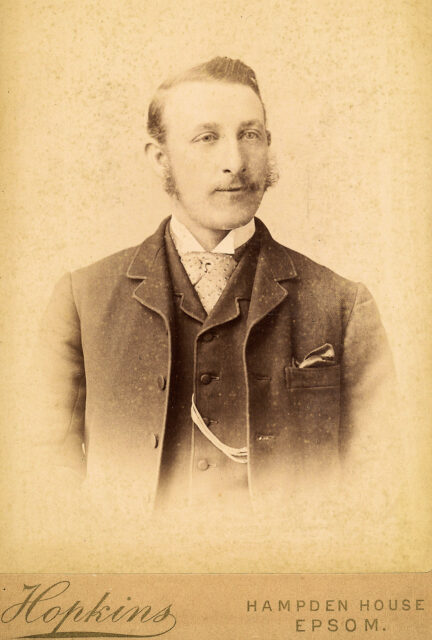 Portrait of an unknown sitter by Cuthbert Hopkins
Image courtesy of Bourne Hall Museum
And then we have two examples from the Southsea/Ernest Hopkins enterprise.
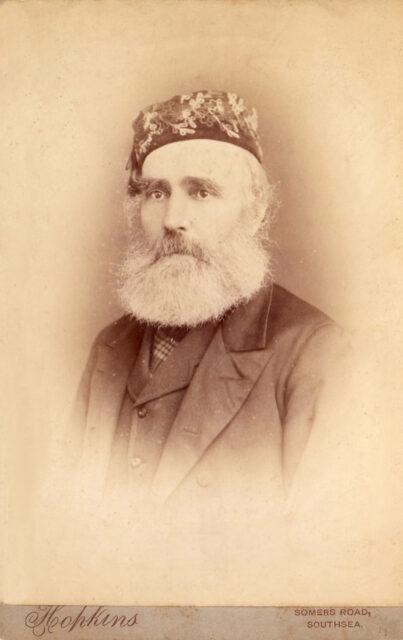 Old man in smoking cap by Ernest Hopkins, Southsea
Image source: Writer’s own collection
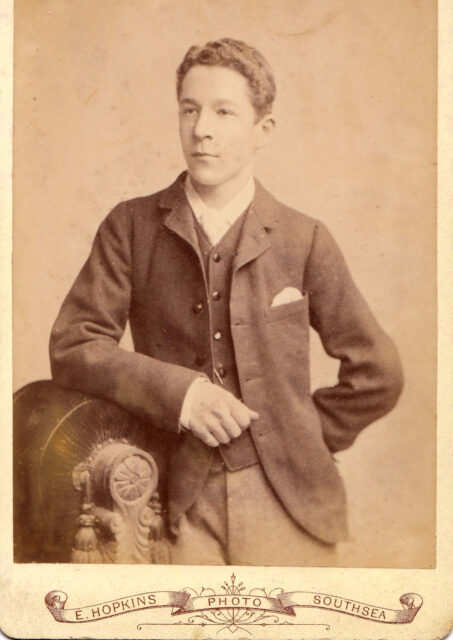 Young Edwardian man by Ernest Hopkins, Southsea
Image source: Writer’s own collection
The marriage of Ernest William Charles Hopkins to Jane Harriet Hendy had been registered in Portsea Island district in Q1 1885. There were three children, being Bertha Florence May (1886), Ernest Dudley (1887) and Gladys Mary (1890-91). Ernest Dudley is the one we want for photographic purposes.
Ernest Senior died on 15 December 1911, by which time Ernest Junior was already a photographer in his own right, but he was also an Acting Bombardier in the 137th Royal Field Artillery, stationed at Bulford, Wiltshire. I don’t know whether Ernest Junior did much in the way of studio portraiture (he might well have learned by assisting his father), but he certainly photographed ships and the picture of the Devonia, which appeared earlier as a mystery photo, could be one of his rather than his father’s.
Paddle Steamer Devonia by Ernest Hopkins
Whichever one of them was responsible for the Devonia shot, the Imperial War Museum has a large collection of Ernest Hopkins photographs of ships that played a part in WW1, so here are a few more. Unfortunately, they are credited only to Ernest Hopkins, Southsea, so we have no way of knowing which of them took most of these pictures. Nearly all of them are undated and, in general, the ships existed before Ernest Senior died in 1911. They are valuable in their own right as a visual record of the ships, but many of them are also fine photos, given the era and equipment.
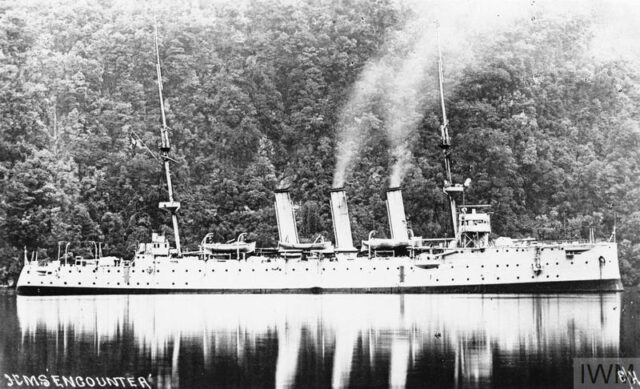 Protected cruiser HMS Encounter.
Copyright: © IWM (Q 75381).
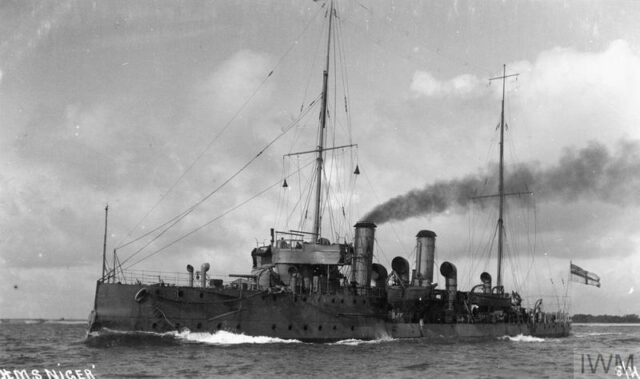 Torpedo gunboat HMS Niger
Copyright: © IWM (Q 75440).
These next two must have been taken by Ernest Junior, since Laforey class destroyers were built from 1912 onwards.
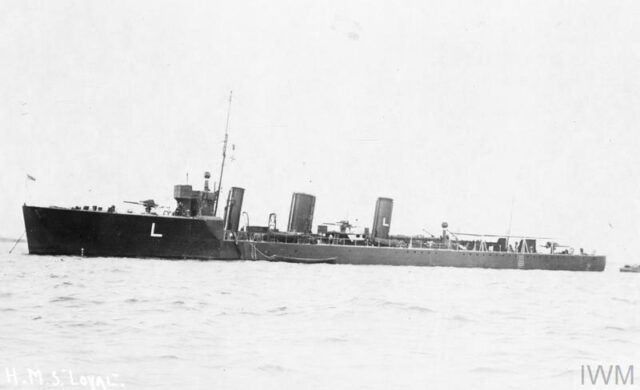 HMS Loyal, Laforey class destroyer, launched November 1913
Copyright: © IWM (Q 75137).
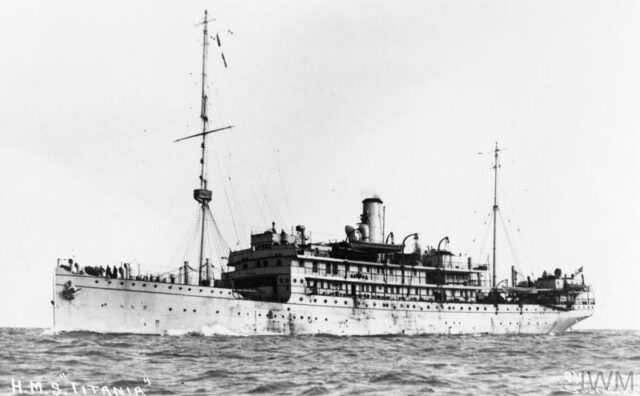 Submarine depot ship HMS Titania, launched March 1915
Copyright: © IWM (Q 75563)
So, there you have it. We have gone from Cuthbert John, the studio portrait pioneer, to his grandson, Ernest Dudley – or from the middle of the Victorian era to WW1. But now we must return to Epsom.
Back to Epsom
Cuthbert died on 4 February 1916, followed by Delilah on 9 October 1921; both were buried in Epsom Cemetery (Plot A448). Their daughter, Bertha, never married and remained at Hampden House after her parents had died, but it was plainly too large for her. A 1922 street directory shows that she still lived there, but parts of it were the offices of architect Albert Williams and surveyor H Charles Pettett. Walter died in 1923, so he would never stay there again, and Bertha moved to a bungalow at 35 The Parade (she didn’t stray far from her original patch), which she named Hampden.
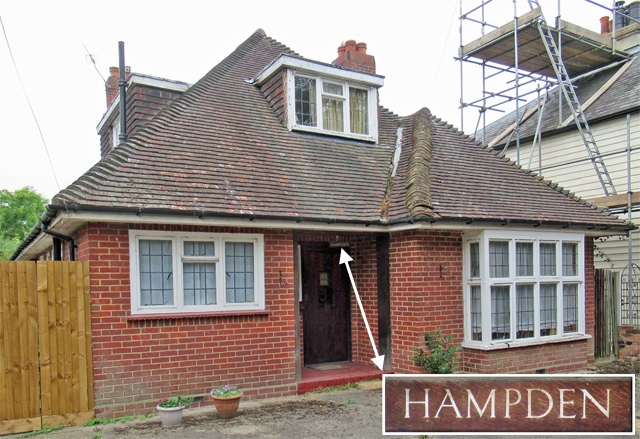 Hampden, 35 The Parade, Epsom
Photo © Roger Morgan 2022
Bertha died on 29 August 1943 and was buried with her parents.
Note:
JoAnne Hopkins, a Florida resident, has very recently (February 2025) been in touch: she is the great-great granddaughter of John Cuthbert Hopkins and tells us that, after retiring from the Army, he became the grounds keeper at Dublin’s Iveagh House , where he resided with his wife Charlotte (née Moore). Their son, Lewis Cuthbert, was JoAnne’s great grandfather and was married to a lady named Alice Mary Gaskin: they went to live in New York City. Alice was known as ‘Diamond Lil’ (also referred to in American popular culture as ‘Diamond Tooth Lil’, – see Wikipedia for further information) because of her toughness and, according to family legend, she and Lewis were not an ideal match. When Lewis was sadly diagnosed with brain cancer, he moved to Jersey, where he was cared for by family until his death.
Following on from the above we have now heard (April 2025) from Casey Womble, another descendant of John Cuthbert, whose grandparents were Lewis John (son of Lewis Cuthbert) and his wife Ellen Louise, née Manchester. Casey’s parents were Lorraine Ellen Hopkins, daughter of Lewis John and Ellen Louise, and her husband Jan H Womble.
Linda Jackson 2022