
Shelvoke and Drewry Dustcart BPL 73
 Shelvoke and Drewry Dustcart (BPL 73)
From a 35mm slide bought off eBay
The webmaster recently bought a 35mm slide off eBay showing a Shelvoke and Drewry Dustcart (BPL 73) as it reminded him of the ones still in use when he was a child.
The vehicle is also shown in our article on the 1958 Borough Guide (Operating and Developing the Corporation’s Services) which contained the following text.
 “21 Years of Progress – A refuse collection vehicle of 1937
alongside its modern counterpart.”
“The Corporation collects and disposes of approximately 18,000 tons of refuse annually and, compared with other local authorities in England and Wales, the cost of this service is one of the cheapest in the country. Recently, a start has been made on replacing the old type of refuse collection vehicles which are loaded at the side, by a modern type of rear-loading selfcompacting machine, which considerably reduces the dust nuisance and, by compacting the refuse automatically, enables a far larger load to be carried, thus reducing the number of journeys to the point of disposal. In addition, the majority of roads in the Borough are swept and cleansed by the latest type of mechanical street sweeper.”
Typically the webmaster could not let the matter rest there so he contacted the SD Enthusiast’s Club and Brian Carpenter has very kindly written the following about this wonderful old municipal vehicle.
Brian Carpenter’s Text
 1934 SD Freighter with Chelsea type body Reg. No. BPL 73 Ex- Epsom & Ewell.
BPL 73 at Edenbridge 20th June 2009.
A lot of the information that I have about this Freighter came to me from the late Bill Thornycroft and I am using an article from Autumn 2012 that I wrote in the SD Newsletter.
“My own first experience at the tiller of a Freighter was in the 1960s. The Borough Engineer of Epsom and Ewell had a dream of setting up a museum and had saved two of their S & D dustcarts for this purpose. But the Council was abolished under the local government re-organisation in 1965 and it became amalgamated with other surrounding areas so that the Borough Engineer’s dream of setting up a museum was shattered. One of the vehicles BPL 73 was given to the Worthing Historic Commercial Vehicle Club [which I think became the Southern Counties Historic Vehicle Preservation Trust SCHVPT ] and I took the other DPF 432.”
The SCHVPT held a rally at Edenbridge in June 2009 which I attended, BPL 73 was on show along with two other SD vehicles.
 The Trafficator
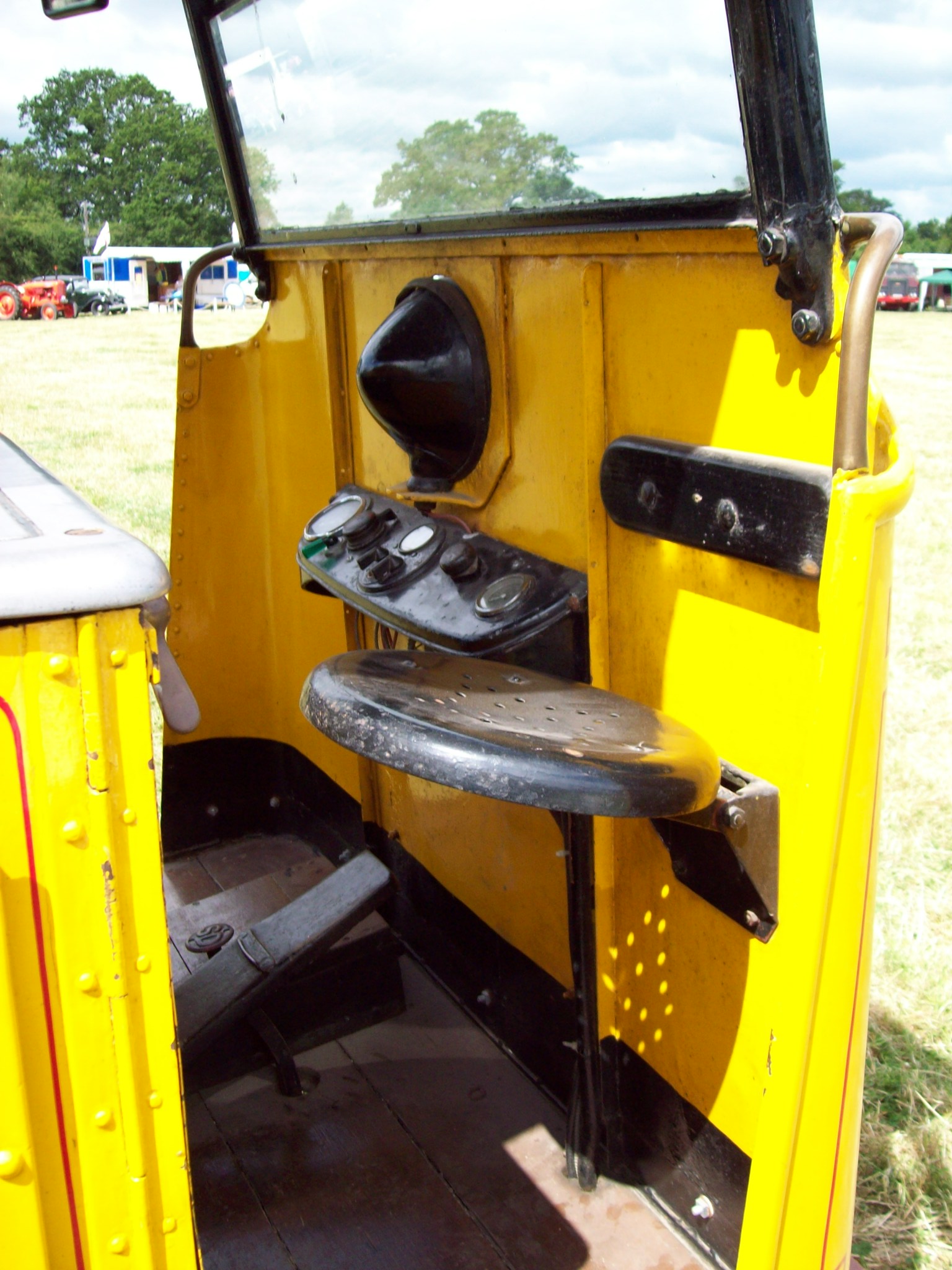 An extra seat in the cab
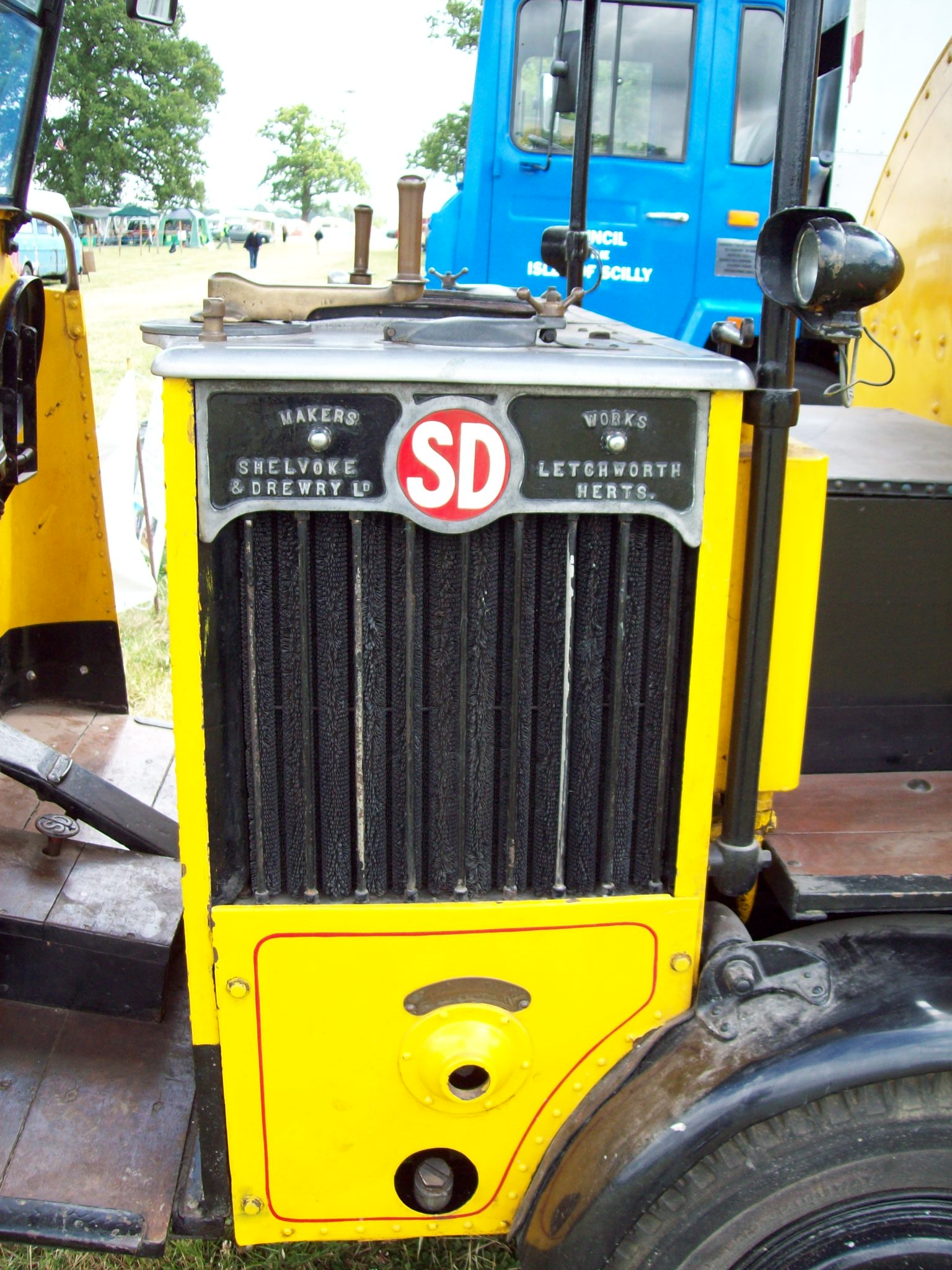 The engine is located transversely.
The original SD Freighters had small diameter solid tyres as seen below:-
 A cab canopy was an extra. Pneumatic tyres became standard in 1931.
The Freighter was controlled by two levers, termed tillers, to the driver’s right and left, plus a foot pedal. It was possible to stand up and face backwards when reversing. Bill gave this description of the SD Freighter:-
“It was only after I got to know the working of a Freighter that I realised why they were such a success. The promotional literature claimed that they could be learnt by any man who was accustomed to driving a horse in twenty minutes. Being semi-automatic, the driver does not have to worry about changing gear, double de-clutching etc. He just moves the lever from brake, through neutral into first, then second and then third speed, keeping the throttle pedal pressed firmly to the floor. To stop he just takes his foot off the throttle and swings the speed control lever back to brake. It is not only simple but even the worst driver can do little damage. There are no gear teeth to break or clutches he can damage – they are all automatic and work regardless of the driver’s skills.”
BPL 73 appeared in a film (very briefly) based on the popular Dad’s Army TV series. In 2015 it was placed on loan to the Museum at Bressingham, as a part of their Dad’s Army display.
 BPL 73 on loan to the Museum at Bressingham,
as a part of their Dad’s Army display in 2015
Brian then supplied two images of the replacement ‘W’ type Fore & Aft tippers, of the type shown in the photo from the 1958 Borough Guide. This model dates from around 1949 and had the added advantage that it was rear-loading and self-compacting. Meaning they reduced the dust nuisance and carried a larger load resulting in fewer time consuming and costly journeys to the disposal site.

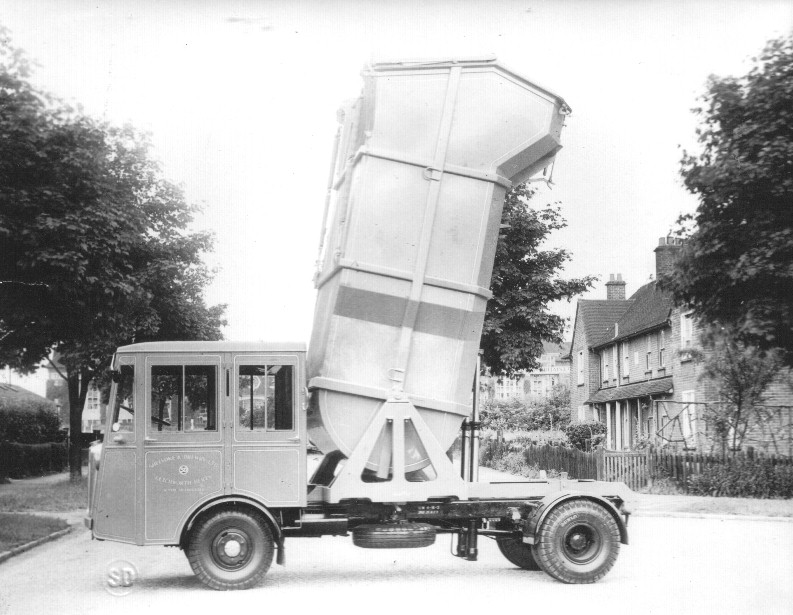
Text and images courtesy of Brian Carpenter ©2021
SD Enthusiast’s Club
A short YouTube clip showing a SD Freighter Dustcart in use,