
16 Waterloo Road, Epsom
(aka “Haswell House” & “The White House”)
& its royal connection
Part 1: The Building
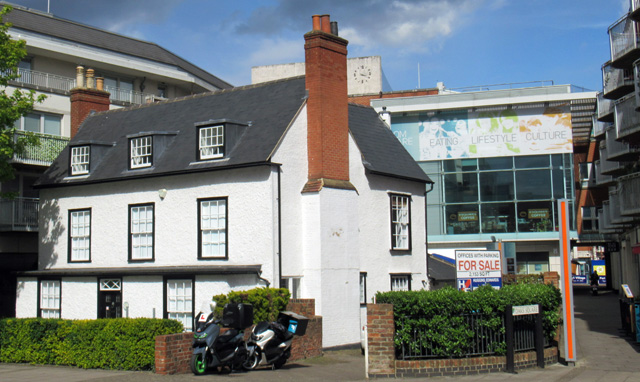
16 Waterloo Road, Epsom.
Photograph by Roger Morgan © 2021
Surrounded by buildings erected in the early 2000s redevelopment of the area, 16 Waterloo Road (just to the north of Epsom’s central crossroads) is clearly of a different generation. But few people today are likely to realise just how old the building is. There is a clue in the plaque beside the front door, as below.
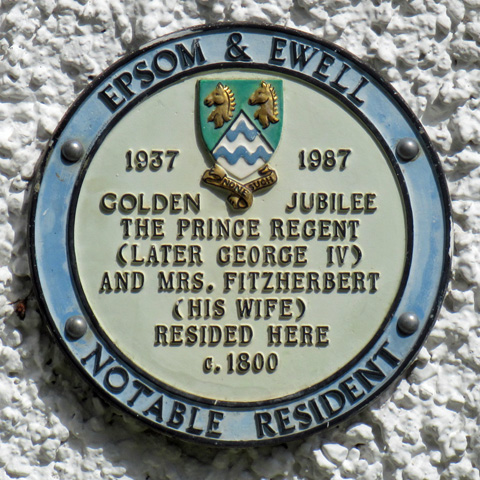
The Borough’s memorial plaque.
Photograph by Roger Morgan © 2021
As will be seen, this records that “The Prince Regent (later George IV) and Mrs Fitzherbert (his wife) resided here c.1800” – of which more in Part 2 below. (They were not the only distinguished residents of the property – see also our articles about the early 1800s historian Sharon Turner and the artists Charles and Fannie Holroyd, resident there for a few years each side of 1900.)
However, even that “about 1800” date was not the start the property’s history: according to Historic England’s Grade II listing of the house, it dates from the 1700s. The listing’s full text is:
“Early – C18. Two storeys and attic, roughcast, three sashes, ground floor projects for full width. Central door with rectangular fanlight having diagonal glazing bars. Overhanging eaves, slate roof with three flat topped sashed dormers.”
The earliest known image of the property dates from about 1860, being a photograph taken by Epsom’s pioneering photographer, George Snashall.

What was then Haswell House (on the right) in about 1860.
Photograph by George Snashall, from the writer’s collection.
In 1953, local resident Tony Elliot took the following intentionally matching shot.
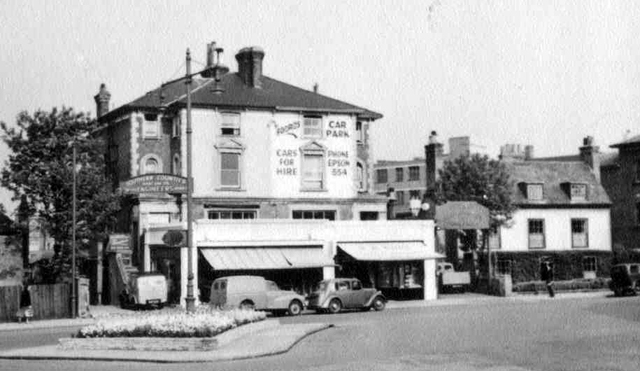
The same section of Waterloo Road in 1953.
Photograph by Tony Elliot, from the writer’s collection.
The residential building on the left of the earlier photograph has been converted into Foords Garage. That was demolished in 1999 to make way for the early 2000’s redevelopment which, as shown below, nowadays rather dominates the old “White House”.

The same section of Waterloo Road in 2021.
Photograph by Roger Morgan © 2021
During its lifetime, what is now 16 Waterloo Road has been known as Haswell House (or Cottage) and The White House. For its first 150+ years, it was a residential property. In 1929, it was taken over by Solicitors Theodore Bell & Co. It continued in that firm’s use until November 2019 – by when, following various partnership changes, the firm was called “Gumersalls”. Gumersalls relocated to new offices nearby and, at the time of writing, the property is on the market.
Part 2: The Royal Connection
As noted above, the royal connection with what was then called Haswell House comes from the apparently brief occupancy (in about 1800) by Prince George and Mrs Fitzherbert – of whom there are the roughly contemporary portraits.
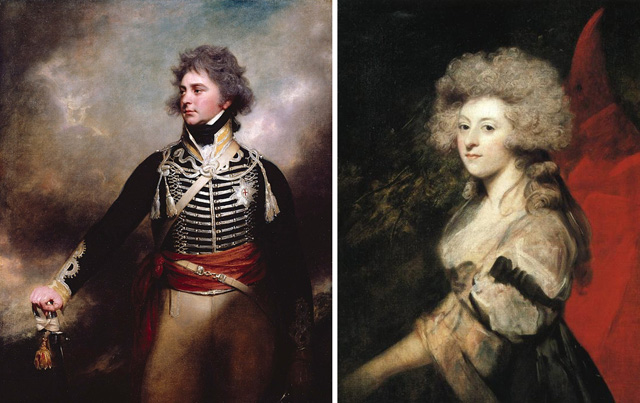
Left: Prince George in 1798, portrait by Sir William Beechey.
Right: Maria in 1788, portrait by Sir Joshua Reynolds.
Both images are in the public domain.
The memorial plaque pictured near the head of this article is slightly premature in referring to George as “Prince Regent”. The incapacity of his father, George III, in the 1790s had resulted in Parliamentary moves to create the oldest son, George, as Prince Regent, but these had not been completed by the time that George III recovered. However, the recovery did not last and George’s role as Prince Regent was eventually formalised in 1810. George III died in 1820, and his son then became George IV until his death in 1830.
The plaque’s reference to Mrs Fitzherbert as his wife also requires a little unpicking. George had contracted a secret marriage with the twice-widowed Maria Anne Fitzherbert (née Smythe, previously Weld) in 1785. Although deemed sacramentally valid by Pope Pius VII, the marriage was invalid under English civil law because George III had not consented to it. (Had the marriage been approved and valid, George – as the spouse of a Roman Catholic – would have lost his place in the line of succession.)
The prince led a famously dissolute lifestyle from which he incurred eye-watering debts. His father made assistance conditional on George’s marrying Princess Caroline of Brunswick – which he did in 1795. However, the couple were unsuited to each other and the marriage was disastrous. They were formally separated after the 1796 birth of their only child, Princess Charlotte. The Prince remained attached to Maria Fitzherbert, but is known to have had many other mistresses.
(More details may be found in the Wikipedia articles about George IV and Maria Fitzherbert.)
As to the source of this Epsom connection, the first still-available record of this appears to be in C J Swete’s well-researched “Handbook of Epsom”. (This was published in 1860, about the same year as George Snashall’s photograph above.) On page 27 of his book, Mr Swete wrote:
“George the IV when Prince of Wales dwelt here for a time with his injured but faithful wife Mrs. Fitzherbert. It will be seen that, when the whim served, he was as careless of the dignity of his abode here below, as he was of securing an inheritance in the land afar off. The house is very humble, and now, from the circumstances of its position, as well as from its age, falling into decay.”
The house was clearly rescued from collapse and, in his 1901 book, “EPSOM: its history and surroundings”, Gordon Home expanded on Mr Swete’s narrative. On page 101 of his book, he wrote:
“The White House, or, as it was formerly known, Haswell House, in Waterloo Road, was for a time, according to Swete’s Handbook of Epsom, published about forty years ago, the abode of the Prince of Wales (afterwards George IV) and his much-injured wife, Mrs. Fitzherbert. It is a quaint and picturesque house, looking smaller than it really is on account of its being a little lower than the level of the road. Before the railway came, the views from the windows across the meadows towards Horton must have been very charming, but now they are limited to the station and embankment of the South Western Railway. In the memoirs of Mrs. Fitzherbert by the Hon. Charles Langdale* (1856), there is no reference to Epsom, but so very few details of places are given there that one need not, on that account, consider it a mere fable. Lord Stourton in his narrative of the intercourse between Mrs. Fitzherbert and the Prince, says that for several years they were extremely poor, and on one occasion, when returning from Brighton to London, they mustered their common means and could not raise £5 between them. The size of the house, therefore, need not be considered an obstacle to the acceptance of the old guidebook writer.”
[* The 1856 book is entitled “Memoirs of Mrs Fitzherbert: With An Account Of Her Marriage With H.R.H. The Prince Of Wales, Afterwards King George IV“. They are based on material which Mrs Fitzherbert dictated to Lord Sturton (the 18th Baron Sturton), who was her cousin. A posthumous attack on her faith and morals led the Hon Charles Langdale, brother of the by then late 18th Baron Sturton, to publish the work in her defence.]
It is tempting to think that George IV’s sculptured coat of arms (pictured below) seen over the west door of St Martin of Tours on leaving the church by this main entrance is somehow linked to the then Prince George’s time in Epsom.
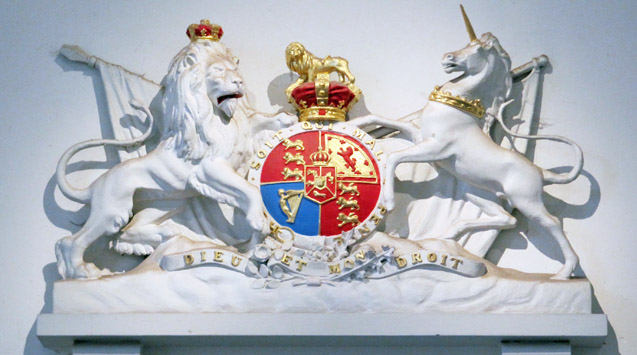 George IV’s Coat of Arms in St Martin’s, Epsom.
Photograph by Roger Morgan © 2019
Disappointingly, this is not the case. When the Church of England split from Rome at the Reformation, Henry VIII insisted the royal arms were prominently displayed in churches to emphasise that the King was ruler – not the Pope. Many churches placed the arms close to the exit making it clear that, while inside, the Lord was King, the monarch ruled outside. That these arms are of George IV simply reflects the fact that St Martin’s was rebuilt in the middle of his 1820-30 reign.
Roger Morgan © 2021