
Sharon Turner, historian
An occasional Epsom resident in the early 1800s
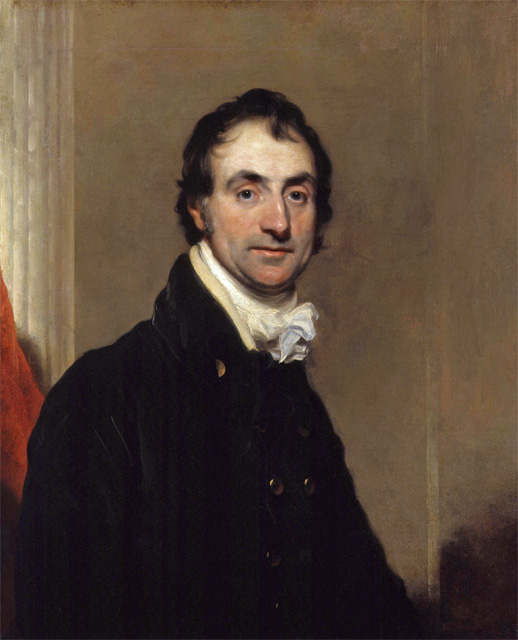
Sharon Turner, oil on canvas by Sir Martin Archer Shee, circa 1817.
NPG 1848 © National Portrait Gallery, London (CC BY-NC-ND 3.0)
The Prince Regent was not the only distinguished resident of the surprisingly old 16 Waterloo Road, Epsom. Shortly after his brief tenure in about 1800, the house was occupied by the important historian Sharon Turner, the subject of this article. (See also our article about significant artists Charles and Fanny Holroyd, who were resident there around 1900.)
The intelligence about Turner’s time in Epsom comes first from C J Swete’s well-researched Handbook of Epsom, published in 1860. Whereas Swete dealt with the Prince Regent’s time in Epsom in one short paragraph, he devoted three full pages to Turner’s occupancy of “The White House” and his literary work.
And while Swete is apparently the sole authority for the Prince Regent’s time in Epsom, verification of Turner’s time here is found in William Jerdan’s 1886 book, Men I Have Known. In his 9 page chapter on Sharon Turner (starting on page 441), Mr Jerdan mentions going “to see him in a quiet retreat from the world, at Epsom”. In his 1901 book, EPSOM: its history and surroundings, Gordon Home thus notes that there can be no doubt about Turner’s Epsom connection and, given how soon afterwards Swete’s 1860 Handbook of Epsom was published, there is little prospect of a mistake in his linking Turner to “The White House”. At the present distance in time, however, it is not possible to say how Turner split his time between his London base and Epsom.
The unusually-named (for a boy) Sharon Turner was born in the Pentonville area of London on 24 September 1768. He was the oldest son of Yorkshire couple William and Ann Turner who had moved to London after their marriage. Turner left school at fifteen to be articled to an attorney in the Temple and, on qualifying, began work as a Solicitor.
On 18 January 1795, the 26 year old Turner married (with her father’s consent) the 19 year old Mary Watts. The couple settled in Red Lion Square, and went on to have at least six children.
At an early age, Turner had found an interest in Icelandic and Anglo-Saxon literature. His new home at Red Lion Square was near the British Museum and Turner found himself spending more and more time there studying its ancient documents. In due course, he left the legal profession to concentrate on historical research. This work resulted in his History of England from the earliest period to the Norman Conquest, published in four volumes between 1799 and 1804. The work was enthusiastically received by historian Sir Francis Palgrave and others. The poet Robert Southey wrote that “so much new information was probably never laid before the public in any one historical publication“. The novelist Sir Walter Scott acknowledged his debt to Turner in his foreword to Ivanhoe. In 1981, the well-regarded historian John W Burrow said Turner produced “the first modern full-length history of Saxon England … It was a genuinely pioneering work, and was much admired, and not without reason“.
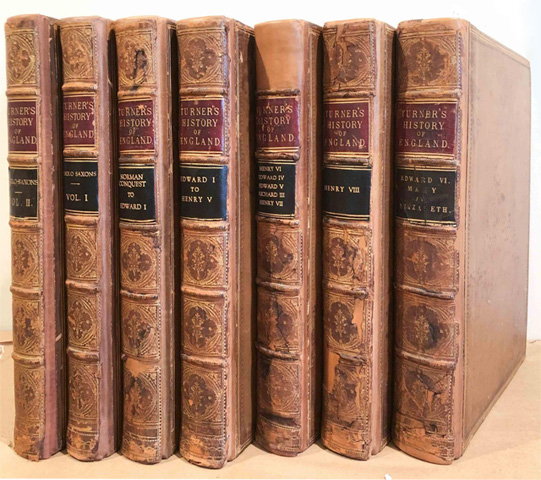
Seven quarto (slightly smaller than A4) volumes of Turner’s histories
published between 1807 and 1829.
Image with thanks to Carydale Books (Rhinebeck, NY, USA), via Abebooks.com
Turner continued his narrative in several subsequent works which, in 1839, were combined into The History of England, a twelve-volume set covering all of English history up to 1603. As he moved into better known periods of history, his rather convoluted style began to affect the reception of his work – but it remains the case that his early work was innovatory.
The esteem in which Turner (a Fellow of the Society of Antiquaries and an Associate of the Royal Society of Literature) was held led, in 1835, to his being awarded a Civil List Pension of £300 pa. By this time, he and Mary had moved to Winchmore Hill. Turner was greatly saddened by the death of his wife in 1843, aged 66. In 1847, and ailing himself, the 78 year old Turner returned to Red Lion Square where he died under his son’s roof on 13 February.
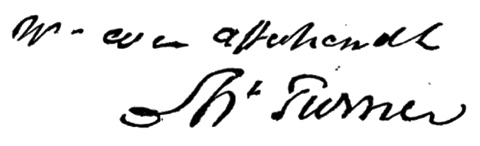
A charming quirk of William Jerdan’s previously mentioned 1886 book, “Men I Have Known” is the reproduction of each his subjects’ autographs at the end of the relevant chapter. Accordingly, this article can be signed off by Sharon Turner himself, as below.
Roger Morgan © 2021