
Gordon Cochran HOME (1878-1969)
and his 1901 “Epsom: its history and surroundings”
& 1902 “Guide to Epsom & District”

Gordon Home in later life (he was only 23 when his Epsom book was published).
Photograph used here with kind permission from Gordon’s family.
Before turning to Gordon’s important 1901 history of Epsom and district and its 1902 offshoot guide, we should get to know the man himself.
Gordon’s background
Gordon Cochrane Home was born in Streatham on 25 July 1878, the sixth of the seven children born to Erskine Sandilands Home (a Woollen Merchant) and his wife Mary (née Thomas). On 29 September 1878, he was baptised in the Trinity Presbyterian Church (unsurprising, given that his father was a Scot) on Clapham Road, Stockwell.
The 1881 Census records the 2½ year old Gordon as the youngest child living with his parents and siblings (supported by two servants) at 4 Garden Road Clapham. Electoral Rolls show that, in the late 1880s, Gordon’s father was living in Sutton. However, by the time of the 1891 Census, the family (supported by a live-in housemaid) were living at 5 Queens Park, Streatham.
The first certain sighting of Gordon in Epsom is in the 1901 Census. The 22 year old (listed as “Editor & Author”) and three siblings were recorded living with their mother, Mary (listed as the head of the household) at Cromwell Lodge in Church Street, Epsom – all supported by a live-in domestic servant. (The local “Andrews Directories” for the 1890s show that the property was occupied by other people in 1893 and 1895, and was vacant in 1899.)

The 17th-century Cromwell Lodge (No 8 Church Street) shortly before its 1974 demolition.
Photograph from the writer’s collection.
Gordon has to be admired for the speed with which, as a newcomer, he got to grips with local matters. In addition to absorbing and digesting information about the town and surroundings from the 26 substantial volumes credited in his book’s bibliography, he thanks – in his Preface – the “large number of residents in and around Epsom” for “much help” that they had given him. Among those he actually names are the significant figures of Lord Rosebery, Rev E W Northey, Mr A W Aston and Mr Dearle. Indeed, Lord Rosebery contributed an introduction to the book (of which more below).
Electoral Rolls show that Gordon and his brother Percy continued living in Cromwell Lodge until about 1907, when they moved to Reston House (or “Rosebank”) in Epsom’s South Street. Gordon’s father, Erskine, died in Q4 1907, registered in the Wandsworth District. The 1911 Census records the widowed 69 year old Mary living with daughter Constance (who had been living with her father in 1901) and domestic support at 16 Kingsmead Road Streatham. As to the now 32 year old Gordon, he was living with four siblings (all unmarried, like Gordon) and three live-in servants at 43 Gloucester Street, Pimlico. This was a creative hothouse: 37 year old Percy is listed as “Assistant Editor, The Sphere”; 34 year old Beatrice as “Writer”; 32 year old Gordon as “Literary Adviser and Artist”; and 29 year old Evelyn as “Literary Contributor to Magazines”.
As the 1911 Census entry indicates, Gordon was involved in both writing and illustration. He was a talented artist, working mainly in pen & ink and watercolour – and frequently exhibited at the Royal Academy. He is best known for his authorship of many self-illustrated travel and history books. His Wikipedia page lists 18, and these exclude at least his first two – the first being a 1900 88-page booklet in the Homeland Handbooks” series (entitled “Farnham with its surroundings“), with the 1901 Epsom book (of which more below) being his second. In addition to these outlets, he had paid employment. In 1900, he worked at “The Morning Herald”. Shortly after that, he moved to be art editor at “The Tatler” and then “The King“. In later life he worked at the publishers, A & C Black, who published many of his books.
Shortly after the outbreak of WW1 in 1914, Gordon joined the Royal Army Service Corps as a temporary Lieutenant. He served in France and over time, rose to the rank of Major. He remained in the RASC until 1920, serving also in North Africa. While in Algiers in 1919 he caught the then pandemic “Spanish Flu” and nearly died of it. (He later travelled widely in France – with a particular love for Normandy – North Africa and the Empire/Commonwealth.)
On return to civilian life, he lived at a number of London addresses, but mainly at 27 Cornwall Gardens in South Kensington. In Q2 1926 and registered in the Bridge District of Kent, the 48 year old Gordon married 31 year old Violet Maud Chapman. The couple then lived in Sondes House, Bekesbourne, Kent. (Gordon seems, however, to have retained his Epsom connections: in 1929, he wrote a 500-word obituary about longstanding Epsom resident Alfred Withall Aston for The Times.)

Gordon & Violet at their 1926 wedding.
Photograph used here with kind permission from Gordon’s family.
In Q1 1933, Violet gave birth to twins Gospatric and Elizabeth.

Violet and the twins.
Photograph used here with kind permission from Gordon’s family.
In due course, the family moved to “Foxbury” in Vann Lane, Hambledon, Surrey. They were recorded there in the September 1939 Register, in which the 61 year old Gordon is listed as “Author & Artist”. The 1939 Register’s standard “occupation” for married women was “Unpaid Domestic Duties”. However, the 45 year old Violet is listed as “Heavy Worker (Domestic) in Kitchen Garden”. The couple’s 6 year old twins are doubtless behind the currently closed records at the address. Other residents were 78 year old Clara Costen, “Nurse (Retired)” together with 28 year old Roza Klein and 19 year old Maraia Farkas, both listed as “Domestic (Hungarian)”.
Sadly, Violet died young on 24 June 1944 – just a few days after their 18th Wedding Anniversary and her 49th birthday. Gordon never remarried. At the age of 81, he died on 13 December 1969 in Whitehanger Nursing Home, Haslemere. He left an estate of £4,723.
“Epsom: its history and surroundings” (1901)
We turn now to Gordon’s first book about Epsom. The scanned text – of an early reprint by Frederick Warne & Co. – may be viewed by clicking this link to the Internet Archive. The first edition (in which Gordon signed off his Preface on 30 June 1901) was published by Epsom’s L W Andrews & Son in conjunction with The Homeland Association Ltd, which counted the book as the second volume in its “Homeland Library”. The Association had been founded in 1897 “for the encouragement of touring in Great Britain“. It aimed to collect and publish “useful information about the towns and country districts of Great Britain and Ireland, the motherland of our Empire“. (The Association had been the sole publisher of Gordon’s 1900 booklet on “Farnham and its surroundings”, which was Number 13 in its catalogue of “Homeland Handbooks”. As we shall see below, it published in 1902 an abridged version of Gordon’s book as Number 17 in that series.)
As noted above, Gordon had established a sufficiently close link with Epsom’s most famous resident, Lord Rosebery, for the latter to provide a thoughtful 8-page introduction – the text of which we have at this link. Oddly, the book makes nothing of what must have been quite a coup. As shown below, the title page mentions only that the book comes “with an introduction”. In the original edition, Lord Rosebery’s essay is signed off only with “A. R.” – being his usual monogram for Archibald Rosebery.
 The book’s title page
The book was reprinted in facsimile by SR Publishers in 1971, second-hand copies of which may be found from specialist booksellers. (This reprint managed to omit the “A. R.” mentioned above, thus making the Introduction completely anonymous.)

The dust jacket of SR Publishers’ 1971 reprint of the book, the illustration being
Gordon’s pen & ink drawing of the Amato Inn in Chalk Lane on page 90 of the original.
From the writer’s bookshelf.
Completed on 30 June 1901, the book provides an invaluable description of Epsom and its community at the dawn of the 20th Century. However, thanks to drawing on the previously-mentioned 26 item bibliography and extensive contacts with long-standing residents, it does so against a broad historical background. For example, Chapter 2 is entitled “Concerning Epsom from the earliest times to the present day“.
Gordon was not, however, infallible. I have a particular interest in the history of Christ Church Epsom Common and am irked by the fact that (in Chapter 4 – “In which an account is given of the churches of Epsom“) he conflated St Martin’s 1843 creation of the first Christ Church as a “Chapel of Ease” with the 1874-76 establishment of the present Christ Church as a separate parish, thanks mainly to the spur of a legacy by Elizabeth Trotter of Horton Manor. The origins of the first Christ Church were clearly set out in Chapter 3 of C J Swete’s 1860 “Handbook of Epsom“ which is listed among the books Gordon consulted. He also overstates Miss Trotter’s tentative suggestions as to how “the follies of (so-called) ritualism” could be best avoided as her stipulation “that there should be no ‘Ritualistic nonsense’ “. Both of these misstatements have informed some subsequent local histories.
For its time, the book’s 190 pages are generously illustrated with 44 images, the bulk of which are Gordon’s elegant pen & ink drawings (as on the cover of the reprint above) and watercolours (see also below).
And the “Surroundings” of the Book’s title is not to be taken lightly: Chapters 8 to 10 range over Ashtead, Banstead, Cheam, Chessington, Chipstead, Ewell, Headley and Walton on the Hill. The Book finishes with chapters about: Birds of the district; Epsom Golf and Rifle Clubs; and a table of distances by road from Epsom to nearby towns.
“A Guide to Epsom and the Epsom District” (1902)
In 1902, an abridgement of Gordon’s 1901 book (losing nearly a third of the original text, but few of its illustrations) was published – again by L W Andrews of Epsom and the Homeland Association – as volume 17 in the series of “Homeland Handbooks”. In due course, an “enlarged” edition of this 17th Handbook was published which was actually a page-for-page reprint of the original 1901 “Epsom: its history and surroundings“.
 The covers of the original 1902 Homeland Handbook on Epsom (on the left) and
(on the right) the subsequent “enlarged” edition.
From the writer’s bookshelf.
Gordon wrote a new Preface (signed off in January 1902) for the first handbook, in which he said:
“This guide to the Epsom District is founded on my larger book – “Epsom, its History and its Surroundings.” It has been produced in this pocket form in order to supply the demand for a reliable and handy guide to a beautiful district which has many visitors in these cycling times.”
He went on to thank “many residents in and near Epsom” for their assistance, but (unlike the Preface to his 1901 book) naming no names – not even that of Lord Rosebery, whose 8-page introduction was repeated in full, with its concluding “A. R.” as the only clue to the authorship.
The “enlarged” Handbook being – as noted above – a page-for-page reprint of the 1901 book, carried the original 1901 Preface.
Conclusion
Gordon’s output of self-illustrated histories and guides over his lifetime was prodigious. His important 1901 book (with its 1902 offspring guide) was not the last time he touched on Epsom. In 1929 A&C Black published his “The Charm of Surrey“, and it is good to conclude this article with Gordon’s accomplished pen, ink & watercolour picture of Epsom’s marketplace that faces page 70 of that book.
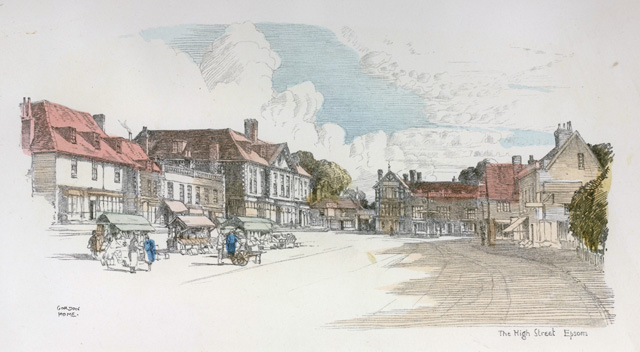
Epsom Market Place in 1929, watercolour by Gordon Home from “The Charm of Surrey”.
Image courtesy of Bourne Hall Museum.
Roger Morgan © 2021
with special thanks to Hazel Ballan for her help in tracing the family background