
LOCAL DIRECTORIES
(One of our “Sources for Epsom and Ewell History“)
Local directories are an invaluable source for tracing people, trades and institutions in the developing communities they map, and we are pleased to have the following available for reference here.
Contents
Andrews’ Directories (1893, 1895 & 1899)
Pigot’s Directory (1839)
Post Office/Kelly’s Directories (every few years from 1846 to 1940 – with a couple from the mid 1950s)
Pigot’s 1839 Directory
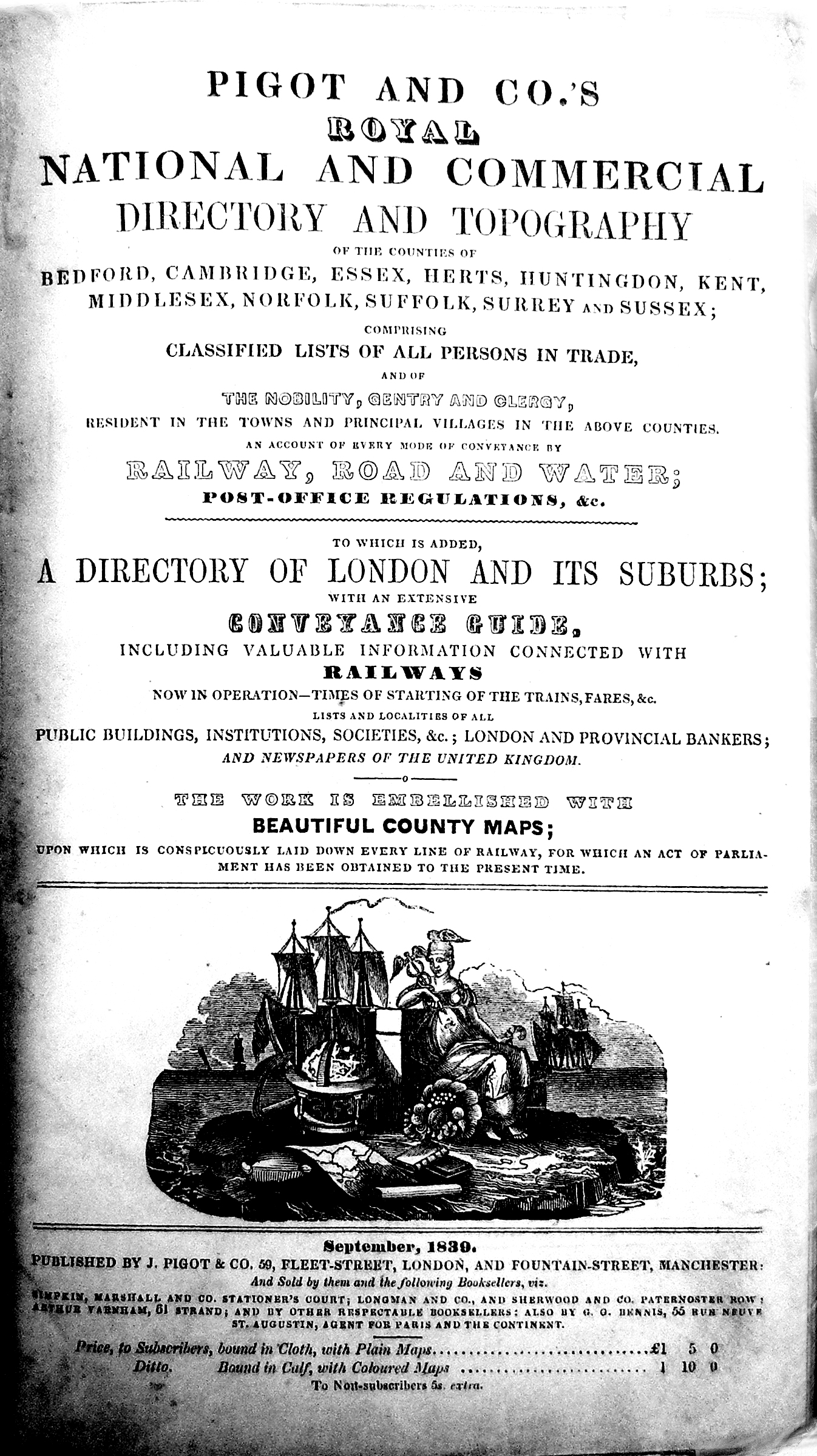
The following text is taken from Wikipedia:
Pigot’s Directories covered England, Scotland, and Wales in the period before official Civil Registration began and are a valuable source of information regarding all major professions, nobility, gentry, clergy, trades and occupations including taverns and public houses and much more are listed. There are even timetables of the coaches and carriers that served a town.
Parishes are listed for each area with useful information including the number of inhabitants, a geographical description and the main trades and industries of the area or town.
Pigot’s 1839 Directory (transcription & Sorted)
Andrews’ Directories
 Andrews Directories Title Page
Andrews’ directories were entirely a local affair, published by L W Andrews at 64 High Street in the centre of Epsom.
Provided here are only the sections listing residents street by street. The background information pages will be similar to that found in the Post Office/Kelly’s Directories further below.
The 1893 transcriptions have a built in search function. The 1895 and 1899 scans are searchable by using your computer’s particular app for finding text on a page.
Andrews Directory – Epsom 1893 (transcription)
Andrews Directory – Ewell 1893 (transcription)
Andrews Directory – Worcester Park 1893 (transcription)
Andrews Directory 1895 – EPSOM
Andrews Directory 1895 – EWELL and WORCESTER PARK
Andrews Directory 1899 – EPSOM
Andrews Directory 1899 – EWELL and WORCESTER PARK
Post Office/Kelly’s Directories
 A Post Office/Kelly’s Directories Title Page
In 1845, Frederic Festus Kelly (initially of the Post Office – hence “Post Office/Kelly’s Directories” – on all of which there is more below) published the first in a series of county directories which continued to appear, at intervals of three or four years, for almost a century.
Available at the links below are scans of the Epsom and Ewell pages of the Post Office/Kelly’s Surrey Directories from 1846 to 1938 – all of which are searchable by using your computer’s particular app for finding text on a page. As noted in the text further below, the directories – while most useful – are less than comprehensive.
Kelly’s Directory 1846
Kelly’s Directory 1852
Kelly’s Directory 1855
Kelly’s Directory 1859
Kelly’s Directory 1862
Kelly’s Directory 1867
Kelly’s Directory 1875
Kelly’s Directory 1878
Kelly’s Directory 1882
Kelly’s Directory 1887
Kelly’s Directory 1890
Kelly’s Directory 1895
Kelly’s Directory 1899
Kelly’s Directory 1903
Kelly’s Directory 1905
Kelly’s Directory 1907
Kelly’s Directory 1909
Kelly’s Directory 1911
Kelly’s Directory 1913
Kelly’s Street Directory 1913-1914 – Epsom
Kelly’s Street Directory 1913-1914 – Ewell
Kelly’s Directory 1913-1914 – Cuddington
Kelly’s Directory 1915
Kelly’s Directory 1918
Kelly’s Directory 1922
Kelly’s Street Directory 1922 – Epsom
Kelly’s Street Directory 1922 – Ewell
Kelly’s Street Directory 1922 – Cuddington
Kelly’s Directory 1924
Kelly’s Directory 1927
Kelly’s Directory 1930
Kelly’s Directory 1934
Kelly’s Street Directory 1936 – Epsom
Kelly’s Street Directory 1936 – Ewell
Kelly’s Street Directory 1936 – Worcester Park
Kelly’s Directory 1938
Kelly’s Street Directory 1940 – Epsom (Large File 53MB)
Kelly’s Street Directory 1940 – Ewell (Large File 70 MB)
Kelly’s Street Directory 1952 (Large File 105 MB)
Kelly’s Street Directory 1956 (Large File 121 MB)
Frederic Festus Kelly had worked at the General Post Office, where he became chief inspector of letter carriers and was in charge of the London directory that had been initiated in 1799. In 1845, he began trading independently, although he retained a semi-official association with his old employers, and at first his publications were sold as the Post Office Directory. The family traded as Kelly & Co. until 1897, and as Kelly’s Directories Ltd. after that. They also published local directories for towns, in a series which eventually came to include Epsom, but this was a separate publication from the county directory.
The first volume to be issued covered Surrey along with Essex, Middlesex, Hertfordshire, Kent and Sussex. Gradually, the population of the Home Counties increased (the entry for Epsom in the final directory of 1938 is six times as long as the first one to be published in 1845) so that Kent, Surrey and Sussex filled a single volume. But throughout this long period, the directories kept the same format, which makes it easier to compare one year with another.
A town or village entry in Kelly’s began with a short history of the place, concentrating on the dates at which various improvements had been made, especially for churches, schools, hospitals and civic buildings. After that came details of public services, from post offices to railway stations, naming magistrates, council officers, doctors, schoolteachers, registrars and anyone else that readers might have to deal with. Next came the two alphabetical listings which formed the core of the book – the Private Residents, and the Commercial Directory.
At the beginning of his career, Frederic Kelly had relied on the Post Office’s letter carriers to collect the information he needed. Subsequently he used agents who compiled returns from each building; if the occupants were out, they left a form to be filled in and sent off. Sometimes men were employed for this, but more often Kelly seems to have relied on local people such as printers, registrars, estate agents and anyone else who could be trusted to know the details of their own neighbourhood. Collecting and processing all this information took time. At first, when dealing only with London, Kelly seems to have sent out agents in September for a print run in December or January. The compilation of the county volumes may have taken longer: certainly the impression from Epsom and Ewell entries is that the publication date of a Kelly’s volume is a year later than the facts on the ground.
The county directories were set out by parish, with some modifications where this seemed unrealistic, such as the new entry created for Worcester Park when the suburb there began to grow. (The entries copied here do not include Worcester Park or Cuddington). It is hard to assess how comprehensive the directories were. They were never meant to list everyone – just the residents who had a private income and large houses, and the businesses which needed people to know where they were. The agents might forget to include someone, or they might be sent a form and not bother to fill it in: besides, short-lived businesses and brief residences would not appear, if they’d happened between one directory year and the next. Under the circumstances, it is surprising how many people do feature in these lists. The 1882 directory features 20% of the householders in Ewell, and 33% of those in Epsom – a higher proportion in Epsom, because there were more small businesses there.
The last county directory appeared in 1938; no volumes were issued during World War 2, either because the resources were not available, or because they were thought to be potentially useful to the enemy. After 1945 the increased use of telephones meant that the phone book took over many of the functions of the old directories and Kelly’s stopped issuing county volumes.
Kelly’s Directories Ltd. also published local directories, typically covering a town along with some of the neighbouring country parishes. They were in a smaller and handier format (about 6 inches high, rather than 10) and became known as ‘buff books’ after the colour of the binding; this is the term still used by local historians to avoid confusion with the county directories. In the 1890s this series was extended to Epsom, with Ewell appearing as one of several nearby villages. The series continued through the years of suburban growth, with the section on Ewell gradually increasing in importance.
After 1937 the sections for Epsom and Ewell were combined into a single sequence. Unlike the Surrey county directories, the Epsom & Ewell buff books continued after the War, with the last volume being published in 1956.
Other Useful sources
Useful sources on directories include: