
Epsom by Rosebery
—–
An extract from “Miscellanies, literary & historical Vol. II” (published in 1921)
by
Rosebery, Archibald Philip Primrose, Earl of, 1847-1929

Lord Rosebery in 1903
Image courtesy of Surrey Libraries and is held in the
Epsom & Ewell Local And Family History Centre
Note: Lord Rosebery originally wrote this as the Introduction to Gordon Home’s 1901 “Epsom: Its History and Surroundings”. In that book, the text below (to which we have added appropriate illustrations), was preceded by the following opening paragraph:
“I am desired to write a few words of preface to a Handbook for Epsom. And, when one comes to think of it, one must write it soon, for there will soon be little material for a preface or a guide.”
XXXI
EPSOM
When I first came to live at Epsom, a quarter of a century ago, it was a little sleepy town, surrounded by long stretches of down and common. Its perennial slumber was broken twice a year by race meetings, when the followers and camp followers of the Turf stormed the neighbourhood during a few agitated days, then struck their tents and left the town, sodden and exhausted. Thereafter the calm recommenced, and the inhabitants could saunter over miles of open turf to breathe the purest air in England. But the memory of those six days of carnival kept off the speculative builder and his serious clients. Thus the town remained rural and old-fashioned. Now all that is changed. The clients of the builder have reconsidered their objections, and so he has come and cut into the lanes and hedges. A gaunt asylum shrouds the misery of hundreds or thousands of the mad patients of London. One or two commons are enclosed. The stray edges of greenery, which were the heritage of the wayfarer, are being gradually fenced in. A new railroad, traversing a rural desert, lands its stray passengers on to a belated bull-ring, which tops the downs with its aggressive bulk. It is all, I suppose, necessary, nay inevitable. But these changes have killed the old Epsom. The new Epsom is only a fragment of the past, and only a fragment of the future.
Long ago, Epsom was fashionable. Charles the Second raced here and played bowls here. Prince George of Denmark, the husband of Queen Anne, came here and drank the waters. Frederick Prince of Wales lived here, enjoyed hawking on the Downs, and, it is said, fought a chimney-sweep, sustaining defeat. But the glorious epoch of Epsom seems to have ended with the seventeenth century. The stay of Frederick Prince of Wales at Epsom was in its unfashionable days; perhaps he only came to court obscurity when in conflict with his father. It is difficult indeed to ascertain when he was at Epsom, in spite of the strong local tradition and the statement of Horace Walpole that he actually owned Durdans. Probably he went on a visit to Lord Guilford, who did own Durdans, and who was a Lord of his Bedchamber. But in any case the chalybeate or cathartic glories of Epsom had then passed away.
 A postcard view of The Durdans
When and whence were those glories? It appears that in the later years of Queen Elizabeth the waters had been obscurely, indeed parochially, drunk; and in the middle of the seventeenth century foreigners were said to come from abroad for that purpose. It was, however, the demolition of the neighbouring Palace of Nonsuch which launched Epsom on its brief career as a watering-place; for the great structure furnished much building material, and so was a quarry out of which were erected dwellings in a sumptuous style, new to the country village. This was in 1670, for in that year Charles II. had given Nonsuch to Barbara Villiers, who lost no time in converting it into cash.
 Nonsuch Palace By Joris Hoefnagel
Our local historian, Mr. Pownall, who published his little book in 1825, lingers fondly over those glorious times. “Soon after the improvements made by Mr. Parkhurst at the Wells (about 1690), the village was enlarged to a considerable extent. It became the centre of fashion; several houses were erected for lodgings, and yet the place would not contain all the visitors, many of whom were obliged to seek for accommodation in the neighbouring villages. Taverns, at that time reputed to be the largest in England, were opened; sedan chairs and numbered coaches attended. There was a public breakfast, with dancing and music, every morning at the wells. There was also a ring, as in Hyde Park; and on the downs, races were held daily at noon; with cudgelling and wrestling matches, foot races, etc., in the afternoon. The evenings were usually spent in private parties, assemblies, or cards; and we may add, that neither Bath nor Tunbridge ever boasted of more noble visitors than Epsom, or exceeded it in splendour, at the time we are describing.’
In spite of this glowing description, I am inclined to doubt whether Epsom was ever fashionable in the sense in which that epithet is applied to Tunbridge Wells or Bath. It was probably the haunt rather of the middle classes than of noble visitors. That at least is the impression left by Shadwell’s coarse comedy. It may be noted, too, that a great number of letters from great people were dated from Bath, but few or none from Epsom. The houses of Bath, too, are redolent with the tradition of sublime names. There are scarcely any such at Epsom. Lord Berkeley, no doubt, had his house and entertained his friends. We have a glimpse of Lord Buckhurst and Sir Charles Sedley flirting with Nell Gwynne in the High Street. Lord Baltimore led a debauched life at Woodcote. Lord Lyttelton closed a debauched life at Pit Place. But these noble names almost exhaust the record. And the visitors to the town who believed in the virtue of the waters, while they were cured at least as much by air, abstinence, exercise, and a healing faith, as by the merits of the well, were, it may be surmised, in the main what were called “cits” This does not imply that they were not as gay and as profitable as the gouty statesmen and nobles who sought health and gambling tables elsewhere.
In spite of Prince George of Denmark the decline of Epsom began, we are told by our historian, in 1704. The “knavery of an apothecary” was, it appears, sufficient to put an end to our career of brilliancy. This miscreant bought land, sunk a well, erected ballrooms, gambling rooms and a pump. Shops too “for milliners, jewellers and toymen,” and a bowling-green were there. His advertisements were indeed alluring.
There was a “variety of raffling-shops, attended every day by a fine consort of musick; there were cockfights and horse-races; there were also empty shops for “a bookseller, pictures, a haberdasher of hats, shoemaker, fishmonger and butcher, with conveniences for several other trades. “The centre of these attractions he called the New Wells. Where this guilty paradise was situated I do not know; but as a source of health it was deceptive.” The water of the New Wells did not possess any virtue, and consequently those who drank it did not derive any benefit there from.” So sighs Pownall, but as nothing was charged for the waters, it may perhaps be said that their want of quality constituted no direct fraud on the public. Worse than all, the old and virtuous wells, full of healing, “grew into unmerited disrepute, for want of a distinction.” Still in all this, though there may have been folly and presumption, there was no actual iniquity. The crime of the man of medicine remains to be told. He procured a lease of the Old Wells and locked them up till he died in 1727. Are there any waters in the world which could triumph over treatment of this kind.
Toland, who wrote in 1711, under the hollow and glittering reign of the wicked apothecary, penned a glowing description. And yet, though the scene that he describes is brilliant and animated, within four years of this period Epsom was, according to Pownall, gradually deserted owing to the “knavish tricks” of the spurious healer. In 1720 there was another brief swell of prosperity, not of the surest, when the South Sea Bubble for a time filled Epsom with its train of speculators and adventurers : “alchemists, Dutchmen, Germans, Jews”; and “gaming with every other description of profligacy and vice, prevailed to an enormous extent.” And at that period several large houses were erected, ” amongst them that of Baron Swasso.”
Who Baron Swasso may have been we cannot guess — though his name rings like that of a possible alchemist—but at any rate he did not arrest the decadence of Epsom. The South Sea Bubble burst and Epsom fell once more. In 1736 the celebrated “Female Bone-Setter,” a Mrs. Mapp, gave us a temporary glamour of popularity, though it was but a flicker. The “neighbouring gentry, however, continued their patronage, and every Monday in the summer they came to the Wells and had a public breakfast with music, dancing, and cards till about three o’clock.” There is a pathetic advertisement in 1754, quite in the modern indirect style, which aims at stimulating this fleeting fashion.
 ‘The Company of Undertakers’,also known as ‘Consultation of Quacks’ by Hogarth 1736.
The heads of some familiar quacks are pictured within a coat of arms
including Mrs Sarah Mapp, John Taylor, and Dr Joshua Ward.
“EPSOM OLD WELL. The Gentlemen and Ladies who did me the honour to breakfast at this place last Monday morning have signified their pleasure of breakfasting here every Monday during the Season; I take this opportunity to return my unfeigned thanks for the favour of so genteel an appearance, and humbly hope for the continuance of the same, which will lay under the greatest obligation their most humble servant Jane Hawkins. Note. The Purging Waters of this place are in excellent order.”
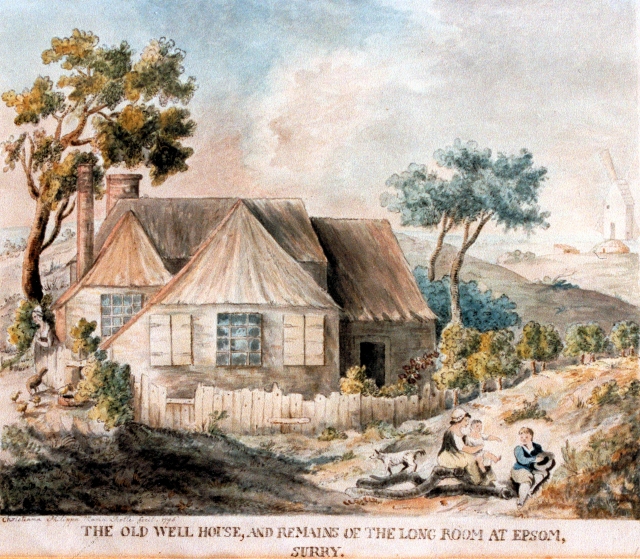 A painting of the well building in 1795
But even this genteel appearance and the attractions mentioned in the Note failed to stimulate the flagging repute of the faded watering- place, and Epsom “became (as it now remains) a populous, wealthy and respectable village, without retaining any of its former dissipated and vicious sources of amusing.”
The vogue of Bath and of sea-bathing gave Epsom the final death-stroke as a health resort; “the modern delightful practice of sea-bathing,” as Pownall forgivingly calls it. When people began to bathe in the sea, they seem indeed to have become demoralised. “The well is preserved . . . but is now only visited occasionally by strangers who, not having faith in the mineral waters, after drinking them a few times, come to the erroneous conclusion that there is no virtue in them.”
There is one further flash of fashion to be recorded. Some of the emigrants of the French Revolution lit upon this peaceful neighbourhood as a haven of refuge. One group settled at Juniper Hall, whose secular and majestic cedars at the foot of Boxhill still refresh the traveller’s eye. Here there resided Talleyrand and Madame de Stael, the Due de Montmorency and M. de Jaucourt, and M. D’Arblay who was courting Fanny Burney. At West Humble were the De Broglies. Another young couple came straight from the church in which they were married to Epsom. Their name was de Gontaut, and she was destined to end as Duchesse de Gontaut, Governess of the Children of France. They were delighted with Epsom, where they inhabited a little house “close to the race-course, surrounded ,by charming country-houses. We learned later that our arrival had excited a sensation among the inhabitants of these pretty houses, who were curious to see the French people who had escaped from the disasters of their country, and in the evening peered through our window blinds to see us.” The Duchess goes on to describe the races, where the English, she says, lose their habitual phlegm, become active and gay, betting with vivacity and tumult. But this little flock of fugitives soon dispersed again, leaving the faint aroma of a pleasant tradition.
Still, though the waters failed us, a miracle yet remained to be wrought on behalf of Epsom. In the last quarter of the eighteenth century a roystering party at a neighbouring country-house founded two races, in two successive years, one for three-year-old colts and fillies, the other for three-year-old fillies, and named them gratefully after their host and his house — the Derby and the Oaks. Seldom has a carouse had a more permanent effect. Up to that time Epsom had enjoyed little more than the ordinary races of a market-town. The great Eclipse, himself, who long lived in Epsom, had run there in some obscurity. But now horses, some of them unworthy to draw him in a post-chaise, were to earn immortality by winning on Epsom Downs before hundreds of thousands of spectators. Parliament was to adjourn during the ensuing century, not without debate, to watch the struggle. Ministers and ex-ministers would ride or drive down to the famous race; and in white hats with blue veils discuss the prospects of their favourites. Political leaders would give vent to splendid groans when they realised that they had sold the winner. In the midst of the Crimean War the result of the Derby was to be recorded in General Orders. Crowds would assemble in London, and from London to Epsom, to watch the still greater crowds returning from the contest. For a week Epsom would reek of racing. During that period the eyes of the sporting section of the civilised world would be turned on the little Surrey town. Many indeed, who were in no respect sporting, became sporting for that occasion.
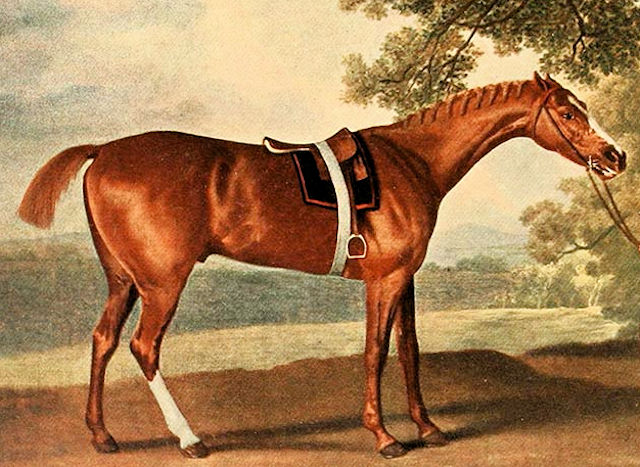 Eclipse: A detail from a painting by G Stubbs.
It is much the same now. The Olympian dust is the same, and is still scattered by the flying horses. The world still admires—not perhaps with so concentrated a gaze. And all this excitement, enthusiasm, triumph, whatever you may call it, Epsom and the universe perhaps owe to an extra magnum of Lord Derby’s choice claret, or a superfluous bottle of Lord Derby’s curious port.
For two weeks, then, or for a part of them, Epsom races and revels; and recovers during the remaining fifty. The recovery is less sweet than it was, for what was once rural is now suburban. But Nature happily, as we know, is not easily expelled. There are still common land and down, still stately trees and vernal blossom, the nightingales still sing, though it may be to an asylum, the air is still racy and clear.
The time may come when this can no longer be said, when each available inch will be covered by brick or stucco, and when that which cannot be built upon, the still sacred commons, will be surrounded by dun streets of whitey-brown houses. Then will be the moment for the resident, who remembers and respects old, or even recent Epsom, to “twitch his mantle blue” and betake himself with his goods and chattels “to fresh woods and pastures new.”
—oOo—