
The Countesses of Worple Road
 Example of a flag of the Kingdom of Hungary from the 19th century
Image source: wikipedia
Introduction
The ladies concerned were Countess Julia Sztaray (born 1849) and her daughter, Countess Flora Ruth Sztaray (born 1866), sometime residents of The Cedars in Church Street, Epsom and 2 Queen Anne Villas in Worple Road. If the addresses don’t sound that exotic for foreign aristocracy, it may be because both ladies were born in England and Count Ladislaus Sztaray, Julia’s husband, went bankrupt in 1866, although it was apparently considered to be a temporary financial hiccup.
Julia must have wondered who she was sometimes. Her family didn’t seem to bother much with registering births and it’s often impossible to discover the surname at any particular time, or even who a child’s father was.
Richard Austin and Caroline Bower
Make of them what you will. Mr Austin, or maybe Austen, was born in Swanscombe, Kent in about 1790. In the 1851 census he was living in Stone, Kent, with his occupation described as ‘household property’, so we are not talking poverty. His marital status was widowed. Also in residence was a dressmaker called Caroline Bower, described as married (but not to Mr Austin, it seems), born c.1822 Langley, Buckinghamshire, plus five children, all surnamed Bower, some of whom probably belonged to Mr Austin. The children were as shown below.
| Forename(s) | Surname | Age | Place of birth |
| Joshua | Bower | 10 | Romford, Essex |
| Francis | Bower | 8 | Stone, Kent |
| Richard Austin | Bower | 5 | Stone |
| Maria Austin | Bower | 3 | Stone |
| Julia | Bower | 1 | Canterbury |
Julia, Countess 1, had been baptised as Julia Austin on 23 September 1849 at St Andrew, Canterbury, so the confusion has started already.
By 1861 Joshua and Francis were elsewhere, Julia’s place of birth was now Stone and everyone’s surname was Austin, including a new arrival, Rosina, aged 8. Whether or not there was ever a wedding I don’t know. Mr Austin probably died in 1863 and Caroline might have too, as there were two matching burials in Stone towards the end of March of that year.
I am not bothering to track most of the children, except to observe that, when Joshua Bower got married in 1870, he gave his father’s details as Thomas Bower, Captain, Army. With that we shall leave this confusion behind and engage in a different confusion.
The Count
It may well be that Count Ladislaus was a relative of the Countess Sztaray who was lady-in-waiting to the Empress Elisabeth of Austria (and who was with her in Switzerland when she was assassinated by an anarchist in 1898), but I have no evidence either way. However, I can offer you a different murder later on.
Hungary was a complicated place: for many years it was part of the Austro-Hungarian Empire, and then it wasn’t, the Empire having fallen apart as a result of the First World War, which in itself was sparked by the assassination of the Archduke Franz Ferdinand at Sarajevo in 1914. What little we do know about the Count is that he was born in about 1829 in Hungary and that he was a professional soldier. I have found a Roman Catholic baptismal record for a Ladislaus Ludovicus Georgius Stephanus Albertus Sztaray in Budapest on 19 July 1830, son of Albertus Sztaray and Maria Waldstein-Wartenberg, so he looks like the man.
This entry appeared under the heading ‘British German Legion’ in the London Gazette.
1st Light Dragoons, Count Ladislaus Sztaray, formerly of the Austrian Imperial Cuirassiers, to be Captain. Dated 5th February, 1856.
The regiment was formed of exiles for the purposes of the Crimean War, but saw little or no action and was disbanded later in 1856. Most of the men did not return to their home countries.
Confusion alert! The 1871 census is illuminating, once you work out that the transcription reading Ladeslis Eaint Sytaray is the man we’re after. It confirms that he was born in about 1830 in Pesth, Hungary (or Pest, the eastern part of Budapest). He is head of a household in Kentish Town and described as unmarried. A Julia Hope is present, aged 21, described as his widowed ward, and we also have a Rosina Austin, born c.1853 Greenhithe, Kent, another ward and presumably Julia’s younger sister. Flora R Hope is there too, aged 4, the first ward’s daughter.
Since I can’t find any records to back up the proposition that Julia had been married to a Mr Hope and widowed, with Flora being the offspring, we probably have to assume that this was a subterfuge. What we do know, however, is that Ladislaus and Julia (surname of Austin, spinster) were married in about May 1876, Flora was christened in Camden Town on 1 October 1876, and Ladislaus died in between those two events.
We have arrived in Epsom
It’s virtually certain that the Count left Julia and Flora provided for (although, needless to say, there is no probate record for him). In the 1881 census the ladies had pitched up at The Cedars in Church Street, which was a private school formerly run by Rebecca Eisdell but now under the stewardship of Miss Bertha Mary Lee – see our article on the Eisdell Family .
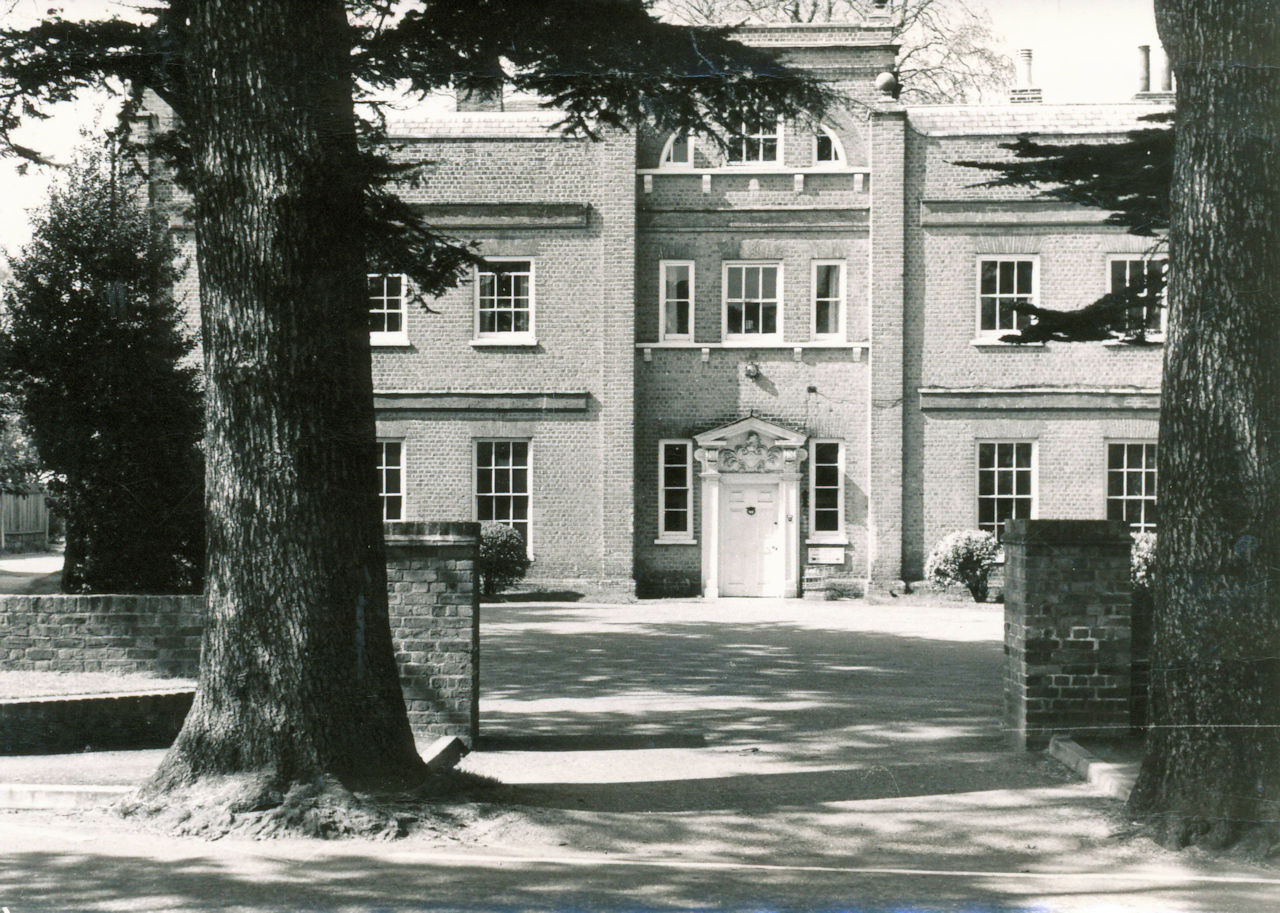
The Cedars, Church Street
Image courtesy of Bourne Hall Museum
Julia was presumably boarding there temporarily whilst Flora was a pupil. By 1882 (Kelly’s Directory) Julia appeared in Worple Road as ‘Mrs Sztaray’, living at 2 Queen Anne Villas. In late December 1891 she advertised for a ‘plain cook’, saying there were two servants in the house. It sounds as if the 1891 Christmas dinner was too fancy and not to Julia’s liking. The ladies had been in Hastings for the 1891 census. Julia was still in Worple Road in the 1898 Electoral Register but towards the end of her life she moved to Eastbourne with Flora.
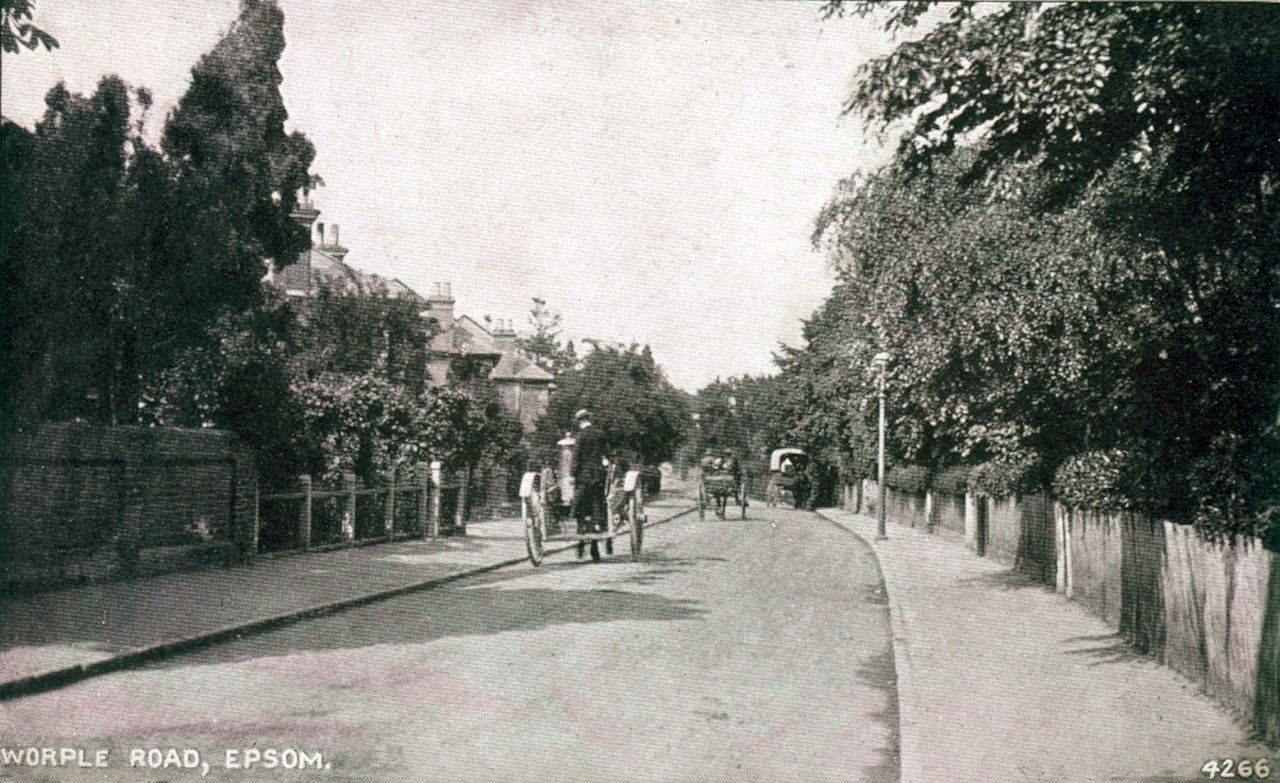
General view of Worple Road
Image courtesy of Bourne Hall Museum
In July 1897 the ladies were up before the beak at Epsom County Court for damage to photographic equipment and assault and battery on a photographer, Mr Tovey. I quote from the South Wales Echo of 17 July 1897.
‘Mr Tovey was called and said that on April 27th he went to Epsom to take photographs. He obtained permission to take his camera on to the balcony of the Epsom Downs Hotel. After he had taken up his position there Countess Julia came up on the balcony with her daughter and asked him if he was going to stay there all day. He replied that he supposed he could stay there as long as he liked, for he had paid for his stand. Countess Julia demurred at this and said that she had been in the habit of walking round the balcony for the past 20 years. A few minutes later witness heard Countess Julia say, “If the man gets in my way I’ll throw the camera over.” (Laughter.) Soon after this she asked to be allowed to pass and he immediately acceded to her request. Witness at a later stage was engaged in arranging to take a series of photographs of the finish of a race. He was about to turn the handle in order to make the exposures when Countess Julia came up and said that she wanted to pass. Witness was then engaged in taking the photos. He said to her, “Wait a minute” but she refused and called her daughter, Countess Flora, and told her that witness would not let her pass. The daughter advised her to push the camera over and a few moments later she took hold of witness’s assistant and swung him round. She then took hold of one of the tripods and said, “We’ll see about it”. She pulled the camera towards her and a part of it struck him in the eye. The camera fell and witness had a serious injury done to his eye. The camera, which was worth £80 or £100, was greatly damaged. The camera was brought into court and fitted up on the bench beside His Honour, in order to show the position it occupied on the balcony. Witness explained the movements of the defendants. The camera was thrown over and he was struck in the eye. His Honour: It is a wonder it didn’t fall on the ladies who were sitting by the side of it.’
The upshot of all this was that Countess Julia got away with it and Countess Flora was obliged to give the plaintiffs £5, which she had paid into court earlier in satisfaction of all damages. There were, however, some interesting points in the defence case.: it was suggested that Flora was of a hasty or violent temper, which caused cheers in court, and a request for Julia to give evidence in a private room was rejected by His Honour, who said that if she was able to attend race meetings, then it was clear that she could attend the open court and give evidence. It also emerged that it had taken a police constable 35-40 minutes to obtain the ladies’ names and addresses.
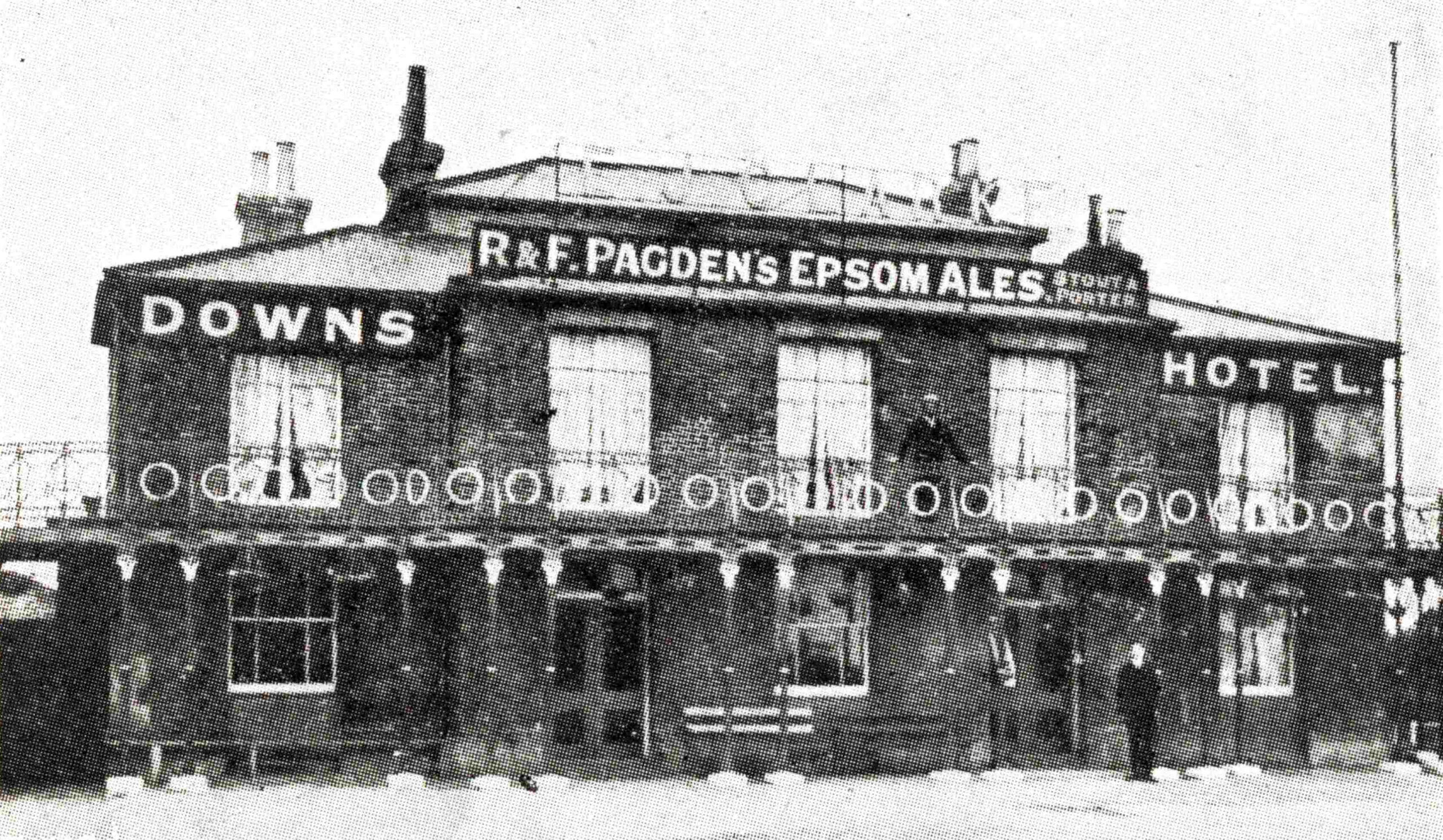 The Downs Hotel, with THE balcony
Image courtesy of Bourne Hall Museum
Julia, who had apparently been quite frail for some time, died in 1900 in Southwark, aged only 50, and in 1901 Flora, who was now in Eastbourne, married a man called Wilhelm Konstanty Stanek, the Austro-Hungarian Consul at Varna, Bulgaria. Otherwise, we know nothing about the bridegroom (until her obituary, which is at the end of this article), except that she divorced him at some point between 1911 and 1914. After that she settled down to becoming a personage in Eastbourne under the name of Countess Sztaray.
The Murder
In a way this had nothing to do with Flora, except that it happened at her house, but she might well have been murdered had she not just gone out. This report appeared in The Times of 10 October 1912.
|
MURDER OF A POLICE INSPECTOR A SUPPOSED BURGLAR’S CRIME Police Inspector Arthur Walls, of Eastbourne, who was well known to visitors to the town for many years as the parade inspector, was shot last night by an unknown man who is supposed to be a burglar, and died within a few minutes. The murderer made his escape, and up to a late hour the police search for him had been unsuccessful. The murder occurred outside the residence of the Countess Sztaray in South Cliff Avenue, which leads from the seafront west of the Grand Hotel to the road at the back of the hotel. The road is steep and rather narrow. Little is definitely known as to what led up to the crime, but it is believed that about ten minutes to 7 a man was seen on the top of a porch above the front door of the house. Inspector Walls, who was on duty in the district, entered the front garden, which is very small, and, it is supposed, spoke to the man. The house had not been broken into, but the man is suspected of having intended to commit a burglary. When near some bushes at the side of the path by the front door the Inspector was shot and severely wounded. He went out into the road and was then shot again. One bullet entered his chest and caused a fatal wound and the other struck him in one of the legs. Several persons heard the report of the shots and an alarm was at once raised. The Chief Constable of Eastbourne, Major E J J Teale, and Inspector H Pratt soon arrived and they were quickly followed by other officers. Every possible measure was taken to trace the murderer who, after firing the two shots, had made off, leaving behind a cloth cap. A cabman states that he saw a man crouching down and heard a shot fired. He drove towards the spot with his cab and on his way heard another shot. The police have been informed that a dogcart was seen going at a rapid pace towards South Cliff Avenue and then down the front. A man was also seen running down the Avenue. After being shot Inspector Walls was heard to groan, but he only lived a very short time. A doctor living in the neighbourhood was summoned but was unable to be of any service. Mr Walls, who joined the East Sussex Constabulary 24 years ago and was transferred to the Eastbourne Borough Police, which came into existence soon afterwards, leaves a widow and two or three children. |
Other versions of events says that Flora had just left the house in a cab and was informed by the driver that he had seen the man on the porch, whereupon she alerted the police, which led to the arrival of Inspector Walls. Given Flora’s apparently forthright nature (after the business with the Downs Hotel photographer), had she been indoors and confronted by the armed burglar, who knows what would have happened!
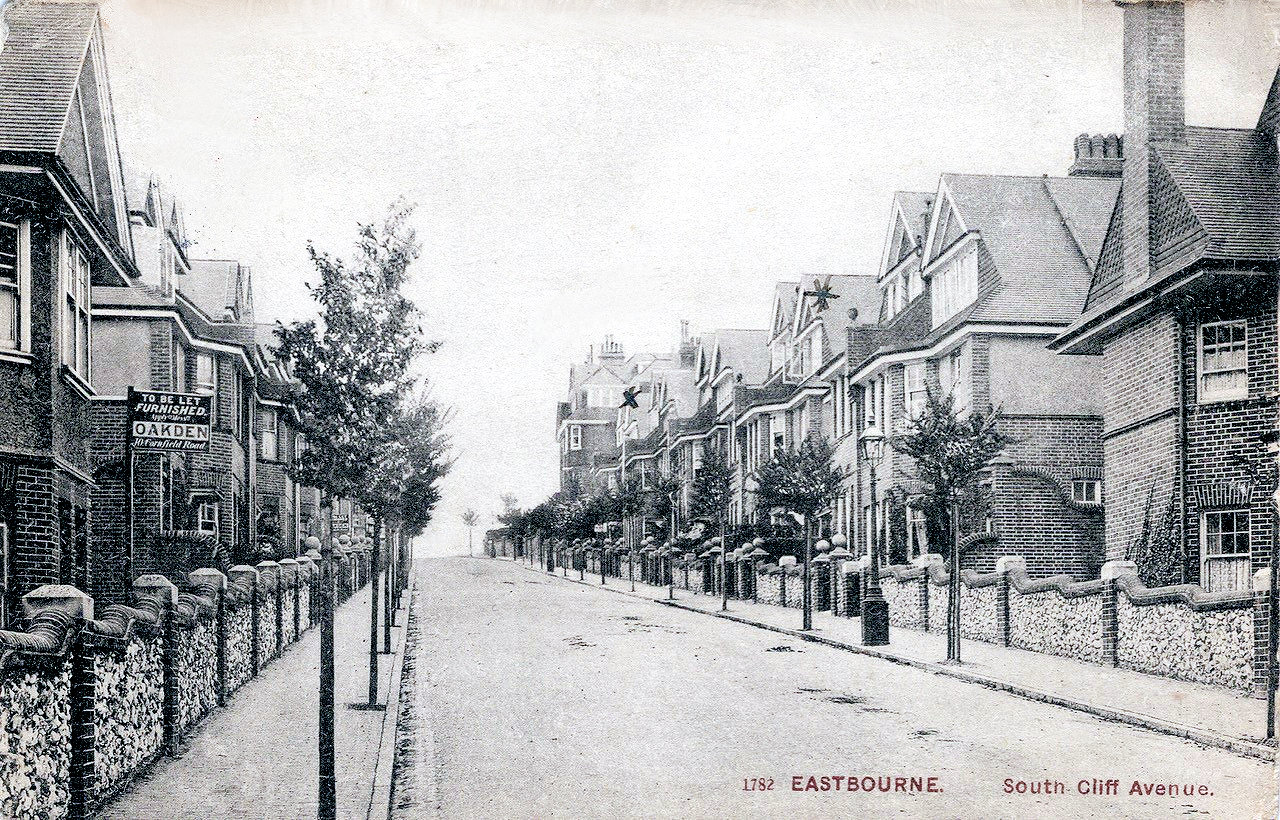 This postcard view shows the scene of the murder in Eastbourne with
Countess Stzaray’s house marked with an asterisk (just to the right of centre)
Image courtesy of Kevin Gordon (Eastbourne Local History Society)
The man was apprehended following a tip-off and turned out to be a burglar going by the name of John Williams. Apparently his real name was George Mackay, but it was suppressed out of respect for his father, who was a clergyman. Additionally, the police went to great lengths to conceal his face from the press and public, which led to this being dubbed ‘The Case of the Hooded Man’. The elaborate disguise did little good, since he was photographed in the dock and had his picture splashed all over the newspapers.

Front page of the Daily Mirror, 23 October 1912
Countess Flora is pictured middle right
(Click to enlarge)
Williams was found guilty and hanged at Lewes Gaol on 30 January 1913.
|
DEATH OF COUNTESS SZTARAY Few women ever suffered heavier misfortune – and triumphed over it – than Countess Flora Ruth Sztaray, who died on Friday in last week at Park Close, Eastbourne. She was 76 years of age. Then only child of a Hungarian Count, who was one of the richest men in his country, she was once a wealthy woman, had a beautiful home at Bourneside, The Goffs, and was one of the best-known hostesses in Eastbourne. She used to give big dinner parties at the leading hotels and was a generous supporter of charities, often anonymously. She lost her money during the war of 1914-18 through the depreciation of the Hungarian currency and afterwards shared a humble flat with a lady friend in Arundel Road. Unhappy Marriage Her troubles were not solely financial. Her marriage at Holy Trinity Church, Eastbourne, in 1901, proved disillusionment. All too late she discovered that there had been insanity in her husband’s family for six generations. He tried to kill her. Twice she went back to him. Finally she obtained a divorce on the grounds of his cruelty and infidelity. He died in an asylum. The Court allowed her to retain her own name, In spite of these strange buffetings of fate, the Countess kept a smiling face. She was a philosopher and a sportswoman and knew how to accept reverses. Her cheerfulness was infectious. To endure what she did required character and grit. She was a brave woman. Her father was Count Ladislaus Sztaray, who had a very big estate at Nagy-Mihaly, Hungary. He fought for the English in the Crimean War. He lost his fortune originally through changing his religion, but although put in the place of a second son he was still a rich man until the last war. Char-ing at Ninepence an Hour Interviewed by the “Chronicle” 13 years ago the Countess said that she should have been a millionairess; instead she was reduced to being dependent on friends, her income being £76 a year. The furniture in her flat was obtained on the hire-purchase system. She was once a prominent figure in coaching circles, driving the London to Box Hill coach and taking up the ribbons at Epsom, where she lived for 21 years before coming to Eastbourne. She also used to drive Mr Chapman’s leaders in phaeton from Brighton to Eastbourne, and at the end of the coaching season he was able to sell his best coaching horses as having been driven by a lady, which was a big asset. When adversity befell the Countess she tried to get employment and put her name down at six registry offices in the town. She also went to the Labour Exchange. She was willing to do almost anything. In fact, she even did what she called char-ing at the house of some friends and was paid ninepence an hour. Eastbourne Murder Recalled In October 1912, when the Countess lived in South Cliff Avenue, a burglar was surprised crouching on top of the porch. Challenged by Parade Inspector Walls, he fired two shots from a revolver and the unfortunate officer was killed instantly. The murderer, John Williams, was hanged at Lewes in 1913. Countess Sztaray had musical ability and composed several pieces, one of which (a waltz called “Disillusionment”) was played by the Eastbourne Municipal Orchestra under Capt. H. G.Amers and by the Bournemouth Orchestra under Sir Dan Godfrey. The Countess had a frank, friendly and unaffected disposition and, notwithstanding all her ups and downs, radiated good humour and affability. The funeral took place on Thursday at St Mary’s, Kensal Green, London.’ |
We have more snippets from other obituaries.
‘Strong in character and individuality, the countess had decided opinions on most matters and never allowed herself to be influenced by any change of fashion in dress. She adhered to the rather masculine style which suited her, yet she was very much a gentlewoman at heart.’
‘… an express desire that she should be laid to rest near her father, the Count Ladislaus Sztaray, and her English mother, the Countess Sztaray, at Kensal Green.’
‘Flora loved flowers and was never seen without her buttonhole. When she could not afford the luxury of a buttonhole her friends thought it a privilege to keep her supplied.’
Flora’s estate amounted to £116.
Researched and written by Linda Jackson Oct 2020