
The HATCHARD-SMITH family
Part 2
The children of John & Frances Hatchard-Smith
being
Hilda Constance (1879-1969)
Violet May (1880-1972)
Sybil Ida (1883-1944) and
William Hornby Hatchard (1887-1987)
Part 1 of this article describes the interesting lives of local architect John Hatchard-Smith and his wife Frances, including the early lives of their four Epsom-born children. This Part describes these children’s interesting adult lives.
A: HILDA CONSTANCE (1879-1969)
Tracking any “Smith” through the readily available records is rarely particularly straightforward, and this is made more complicated in Hilda’s case by the fact that she sometimes went by her second Christian name of Constance. As for her siblings, the adopted double-barrelled surname of “Hatchard-Smith” should be a help, but many records fail to index the “Hatchard-” element.
We noted in Part 1 that, as a 32 year old, Hilda was away from the family’s Epsom home visiting her younger (and married) sister, Violet, in Budleigh Salterton (on Devon’s south coast) – a town of which there is much more below in the sections about both Violet and brother William.
Hilda was soon back with her parents at “Charlwood” in Epsom. During the middle years of WW1, she served as a part-time volunteer Red Cross Nurse at Red House Auxiliary Hospital, Leatherhead.
Various Electoral Rolls show that Hilda, who never married, spent most of the rest of her life living in Epsom with her parents, continuing after their deaths in the late 1930s. The September 1939 Register records this now 60 year old at “Charlwood”. She is listed with the conventional “Unpaid Domestic Duties”, although the record is annotated to show that she returned to Red Cross Nurse duties, as in WW1. The only other resident in 1939 is the 34 year old domestic servant Isabella Hriber. Hilda and Isabella continued there in the post war years and the 1950s. The 1962 Electoral Roll records Hilda (but now calling herself just Constance) still there, but Isabella has been succeeded by a Jessie M Cook.
That paragraph carefully began saying “most of the rest of her life”. She doubtless travelled around and, interestingly, a mid 1930s Electoral Roll covering 11 Haymarket (the London Office of J Hatchard-Smith & Son, Architects) includes Hilda (as “Constance”) and her mother alongside her father and brother. While her parents’ “abode” is noted as “Charlwood, Epsom”, both Hilda’s and her brother’s are noted as “Watch Hill, Budleigh Salterton” which was by then brother William’s home address.
At some point in the 1960s, Hilda moved to Budleigh Salterton, doubtless to be near her surviving siblings. (Sybil had died in 1944.) The 10 February 1970 Probate record (about administration of her £2,601 estate – and which also accommodates all combinations of her names) notes that, when she died on 20 December 1969, she was “of Firs Hotel, Budleigh Salterton”.
B: VIOLET MAY (1880-1972)
As noted in Part 1, the 1901 Census recorded the 20 year old Violet at home with her parents and siblings at “Charlwood” in Epsom. Rather surprisingly, her next appearance in the readily available records is in Bombay where, as a 25 year old, she married 28 year old Michael George Dobbie Rowlandson, a Lieutenant in the Indian Army, on 20 October 1906.
Michael was the son of Michael Alexander Rowlandson, a Lieutenant (eventually a Colonel) in the Indian Army, and Beatrix Elizabeth (née Dobbie, hence Michael junior’s third Christian name). Both parents had been born in Bangalore, India – Michael senior in 1841 and Beatrix on 30 May 1854 – and they married in the San Thome Church in Madras (modern-day Chennai) on 4 March 1874.
It seems that either the Dobbies or Rowlandsons (or both) had some connection with Budleigh Salterton. This is where the pregnant Beatrix came back from Madras for the birth of Michael junior on 3 August 1878. He was baptised in All Saints Church, East Budleigh on 13 August 1878. Mother and son returned to India, and the Rowlandsons had other children born there.
Michael junior followed his father into the Indian Army and as noted above was a Lieutenant when, in 1906, he married Violet May in Bombay – where they remained for some years.
In the early 1900s, Michael senior and Beatrix retired to the UK and Budleigh Salterton. Beatrix died aged 49 in May 1904 and was buried there on 17 May 1904. The 1911 Census records the widowed 69 year old Michael senior (“Colonel, Unemployed List, Indian Army”) with an Indian-born daughter and grandson together with three domestic servants and some visiting relatives at “Addiston”, Budleigh Salterton. (Michael senior – “retired Colonel, Indian Army” – died in Budleigh Salterton on 17 April 1921.)
The 1911 Census also records Violet in Budleigh Salterton, but at “The Glen” and listed as “Wife, Husband in India”. Living with her were 2 year old son Michael (whose birth was registered in Epsom Q1 1909 so she was probably at her parents’ Charlwood” for this) and 6 month old son Jack, who had been born in Quetta, India on 24 September 1910, together with a domestic nurse. As noted in the preceding section, her sister Hilda was visiting her from Epsom. It is not clear when or for how long Violet subsequently returned to India. She was certainly back in the UK by late 1917 (and presumably with her parents at “Charlwood”) for the birth of her daughter Violet, registered in Epsom Q4 1917.
In the meantime, her husband’s 82nd Punjabis, an infantry regiment of the British Indian Army, had in January 1916 been redeployed from India’s then North West Frontier to Mesopotamia (modern-day Iraq), where they were engaged in much fierce fighting. During all this, Michael junior gained the rank of Major, was appointed Commander, Order of the British Empire (CBE) and, on 4 September 1918 was awarded the Distinguished Service Order (DSO).
By 1921, the local Electoral Roll shows that both Violet and Michael junior (doubtless with their children) were living at “Wildflowers” (pictured below), Budleigh Salterton. The house had been built for them to the design of Violet’s architect brother, William, who was by now in partnership with their father. Inspired by the international Arts and Crafts design movement, it was the first of some fifty much sought-after “Hatchard-Smith” houses in the area that were developed from the office that “J Hatchard-Smith & Son” opened in Budleigh Salterton.
 “Wildflowers”, East Budleigh Road, Budleigh Salterton
Photograph with thanks to the Fairlynch Museum, Devon
The September 1939 Register records Violet and Michael still at “Wildflowers”. 61 year old Michael is listed as “Army Colonel Retired Russian Interpreter” (with the original annotated to add “District Organiser ARP Budleigh Salterton”) and 59 year old Violet with the conventional “Unpaid Domestic Duties”. Also listed at the address was their 29 year old son, Jack, (listed as Deputy Manager Exeter Airport Under Air Ministry – Travelling”) and his 25 year old wife, Mary (listed as “Unpaid Domestic Duties and, as wife of above, Travelling”).
Michael died at “Wildflowers” in Q2 1957, aged 78. Violet lived another 25 years, dying aged 92 on 30 August 1972 at St Cecelia’s Nursing Home, North View Road, Budleigh Salterton.
C: SYBIL IDA (1883-1944)
 Sybil, aged 25, photographed on 9 September 1908
by David Knights-Whittome
Image courtesy of Sutton Archives
We noted in Part 1 that the 1911 Census had recorded the 28 year old Sybil at home with her parents at “Charlwood, Epsom”. Only a few months later, on 20 September 1911, she married the 32 year old Dr Michael Abdy Collins at Christ Church Epsom Common. They had probably met at this, the family’s church. The 1911 Census had recorded Michael as the “Medical Superintendent of Epileptic Colony” in Epsom’s “cluster” of Mental Hospitals, on Christ Church’s doorstep. He had not been there long: until 1910, he had been working at the Bexley Asylum.
During WW1, Michael served as a Lieutenant-Colonel in Royal Army Medical Corps, including nearly three years in the Mediterranean theatre – work for which he was awarded the OBE in December 1919. Sybil’s contribution to the war effort was helping to provide free buffets for soldiers and sailors at Waterloo Station – work for which she was awarded an OBE in January 1920. It is assumed that Sybil was living with her parents over this period: the birth of her and Michael’s first child, Hugh Abdy, was registered in Epsom Q2 1919.
After leaving the RAMC, Michael took employment at the East Kent Asylum in Chartham (NB not “Chatham”), Kent and was living there with Sybil and their son. A second child, Ann, was born in Q1 1922. Sadly her death was registered the same quarter, both registrations being in the Bridge District of Kent, which covered Chartham.
The readily available records are of little help in establishing how things worked out over the next 15 or so years. In particular, there are conflicting entries in the September 1939 Register for Sybil’s location in north Kent. That Register is, however, clear in recording Dr Michael Collins as the “Medical Officer” at the Ministry of Pensions Hospital in Chepstow, Monmouthshire.
Sybil died, aged 61, in Margate General Hospital on 8 November 1944. The Probate record of administration of her £ 913 estate being awarded to he husband noted that her home address had been “Fernlea”, London Road, Canterbury. Michael outlived her by 10 years, dying at the Holloway Sanatorium, Virginia Water. The Probate records of his £ 11,967 estate note that he was of the Kent & Canterbury Club, The Elms, Old Dover road, Canterbury.
The couple’s surviving child, Hugh, served during WW2 in the 1st Battalion of The Buffs (East Kent Regiment), initially as a Second Lieutenant with Service No. 153063. Casualty List No. 1279. reported that, on 6 October, he had been wounded in action in the Italian Campaign but had remained at duty. In March 1944 (and now a Temporary Captain), he was Mentioned in Despatches. After the War, he attended the Staff College at Camberley, graduating on 1 July 1946 as a Major. On 18 November 1954, he married Eleanor Brienne Beaumont, the grand-daughter of Sir Edward and Lady Northey of Epsom.
On 30 June 1955, Hugh and Eleanor emigrated to Kenya, the passenger manifest of the MV Warwick Castle giving their last UK address as “Rosell”, Margate Street, Littlebourne, Canterbury, and listing Hugh’s occupation as “Army”. Hugh later became the Chief Executive Officer of the Agricultural Society of Kenya and, completing the family hat-trick, was awarded the OBE in the 1977 New Year Honours.
D: WILLIAM HORNBY HATCHARD (1887-1987)
 William in uniform during WW1
Photograph © IWM (HU 123065)
William, the last born of John and Frances’ four children (and their only son), was the only one given “Hatchard” as a Christian name, making its subsequent double-barrelling with Smith rather more legitimate for him than for his siblings. Given the success of his father’s architectural practice, it is no surprise that William followed him into the profession. After completing his education at Charterhouse, William was articled to his father’s practice.
In the 1911 Census, the 24 year old William (living with his parents at “Charlwood”, Epsom) was listed as an “Architect” even though he did not gain his Associateship of the Royal Institute of British Architects until 1914. On William’s becoming ARIBA, John took him into partnership and the practice “J Hatchard Smith” became “Messrs J Hatchard Smith & Son”.
Alongside his pre-war studies, William had served in The Artists’ Rifles and Inns of Court Officer Training Corps, a volunteer force. Following the outbreak of the War several members of the Artists’ Rifles were selected to be officers in other units. William was commissioned as 2nd Lieutenant into the 5th Battalion East Surrey Regiment on 31 August 1914. On 29 October, the Battalion sailed for India reaching Bombay on 1 December. It was then posted to several cantonments on garrison duties. William was promoted to temporary 1st Lieutenant in September 1916 and, in 1917, was appointed Staff Captain 3rd Infantry Brigade, 1st (Peshawar) Division. Later he was DAQMG (Deputy Assistant Quartermaster General) of 4th (Quetta) Division.
in December 1917, the Battalion (with William) was sent with to Mesopotamia (modern-day Iraq) for the rest of the war. (It is open to question whether, during his time in NW India and then Mesopotamia, he ever bumped into his brother in law Michael Rowlandson, husband of sister Violet, who also served in those areas.) Anyway, after nearly a year in Basra and Samarra, the Battalion (with William now as Adjutant) took part in the final operations against the Turks, resulting in their surrender on 30 October 1918.
On return from his WW1 service, William left the parental home to live at 17 Worple Road, Epsom which – as noted in the 1918 and 1922 Kelly Directories – he followed his parents’ lead in (for reasons not now known) adopting the name “Charlwood”.
After the War, in January 1920, William rejoined the 5th Battalion reconstituted as a Territorial Unit, with the rank of Acting Captain. In April 1924, he was promoted to Major and appointed to command the Battalion in April 1930. At the end of his period of command he was promoted to Colonel. In recognition of his long service, William was awarded the Territorial Decoration and used the letters “TD” after his name.
All this post-war military activity was, of course alongside the partnership’s blossoming architectural practice. While, as we shall see, the main body of William’s work was in Budleigh Salterton, he was also active in other parts of the joint practice’s business. Particular things in Epsom for which William is given individual credit include Epsom’s WW1 memorial in Ashley Road. and the WW1 memorial at Epsom Golf Club, in Church Lane, Newdigate, Surrey and in Eltham Road, Lee (not far from his father’s Blackheath birthplace).
As noted in the section of this article about sister Violet, William designed “Wildflowers” in Budleigh Salterton for her. This early work was very well received in the town. In addition to commissions from other locals for similar prestigious houses (as well as altering/extending existing properties), William was commissioned to design the Budleigh Salterton Croquet Club (completed in 1922) and the town’s Public Hall (completed in 1925). Sponsored by the Friends of Otter Valley and Friends of Fairlynch Museum, a blue plaque at the Hall was unveiled in June 2016 to honour “COLONEL WILLIAM / HATCHARD-SMITH / TD FRIBA / 1887-1987 / Architect of the Public Hall / and over fifty private residences / in the town”
 Left: The Budleigh Salterton Public Hall
Photograph with thanks to the Fairlynch Museum
Right: the June 2016 unveiling of William’s “blue plaque”
Photograph with thanks to the Exmouth Journal
All this work led the partnership to open an office in Budleigh Salterton in 1924, the year after William became FRIBA. In 1929, William was commissioned by American millionaire Blake Thompson to build “Watch Hill” in Cricketfield Lane, Budleigh Salterton. In the last quarter of that year, the 42 year old William married (registered in London’s St Martin District) his client’s 37 year old daughter, Margaret. The couple – who do not appear to have had any children – subsequently moved into the magnificent property, pictured below.
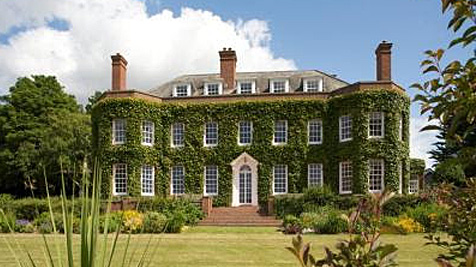 Watch Hill”, Cricketfield Lane, Budleigh Salterton.
Image with thanks to budleighbrewsterunited.blogspot.com.
They were recorded at the address in the September 1939 Register. 52 year old William is listed as “Architect Traveller” and 47 year old Margaret with the conventional “Unpaid Domestic Duties”. Also there at the time were a niece (daughter of William’s sister Violet) and great niece, a couple of other visitors and three domestic servants.
During WW2, “Watch Hill” was a refuge for foreign servicemen who had nowhere to go on leave. From 1939 to the late 1970s as many as 1,500 servicemen from Australia, Canada, South Africa and Margaret’s native US were invited to the house – and they included the future Prime Minister of Australia, Bob Hawke. (After the war this hospitality was extended to Rhodes’ scholars in particular.)
In the June 1961 Birthday Honours, Margaret was awarded the MBE “For services rendered under the auspices of the Dominions Fellowship Trust in connection with hospitality to visitors from overseas.” And in St Peter’s Church, Budleigh Salterton, there is a two-light memorial window which includes the dedication, “In affectionate remembrance of / Margaret Hatchard-Smith M.B.E. / 17 July 1892 – 18 Dec 1971 / William Hatchard-Smith/ 17 Jan 1887 – 9 Oct 1987 / In gratitude for their kindness/ & hospitality at Watch Hill to / visitors from the Commonwealth / & U.S.A. in war and peace.” Alongside the window is an explanatory framed inscription, “This window has been given by the many men / and women from the armed services of the / Commonwealth and U.S.A., overseas students / & visitors who were guests of Col. and Mrs Hatchard-Smith at their home Watch Hill between 1940 and 1972./ The national flowers incorporated into the window design record their many countries of origin.”
 Margaret & William’s memorial window in St Peter’s Church, Budleigh Salterton
Copyright acknowledged
After the war, William went into a new partnership and the family firm became “Hatchard-Smith & Bertram”. (After William’s eventual retirement, it became “Bertram & Company”.)
William’s wife, Margaret, died at “Watch Hill” on 18 December 1971, aged 79. Like his sister, Violet, William spent his last years in Budleigh Salterton’s St. Cecilia’s Nursing Home, although his chauffeur and general handyman Robin Dyer picked him up regularly and took him back home to read in his library or for a drive in the country. It was at St Cecelia’s that William celebrated his 100th birthday on 17 January 1987, as in the photograph below. (The others in the picture are Mr Waddington, Manager of the local Lloyd’s Bank, paying tribute to the bank’s oldest client and Mrs Eileen Brookes, Chairman of the Town Council, presenting flowers from the Council.)
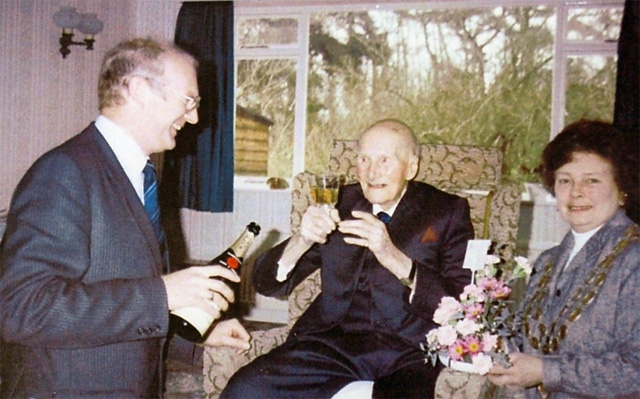 William celebrating his 100th birthday
Photograph with thanks to budleighbrewsterunited.blogspot.com.
William died later that year, on 9 October 1987.
The many large residences in the Budleigh Salterton area designed by William are today marketed as “Hatchard-Smith” houses. They are instantly recognisable with their red and white decoration and their front doors set within brick arches, and are said to be sought after and appreciated by their owners for their elegance and comfort, their sturdy construction and their attention to practical detail.
Roger Morgan © 2019
With special thanks to Hazel Ballan
for some of the background on Hilda & Violet