
The HATCHARD-SMITH family
Part 1
John Hatchard-Smith (1854-1936), architect
and his wife, Frances Mary (1857-1939)
(Their four children are covered in Part 2)
 The architect John Hatchard-Smith towards the end of his life.
From his obituary in “The Builder” on 9 October 1936.
John Hatchard Smith was born in Blackheath on 29 July 1853, the only child of John Smith and Kate Maria (née Hatchard, hence John junior’s second Christian name which, in due course, he – and other members of the family – took to hyphenating with Smith). The parents had married at St Peter’s, Eaton Square, Pimlico in 1852 when John senior was 41 and Kate was 36.
John’s parentage
It is known from various sources that John senior’s 1815 birth was in St Albans, but it has so far proved impossible to establish any more from the readily available early records about the background of this plain “John Smith”.
Kate’s background is, however, clear. She was born in Epsom on 7 January 1815, the first child of Charles Hatchard and Anna Maria (née Smith) who had married on 11 February 1914 at St Nicholas Cole Abbey in the City of London (on what is today Queen Victoria Street). The record of Kate’s baptism on 11 February 1815 in Epsom’s St Martin of Tours notes that her parents were “of Epsom” and that her father was a “Surveyor”. Charles and Anna had five other children baptised at St Martin’s, namely:
- Charles (birth date unrecorded): Baptised 23 February 1818;
- Frank (Born 8 January 1820): Baptised 13 March 1820;
- Louisa Smith (Born 13 January 1822): Baptised 17 December 1822 ;
- Caroline Owen (Born 14 May 1825): Baptised 2 November 1825; and
- Elizabeth Fanny (Born 12 May 1828): Baptised 30 January 1829.
For the last two, however, the parents are recorded as being “of Pimlico” rather than “of Epsom”. So, some time between 1822 and 1825, they had moved away – and the first modern Census of 1841 records the 50 year old Charles (now listed as an “Architect” – and, indeed, he was the “Mr Hatchard, Architect, of Pimlico” responsible for the almost entire rebuilding of St Martin’s in 1824) and Anna living at No 50 Lower Belgrave Place with children Kate, Charles junior and Caroline – all supported by a domestic servant, Ann Flemming.
Towards the end of that decade, both parents died: Anna in Q4 1848; and Charles senior in Q3 1849. The 1851 Census records the now 35 year old Kate as head of the household (and listed as a “Governess”) in Upper Eaton Street in the St George’s Hanover Square District of London. Living with her were two of her younger brothers: 33 year old Charles (“Assistant”, presumably to his sister); and 31 year old Frank (a “General Practitioner”). Also living there were the apparently unrelated 21 year old Thomas Jones (a “Medical Student” assisting Frank) and the same “General Servant”, Ann Flemming, as in the 1841 Census.
Anyway, after their 1852 marriage, John senior and Kate made their home in the Blackheath area. The 1861 Census records them living there in Albert Terrace, Avenue Road. 50 year old John senior is listed as a “Fund Holder”. He, together with 45 year old Kate and 7 year old John junior were supported by a domestic maid.
First years in Epsom
At some point in the 1860s, the family of three moved to Kate’s home town of Epsom, where the 1871 Census records them at “Stanley Villa”, Railway Terrace – now lost housing on the south side of Epsom’s Upper High Street, which (as it led to the old railway station) was then called Station Road. John senior is now listed as a “Railway Share Broker” and (perhaps encouraged by the example of his maternal grandfather) the 17 year old John junior as an “Articled Pupil” – from other sources, known to be with Messrs Gardner & Bell, Architects, of Great Russell Street, London.
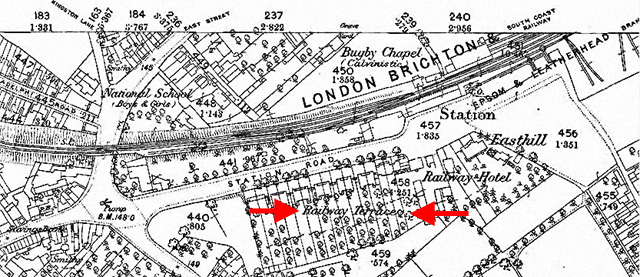 Railway Terrace in the 1866 Ordnance Survey map
John senior died at home, aged 62, on 3 July 1873 and, on 8 July, was buried in grave B6A of Epsom Cemetery which had been opened only two years earlier. The Cemetery records refer to him as a “Gentleman”. (Hereafter, John junior is referred to as just plain John.)
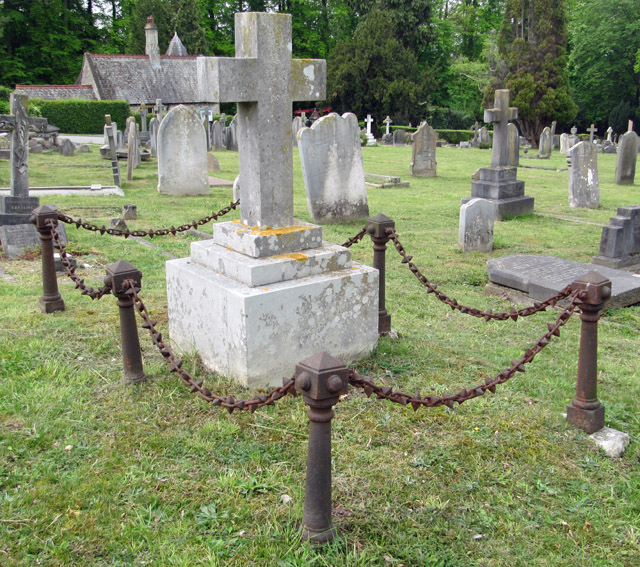 John senior’s grave in Epsom Cemetery
Photograph by Roger Morgan © 2019
Although Station Road/Upper High Street is near the church of St Martin of Tours, the family chose to attend the more distant Christ Church Epsom Common. As noted below, at least three of John’s four children were baptised at Christ Church and one of them was married there. While John did not formally begin his architectural practice until 1877, he obviously had significant skills before that and applied them free of charge to Christ Church by acting as the honorary (ie unpaid) Clerk of Works when the present replacement of the smaller building was being erected in 1875-76. (In the late 1890s, he designed the original Christ Church Hall on West Hill – nowadays housing the Epsom Christian Fellowship – but a later section of this article concentrates on his architecture.)
John’s marriage
In Q2 1878, the 26 year old John married 21 year old Frances Mary Newsham, registered in the St. George Hanover Square District.
Frances had been born on 4 April 1857, apparently the only child of William Newsham and Frances Maria (née Ward). Her parents had married on 26 April 1851 when William was 43 and Frances was 21. The marriage was in Frances’s home village of Terrington St Clement, Norfolk (just south of The Wash), and that is where Frances junior was baptised on 15 May 1857. The 1861 Census records the family at Wisbech St Mary in Cambridgeshire. 53 year old William is listed as a “Farmer of 380 acres employing 16 men and 1 boy”. As usual, no occupation is listed for 30 year old Frances senior (herself a farmer’s daughter) – and Frances junior was aged 4. The 1871 Census records the 13 year old Frances junior as one of a dozen pupils at John & Anne Wilkie’s “Amberley House Ladies’ School” in Hampton Road, Teddington.
John & Frances’ first home, and their children
The married John and Frances set up home back in Epsom. The 1881 Census records them living at 5 Station Road (now the Upper High Street). This was John’s parents’ now numbered “Stanley Villa” (which is how John gave his address for the purposes of his children’s subsequent baptisms). John is listed as an “Architect & Surveyor”, and the couple already had two children – Hilda Constance (born 31 January 1879) and Violet May (born 28 April 1880). The household was supported by three servants.
Their home was only a few doors away from John’s 66 year old widowed mother, recorded in the 1881 Census living at 10 Station Road. Living with her was her 55 year old unmarried sister, Caroline Hatchard. Both of those are listed as having “Dividends and House Property”. They were supported by a domestic servant. (It is likely that these houses were similar to the now lost 34 Station Road in which Epsom’s automatic telephone exchange began operations in 1912.)
While no record has yet been found of the baptism of the couple’s first child – Hilda Constance (born 31 January 1879) – the parents’ other three children were all baptised at Christ Church: Violet May (born 28 April 1880) on 8 June 1880; Sybil Ida (born on 27 September 1883) on 12 November 1883; and William Hornby Hatchard (born on 17 January 1887) on 4 April 1887.
There are interesting features in the lives of all four children (in particular, son William’s architecture and partnership with his father), and they are set out in Part 2 of this article. However, it is worth noting here the understanding that their education was principally at home with governesses – although it is known that William attended Charterhouse School for his secondary education.
John & Frances’ second and third homes
The family was still at 5 Station Road for the 1891 Census, supported by two domestic servants and a governess. Alongside his other work, John was busy designing his ideal home – “Charlwood”, as illustrated below – which was then built on the NW corner of Downs Road and Downs Hill Avenue, Epsom. (The house was demolished in the 1970s and new housing developed on its site.)
 “Charlwood”, the family’s home on the corner of Downs Road/Downs Hill Avenue designed by John.
Image (out of copyright) from “The Building News” of 19 August 1898,
With thanks to the Internet Archive
The family had moved to “Charlwood” by not later than 1895. The parents and all four of their children were recorded at that address in the 1901 Census, supported by three domestic servants.
(At the end of 1908, John’s widowed mother, Kate, died aged 91 and was buried with her late husband In Grave B6A of Epsom Cemetery on 3 January 1907. She and her unmarried younger sister, Caroline Hatchard, had both been living “on own means” at “Queen Anne”, Worple Road. Caroline subsequently moved to 1 Ashley Villas, Ashley Road, Epsom. She died, aged 90 in 1916, and was buried with her sister in Grace B6A of Epsom Cemetery.)
For the 1911 Census, John and daughters Hilda and Violet were away from Epsom. Hilda was visiting the now married Violet at “The Glen” in Budleigh Salterton – on all of which there is more in Part 2. The 58 year old John, however, was recorded in that Census at the Grenville Hotel in Bude, Cornwall. This was unlikely to be a pleasure trip: the hotel (illustrated below) had been built to his design only the year before, and he was probably there for some follow-up purpose.
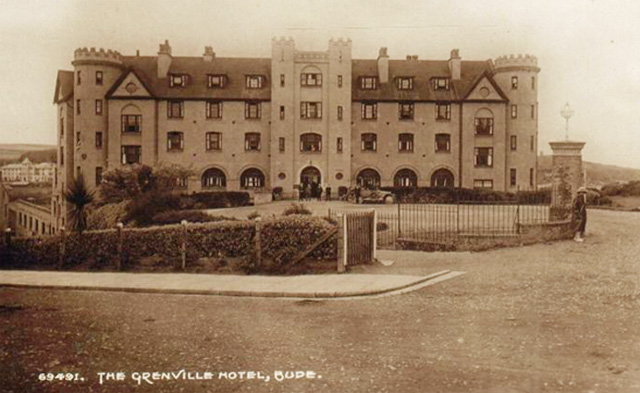 An early postcard view of the Grenville Hotel, Bude
(At the time of writing, the building is the home of “Adventure international”.)
In the early 1920s, John and Frances (together with their two unmarried children, Hilda and William) moved from “Charlwood” to a newly-built house in Downs Avenue. Confusingly, they took the name “Charlwood” with them. The extracts from the 1896 and 1932 Ordnance Survey maps below show the location of the first and second “Charlwood” (shaded red and green respectively).
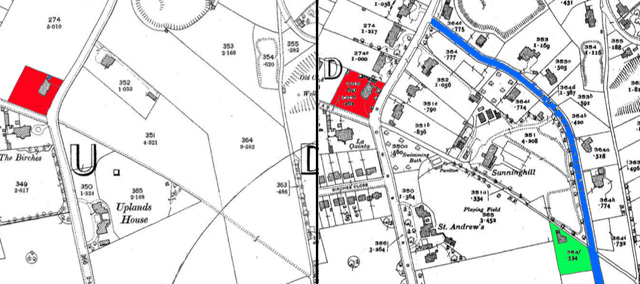
Extracts from the OS maps for 1896 (left) and 1932 (right) in which the original “Charlwood” is shaded red and the second “Charlwood” is shaded green.
In the right hand extract, Downs Avenue (first seen in the 1913 OS map) is shaded blue.
(The name “Charlwood” – presumably taken from the Surrey village of that name, just to the north of today’s Gatwick Airport – was obviously significant for the family, but it is not known why. There is nothing in the family history outlined above to suggest a connection. Indeed, the resonance was so strong that, when youngest child William set up his own home in Epsom’s Worple Road after his WW1 service, he also named the house “Charlwood”.)
The new “Charlwood” (pictured below – but no longer of that name) was also a Hatchard-Smith design, but its gentler lines suggests that it could the work of John’s architect son, William, who (as we shall see in Part 2) became well known for similarly-styled houses in Budleigh Salterton.
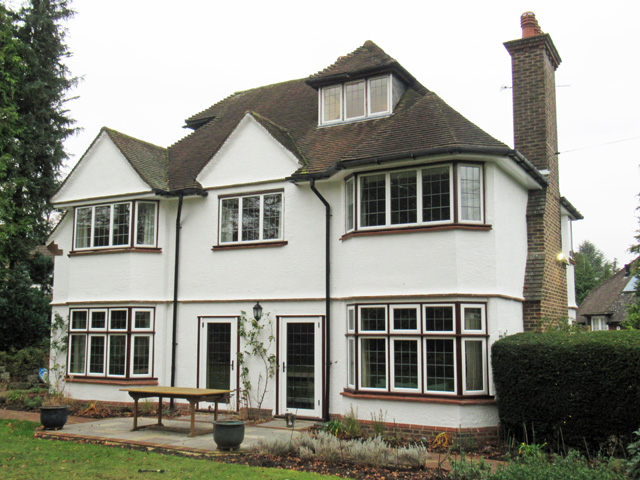
The second “Charlwood”
Photograph by Roger Morgan © 2021
John’s architecture
After completing his school education, John was articled to Messrs Gardner & Bell of Great Russell Street, London WC. On completing that – but before beginning independent practice in 1877 – he travelled and studied extensively in Europe. (Indeed, to the end of his life, his great pleasure and relaxation was an architectural sketching tour, generally in some little-known part of a foreign country.) He worked both from his Epsom home (initially “Stanley Villa” and then “Charlwood”) and an office in London (initially 41 Moorgate Station Buildings, then 6 Duke Street, Adelphi and, finally, 11 Haymarket). He was elected an Associate of the Royal Institute of British Architects in 1881 and a Fellow (FRIBA) in 1892. He was also an active member of the Town Planning Institute.
(In 1914, he took his son, William, into partnership. As discussed in Part 2 of this article, this led to “Messrs J Hatchard-Smith & Son” opening an office in Budleigh Salterton in the 1920s.)
Over the years, John’s practice developed a substantial and wide-ranging body of work. Mention was made above of the Grenville Hotel in Bude. There were also hotels in Devon, Somerset and Hampshire. At the other end of the scale was domestic work, with houses in Epsom (in particular, his now-lost “Charlwood” and a number of others, among which remain “Summerdale” at 14 Burgh Heath Road – for a couple of decades from the late 1920s, the home of the Mullins family – and “Charnwood” at 70 Worple Road), and throughout Surrey, Kent, Sussex, Hampshire, Devon, Lincolnshire and Yorkshire. On a grander scale, there were London apartment blocks such as Alexandra Mansions in Victoria Street and Crown Mansions in De Vere Gardens. While his architecture was generally pretty mainstream, he was also capable of surprise: in 1882, quite early in his career, he designed and supervised the building of the exotically-styled Turkish Baths at Dalston Junction. (Sadly, these were destroyed by fire in 1890.)
In the early 1900s, John had been commissioned by Ernest Blackburn to build a house in Sussex called “Little Thakeham”. By April 1902, Mr Blackburn was dissatisfied with the half-built brick villa and brought in Edwin Lutyens, who advised him to demolish it, which he did. John accused Lutyens of poaching his client, and the dispute was played out in the pages of Building News, which supported Hatchard Smith (hinting that Lutyens had first approached Blackburn rather than vice versa) and Country Life, which supported Lutyens. RIBA cleared Lutyens of misconduct but, even though Little Thakeham is held to be a masterpiece, the affair left a bad taste across the profession.
John was particularly skilful in the adaptation and modernisation of old houses, in particular carrying out work at “The Durdans” for Lord Rosebery.
His practice designed a wide range of well-regarded office and other buildings in London – perhaps most notably “The Trocadero” on the corner of Shaftsbury Avenue and Piccadilly Circus. The building a development by J Lyons as an up-market restaurant with ballroom and banqueting hall. The building won wide praise for its facilities and features. John was more than a little miffed to find that J Lyons’ architect, William James Ancell, was being named in some sources as the sole architect of the building. Accordingly, he contacted the Morning Post newspaper which, in its edition of 8 October 1896, printed the following:
“THE TROCADERO RESTAURANT. Mr J. Hatchard-Smith, F.R.I.B.A. requests us to state that he was the architect of this building, which opened recently, and that Mr W. Ancell acted as joint architect.”
John made a substantial contribution to the non-domestic architecture of Epsom and district. These include: the now-lost Public Hall on the junction of Epsom’s Upper High Street and Church Street; the Epsom and Ewell Technical Institute in Church Street; the Epsom Common Working Men’s Club on Stamford Green; the Amato Inn in Chalk Lane, Epsom; the now-lost Admiral Nelson Inn in Ewell High Street; the Epsom Golf Clubhouse in Longdown Road South; the Royal Apartments in the racecourse’s old Grand Stand (the plans for which brought him King Edward VII’s personal congratulations); and Headley Village Hall.
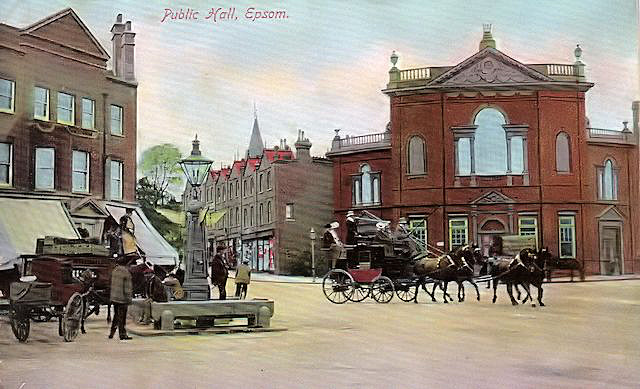 Epsom’s now-lost Public Hall
Image source: Bourne Hall Museum
Finally, John designed a number of war memorials in various parts of the country although, as noted in Part 2, Epsom’s own WW1 memorial in Ashley Road was designed by son William, a WW1 veteran.
Other aspects of John’s life
John took a close interest in Epsom’s welfare and development. One obituary notes that “he was always ready with advice and assistance in local problems”, but another that “he was a stern critic of most Council affairs and loved controversy: if any local storm was brewing, he could be relied upon to provide some of the squalls.” In 1907, he became a member of the Urban District Council (which met in the Public Hall he had designed) so that, as he put it, he “could carry his criticisms into the enemy’s camp.” John became Chairman of the Council in 1913, resigning from the chairmanship in April 1914 (perhaps consequential on coming a poor second to James Chuter Ede in elections to the County Council) and from the Council itself in November 1914.
He was also active in London affairs. He was a member of the Court of the Worshipful Company of Dyers and was its Prime Warden in 1903-04. In due course, he (with his son William) took ownership of part of a tenement at 76 Watling Street, entitling him to participate in local elections. He was also a member of the Caveac Lodge, No 176 of the Freemasons – which gave him a particular advantage in designing the Freemasons’ temple that was part of his Trocadero development.
John was 60 when WW1 broke out, but still tried to enlist. In the event, he had to settle for being a Special Constable but did not find that sufficient. He took a course at Vickers to become a machine gun instructor and, when invasion was feared on the coast, he went with other local volunteers ready to repel it.
There is little else about an obviously full life in the readily available records, but there is the interesting snippet of finding the 71 year old John ( “Architect” of Charlwood, Epsom) as an unaccompanied first class passenger on RMS Almanzora which left Southampton on 3 April 1925 bound for Buenos Aires.
The deaths of John & Frances
In late September 1936, John and Frances were on holiday at Westfields, West Barnby, near Whitby. John was now 83, but still active in his profession. Indeed, he was returning from a country walk on 24 September to keep an appointment with a local builder when, notwithstanding his previously good health, he collapsed and died of a heart attack. His body was brought back to Epsom and, on 29 September 1936, was buried in Grave U6 of Epsom Cemetery. Just over a year later, on 21 January 1938, the 80 year old widowed Frances died at home. She was buried with John on 24 January.
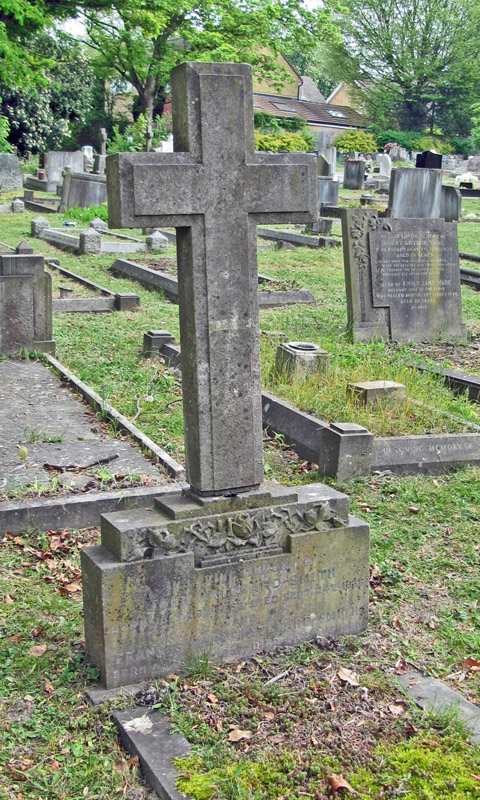 The headstone over the grave of John and Frances
Photograph by Roger Morgan © 2019
Given John’s status – and, indeed, his profession – their headstone, illustrated above, is quite modest. That modesty extends to the simple inscription which reads: “In loving memory of / John Hatchard-Smith / Born July 29th 1853 – died Sept. 24th 1936 / and / Frances Mary Hatchard-Smith / Born April 4th 1857, Died Jan. 21st 1939.” (Note that this gives both their surnames as “Hatchard-Smith” – the double-barrelled surname eventually adopted by the children.)
Part 2 of this article deals with the interesting lives of John & Frances’s four children
Roger Morgan © 2019 & 2021