
PHYLLIS NICOL (née GREEN) (1908-99)
Athlete and Missionary, and long-time Ewell resident
 Phyllis with some of her many trophies
Image Courtesy of Bourne Hall Museum
Introduction
Most female athletes between the two World Wars are not well-known, Phyllis being a case in point. Back then, athletes were amateur, so people generally did it for love of the sport; as with many other things, the sports world was male-dominated. Nevertheless, short though her career was, Phyllis did make a big splash in both high jumping and long jumping at the time and was a major talent. She was a Ewell resident for a very large part of her life, until her death in 1999.
Early Life
She was born Phyllis Adine Green in Peckham on 8th February 1908. Athletics was ‘in her blood’ as her father Henry Ernest – an undertaker’s manager in his everyday life – was also a member of Peckham Harriers, as it then was. Phyllis attended Peckham High School for Girls and, incredibly, aged just 17, she set a world best for the high jump of 1.51 metres (just short of five feet). This might not sound much today, when the record exceeds 2 metres, but in those days the technique was the old-fashioned scissors jump. Here’s a picture to demonstrate.

Ethel Catherwood of Canada winning the gold medal at the 1928 Olympic
Games with a jump of 1.59 metres (5 feet 3 inches)
Image courtesy of: Wikimedia Commons
Before continuing with Phyllis, I should mention for anyone who doesn’t know that top-class high jumping now features the famous Fosbury Flop, which changed the sport forever (although children just starting out often begin with the scissors method, because it isn’t a great idea to try going over the bar backwards as a first-timer). At one time there was also the straddle technique, whereby, to put it very simply, (although there is a highly technical explanation on Wikipedia if you want to know more) you hurled yourself bodily over the bar frontwards, but after Dick Fosbury revolutionised high jumping by winning the Olympic Gold Medal in 1968 with his flop method, that was more or less it. Almost everyone now flops but, speaking as someone who couldn’t even manage a low hurdle at school, I shall swiftly move on.
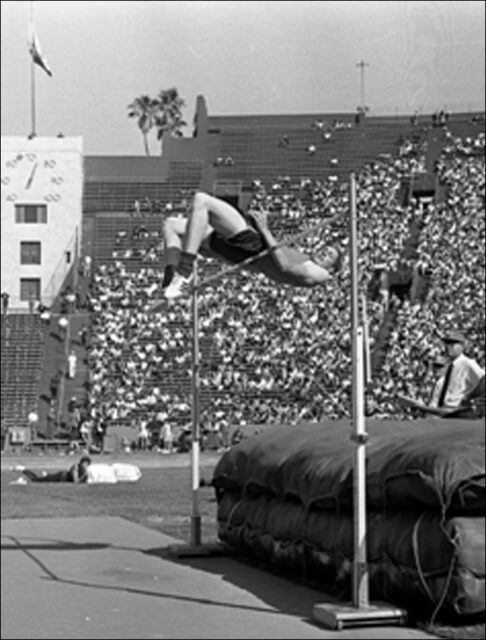
Dick Fosbury at the 1968 Olympic Trials
Image courtesy of Wikipedia

We can now look at some of Phyllis’s achievements.

Group Photo, 1925 of the London Olympiades Athletics Club
Phyllis front row fourth from left
Image courtesy of Bourne Hall Museum
Had she continued high jumping, then she might well have won the 1928 Olympic gold medal, as she had already cleared 1.58 metres in 1927, but she gave up the sport. The 1927 jump should have been a world record but wasn’t ratified owing to a measurement discrepancy (i.e. this jump was measured in feet and inches, and was, allegedly, when converted, a smidgeon short of the metric record, the smidgeon being a very measly fraction of an inch). Phyllis didn’t compete in the high jump again after that. Unusually though, she was also a talented long jumper and in 1927 leapt 5.52 metres, which was just 5cm short of the world best. (However, we did have a home-grown world record holder in the long jump at around that time – Muriel Gunn, later Mrs Cornell, who came from just along the road, almost – Mitcham.) For comparison purposes the current world record in long jump for women stands at 7.52 metres, but over the nearly 100 years since Phyllis and Muriel were active in the sport it has only crept up in very small increments to that mark, which was set as long ago as 1988.

Phyllis leaping over the sea wall at Sandown
Image courtesy of Bourne Hall Museum
It’s a shame that we don’t have – and never will have – the 1931 England and Wales census for reference (all of the paperwork was destroyed by fire, probably accidentally, in 1942, which led to a major change in storage methods thereafter), so we don’t know exactly what Phyllis was doing immediately after her athletics career, although sources say she was a clerk, and I imagine she may have been assisting her father, Henry, who was by 1926 managing director of a limited company, presumably in the undertaking business – this comes from the marriage certificate of the eldest son, Eric Seaward Green. Henry died in 1934 and Phyllis subsequently moved to Ewell with her mother, Rose, and siblings, Cyril Ernest and Sylvia Margaret. Eric, who was a municipal accountant, and his wife, Dorothy, lived in Pinner, Middlesex. Cyril Green was also in the undertaking business and by 1939 he was in charge, being assisted by Phyllis, who did engraving and paperwork. We don’t know where this business was but I surmise that it could have been the same firm that Henry Green was involved in. In 1934, when Henry died, the family home had been in Wood Vale, Honor Oak, which isn’t that far from Ewell.
So, by 1939 Phyllis and her family (all bar Eric) were at 11 Conaways Close, Ewell, where they remained, except for a post-war period when Phyllis was abroad and the fact that Sylvia eventually married a Mr Smith and moved away. I decline to search for Sylvia’s husband any further, since it is hugely hard work to locate people surnamed Smith in the wartime and post-war era and we don’t strictly need her for this piece. I am certain, though, that she died in Bournemouth District towards the end of 2001 – if anyone can fill in the gap on Sylvia, please contact the webmaster.

Phyllis lived for many years at 11 Conaways Close
Image courtesy of Google Maps
Marriage and Missionary Work
I should mention that there is evidence of Phyllis’s interest/involvement in the Christian faith as far back as 1925, since we have the frontispiece of a Christian publication for young people where Phyllis has star billing in the list of articles. The editor, Arthur Hallack, was a Congregational minister, which gives us a strong clue about her religious leanings.

Phyllis wrote in a Christian Magazine
Image courtesy of Bourne Hall Museum
One of her long-time friends has said that she would not compete in sports on Sundays, which is a further indication that she was religious.
We don’t know where/how Phyllis met the Reverend George Manson Nicol, a Presbyterian minister, but meet him she did and they were married at a local Congregational Church in 1946.
George Nicol, a Scotsman, was considerably older than Phyllis, having been born in Partick, Lanark in 1891. His father, (another George Manson Nicol, who died in 1921), had also been a Presbyterian minister. Details of George’s career are hard to find, but we know he had much to do with the Presbyterian Church in Malaya and there is an interesting little article online which tells of his role in establishing St Andrew’s Presbyterian Church in Ipoh, (capital of the state of Perak). Lest this article, which appeared on the ‘Ipoh World’ website, should disappear from the internet – in which case we shall know nothing at all about George and Ipoh – I’ll just pull a couple of bits from it for posterity and hope they don’t mind. The church is still there, by the way, should you ever be in the area.
‘The church was built in 1929 and opened in 1930 at No.47, Golf Club Road (Jalan Kelab Golf), Ipoh.’
‘It was Ipoh’s first Presbyterian minister George Nicol who spent two years organizing the funding and construction of the church. He was there for the laying of the foundation stone by Arthur Worthington* in March 1929 but, alas, he had to leave Ipoh for home before the building was completed and the first services held.’
*probably Arthur Furley Worthington, an official in the Colonial Service
George had been married before and was with his wife in Sheffield in the 1939 Register (in 1921 they had been in Tow Law, Durham, George being the Presbyterian minister there, and his wife, Mary Paterson Nicol, née MacGillivray, being a native of Jarrow). However, they must have been divorced during or very shortly after the war, since, otherwise, he would not have been able to marry Phyllis. His first wife was still alive at the time and died in 1960 in Napsbury Hospital, St Alban’s, a large mental facility: in the probate record she was described as a single woman. There were two children of George’s first marriage, one of them being the distinguished historian Donald MacGillivray Nicol FBA (Fellow of the British Academy), MRIA (Member of the Royal Irish Academy). A synopsis of his life and work can be found here.
Missionary work in Malaya was impossible during WW2, since the Japanese invaded in 1941; the invasion had been expected, but the Allies misjudged the scale of the danger until it was far too late. Penang, for example, was bombed relentlessly, the British and Europeans were evacuated in a hurry and the ‘native’ population was left at the mercy of the Japanese, quickly followed by the same thing at Kuala Lumpur. The invasion culminated in the fall of Singapore in February 1942. Many thousands of Asian civilians, including Malays, and military prisoners of war were forced to work on the construction of the Burma Railway, the human cost of which, in terms of suffering, disease and death, was horrific.
George and Phyllis went out to Malaya after WW2. I can’t find any particular information about what they did there, but their final abode was St Andrew’s Manse, Codrington Avenue, Penang (strictly George Town, Penang). I did find a shipping manifest for their passage to Malaya in 1954, giving a home address in Slough, so I imagine that they went back and forth on occasion. There were and are a number of St Andrew’s Presbyterian Churches in Malaya (now Malaysia) and there is a substantial Christian population in the country, although the majority of inhabitants are Sunni Muslim or Buddhists. Originally churches representing various strands of the Christian faith catered mainly for the British/European expatriate community (the expats were usually planters and dealt in commodities, such as rubber and tin) but they drew in/converted locals.
Back Home
George (and presumably Phyllis too) was in the UK in/by 1957 and he died suddenly at the Royal Lyceum Theatre in Edinburgh – possibly of a stroke – on 28 September of that year. Phyllis returned to the family home in Ewell., where her mother, Rose, and brother, Cyril, still lived. Unfortunately, we don’t know specifically what Phyllis did after her return home, but if anyone has information, please let us know. Rose died on 6 August 1964, with the probate record describing both Eric and Cyril as Funeral Directors, so it would appear that Eric had joined his brother in the business. Cyril died on 27 September 1979, still living in Conaways Close, followed by Eric in 1980. Phyllis survived until 1999, dying in Epsom General Hospital on 26 November of that year.
Linda Jackson © 2025
With grateful thanks to the late Peter Reed, who suggested and helped with this article