
THE CHURCH STREET DOCTORS
6-8 Church Street, Epsom
Dorothy Graham Angus, Barbara Harrison Mitchell and Margaret Greville Oyston
 1968 photo of 8 Church Street, Epsom, then owned by Dr Mitchell
Image courtesy of Epsom & Ewell Local & Family History Centre
Introduction
There are many articles on this website about local hospitals and the doctors and nurses who worked locally – and rightly so because of the Hospital Cluster – but something sticks out like a sore thumb, or, rather, it doesn’t stick out at all because it‘s not there. Female doctors. I had no intention of writing anything on this topic but stumbled across three of them, all connected, when researching someone else (a male doctor).
Female doctors are a fairly ‘modern’ innovation because of the barriers that were erected and maintained by the male establishment in the past. That didn’t just involve the medical profession, but other professions, the clergy being the most glaring example. The Bar was another male bastion, but Ivy Williams, who never actually practised, broke that particular glass ceiling in 1922, closely followed by Helena Normanton, who smashed it to pieces. The remarkable thing about Normanton was that she had come from humble beginnings and endured a tough childhood but she made it through sheer brains and determination.
 Helena Florence Normanton
by Elliott & Fry
bromide print, 4 September 1950
NPG x90837 (CC BY-NC-ND 3.0)
(Odd fact: Normanton’s ashes are buried with her late husband in St Wulfran’s Churchyard, Ovingdean and there is a memorial in that same little churchyard to Sophia Jex-Blake, mentioned below as a doctoring pioneer. Jex-Blake is buried elsewhere, but many members of her family reside in an elaborate tomb at St Wulfran’s. The two women wouldn’t have known each other, so this is just a strange coincidence.)
However, in the World War 1 era women were useful for some jobs and they were acceptable as nurses, munitions workers, drivers and a host of manual occupations. We have examples on this website of women who did sterling work as wartime volunteers (see for instance The Baroness de T’Serclaes, Cicely Marion Ellis and Margaret Esther Hopper) but none of them were doctors.
Before I start, I should say that information about the three ladies described below is sparse. We know much more about one of them because she had a detailed obituary in the British Medical Journal (BMJ) but otherwise it’s been an archaeological dig. They seem to have flown largely below the radar, but now that I’ve found them let’s put them on the map.
Dorothy Graham Angus
 Dorothy Graham Angus
Image found on Ancestry attributed to S.P. Stacey by Darbcon4
This image is presumed out of copyright due to its age,
but please contact us if you know different.
Dorothy was born on 4 August 1886 in Newcastle upon Tyne, the eldest child of William Mathwin Angus and his second wife, Sarah Graham. The Angus family had been successful in leather manufacture for many years, so there was probably no compelling need for a daughter to do anything much, but Dorothy did. The 1911 census found her in Hampstead with her half-sister Isobel and Isobel’s husband, the Reverend Herbert Newell Bate, who ultimately became Dean of York. No occupation was shown for Dorothy and I would guess that she was just on a visit at the time; she was 24 years old then and perhaps considering her future.
What she did in due course was to enrol as a World War 1 VAD (Voluntary Aid Detachment) and, although you may well have seen this recruitment poster before, let’s take a closer look, because it emphasises the ‘place’ of women in society at the time.
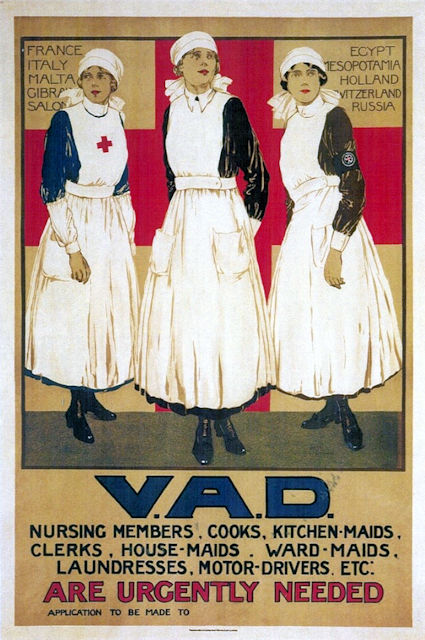 VAD recruiting poster, 1915
Many VADs were men, although you would never know it from the poster. Looks glamorous, doesn’t it, but, when you read the list of ‘jobs’ you could do, most of them are menial. A run-through of deaths on the internet shows the appalling risks of being a VAD nurse – not only the risk of enemy action overseas or drowning when your transport ship hit a German mine, but also Spanish flu, pneumonia (often contracted from patients) and/or sheer exhaustion. So, no, it wasn’t glamorous at all and the poster was a potentially lethal con, just like the 1915 poster from the Ministry of Information that said to men: ‘It is far better to face the bullets than be killed at home by a bomb. Join the Army at once and help to stop an air raid.’
Dorothy served for roughly two and a half years and her record shows that she was initially at the 2nd Northern General Hospital in Leeds, commencing in April 1915.
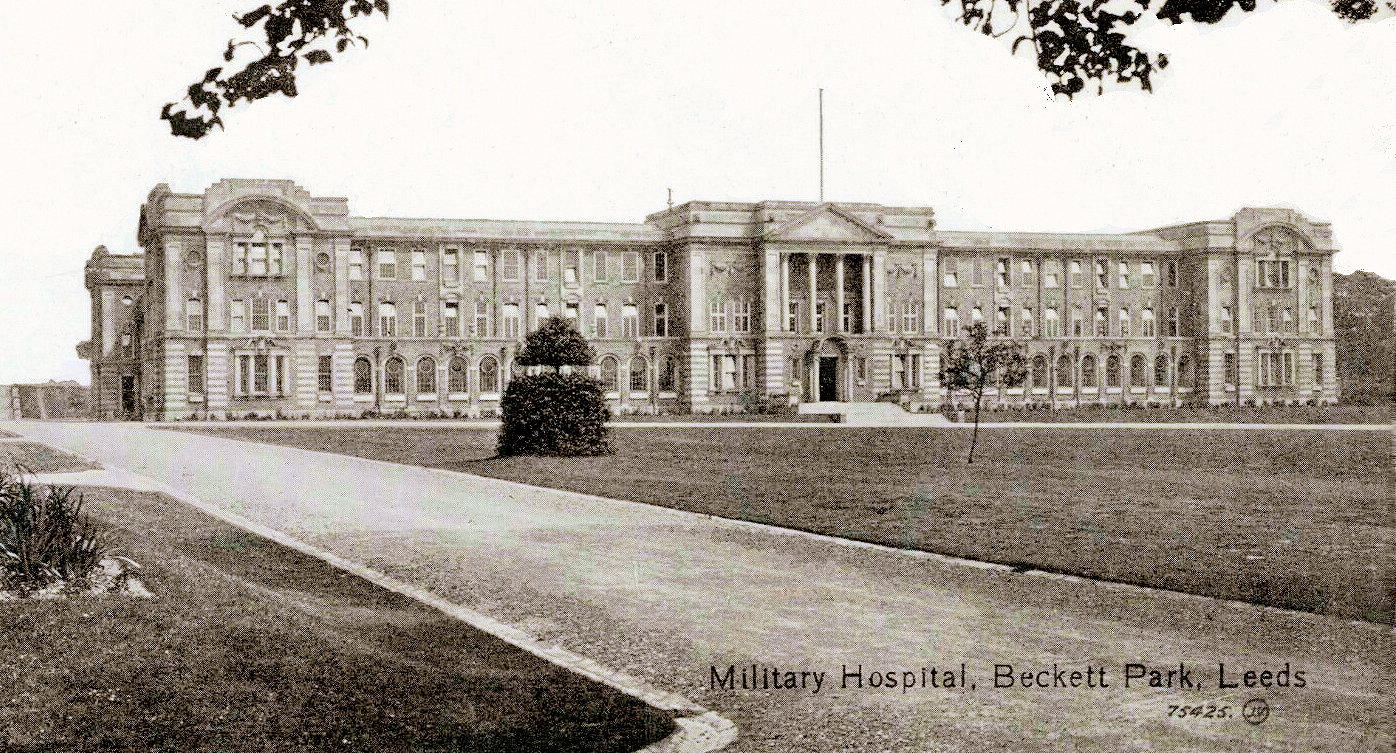 2nd Northern General Hospital, Beckett Park, Headingley, Leeds, 1918
Image source: Wikimedia Commons
This establishment had been a teachers’ training college but, like so many other buildings, both in the UK and abroad, it had been commandeered as a military hospital. The matron during WW1 was Euphemia Steele Innes. From September 1915 Dorothy served at the intriguingly named Baltic & Corn Exchange in France, which appears to have been at Paris-Plage Le Touquet and was actually Number 8 Red Cross Hospital. Then, from April 1917 until September of that same year, she was at Number 9 Red Cross Hospital, which might well have been in Calais at the time and could have been the Duchess of Sutherland’s Hospital. On the assumption that I’m right (and the records concerning these establishments are patchy – especially as some of the hospitals moved around, according to where the Front was at any given time – with people on blogs arguing about which was which and where they were etc}, here is the Duchess herself, admittedly in a bit of a glamour shot. Don’t be fooled – she narrowly escaped death at enemy hands in both World Wars.
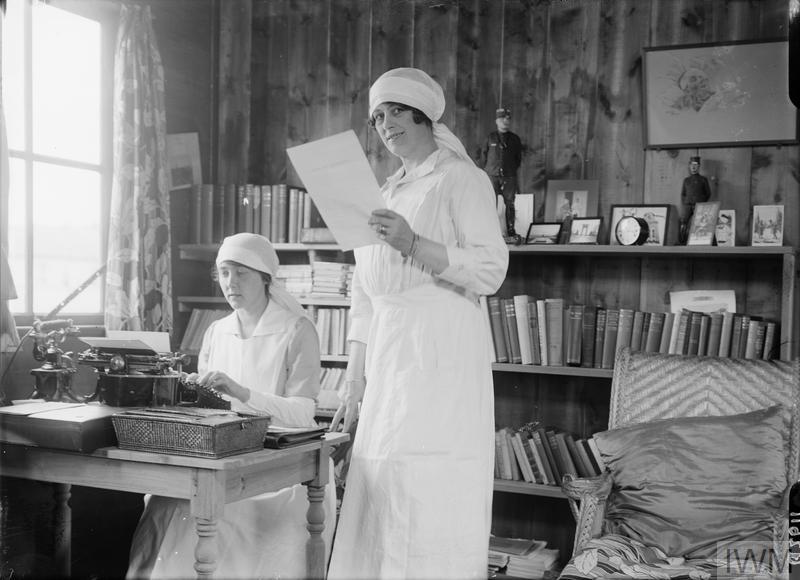 Millicent Leveson-Gower, Duchess of Sutherland, and her secretary
Image Source © IWM (Q 2611)
1917 seems to have been the end of Dorothy’s VAD career and we next pick her up in the 1921 census when she’s in Newcastle, visiting again, but this time we have an occupation – whole-time medical student. She was still living in Newcastle back then, her normal abode being The Cottage, Benwell (‘cottage’ is misleading, since this was a large house and estate owned by her father). She was registered M.R.C.S and L.R.C.P London in May 1929. She appears to have stayed in Newcastle for a while but certainly not later than 1932, when, finally, in her-mid-40s, she materialised at Douglas House, 6 Church Street, Epsom.
 1932 map with 6-8 Church Street highlighted
We must now move on to Barbara Harrison Mitchell who, although considerably younger than Dorothy, qualified earlier and almost identically in 1926; she also appeared in Number 6 at around the same time as Dorothy. I think the two ladies probably knew each other from their studies in London and decided to set up shop together in Epsom. In Barbara’s case, general practice wasn’t her first choice of speciality.
We don’t know much else about Dorothy, but she was in partnership with Barbara until she died on 24 January 1954, still at Number 6; Barbara was one of her two executors.
Barbara Harrison Mitchell
It’s been easier to find information on Barbara, as someone kindly wrote up her obituary in the BMJ (reference: Volume 290, 15 June 1985, page 1821). She was born in Glasgow on 9 November 1901. Her father, Robert, was a manufacturer of sugar machinery and the family moved down to England in the 1900s. Mrs Mitchell was Robina Margaret (known as Ruby – née Harrison). We shall return to the other Mitchells later, as they all came to Epsom and Ewell.
Barbara was a pupil at St Paul’s School, London and I presume this to be St Paul’s Girls’ School in Brook Green, Hammersmith, because it opened in 1904 as a ‘branch’ of the St Paul’s Boys’ School. She became head girl there and developed a passion for music (during her time at the school Gustav Holst, composer of ‘The Planets’, was the director of music).

St Paul’s School, Brook Green, showing the blue plaque commemorating Holst
Photo by Spudgun67 (CC BY-SA 4.0) Source: Wikimedia Commons
Barbara had wanted to be an engineer like her father but ultimately enrolled at the London School of Medicine, followed by the Royal Free Hospital. The former establishment looks to have been the London School of Medicine for Women, founded in 1874 by the ‘usual suspects’ who had been barred from studying medicine by the male establishment (e.g. Elizabeth Garrett Anderson, Sophia Jex-Blake, Elizabeth Blackwell, all of whom had been forced to exploit loopholes and/or study outside England to become qualified) and the Royal Free was the first training hospital to admit women. So the deal was, and Barbara Mitchell must have followed this route, that you started off at the London School of Medicine and completed your studies at the Royal Free.
 Portraits of E. Blackwell, E.Garrett Anderson, .S Jex-Blake
Image Source: Wellcome Images (CC BY 4.0)
Barbara began a career in obstetrics but pricked herself with a scalpel and developed septicaemia, which withered her finger, so she was unable to continue down that path. Hence her move to general practice and Epsom. She is said to have arrived in Epsom in 1930 and certainly the whole family (except Robert Mitchell, who had died in 1928) was there before 1932, as one of Barbara’s two younger sisters, Isobel Margaret, was married at St Martin’s in 1931, giving her address as the now familiar 6 Church Street.
Barbara became a founder member of the Royal College of General Practitioners, which was operative from 1952, and a member of the Medical Women’s Foundation. The BMJ relates how she had a particular interest in helping young people and loved to reminisce about delivering gypsy women on the Downs in Derby week and adventures in the blackout during the War. Talking of the second World War, both Barbara and Dorothy juggled their GP work with part-time duties as emergency doctors for the Ministry of Health, which is probably how some of the adventures in the blackout occurred.
By 1952 Margaret Oyston had joined the practice and they were all listed as being at Number 6.
Barbara was very active in the community: she was on the board of governors of several local schools and was president of both the Cottage Hospital and Epsom Choral Society. She also gave a lot of time to St Martin’s church and was a keen gardener.
 Dr Barbara Mitchell at an Epsom Choral Society rehearsal in the early 1950s.
Photograph with thanks to Jon Pullinger and the Choral Society archives.
However, after retirement in 1972, she wasn’t in good health and died on 23 March 1985, then residing at 7B St Martin’s Avenue, Epsom. Following her death, there was this tribute at a meeting of the Epsom Choral Society committee (to which she had been elected in 1935).
“The Chairman told the Committee that Dr. Barbara Mitchell joined the Choral Society in 1932, was Chairman of the Society from 1955 until 1977, the Vice-President from 1962 until 1977 and President from October 1977 when she succeeded Ursula Vaughan Williams [widow of the composer Ralph Vaughan Williams]. She had been a marvellous Chairman, she thought very clearly and hard about the Society’s problems and always came up with good solutions and put them over well. We all owed her an enormous amount.”
A contributor to the BMJ obituary said of her that she was a modern version of the old-fashioned GP, or a no-nonsense doctor.
Margaret Greville Oyston
Margaret was born in October 1910 in Sheffield; her father was Henry Gifford Oyston, a Wesleyan Methodist Minister originally from Birkenhead, and her mother was the wonderfully named Crystella Crawshaw from Bradford. By all accounts Henry was a much-appreciated minister and a keen sportsman, but his health deteriorated to the extent that he died in 1921, having most recently been working in Torquay. The remaining family moved to Slough and in 1939 Crystella was described as a professional musician (instrument not specified) and Margaret was a pharmacist. She qualified as a doctor in 1948, and by 1952/53 she was at Number 6 with Barbara and Dorothy.
You must be wondering by now why I mentioned Number 8 Church Street at the beginning and yet it hasn’t turned up. Here it is! So, by 1956, Dorothy having died, Barbara was at Number 6, Margaret was at 6a, and the surgery of Mitchell & Oyston, physicians and surgeons, was at Number 8. I am not certain what was going on here, but I believe that Barbara lived at Number 6, Margaret lived at 6a (so Number 6 had presumably been carved up into two separate abodes) with her mother, Crystella, and the ‘shop’ was at Number 8. Crystella died on 20 December 1965 at Cuddington Hospital, Cheam.
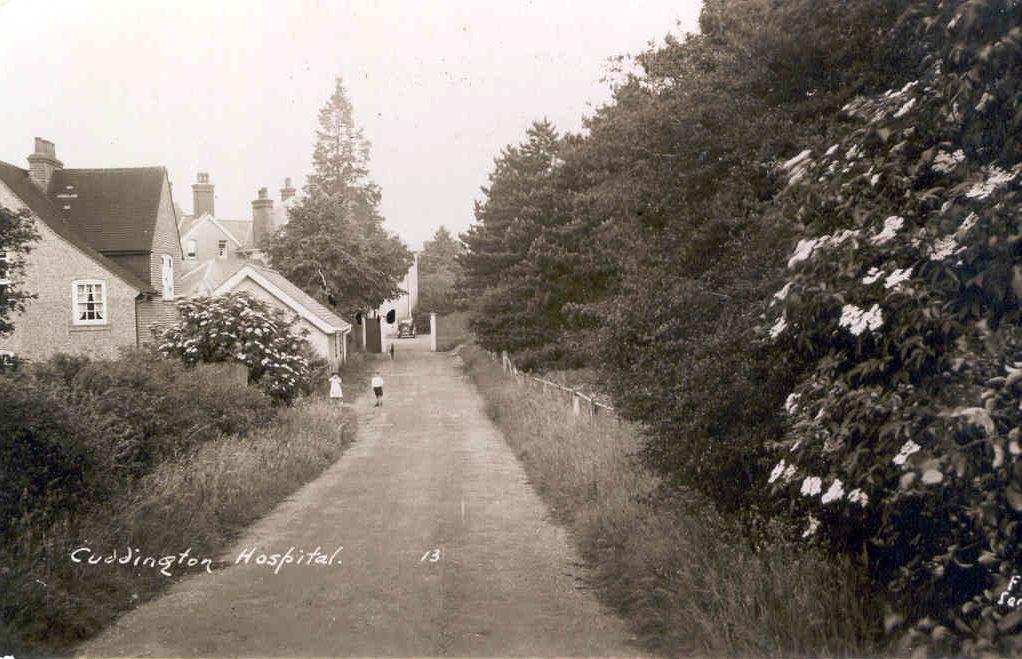 Old postcard of Cuddington Hospital (1910s)
Image courtesy of Bourne Hall Museum
Margaret died on 3 February 2009 in Maidenhead, Berkshire.
The other Mitchells
As I said earlier, Barbara Mitchell had all her remaining family in tow when she came to Epsom, so we’ll have a quick look at them.
Mother was Ruby (Robina) Margaret, who lived at 22 River Way, Ewell, and died on 27 February 1944. There were two other daughters, being the Isobel Margaret who married at St Martin’s in 1931 and Ruby Mary, known as Molly.
Isobel’s husband, Ivor Eastaway Thomas, was the son of Theodore (later Sir Theodore) Eastaway Thomas, who was not only an important engineer in the public transport sphere but also a brother of the poet Edward Thomas, probably best remembered for Adlestrop. Ivor worked for the BBC. Isobel sadly died on 24 October 1945.
Ruby Mary married someone I’ve already met on the archeologic dig for information: this was James Kingdon Carless (latterly a quantity surveyor), who was one of the Richmond, Surrey family that Barbara was visiting in the 1921 census. His sister, Lucy, was also there and she was an assistant mistress at St Paul’s School. Ruby Junior, James and their children were part of the 22 River Way household. Ruby died on 31 August 1986.
Linda Jackson 2023