
THE LONGMANS
Publishers
Introduction
We shall briefly explain the distant history of the Longman family in publishing, dating back to 1724, just to establish who these people were. Although the imprint no longer exists in its original form, it still has a presence as part of Pearson plc, specialising in educational material, primarily teaching of the English language. So, the name, in publishing terms, is fast approaching its 300th anniversary.
 Pearson Longman Logo
Via Wikipedia
I vaguely remember seeing/having mainly educational books published by Longman but, generally speaking, you rarely notice the name of a publisher unless it appears large on the front cover: however, without publishers there would have been no books and artistic prints would never have seen the light of day. The firm was involved in many classic works over the years: their longevity and reputation was such that the eminent historian, Asa Briggs, wrote a whole history of the Longman business, covering the period from 1724-1990.
There was a much under-rated artist, called William Daniell, who worked in collaboration with his uncle, Thomas Daniell, and together they travelled far afield drawing, painting and making aquatints. Their great collaborative work was entitled Oriental Scenery and, if you consider the era of publication (1795-1808 in this instance), it was a Herculean task. William was born very near to our area, in Kingston upon Thames, and his father was a bricklayer who also ran a pub in Chertsey: had it not been for the fact that Mr Daniell Senior died when William was just a boy, then who knows what would have happened, but, as it turned out, he was taken under the wing of his uncle and the rest is a small slice of British art history. Indeed, William became a Royal Academician in 1822 and worked constantly at his art until he died in 1837. The point of mentioning all this is that the Longman company printed and published much of William’s work (Oriental Scenery, for example, was published in six parts and cost £210 for the lot, which would be close to £20,000 in today’s terms – it was very successful, especially as quite a few copies were sold to the well-heeled East India Company).
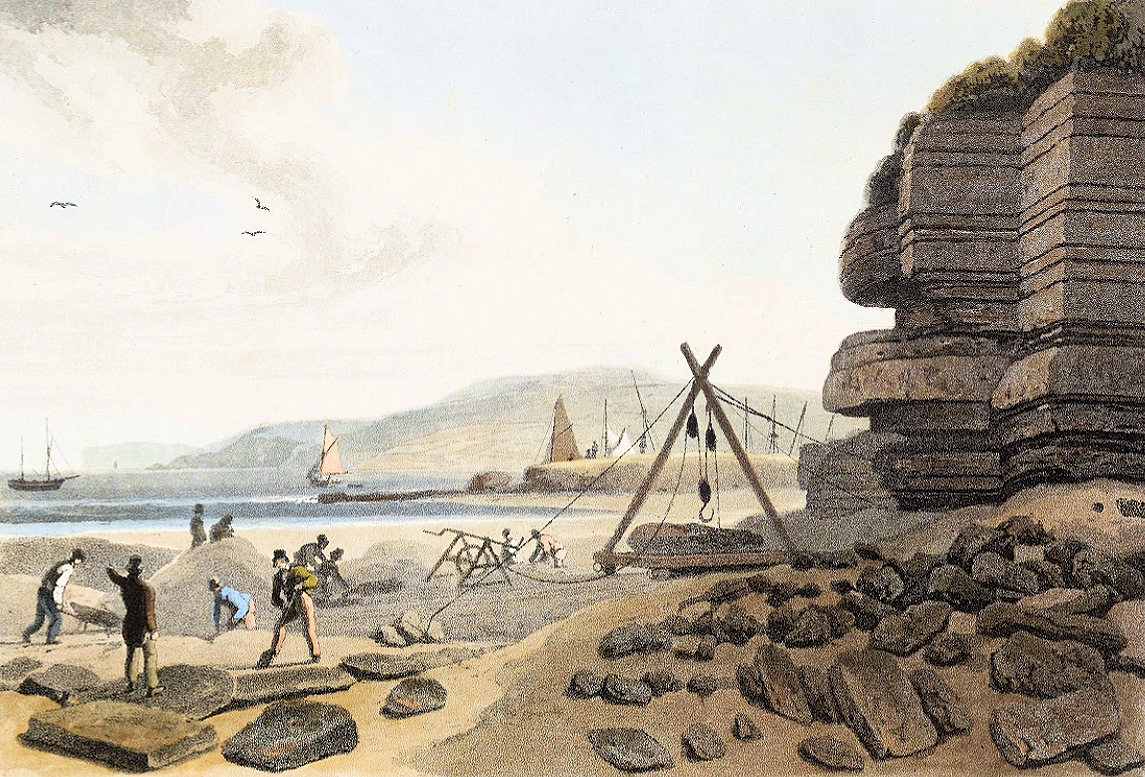 Black Marble Quarry, Red Wharf Bay, near Anglesey, 1815
Aquatint drawn and engraved by William Daniell.
Published by Daniell and Messrs Longman & Co, Paternoster Row, London
And here is another Longman production.
Frontispiece – Lindisfarn, 1814.
From The Border Antiquities of England and Scotland, Vol. II,
by Walter Scott, Esq. [Longman & Co., London, 1814] Artist: John Greig.
Maybe publishers don’t seem that exciting today, but the Longmans constituted a highly distinguished dynasty – no pulp fiction there. One of the main ‘players’, George Henry Longman, lived in West Hill House, Epsom, from about 1891 until the 1900s. The end-date isn’t certain, but I think he retained the freehold of the house and land for some time after he actually resided there. He seems to have been slightly absent towards the end of the period, because he was ‘c/o the Hon Constance Kerr at Kensington Palace’ in electoral registers.
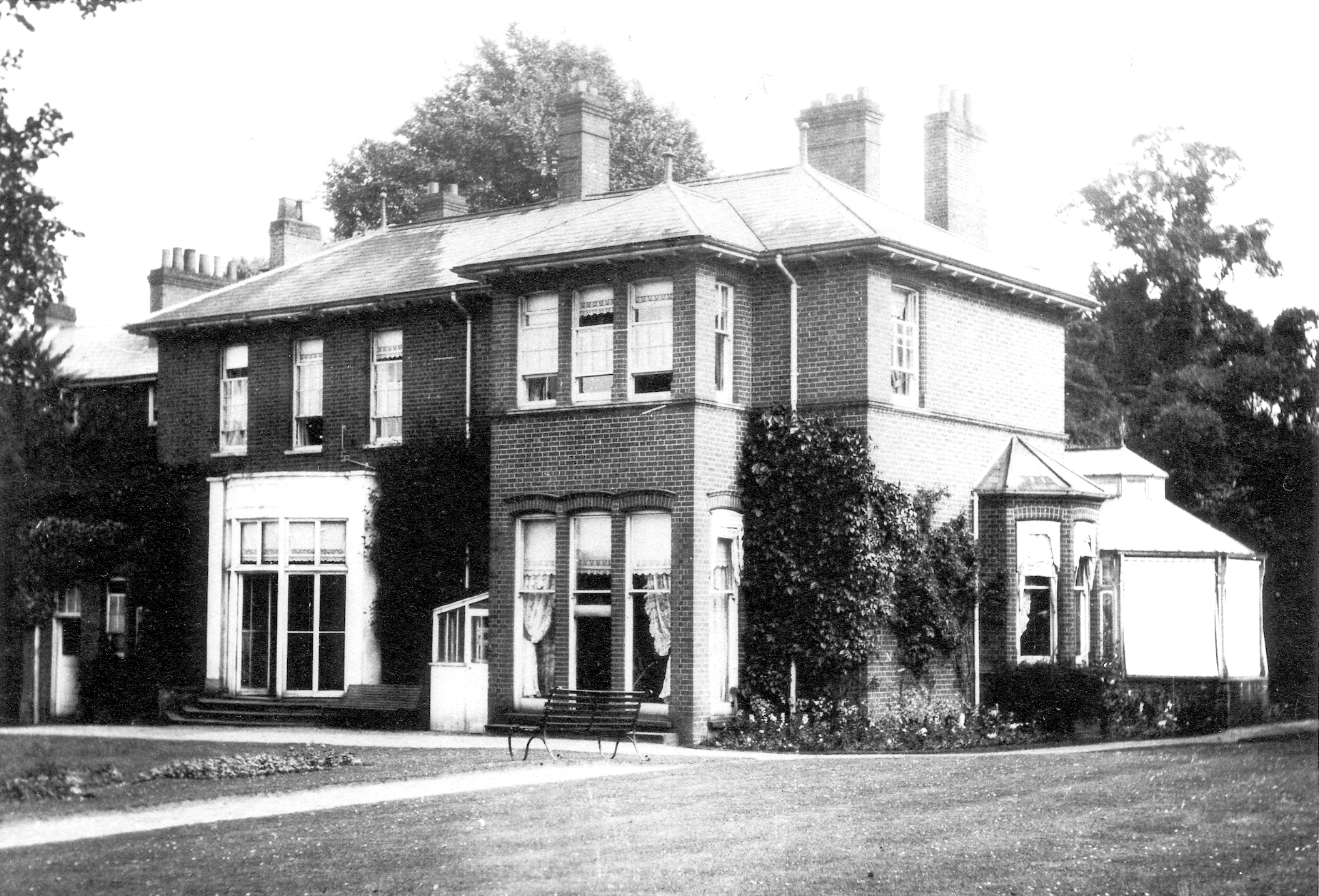 West Hill House c.1908
Image Source Epsom & Ewell Local & Family History Centre
Constance Kerr was George’s sister-in-law and she had been a maid-in-waiting to Queen Victoria, but surrendered that position in 1886 because of ill health. ‘Maids of honour are in waiting for 12 weeks in each year. The salary is £300 a year (approximately £42,000 in today’s terms) but the dress expenses are heavy.’ Constance’s ill health ‘retirement’ is fairly odd, because at that time she was only in her twenties and she lived on until 1940.
Kerr digression over, temporarily, we shall now concentrate on George Henry Longman, but we do need to record his ‘pedigree’, which is soon accomplished via a truncated family tree. (Note: The Longman business has gone through many names/partnerships over the years, which are of little relevance here, so we shall concentrate on the family.) I show this tree solely to pave the way for a photograph of the main publishing figures.
The Dynasty
Ezekiel Longman, died 1708
‘Gentleman of Bristol’
Thomas Longman, son of Ezekiel, died 1755
Founder of the Longman publishing business in 1724
 Thomas Longman, founder of the business
Image source: Wikipedia via Archive.org
Thomas Longman (nephew of the founder), died 1797
Thomas Norton Longman (son of the above), died 1842
Thomas Longman, died 1879
William Longman, died 1877
(sons of Thomas Norton Longman)
George Henry Longman, son of Thomas above
(Sir) Hubert Harry Longman, son of William above
Charles James Longman, son of William above
William Longman, son of Charles James above
Robert Guy Longman, son of George Henry above
That’s as far as we need to go for now, so here is the photo.
 The Longman publishing dynasty in 1924
L to R: Sir Hubert Harry Longman, William Longman, Charles James Longman,
Robert Guy Longman, John William Allen*, George Henry Longman
Image source National Portrait Gallery NPG x29998
*Mr Allen was a school teacher who joined the firm in 1884 and enhanced the educational side of the business, particularly in overseas markets.
George Henry Longman
George was the son of Thomas Longman (died 1879) and Georgiana Townsend Longman (née Bates, died 1890). Georgiana was born in what is now Sri Lanka and her father appears to have been a Major in the Royal Artillery, or possibly the Royal Marines. Her elder brother, Henry, also saw much overseas service in the Army and became General Sir Henry Bates KCB.
Born in 1852 in Farnborough, Hampshire, George was educated at Eton College and Trinity College, Cambridge and was noted for his cricketing prowess. This was, of course, in the days of amateurs or ‘gentlemen’. Subsequently he played for Hampshire, although the county was in a poor (cricketing) state at the time, and he took part in a handful of matches for MCC. George’s career statistics are not exactly stellar, but they most probably reflect the then standard of cricket in general and the teams he played for. Over 68 allegedly first-class matches he had a batting average of 20.57 and took 3 wickets.
Eton School Cricket XI
The Eton school cricket team photographed prior to their annual fixture against
Harrow school, played at Lord’s cricket ground in St John’s Wood, London
on the 9th July 1869. George Longman is seated front left.
Note: Next to George (seated front centre) is FW Rhodes, brother of Cecil Rhodes of Rhodesia fame/notoriety
In 1880, at Church Crookham, George married Mary Frances Kerr (born 1856 and a sister of the aforementioned Hon. Constance Kerr of Kensington Palace). Mary’s father was a naval man, Lord Frederic Herbert Kerr, a son of the 6th Marquess of Lothian. Lord Frederic ultimately became an Admiral. His wife was Emily Sophia Maitland, a daughter of General Sir Peregrine Maitland.
 Lord and Lady Frederic Kerr, 1860s
Image source: Auckland Libraries Heritage Collections 1653-ALB323-20-1
George and Mary had three children, who were Henry Kerr (born 1881), Robert Guy (1882) and Margaret Frances (1889).
Returning to George, from 1900 until 1904 he was master of the Surrey Union Foxhounds and in 1926 he became president of Surrey County Cricket Club (they weren’t doing very well at that point, but came into their own during the 1950s). From 1929 he was Honorary Treasurer of the Club, a position he retained until his death in 1938. Mary died in 1941.
Henry Kerr Longman
Henry followed his father to Eton and Trinity, Cambridge, and was also a keen cricketer. His batting average from 32 first-class matches was slightly inferior (20.5) to that of his father, but he did have a highest score of 150, whereas George never quite scored a century. In 1911 Henry was living in Malton, Yorkshire, described as pupil to a land agent. However, whatever his original career intentions might have been, he ended up as a stockbroker, which may have had something to do with his father-in-law, who was a stock jobber.
Henry had married Marjorie Amy Cecil Russell in 1909 and there were two children, being Arthur Valentine Longman (born 1910 York) and Mark Frederic Kerr Longman (born 1916 Gerrards Cross). Arthur became a journalist and is not really involved in the particular strands of this narrative, but Mark is relevant and we shall come to him in due course.
During WW1 Henry was a Captain/Major in the Gordon Highlanders. I am not entirely clear what he did but he served in France at some point and in the 1918 New Year Honours List was awarded both the DSO and MC.
 Captain Henry Kerr Longman DSO MC, Gordon Highlanders
Image Source livesofthefirstworldwar.iwm.org.uk
Henry ultimately lived in Pyrford and died in 1958, his wife having predeceased him by just a few weeks.
Robert Guy Longman
In 1891 both Robert and his elder brother, Henry, were pupils at Upland House School. Robert then moved on to Eton. I don’t know if he also went to Cambridge University and I have no evidence that he was a cricketer, but he was in France during WW1 and served as a Captain in the Gordon Highlanders.
In 1915 he married Dorothy Marriott Fletcher, daughter of barrister John Martineau Fletcher, who had recently died. They had one son, Thomas Michael Longman (1916-78). Dorothy died in 1940 and In 1948 Robert married Madeleine Louise Reynolds, who seems to have been his next-door neighbour in Kensington at the time. Eventually the couple retired to Salisbury, Wiltshire, where Robert died in 1971. Madeleine, who was many years younger than Robert, subsequently remarried.
Margaret Frances Longman
I cannot find much about Margaret and I rather think that she remained with her mother until the latter’s death. Margaret never married and died in 1975, then living in London NW11.
Mark Frederic Kerr Longman
As mentioned earlier, Mark was the younger son of Henry Kerr Longman and became chairman of the Longman Group Ltd. He was the last Longman to be associated with the company.
Mark Longman (right), pictured with architect Frederick Gibberd
discussing the design for the new Longman company offices in
Harlow, Essex, 28 July 1966.
I have already touched on connections with the Royal Family and there was another one here. See if you can spot anyone you recognise in this photo.
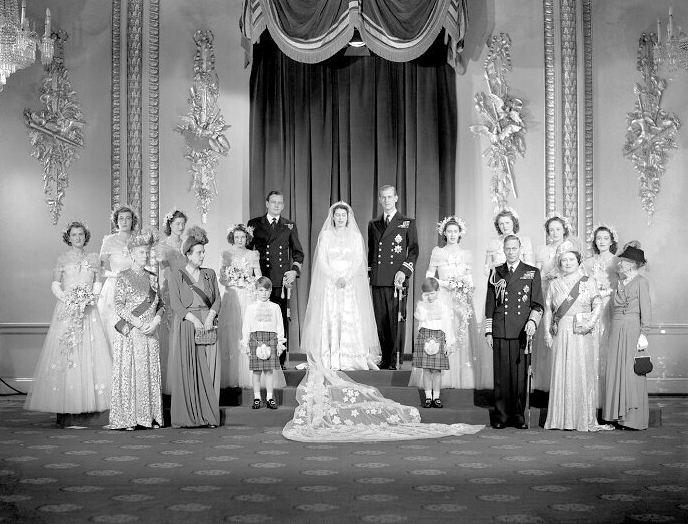 The wedding of Princess Elizabeth and Prince Philip
by Bassano Ltd half-plate film negative, 20 November 1947
© National Portrait Gallery, London NPG x158910
Apart from the main characters, you will see a row of eight bridesmaids at the back of the picture, including the Princesses Margaret and Alexandra. The bridesmaid standing second from right is Lady Elizabeth Lambart (born 1924), daughter of the 10th Earl of Cavan. Lady Elizabeth had been a childhood playmate of Princess Elizabeth and a fellow member of the Buckingham Palace Girl Guide Troop.
On 20 July 1949 Lady Elizabeth married Mark Longman at St Peter’s Church, Eaton Square and Queen Elizabeth (later the Queen Mother) was the star guest.
Mark Longman died in 1972, but his wife remained a close friend of the present Queen until her death in 2016. At the time of writing, just two of the eight bridesmaids survive – Princess Alexandra and Lady Pamela Hicks.
Linda Jackson 2022