
THE EMBLETONS OF EWELL
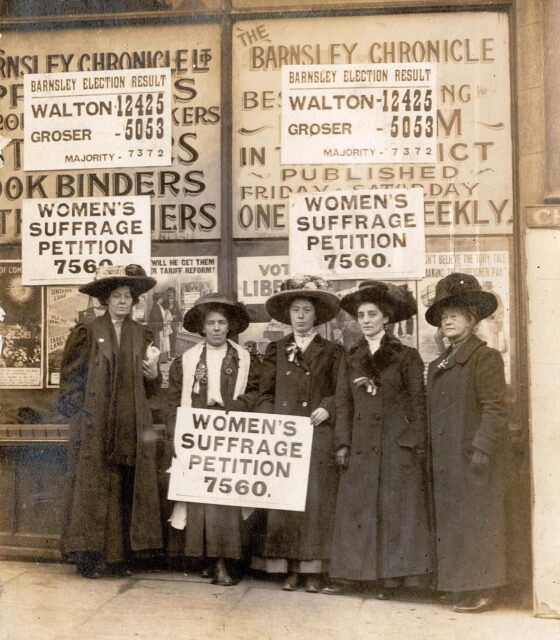
Campaigners for Women’s Suffrage in Barnsley (20 Jan 1910)
Miss A Embleton, Miss O Royston, Miss C Wray, Miss M Fielden and Miss E Ford*
Image source: LSE Library via flickr
*Presumably, the names run from left to right, in which case Alice Embleton
is on the far left; her partner, Celia Wray, is in the centre either way
Introduction
There are many families who appear together regularly in censuses for a particular place, but the descriptions (jobs etc) don’t necessarily reveal anything much about them. Similarly, gravestones can be uninformative.
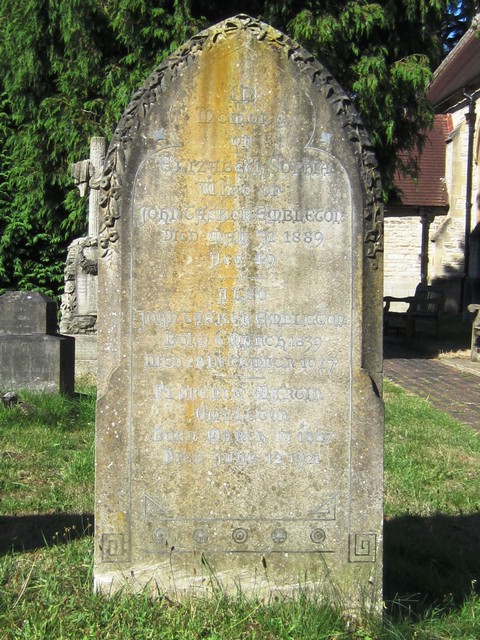
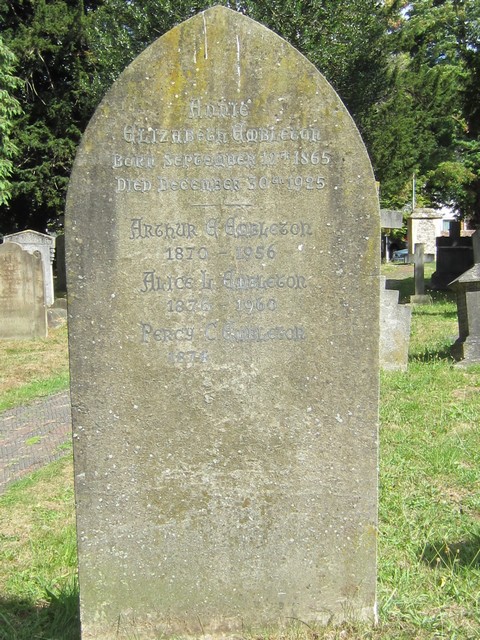
(see below for inscriptions)
I don’t know how many Embletons are actually in the plot at St Mary’s, Ewell (some of the inscriptions may just be memorials ), but the parents certainly are. These are the inscriptions.
Front
In memory of Elizabeth Sophia wife of John Tasker Embleton died May 31 1889 age 49
Also John Tasker Embleton born 6 March 1839 died 28 December 1917
Florence Martin Embleton born March 10th 1867 died June 12th 1921
Back
Annie Elizabeth Embleton born September 12th 1865, died December 30th 1925
Arthur E. Embleton 1870 – 1956
Alice L. Embleton 1876 – 1960
Percy C. Embleton 1874 -1963
Oddly, this family encapsulates a couple of topics that we’ve featured quite extensively on the website – engraving and suffrage, so we’ll start with the engraver, Mr John Tasker Embleton.
John Tasker Embleton
A publication entitled ‘Illustrated London’, dating from 1893, contains the following entry.
|
Close upon a century and a half has now elapsed since the first formation of the above firm, it having been inaugurated in 1752 by a Mr. Spencer, who was then the leading stone, seal, and signet engraver in London, and he was also admitted to be the best heraldic engraver at that time. Thirty years later the business was handed over to Mr. Mutlow, who certainly added to the well – deserved fame of the house. The chapter upon “Knighthood” in the ” Encyclopædia Londoniensis,” published in 1812, was entrusted to Mr. Mutlow, and all the beautiful plates of heraldry in it were executed by him , as his name on the plates undoubtedly testifies. In 1817 the business was transferred to his son , Joseph Mutlow , who also added to the great and renowned character of this house by having the honour of appointment of Engraver to His Majesty King George IV, in 1820 . (These letters of appointment are still in the possession of the present proprietor .) The finest plates in the “Encyclopædia Heraldica ” edited by Berry , published in 1820, were engraved by Joseph Mutlow , and without doubt there is no heraldic work in existence equal to the truth and beauty of these plates . In 1862 the business was succeeded to by Mr. J. Luff, who for many long years past had managed and executed the work of the firm . Mr. Luff was considered by all the practical engravers of London in his day, to be unrivalled as a writing engraver and heraldic authority; in 1883 he was succeeded by his own apprentice, J.T. Embleton, an engraver of recognised ability in every branch of engraving, heraldry, and die-sinking. This business was originally started and carried on in York Street, Covent Garden, until 1868, when it was transferred by Mr. Luff to Henrietta Street, Covent Garden , and upon this lease terminating in 1889, Mr. Embleton removed the business to the present large and commodious premises — 8, Garrick Street, Covent Garden. The ground floor is well furnished with a thoroughly representative stock of general, commercial, legal, and fancy stationery. This, however, is but a subsidiary part of the business, for the remainder of the premises is occupied by a well trained staff of engravers and printers, all directly working under the personal supervision of the proprietor, who himself works practically at the business, and is ably assisted by his two rising and talented sons. In the copperplate engraving and printing department the firm stands practically unrivalled, a circumstance that is duly attested by the fact that they execute work for most of the leading West End houses in the trade. In each and every department, however, the work done is exclusively of the highest order; indeed, the business connections of this house are among the oldest and most respected of the metropolitan, provincial, and foreign houses in the world, and it has the honour to number amongst its customers more than one dating from 1792, and many more date fifty years back. Upon the creation and institution of the Royal Academy of Arts, at Somerset House, Messrs. Mutlow were appointed Engravers to the Academy, and during the whole of the past century this business connection has never been severed, and they still have the honour to be entrusted with work for the Royal Academy. Mr. Embleton has made a lifelong study of antique writing and lettering, which is especially valuable at the present time, when there is so much demand for correct and genuine reproductions of old art work. |
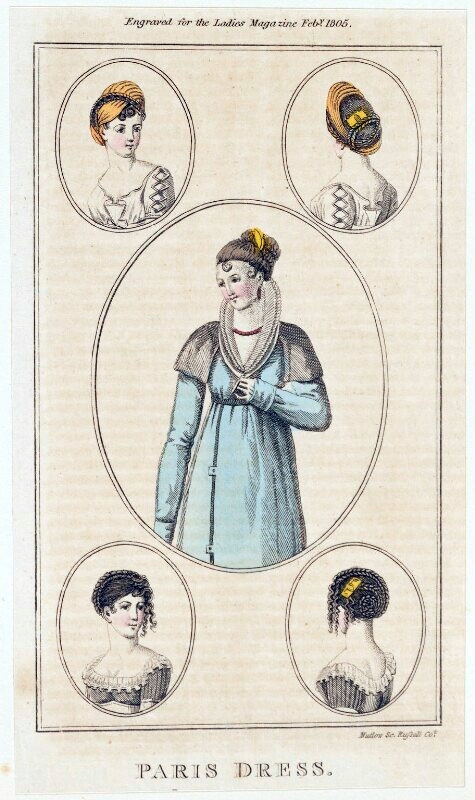
Before we proceed with the Embletons, I should say that it’s been tricky to find examples of works produced by anyone mentioned in the ‘puff piece’ above. It seems that Henry Mutlow (the man who took over Mr Spencer’s business) could turn his artistic hand to anything, ranging from banknotes and illustrations of the plumbing of water closets to etchings of the likes of King Charles I and Oliver Cromwell, but, as they’re fairly turgid, here’s one of his fluffier illustrations.
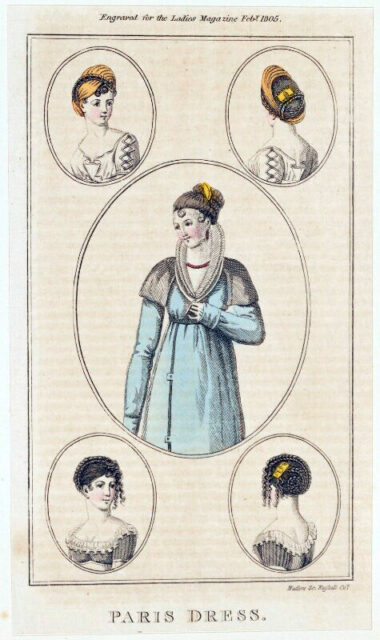 ‘Paris Dress’, February 1805
by Henry Mutlow, published in The Lady’s Magazine
hand-coloured etching and line-engraving, published February 1805
NPG D47493 © National Portrait Gallery, London
The British Museum has a trade card for Mr Embleton’s business.
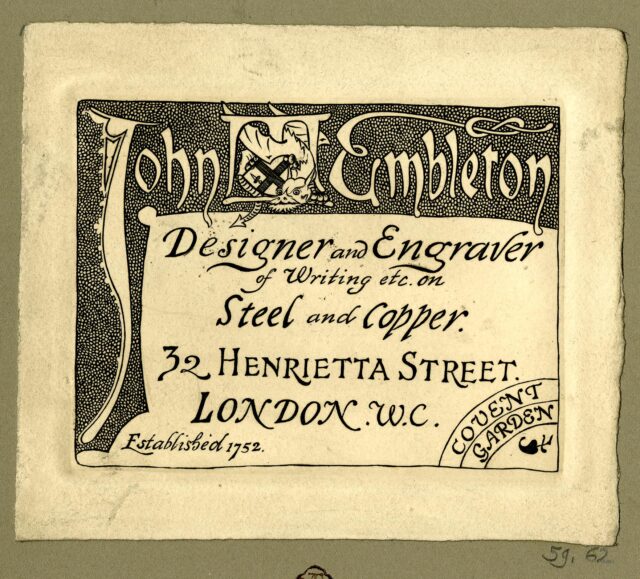 Trade-card of John Embleton, engraver
© The Trustees of the British Museum (CC BY-NC-SA 4.0)
The catalogue entry suggests that this card refers to a John M Embleton, because of the decorative ‘M’ between the names, but, as far as I can tell, there never was a John M, so it’s either a very elaborate ‘T’ or refers to something else entirely. However, the card does date from the 1890s, so this is almost certainly our man.
John T Embleton was born in Brixton on 6 March 1839 to Cuthbert, a gardener, and his wife Rebecca. The latter died in 1849, leaving Cuthbert with several of their large brood still on his hands. John was in due course apprenticed to an engraver and, as we saw earlier, he ended up with his own London firm.
In 1864 John had married Elizabeth Sophia Martin and their five children together were Annie Elizabeth, Florence Martin, Arthur Edward, Percy Cuthbert and Alice Laura. Elizabeth died in 1889, leaving John in much the same situation as his father. The family home was in Green Man Street, Ewell, but by 1911 those remaining at home (Annie, Arthur and Percy) had moved to Beaumont, Epsom Road, Ewell. Arthur was in stationery, printing and engraving too and Percy had been, but was now a motor car accessory dealer. John died in 1917.
Alice Laura and Florence Martin Embleton
Returning to the 1911 census, both Alice and Florence were ‘missing‘ and we shall deal with the latter’s absence first. She was visiting a temperance family in Scarborough, which is mundane enough, but it’s her occupation that’s interesting – ‘Organising Secretary to Lady Carlisle’ and ‘temperance worker’. Lady Carlisle was Rosalind Frances Howard, Countess Carlisle, and rather than attempting to explain her myriad and sometimes confusing activities, I refer you to her Wikipedia entry. Basically, the Countess was staunchly temperance and an advocate for women’s rights (a suffragist rather than a suffragette, since she didn’t approve of some of the antics of Mrs Pankhurst and her followers, such as violence). If we then go back to the 1901 census, Florence was visiting at Castle Howard (near York), the overwhelmingly stately home of the Carlisle branch of the Howard family, where the Countess was in residence at the time; Florence was described as a ‘political agent’. Oddly, both Florence and Countess Carlisle died in the summer of 1921. Florence expired at the Royal Homeopathic Hospital, Great Ormond Street, on 12 June 1921 and the Countess on 12 August. The hospital is still operational, next door to the more famous Great Ormond Street Hospital. I imagine that Florence was suffering from a terminal illness and resorted to alternative medicine.
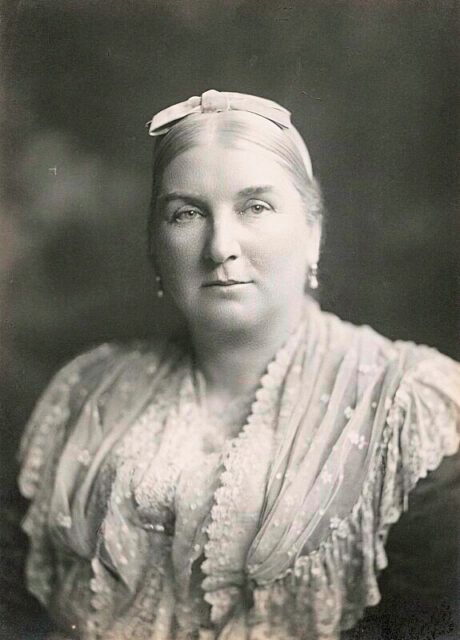 Rosalind Frances (née Stanley), Countess of Carlisle
by H. Walter Barnett
bromide print on card mount, 1900s
NPG x200108 © National Portrait Gallery, London
So, the other missing person in 1911 was Alice Laura, the youngest child of the family. Alice was, for her time, a scientific star in the making – and you will know that in the Victorian era women had a very hard time entering the professions or getting qualifications, even if they were disposed to attempt it. Elizabeth Garrett Anderson, for example, only qualified as a doctor in the mid-1860s because the Society of Apothecaries had a charter which didn’t discriminate against women, but, as soon as Anderson had gained her licence, the Society changed its rules and slammed the door shut on any more women. Sophia Jex-Blake, a colleague of Anderson’s, was just too late to exploit the loophole, but she persevered and became one of the ‘Edinburgh Seven’, who finally forced the University of Edinburgh into accepting them.
The 1911 version of Alice was up in Barnsley, allegedly visiting a family comprising 67 year old Charles Wray and his daughter Celia, originally Cecilia, who was an architect (whether qualified or not, I don’t know). The Wray occupations, presumably written by Celia, were shown as ‘Getting votes for those who pay the piper’ and ‘Getting votes for women’. The official who gathered up the forms was having none of that, crossed out the contentious words and replaced them, in red ink, with ‘Pig dealer and Alderman of Barnsley Borough Council’ for Mr Wray and ‘No occupation, private means’ for Celia. Alice was described as being in cancer research.
 Thought to be Alice Embleton
Detail from Campaigners for Women’s Suffrage in Barnsley shown above.
We need to go back, as Alice wasn’t originally in cancer research – in 1901, then aged 23, she had been a scientific research student, based at Cambridge University, doing pioneering work in researching pesticides to increase crop production. Sue James, a Sutton teacher and researcher, has already done the hard yards in investigating the earlier part of Alice’s life and the fascinating result appears on a guest blog for Cardiff University Archives. Something must have happened between 1901 and 1911, and we don‘t know exactly what that was, but it could have been a combination of things. For example, Alice’s suffrage beliefs might have overtaken the scientific path she was on, or perhaps she met /was influenced by Celia, but in any event she didn’t become a feted scientific superstar.
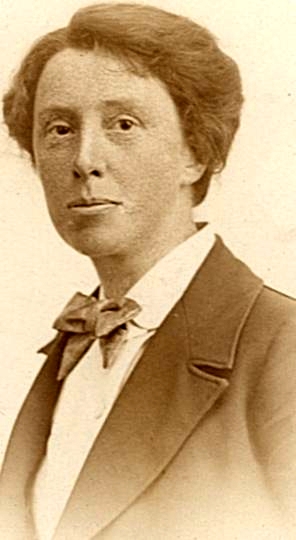 Celia Wray, May 1914
Source LSE Library via Flickr
‘The Foosack League’
This secretive organisation/group seems to have been a lesbian society. Alice Embleton was a member, under the pseudonym of ‘Alick’, as was Vera ‘Jack’ Holme, originally an actress. Vera was well-known for cross-dressing and, when not acting or organising suffrage activities, she doubled as the Pankhursts’ chauffeur.
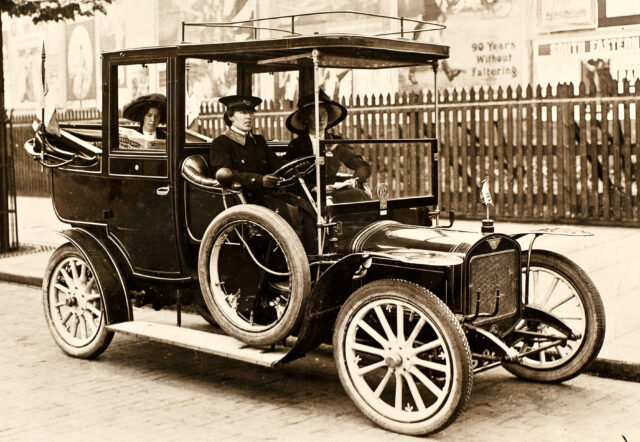 Vera Holme, chauffeur to the WSPU (The Women’s Social and Political Union) c.1910
Source LSE Library via Flickr
Unless you’re an expert on the suffrage movement, which I’m not, it’s too easy to regard them as forthright, militant, maybe lesbian, women who went around protesting, chaining themselves to railings, setting fire to property etc etc. However, regardless of whether they fitted that stereotype or not, many of them did extraordinary and dangerous work for the good of others.
During WW1 Vera Holme joined the Scottish Women’s Hospitals for Foreign Services (SWH), a topic we have already covered in our article on Cicely Marion Ellis. Unlike Cicely, Vera drove ambulances in Serbia and Russia – she was captured and imprisoned in Austria. Subsequently she was decorated by both Serbia and Russia. After the war she returned to Serbia with Evelina Haverfield to set up an orphanage.
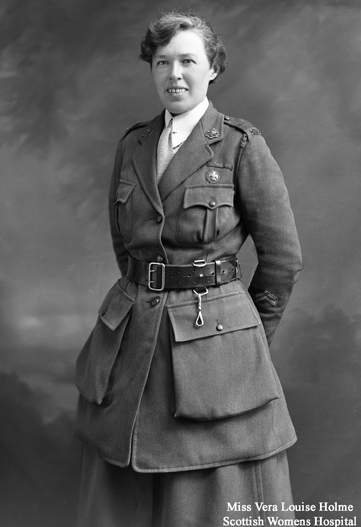 Vera in her Scottish Women’s Hospital uniform 11 July 1918
Image courtesy of Clive Gilbert
As for Alice and Celia, we don’t really know much about their life together and exactly what they did in the suffrage cause or, indeed, in other spheres, but they remained together as a couple, living in Saxmundham, Suffolk, until Celia’s death in 1954. Alice then moved to Bradfield, Essex and died on 14 March 1960, leaving effects of more than £10,000.
Linda Jackson 2021
From a suggestion by David Brooks (Bourne Hall Museum)