
Sir Robert Henry Davis (1870 – 1965)
Inventor of diving and breathing apparatus
 Sir Robert Davis 1932
Image Source Illustrated London News
Sir Robert Davis started work in 1882 at age 11 and only finished working for the same firm in 1964 some 82 years later! During that time he invented and developed many breathing and escape devices that made dangerous working conditions safer and saved a great many lives. He lived for many years, until his death, in ‘San Toi’, Jackson Close, Epsom.
 A cigarette card showing a typical self-contained ‘Hard Hat’ Diving Suit
His obituary was published in The Times 31 March 1965:
SIR ROBERT DAVIS
DIVING AND ESCAPE APPARATUS
Sir Robert Henry Davis. the inventor of numerous breathing, diving and escape apparatuses, and life president of Siebe, Gorman and Co., died at Epsom on March 29, 1965. He was 94.
He spent the whole of his working life with the firm, and went to the office regularly until May 1964.
When a presentation was made to Davis to commemorate the completion of 50 years’ service, in 1932, it was recorded that he had “devoted his life to study of the problems confronting those who are called upon to work in irrespirable atmospheres, and had spent thousands of pounds in research and experimental work in connexion with deep-sea diving, high-altitude flying, mine research work, &c.”
Robert Henry Davis was born in London on June 6, 1870, the eldest son of the late Robert Davis, detective in the City police. When he was 11 he obtained employment in the Siebe, Gorman works in Lambeth. By a lucky chance his neat handwriting was noticed by Mr. Gorman, and he was given a place in the office. He studied hard to complete his education after office hours. While still in his twenties he was promoted assistant manager. In 1900 he married Margaret. daughter of the late William Tyrrell, of Kildare. She died in 1952. Mr. Gorman’s wedding present to his gifted assistant was a house and a gold watch.
With an established position and a free hand, he became successively general manager, managing director, and governing director. Davis’s inventive, yet practical. mind concentrated entirely in developing and extending the diving and other safety apparatuses in the field in which his firm had long specialized. For use in connexion with deep sea diving, Davis and Professor Leonard Hill designed a special diving bell which comprised also a decompression chamber. Davis also invented an altitude apparatus for supplying oxygen to airmen flying in rarefied atmospheres. He originated a heated dress for flying in high altitudes.
GAS ATTACKS
When in April. 1915. the country was roused by news of the first German gas attack and the sufferings of our troops. Davis immediately devised and manufactured his emergency ” respirator,” known as the stocking skene or veil mask. He set to work his family and relations and anybody else he could bring in: the women of Lambeth. under his direction, turned out great quantities, working in their own homes, and within 48 hours the first consignment was sent off to France. Whether by accident or by design, the firm’s works received attention during a Zeppelin visit.
Davis was a member of the Admiralty Deep Sea Diving Committee, and in 1933 the deep diving decompression tables using oxygen were completed, which for the first time allowed a safe ascent from 300ft.
He worked on these tables with Professor J. S. Haldane. Sir Leonard Hill. and Captain G. C. Damant, the leading naval diving expert. They have been used by the Royal Navy ever since, with revision in 1962.
The Davis Submerged Escape Apparatus was first used in 1929. and was standard equipment until replaced by the BIBS (Built In Breathing System) which the firm produced in 1951 and which is now in use in all British submarines.
 The Davis 1929 Submarine Escape Apparatus
Image Source: The Illustrated London News 30 Nov 1929
In 1939, after the sinking of the submarine Thetis. Davis was appointed a member of the Dunbar Nasmith Committee to investigate causes.
The Siebe, Gorman works in Westminster Bridge Road were bombed at the beginning of the Second World War. and the firm moved to its present site at Chessington.
DIVING UNIT
There, the extensive experimental facilities for diving were put at the disposal of the Royal Navy and the Admiralty Experimental Diving Unit. Davis worked with Professor J. B. S. Haldane and Sir Leonard Hill on problems of the underwater physiology of operational divers.
Among the inventions to come out of the Chessington works were human torpedoes. midget submarines, human mine-sweepers, and anti-blast clothing.
Between 1946-48 he cooperated again With the Royal Navy on deep diving experiments, and the work culminated in the Navy’s record “hard hat” dive of 540ft. in 1948.
In 1906. Davis had perfected the first really practicable oxygen breathing apparatus or mining rescue which was accepted and is still in use in a modified form.
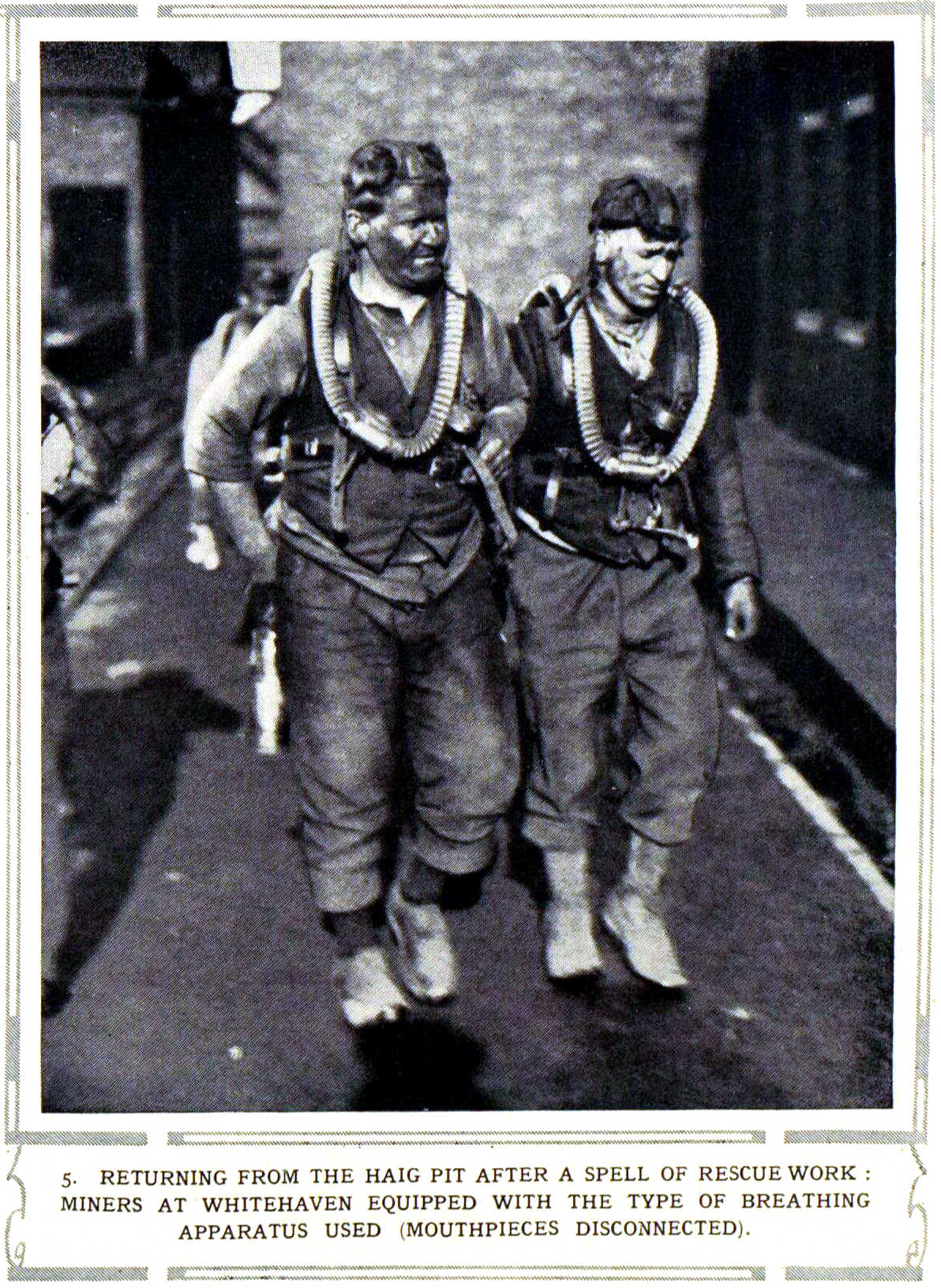 Mine Rescue Breathing Apparatus
Image source: Illustrated London News 07 Feb 1931
 A 1938 Gas Mask Advertisement
More recently the firm helped to pioneer the use of underwater television to investigate the sinking of the submarine Affray in 1951 and the Comet airliner disasters. In 1953 they provided the oxygen breathing apparatus for the successful British Everest expedition.
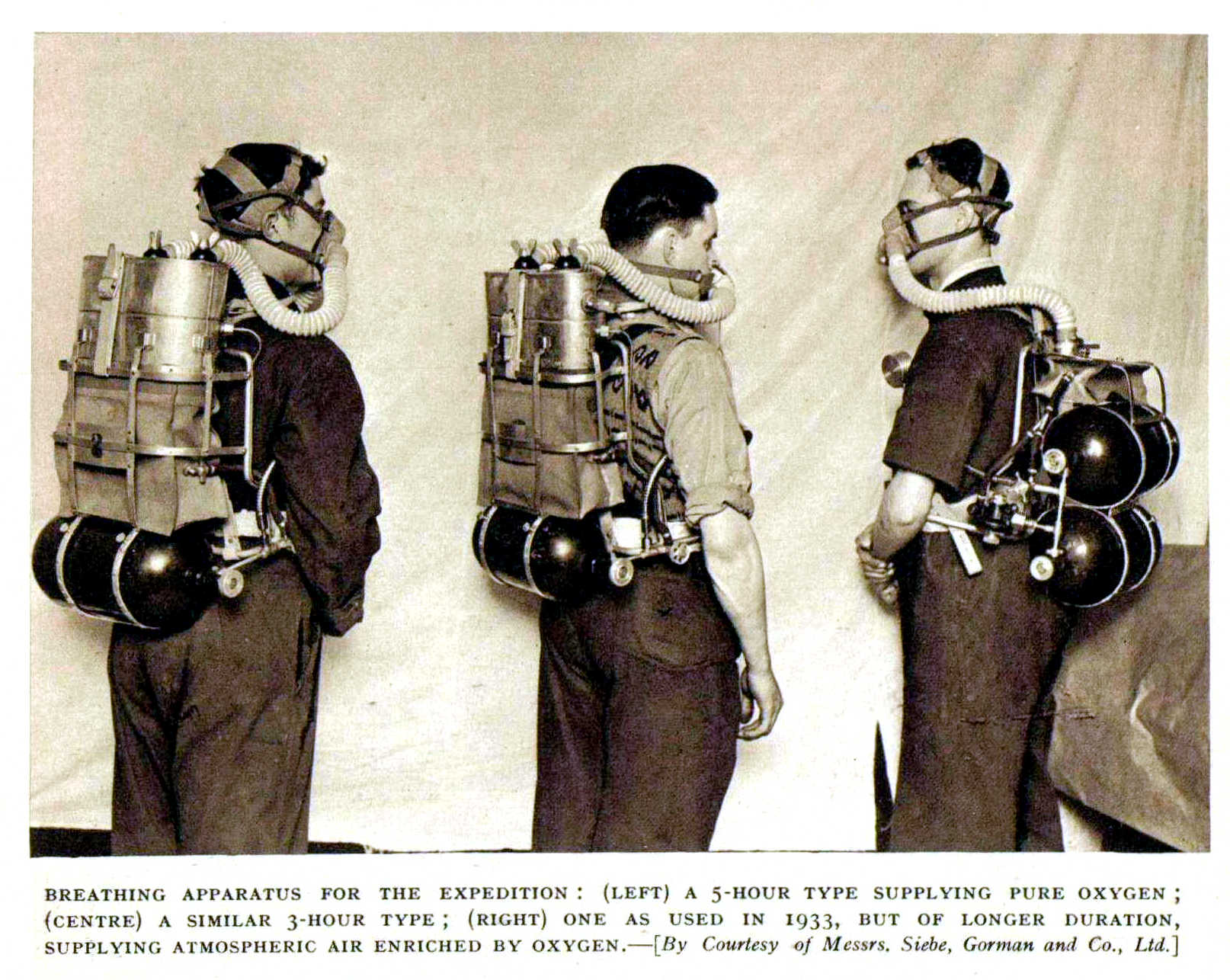 Breathing Apparatus used in the 1936 Everest Attempt
Image Source Illustrated London News 13 Jun 1936
Davis was appointed life president of Siebe, Gorman in 1959, when the Fairey group took over the company. It became a public company again in 1962.
For the past 50 years. Davis had been at the centre of developments in the knowledge and practice of diving. His intensive absorption in a field of experiment in which he was a supreme – though never a satisfied – expert, virtually excluded outside interests from his life. He found time, however, to write several manuals on diving. He was knighted in 1932.
 An Iron Lung used to treat Polio Patients
Drinker iron lung respirator, by Siebe Gorman and Co. Ltd., London, 1930s
Image Source: Science Museum (CC BY-NC-SA 4.0)
Hazel Ballan, one of our able band of volunteers has done a remarkable job finding additional facts about this interesting man.
- Robert was born on 6 Jun 1870, son of Robert and Ellen (neé Bohannon) Davis. (No baptism record found).
- His parents had married on 26 Jun 1869 in St Mary’s Church Addington, Surrey.
- On 31 Aug 1870 his father joined the Metropolitan Police in L Division (Lambeth).
- The 1871 census shows Robert living at 2 Blythe Terrace, Lambeth with his parents who were sharing the house with another policeman’s family.
- Robert was enrolled into Addington Street School, Lambeth on 20 Aug 1877.
- The 1881 census shows Robert was living at 2 Blythe Terrace, Lambeth with his parents and 4 siblings. Sharing the house with two other families.
- By the 1891 census Robert was living at 10 St Mary’s Street, Lambeth with his parents and 6 siblings.
- On the 18 Nov 1895 his father retired from the police and at that time the family home was recorded as 30 Torrington Square, London.
- In 1900 Robert married Margaret (Maggie) Tyrrell in Dublin, Ireland.
- The 1901 census shows that Robert & Margaret were living at 31 Victoria Avenue, Surbiton, with one servant.
- Later, on 30 Jul 1901, the couple celebrated the birth of a son, Robert William O’Gorman Davis, who was baptised on 18 Sep 1901 at the Holy Trinity Church, Claygate. (RWO Davis died 12 Mar 1988).
- On 29 Sep 1902 another son was born – Harry Tyrrell Davis. He was baptised without his middle name on 16 Nov 1902 at St Andrews Church Surbiton. (HT Davis died in 1970).
- Their third son William Eric Davis (names sometimes swapped round) was born on 31 Mar 1904. No baptism found. (Married 22 May 1933.)
- The couple’s first daughter, Phyllis Margaret Davis, was born in 1906 and registered in the Hendon district. No baptism found. (Married 3 Jun 1933 St Giles Church, Ashtead.)
- In 1909 the birth of twin daughters Molly and Norah Davis was recorded in the March quarter in the Hendon district. No baptisms found. Unfortunately, Norah died shortly after birth and this was also recorded in the same quarter (March 1909).
- By the 1911 census Robert and Margaret were living at 31 Victoria Avenue, Surbiton, with 5 children and 2 servants. Census records there was 1 child who had died (Norah).
- On 18 Feb 1914 another son, Richard James Davis, was born and registered in the Kingston district. He was baptised on 24 May 1914 at St Andrews Church Surbiton. The family address was recorded as 29 Lovelace Gardens.
- The 1939 Register shows Robert and Margaret living at ‘Wickham’ Oakfield Rd, Ashtead with sons Robert & William.
- Robert died on 29 Mar 1965 at his home San Toi, Jackson Close, Epsom.
- Probate on Robert’s estate was granted on 15 Jun 1965 with a stated value of £112,930.00
Hazel also points out that a short history of the Siebe Gorman company is available at siebe-gorman-heinke.pdf (tauchhistorie.eu) which also adds some useful information about Robert’s management style.
Peter Reed and Hazel Ballan 2021