
The Rt Hon BARON ASHLEY of STOKE CH (1922–2012)
(formerly JACK ASHLEY MP)
Disability rights campaigner and long-term Epsom resident

Lord (Jack) Ashley.
Photograph with thanks to Mirrorpix.
Beginnings
Jack Ashley was born in Widnes, Lancashire on 6 December 1922, the second of three children born to John and Isabella (née Bridge) who had married locally in Q4 1919. As the couple’s first (indeed, only) son, he was named John after his father. While formal records have him as such, he was always known as “Jack”.
The family (together with an aunt’s family – also of five – which made for extremely cramped conditions) lived in the rented 34 Wellington Street, Widnes. This was a decrepit “two up, two down” terraced house with a “privy” in the back yard and no bathroom. Jack’s father, like many of the neighbours, worked in one of the many ICI chemical plants that dominated the town. Life for the family was hard – and got even harder when, in early 1928, Jack’s father, now a night watchman, died of pneumonia aged only 34. (Jack was then aged 5.)
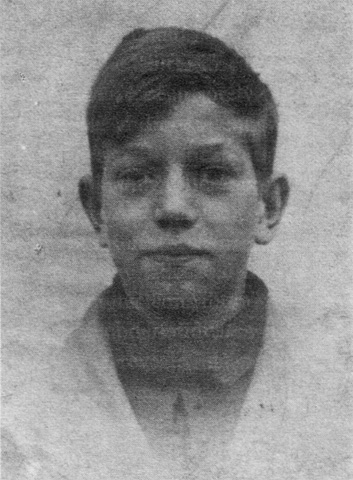
Jack, aged 6.
Photograph from his 1992 autobiography, “Acts of Defiance”, copyright acknowledged.
The family was Roman Catholic and Jack (who later lost his faith) attended St Patrick’s Elementary School where he was an above average but, thanks to the harsh regime, not an outstanding pupil. The school had a good reputation for sports, but Jack was not particularly sporty. Indeed, he was discouraged from swimming because of a perforated eardrum (following an earlier infection) – an ailment that seemed minor at the time. He did enjoy his music tuition, and became a choirboy at the adjacent St Patrick’s Church. In 1933, his widowed mother remarried and had another child.
First jobs
In December 1936, the 14 year old Jack left school. (Apart from financial imperatives, there was no question of his applying to the local non-Catholic grammar school.) The normal career path was to become a labourer in one of the many local plants, but Jack aspired to an office job and applied to ICI for one. While waiting, he took a labouring job in a more distant asbestos factory and was glad to be earning – although bus fares left modest profit out of the 12/3 (62p) weekly pay.
After a few weeks, ICI invited him for interview, and he accepted the subsequently offered job. On turning up for his first day in a collar and tie, he found the job was not in an office but as a labourer filling large glass carboys with acid. The work was hard and dangerous – and only slightly better paid than the asbestos factory.
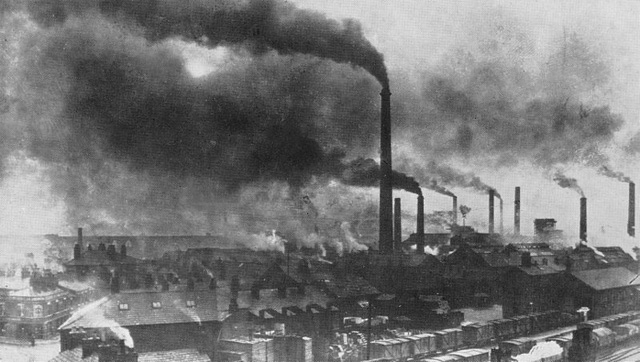
Industrial Widnes. This photograph (public domain, via Wikimedia Commons) was taken in
the late 19th Century, but conditions in the interwar years will not have been very different.

In 1939, and much to the consternation of his mother and (now-unemployed) stepfather, the 16 year-old Jack left ICI to look for better-paid employment. After a series of casual jobs, he landed a job in Thomas Bolton’s copper-smelting works, quite near the family’s Wellington Street home. The hard manual labour loading the furnaces made Jack physically very fit.
WW2 – brief Army service
In December 1940 – just over a year into WW2 and shortly after his 18th birthday – Jack was called up. He applied to join the RAF as an air gunner, but was rejected early in the selection process because he knew too little mathematics. Instead he joined the Army, and was assigned to the Service Corps. After less than a year, he was discharged on medical grounds: a slight difficulty with his hearing had worsened. Even though the long-perforated eardrum was repaired after his return to Widnes, the Army didn’t want him back, and Jack returned to work loading furnaces in the copper-smelting works.
The beginnings of activism
The war had increased demand for copper and brought more opportunities for overtime at Bolton’s. Jack – having previously been accepting of harsh management practices (perhaps helped by his harsh schooling) and with little thought of trade unionism – began to take offence at the way overtime was denied to those who had displeased the foreman in some way.
An emergency operation for appendicitis and convalescence then kept Jack off work for a month. Bolton’s refusal to give him a light job until he was fully fit for loading furnaces again was the last straw. When he did return to work – in his words “fit, broke and bitter” – it was with a determination to seek a better deal for the workers and with an armful of application forms for his fellows to join him in membership of the Chemical Workers trade union.
Jack’s initiative paid off: his fellow workers joined the union in droves. He was elected the local shop steward and then orchestrated a strike which yielded the desired improvements in pay and practices. The union activity got Jack recognised both locally and more widely. By 1944, the 22 year old was a new – and far the youngest – member of the union’s national executive committee.
Jack also exercised his new-found activism outside work, among other things campaigning for rent reductions for the near-derelict housing in his home street and for the Labour Party in the July 1945 General Election (which was a landslide for Clement Attlee’s reforming Labour government). He then stood in the November 1945 local elections and, just short of his 23rd birthday, was elected as a Labour councillor to the Widnes Town Council.
Further & higher education
Alongside all that, he continued his day job at the copper foundry. One day, during a meal break, he was reading a newspaper when he happened to see an advertisement for scholarships for working men to Ruskin College, Oxford. This was one of a number of those chance events that change a life. He applied to Ruskin and was accepted. In late 1946, he left his job at Boltons, gave up his official position in the union, resigned from Widnes Council and travelled to Oxford – a relatively short train ride, but to a different world.
The transition from manual to academic work was challenging, but the modestly-educated Jack buckled down and made great progress. By the end of the two year course, he decided to apply for a scholarship to Cambridge university, which he won.
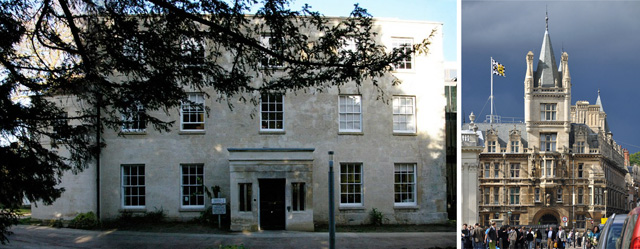
Left: Ruskin College, Oxford (Photograph via Wikimedia CC BY-SA 3.0)
Right: Gonville & Caius College, Cambridge (Photograph via Wikimedia, Public Domain)


Alongside his studies for an economics degree at Gonville & Caius College, he was active in the Cambridge University Labour Club – where his natural abilities (together with his experience – novel among his peers – as a Councillor) resulted in his being elected Chairman. (His opposite number in the University’s Conservative Club was Geoffrey Howe.) He joined the Cambridge Union Society and, in spite of wearing (out of financial necessity) a lounge suit rather than the standard evening dress, stood out in debates to the point where he was elected (with a comfortable majority) first as Vice-President and, the following year, unopposed as President – the first working class person to hold the post.
During his Presidential year, he was invited to go to the USA on a debating tour of universities. On his return, the Cambridge university students’ newspaper, Varsity, wanted an interview with him for an article about the trip. The person sent to interview him was Pauline Kay Crispin, a first year student from Girton College. While their natures and backgrounds were radically different, and there was quite a large age gap (the 18 year old Pauline was ten years Jack’s junior), they were instantly attracted to each other.
Marriage
Jack later admitted that he spent far too much of his final months at Cambridge either cycling over to Girton to see Pauline or entertaining her at Gonville & Caius, to the point where he was greatly relieved to have been awarded a Second Class Honours degree on graduating in June 1951. Their relationship had grown so strong that they got married on 15 December 1951 – having first ensured that Pauline could complete her degree at Girton, breaking for ever the College’s previous general practice of barring married students (although it had made some exceptions for now-married women returning to complete their degrees after WW2 ).
Jack and Pauline, outside London’s Caxton Hall after their wedding on 15 December 1951.
(Photo by Douglas Miller/Keystone/Hulton Archive/Getty Images)
Post-graduation work
But we have got a little ahead of ourselves. After graduating, Jack had returned to Widnes. With an Oxford diploma and a Cambridge degree, he thought he could get a permanent job in the Chemical Workers’ Union. However, no post was available and, while working out what to do next, he took a labouring job with the local Council . Keen to work in the Labour movement, Jack contacted George Woodcock – then Assistant General Secretary of the TUC and another Ruskin alumnus (also an Epsom & Ewell resident) – who put out feelers for him. He also spent a few days with Pauline and her recently-widowed mother at their home at 12 Hampton Grove, Ewell. (While the Crispins were originally from Cheshire, they had moved to Ewell in the late 1940s.)
Back in Widnes, a chance discussion led to Jack’s applying for a radio producer’s job on offer at the BBC for which, thanks to his recent debating tour, he met the main qualifications of having some experience of the USA. He applied for the job but, at about the same time, the trade union feelers bore fruit: Jack was offered, and accepted, a job in the London-based research department of the National Union of General and Municipal Workers. In September 1951, he moved to a bedsit in Belsize Park and began the interesting (but poorly-paid) work. Hardly had he begun that when the BBC contacted him for interview and, somewhat to the inexperienced Jack’s surprise, offered him the better paid producer’s job – which he accepted.
First Parliamentary election
Before Jack could take up the BBC job, the Labour Government called a snap General Election for 25 October 1951 hoping to increase its slim majority gained on re-election in February 1950 (in contrast to the landslide term begun with the 1945 election). Now politically ambitious, Jack asked to fight a seat and, as an apprenticeship, was selected as the Labour candidate for the solidly Conservative London constituency of Finchley, where he took new lodgings. While Labour lost to the Conservatives in the election, Jack – against the general swing – reduced his Conservative opponent’s majority. The campaign confirmed Jack’s interest in becoming an MP. It also confirmed the Labour Party’s interest in him as a candidate, but they wanted him first to build up his background. Consequently, in November 1951, Jack took the BBC job – where his predecessor had been Anthony Wedgwood Benn (later “Tony Benn”) who had resigned on being elected as a Labour MP in the 1950 General Election.
The BBC – and trip to the USA
Jack found the initial BBC job in the North American section less than exciting, but his focus was on his already mentioned mid-December marriage to Pauline – after which she split her time between Jack and the Finchley lodgings and her degree course at Girton. She graduated with a good degree, and the couple were fortunate then to secure a small but pleasant flat in Hampstead. They were keen to start a family, so Pauline did not look for a job. She quickly became pregnant and their first daughter, Jaqueline (subsequently a high-profile journalist) was born on 10 September 1954.
Jack’s dissatisfaction with his BBC job grew to the point where he was actively looking for alternative employment. However, another chance conversation led to his applying for – and gaining – one of the Commonwealth Fund (now “Harkness”) Fellowships for “journalists” to study in the USA. And, rather out of the blue, he was head-hunted by the Current Affairs Unit of the BBC’s Home Service (now Radio 4) to which he transferred for a much more engrossing job.
After six months in that job and shortly after Jaqueline’s birth, he took a long sabbatical for the Fellowship-funded USA trip. The couple gave up their flat in Hampstead. Pauline and the baby went to stay with her mother in Ewell, aiming to join Jack in the States after a few months. On his arrival in New York, Jack bought his first ever car – an outrageously large Oldsmobile – and toured broadcasting stations in the Southern States. In January 1955, Jack was of course delighted when Pauline and the baby arrived in New York to join him but, after all his time in the South, recalled being very struck by her English accent!
They travelled widely across the USA and, in September 1955, returned to the UK. For a few months, they stayed with Pauline’s mother (then living at 30 Cheam Road, Ewell) before settling in a semi-detached house in New Malden. Jack returned to his BBC radio producer’s job and, in spite of a misstep in rejecting the later high-achieving broadcaster Alan Whicker, did so well that, in 1957, he was transferred to BBC television as a producer specialising in industrial relations matters.
In 1956, Jack and Pauline suffered the great sadness of having a very premature baby who had not survived. Another daughter, Jane, was born in late 1958. When Jane was old enough to start school, Pauline for a while worked as a part-time maths teacher, which she greatly enjoyed.
The move to Epsom
In 1964, the family moved to 17 Bridge Road, Epsom where Jack and Pauline lived for the rest of their lives – and with their three girls until, as adults, they left home. (During his time as an MP, from 1966 to 1992, Jack also maintained a modest second home in his constituency in Stoke-on-Trent.)
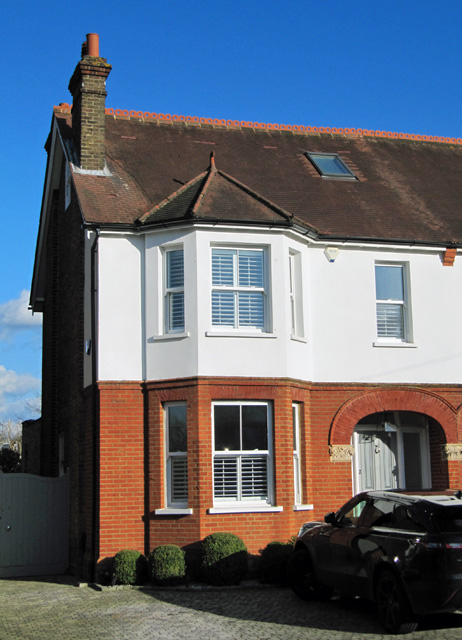
17 Bridge Road, Epsom.
Photograph © Roger Morgan, 2020.
Member of Parliament
Much as Jack enjoyed his work at the BBC, by the mid-1960s he began to crave a seat in Parliament where he would be free to express his own opinions rather than being required to present a balanced account of others’ views. He considered a number of potential constituencies where it was known the sitting MP would not contest the next election and felt the greatest connection with Stoke-on-Trent South: this industrial town at the heart of “The Potteries” had many similarities with his home town of Widnes, just 30 miles to the northwest. Jack was delighted to be chosen by the local selection committee from the various candidates and, as Stoke-on-Trent South was a safe Labour seat, felt he was now set on a lengthy Parliamentary career.
In the light of favourable polls, the general election on 31 March 1966 was called by the Labour Prime Minister, Harold Wilson, with the aim of improving his party’s slender majority (of 4 seats) gained over the long-serving Conservative government at the general Election on 15 October 1964. The aim was realised, and the Labour Government was returned with an overall majority of 98 seats. Jack, who had won Stoke-on-Trent South with an increased majority, resigned from his job at the BBC (where, for the duration of the campaign, he had been moved from his “current affairs” role) and prepared to take his seat in Parliament.
21 April 1966 was a momentous day for the Ashley family. Jack’s immensely proud mother came to the Palace of Westminster to witness the Queen’s opening the new session of Parliament. Jack was in his place in the Commons for the debate on the Queen’s Speech – but only for the opening, as a message came for him to rush to Epsom Hospital where Pauline was about to give birth to their last child, Caroline.
Over the coming months, Jack found his feet in Parliament. He quickly realised that, while reputations could be made on the floor of the House of Commons, real influence was exercised elsewhere – in committees and small groups, where reason replaced rhetoric. He got noticed and, just over a year into his term, he was appointed as Parliamentary Private Secretary (PPS) to Michael Stewart, the Minister for Economic Affairs. The PPS role provides significant opportunities and is seen as a stepping stone to ministerial office. Indeed, Jack was noted as a rising star in the Labour Party – with some even thinking of him as a potential future leader.
Loss of hearing
Mention has already been made of Jack’s hearing difficulties. These began with a perforated left eardrum as the result of a boyhood infection, but there seems also to have been a genetic component: his mother also became seriously deaf. The hearing in Jack’s right ear also grew deficient, and he had three stapedectomies (surgical procedures on the delicate bones in the middle ear that connect the eardrum to the inner ear where sound waves are converted to nerve impulses for the brain). Jack was finding it increasingly hard to hear – particularly in the noisy ambience of the House of Commons – and, on 2 December 1967, he underwent routine surgery to repair his left eardrum.
While the surgery was routine, the aftermath was anything but. He developed a serious infection that went to both ears, damaging both beyond possible repair. This left him not only profoundly deaf but also, making things even worse, significant tinnitus (“ringing in the ears”). After a crash course in the complex skill of lip-reading, he returned to the House of Commons but found it almost impossible to function effectively. Devastated, he he stood down from his PPS role and announced that he would be resigning his seat.
However, his constituents and and his close Parliamentary colleagues had different ideas. With their encouragement and, even more than before, wife Pauline’s active support , he continued in post – as the first ever profoundly deaf member of any legislature.
New ways of working as an MP
A turning point came in mid-1968 when he was asked to promote a Ten-Minute-Rule Bill on disablement issues. (Such “Bills” are not allocated further Parliamentary time, and are a means whereby backbenchers can raise the profile of particular issues.) While appreciating the opportunity and confident about the subject (in which he’d long been interested), Jack was concerned about speaking in the House at an appropriate volume, and he arranged for a fellow MP to sit in his range of vision with an agreed series of signals to adjust volume as necessary.
The chamber was, as usual, crowded for Prime Minister’s Questions on Tuesday 16 July 1968. Normally, most members then left to attend to other things. On this occasion, however, most stayed to hear Jack re-engage with the House. Jack made his speech most effectively and was delighted at its warm reception. He was even more delighted at having overcome the first major hurdle in his new Parliamentary career.
There were many more hurdles to overcome. In all this, he was powerfully supported by his wife, Pauline. He later wrote of her outstanding role in what he termed a partnership – noting that she deliberately kept in the background lest his real reliance on her was interpreted as inability to do the job.
A key step was then state of the art equipment to turn the Hansard reporters’ typing on their Palantype (a form of shorthand) machines into text transmitted to a screen at his seat. He wrote movingly about the whole experience in the closing chapters of his 1973 autobiography, “Journey into Silence“.

The dustjacket of Jack Ashley’s 1973 memoir, “Journey into Silence”.
From the writer’s bookshelf.
Disability/Disadvantage Campaigner
Having long been concerned about injustices, Jack’s deafness gave him a particular focus on the raw deal society gave those with disabilities compounded by Parliament’s neglect of the matter. (In “Acts of Defiance” Jack later described his generation’s attitude to disabled people as “casual indifference slightly tinged with pity” and “bordering on neglect”.) In 1968, he established the All-Party Disablement Group (later, the All-Party Parliamentary Disability Group) and served as its chairman for the next 40 years.
Details of all Jack’s achievements in the field of not only disability but also many other areas of disadvantage is beyond the scope of this article. These are expertly set out in the 2008 booklet produced by the Royal Association for Disability And Rehabilitation (RADAR) to celebrate Jack’s four decades as the Chairman of that All-Party Group. And many incidents and anecdotes are set out in the many many obituaries assembled in the website set up by his family to celebrate his life and work.
However, particular highlights include:
- mustering support for Alf Morris’s Private Member’s Bill that, rather against the odds, became the landmark Chronically Sick and Disabled Persons Act 1970;
- campaigning for the victims of Thalidomide and Debendox, which resulted in increased compensation for those affected and improvements in drug safety;
- promoting other compensation issues, such as vaccine damage to infants, the transmission of HIV to people with haemophilia and the arthritis drug Opren;
- tabling the first Private Member’s Bill to outlaw discrimination on grounds of disability which, while (like most Private Members’ Bills) it failed to reach the Statute Book, paved the way for another Private Member’s Bill which was enacted in July 1986 as the Disabled Persons (Representation, Consultation and Services) Act; and
- organising a successful mass lobby of Parliament to persuade the Government to implement more of the Act’s major provisions
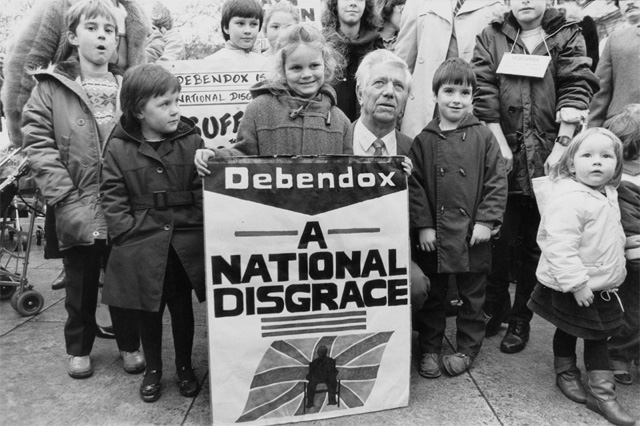 Jack at a 1984 demonstration to raise awareness of the dangers of the drug Debendox.
Photograph by Chris Shaw of The Times. Copyright acknowledged.
Jack shared with Pauline a strong belief in the need for justice for women and he was the first MP to raise the issue of domestic violence in Parliament. He also campaigned for and secured changes to the law on rape.
“This is your Life”
In the run-up to the October 1974 General Election, Jack accepted the invitation from a Labour Party Press Officer to participate in a party political broadcast. It was agreed his contribution would be filmed in the garden of his Epsom home, and would start with a shot of Jack playing badminton with his daughters. The film crew arrived and the game began, only to stop abruptly when Eamonn Andrews appeared with his “Big Red Book”: the whole thing had been an elaborate ruse (in which the family was complicit) to get the unsuspecting Jack on BBCtv’s “This is Your Life”.

Screenshot from BBCtv’s “This is your life”, 10 October 1974.
From left to right: Eamonn Andrews (host), Jack, Pauline and their three children.
Image with thanks to bigredbook.info
Honours
In the 1976 New Year Honours, the Queen was “graciously pleased” to admit Jack as one of the 40 UK Companions of Honour (hence his letters “CH”). As noted in the citation, this was in recognition of his “services to handicapped people”. Ever a modest man, Jack wore the insignia (with its motto “In action faithful and in honour clear“) only once after the initial presentation: this was in 1991 when he was persuaded by Pauline to wear it to a dinner with the Stoke Labour Party to mark his quarter of a century as their MP.
In 1979 and slightly out of the ordinary for a backbench MP of only 13 years, Jack was made a Privy Councillor (hence his “Rt Hon”). While there was an honorific purpose, the move by the then Labour Prime Minister, Jim Callaghan, was more specifically to entitle Jack to be higher up the list of those called to contribute to debates.
Over his many years of service, Jack also received a number of honorary degrees and doctorates.
Elevation to the House of Lords
Jack stood down as an MP at the April 1992 General Election. In July 1992, he was created a life peer. Acknowledging his Parliamentary seat of 26 years, he took the title of Lord Ashley of Stoke.
Later in 1992, his second autobiography, “Acts of Defiance“, was published to general acclaim.
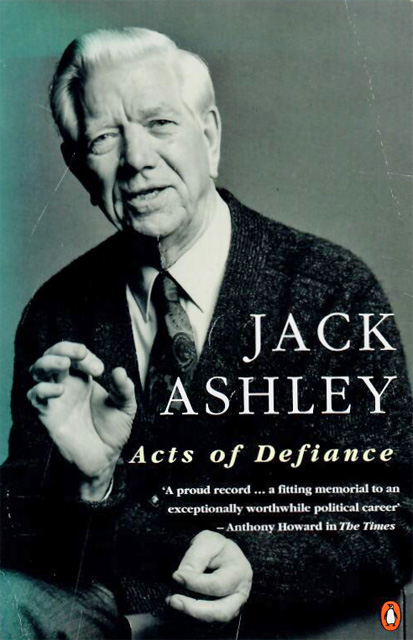
Cover of the newly ennobled Jack Ashley’s 1992 autobiography.
From the writer’s bookshelf.
While this elevation to the House of Lords was not without honorific purpose, he was – various governments then found – very much there as a working peer. Jack continued not only to initiate numerous debates on disability but also fought against aspects of proposed legislation that he felt were detrimental to disabled people. He sponsored a number of private member’s bills on anti-discrimination matters and on social care. Such bills rarely progress to the statute book, but it was pleasing that the Government’s own Disability Discrimination Act 2005 mirrored Jack’s own 2002 Disability Discrimination (Amendment) Bill.
Cochlear implant
In 1993, after 25 years of profound deafness, Jack had some sense of hearing restored with a cochlear implant. The technology was invented in the late 1950s, but was of limited use until major advances in the 1970s, since when substantial further improvements have been made.
Unlike a traditional hearing aid (which amplifies sound delivered to the user’s eardrum), these implants completely bypass the ear’s mechanical processes and deliver electric impulses direct to the auditory nerves on the cochlea – the inner ear’s structure which normally converts sound conducted from the outer ear into nerve impulses. The process starts with a microphone but, rather than being amplified as in a traditional hearing aid, clever electronics convert the sound into electrical impulses which, via an external coil to another just under the skin of the scalp just behind the selected ear, are transmitted electro-magnetically to electrodes attached to the base of the auditory nerves on the cochlea itself.
Miniaturisation enables the latest devices to be little bigger than a standard “behind the ear” hearing aid. In Jack’s time, the processing unit was too large for this and had to be worn in a pocket. The lead from Jack’s “behind the ear” microphone to the processing unit, and from that to the external coil transmitting to the implant is clearly seen in the photograph below.

Jack Ashley in the early 2000s (note the lead to his cochlear implant)
Photograph with thanks to RADAR’s 2008 booklet, copyright acknowledged
From Day 1, the technology not only provides users with invaluable awareness of the world of sound around them but also helps them regulate the level of their speech. After practice, it becomes at least a powerful reinforcer of lip-reading skills – indeed, in the most successful cases, users can “hear” to the point where they can understand the radio or use a telephone.
In connection with his appearance on BBC Radio’s “Desert Island Discs” on 16 December 1994, among the things Jack noted after a quarter of a century of total silence was hearing the voices of his grandchildren for the first time. (His favourite track was the Hallelujah Chorus from Handel’s Messiah, his chosen book was a book about warfare and his luxury item was smoked salmon and wine.)
Pauline, Lady Ashley
Jack was understandably devastated when, as the result of an “out of the blue” heart attack, Pauline died on 28 July 2003. She was aged just 70. He paid tribute to her extraordinary “clarity of mind and powers of concentration” – and acknowledged her huge contribution to his parliamentary work, saying “We shared an anger against injustice which meant that we worked in harmony on subjects about which we both felt deeply.”
It is known that Pauline modestly played down her contribution to Jack’s success in case his reliance on her detracted from the credit he rightly deserved. On paper, she was his researcher, but the reality was that – with like minds and passions – they worked in the closest of partnerships. However, she did not fool everybody: as Neil Kinnock (one-time leader of the Labour Party) said, “When I see ‘Mr and Mrs Jack Ashley, Companion of Honour’, I know that Companion is in the plural.”
Pauline was also active in her own right. In 1977, she took a Master’s degree in social administration at the London School of Economics. Subsequent work on a York University and Department of Health and Social Services study into the spending and income patterns of families with handicapped children led to the 1983 publication of her book “The Money Problems Of The Poor”.
In 1985, Pauline founded the Hearing Research Trust (now called Deafness Research UK – which, since 2005, has awarded an annual “Pauline Ashley Prize”), and was its chairman for 10 years. She was, for some years also a governor of London’s Royal National Throat, Nose & Ear Hospital. She was also passionately interested in consumer rights – and particularly how public utilities serve their vulnerable customers. She chaired the Electricity Consumers’ Committee for the South East and was a member of BT’s committee on disabled customers. It was her lobbying that led to the first Typetalk service allowing deaf and hard-of-hearing people to communicate via the phone. Appropriately, Typetalk’s first building was called “Pauline Ashley House”.
Activity in Epsom
In addition to his national prominence, Jack was also active locally. In 1997, he accepted appointment as President of Epsom General & West Park Hospitals’ League of Friends and, among other things, took a vigorous part in various campaigns to resist the downgrading of provision at Epsom General. The League’s Chairman, Geoffrey Robb, has written, “Jack was an ideal President. He didn’t interfere but was available with wise advice when this was most needed. We saluted him in life and we miss him now he has gone.”
Jack’s GP, John Flower (at the time of writing, now semi-retired), remembers him as “a delightful man, quite inspirational in overcoming his complete hearing loss and fighting battles for the hard of hearing and many other worthwhile causes“. As a patient of the Practice, Jack was pleased to perform the formal opening of its new Derby Medical Centre on 16 February 2001.
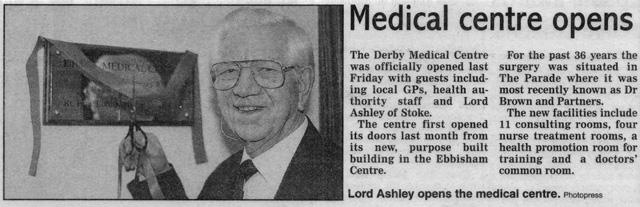
A 2001 press cutting about the opening.
Image from, with thanks, the Derby Medical Centre archive.
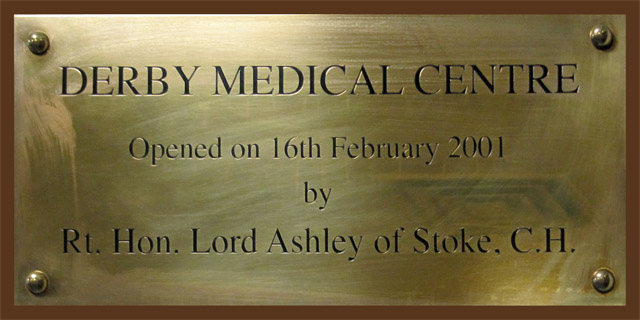
Plaque in the Derby Medical Centre.
Photograph © Roger Morgan, 2020.
The 2001 photograph above is one of only few so far found of Jack’s local activities. Another – as below – is of the now 84 year old speaking at a 2007 cross-party demonstration against the subsequently withdrawn proposal to remove maternity services from the Epsom General Hospital. (The photograph merits being reproduced here in spite of its comparatively low – the best available – resolution.)
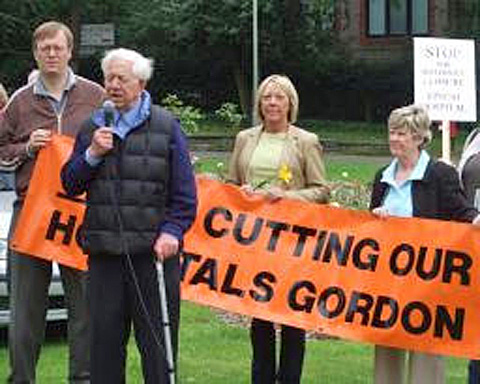
Jack Ashley speaking at a 2007 demonstration outside Epsom General Hospital.
Photograph with thanks to Epsom & Ewell Liberal Democrats © 2007
Although increasingly frail, Jack continued as President of the Hospitals’ League of Friends until his death in 2012. 18 months before that, he hosted a September 2010 tea party in the Queen’s Stand at Epsom Racecourse to thank the many volunteers who help with ancillary support at the hospitals.
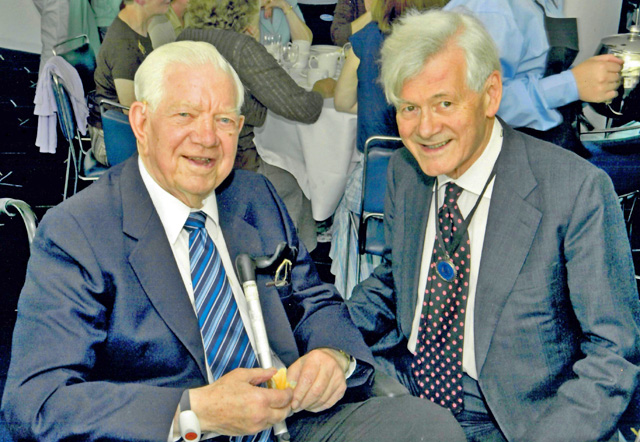
The Friends’ President, Jack Ashley, and Chairman, Geoffrey Robb, at the September 2010 “Thank you to Hospital Volunteers” event.
Photograph with thanks to the Hospitals’ League of Friends © 2020
Jack’s final public outing as President of the Hospital’s Friends was on 28 January 2011 – just over a year before his death. As shown in the photograph below, he unveiled a plaque formally to open the new Radiology Room at EGH, the equipment for which had been provided by the Friends.
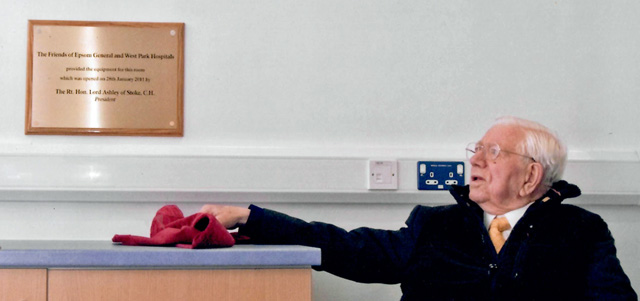
Jack Ashley unveiling the plaque to mark the January 2011 opening of the new Radiology Room.
Photograph with thanks to the Hospitals’ League of Friends © 2020
Conclusion
At the age of 89, Jack Ashley died of pneumonia on 20 April 2012. He was deeply mourned by not only family and friends, but also the wide circle of the disabled who, while they may never have known him personally, had benefited from his passionate advocacy of their causes. And a yet wider circle – in politics and many other spheres – felt the loss of a rightly celebrated individual.
Roger Morgan © 2020