
LIVINGSTONE’s ALMSHOUSES
(and the now-lost successor)
at 42 East Street, Epsom
 “Livingstone’s Almshouses, Epsom Surrey.”
1825 Watercolour by Gideon Yates.
Image with thanks to Bourne Hall Museum.
The main claim to fame of John Livingstone (occasionally “Levingstone” or “Levingston”) – an apothecary who moved to Epsom in the late 1600s – is as the entrepreneur who, as set out in our article on Epsom Spa, breathed new life into what was then the town’s most valuable asset. Indeed, it is for this that he is remembered in one of the Borough Council’s commemorative plaques that is attached to Epsom’s West Hill House, the brick-built replacement of his timber-framed home (apparently of similar size and outward appearance) from 1706 until his death in 1727.
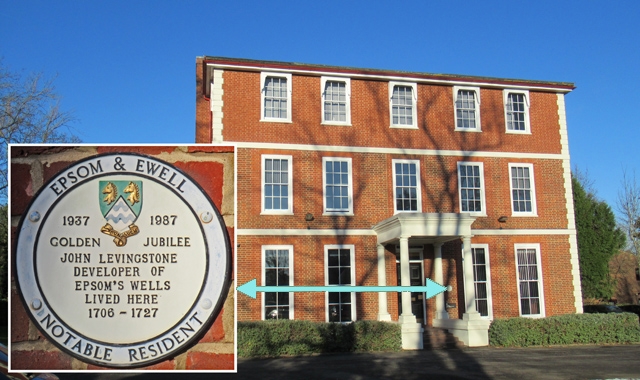 John Livingstone’s memorial plaque on West Hill House, Epsom.
Photographs by Roger Morgan © 2023.
He arrived in Epsom a wealthy man – and went on to enhance his fortune in further developing Epsoms Wells. However, he also gave back to the community – in particular by building some almshouses in what is now East Street. While, sadly, no portrait of this significant character has been found, we do have the watercolour of his almshouses as reproduced at the head of this article. (As discussed in the Annex, Bourne Hall Museum has another 1825 watercolour – also by Gideon Yates – entitled “Almshouses, Epsom Surrey” which seems to be of some other building, as yet unidentified .)
The article on Epsom Parish in the Victoria History of the Counties of England: The County of Surrey (Vol. 3), published in 1911, notes that it was in 1703 that John Livingstone “built almshouses for twelve poor widows in East Street on a piece of land granted by the parish” and that the building was, in part, supported by rent of a piece of land called Church Haw (Plot 605 in our article about Down Lodge) that had gone to the churchwardens of St Martin of Tours since 1692. (The History goes on to note that the almshouses were further supported by the “rent . . . of ‘Workhouse Field,’ the site of the old parish workhouse, and by the bequests of Samuel Caul (£500) in 1782, Mr. Langley Brackenbury (£300) in 1814, Mr. Story (£100), 1834, Mrs. Margaret Knipe (£300), 1834, the last to be devoted to this purpose after providing for the upkeep of vaults and monuments in the church“.)
What social care there was in the 1700s came under “the Parish” – being St Martin’s – and, more specifically, under the wing of the Vestry Meeting (which all parishioners were entitled to attend), headed by the the Vicar and Churchwardens who had day to day oversight of the various initiatives. (Things have radically changed since, but the tail end of all this remains in the “Epsom Parochial Charity” which, among other things, has an interest in Mary Dundas House at 5 Church Road, Epsom – a modern day “almshouse”.)
The 1846 and 1852 Kelly Directories noted that Epsom had “almshouses for 12 poor widows, built by John Livingston, a parishioner, in 1703.” The 1855 edition reported that “The almshouses are condemned as unfit for residence, and the almsowners no longer inhabit them. It is hoped that new almshouses may soon be erected.”
Steps were duly taken to replace the 150 year old premises and, on 19 December 1857, the churchwardens of St Martin’s (namely, Henry Dorling and Charles Langlands) circulated the following invitation to potential donors to the rebuilding find. (The meeting it called was arranged for Boxing Day!)
A meeting of Subscribers and other persons who may feel desirous that the EPSOM ALMS HOUSES should be re-built, will take place at the King’s Head Inn, on SATURDAY, 26th instant, at Three o’Clock p.m., for the purpose of appointing a Committee to carry out this benevolent object, and to transact any other business connected therewith, which you are hereby respectfully invited to attend.
It will materially assist the Committee, and be the means of preventing much delay, if you will, previously to the day of Meeting, kindly pay the amount of any Donation you may think proper to give for this purpose, to the Credit of the ALMS HOUSE FUND, at Messrs. Mangles and Co., West Surrey Bank, Epsom.”
To encourage recipients, the note included a list of 24 donations already promised. These ranged from £50 to 3 guineas (a guinea being £1 1s.) – with the great majority being 10 guineas – yielding a total of £222. The note also included a helpful history, as repeated below.
EPSOM ALMS HOUSE CHARITY
The Epsom Alms Houses were built by a Mr John Livingstone, an Apothecary, about the year 1700, and have ever since and from time to time been inhabited by twelve poor widows, nominated thereto by the Minister and Churchwardens. About two years since the building became so much dilapidated that under the advice of competent persons the poor widows were removed, and the Houses have ever since remained empty.
On the 5th November, 1856, notice was given to the Vicar and Churchwardens, by the Surveyor of the Epsom Board of Health, to remove the old building, as being dangerous, and likely to cause damage to persons passing by; and on application being made to the Charity Commissioners for England and Wales, their authority was obtained to pull down the old Alms Houses and to sell the same, applying the proceeds towards the erection of new Alms Houses for the purposes of the Charity.
The materials of the building were sold by auction on the 4th December, 1856, and produced, deducting charges of the sale, the sum of £15 8s. 0d., in addition to which John Ivatt Briscoe, Esq., Lord of the Manor of Epsom, has most liberally offered the sum of £50 as a commencement of the necessary subscription for re-building them.
The Vicar and Churchwardens now earnestly solicit the contributions of the Parishioners of Epsom and their friends in aid of this object, and so soon as the necessary amount is promised, a meeting will be called of the Subscriber, who will be solicited to form a Committee to assist the Vicar and Churchwardens to decide on some plan for rebuilding the Alms Houses in plain and substantial manner, avoiding expensive and unnecessary ornament, but combining every improvement in sanitary and other matters likely to add to the comfort of the aged inmates.
If through the liberality of the Parishioners and others a larger sum should be realised than is considered necessary to appropriate to the building, the surplus will be bought into the public funds in the names of the trustees of the other Epsom Charity property, and the interest divided in money annually or otherwise amongst the aged widows as may be determined by the majority of the subscribers.
The following sums of money have already been bequeathed to the Widows in the Alms Houses, the Interest being applied annually as follows by the Minister and Churchwardens.
CANE’S CHARITY . . . £500 Consols.
For Bread and Coals . . . Annual value £15
BRACKENBURY’S DITTO . . . £300 Consols.
For Bread and Coals . . . Annual value £9
KNIPES DITTO . . . £300 Consols.
To be divided in money to each of the twelve widows on Christmas Eve . . . Annual value £9
STOREY’S DITTO . . . £100 New.
To be divided in money to each of the widows on 25th March . . . Annual value £3
HOPE’S DITTO.
The Testator only died in 1856, and no money has yet been received from his Executors, but the Bequest is believed to be the Interest of £150, to be divided in money weekly among the poor Widows . . . Annual value £4 10s.
Total annual value . . . £40 10s.
All this eventually bore fruit, and the 1867 edition of the local Kelly Directory noted, “The almshouses for twelve poor widows, founded by John Livingston, a parishioner, in 1703, have recently been re-built upon the site of the old foundation, in East-street: Mrs. Sarah Pugh, formerly a resident in this parish, has been at the cost of half the expense of the building, the remainder is being raised by subscription.” (Mrs Pugh – formerly of Abele Grove – was a most generous donor to various Epsom causes.) Notwithstanding that 1867 statement about the recent rebuild, subsequent editions of the Kelly Directory all refer to the rebuild as being completed in 1871.
Below is the only known picture of the rebuilt almshouses. I leave it to the reader to decide to what extent the architect stuck to the 1857 aim of rebuilding “in plain and substantial manner, avoiding expensive and unnecessary ornament.“
 The newly rebuilt Almshouses in about 1870.
Photograph from the writer’s collection.
This c.1870 photograph was taken by Epsom’s pioneering photographer, George Snashall. As the original is now very faint, the above has had to be greatly enhanced. That has inevitably accentuated various blemishes – including what perhaps might be Mr Snashall’s fingerprints at the top right!
The following extract from the 1913 Ordnance Survey Map shows the location of the Almshouses in East Street – now numbered 62 – standing opposite the entrance to the Water Works.
 Extract from the 1913 Ordnance Survey map, in which the Almshouses are coloured red.
(Click to enlarge.)
The almshouses and their 12 inmates continued to be mentioned in the occasional Kelly Directories up to and including the 1938 edition. During WW2, the building was destroyed by bombing. In 1953, local resident Tony Elliot took a series of “now” photographs to match the “then” in his collection of George Snashall’s early Victorian scenes. As will be seen below, the site was bare – although there remained part of the front boundary wall and one of the distinctive gate pillars.
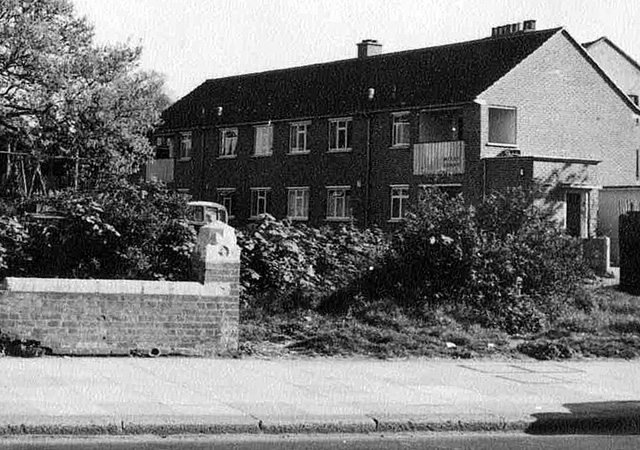
The site of the former Almshouses in 1953.
Photograph by Tony Elliot, from the writer’s collection.
The site was eventually sold off in 1967 and is now covered by a large office block.
Roger Morgan © 2023
ANNEX: Two Epsom Almshouses?
The London-based Gideon Yates (1790-1840) was a prolific topographical artist. It is thanks to him that we have the only image of John Livingstone’s original Almshouses (as at the head of this article and repeated immediately below). This, dated 1825, was titled by him as “Livingstone’s Almshouses, Epsom Surrey.” The second image below is also by Yates and, again dated 1825, was titled “Almshouses, Epsom Surrey.”
 Two 1825 watercolours by Gideon Yates.
Top: entitled “Livingstone’s Almshouses, Epsom Surrey.”
Bottom: entitled “Almshouses, Epsom Surrey.”
Images with thanks to Bourne Hall Museum.
As both are dated 1825 and given the superficial similarity, it is tempting to think that they show the front and back of the same building. But that doesn’t stand up under close scrutiny. In both images, the central chimneys are on the side facing us, so the “front and back” explanation does not work. In any case, the height of the chimneys (and number of chimney pots) as well as the arrangement of doors and windows are all quite different between the two.
So, what is the subject of the second picture? It is unlikely that there was a second Epsom Almshouses lost to currently available records, so did Mr Yates just make a mistake in titling his second picture?
Roger Morgan © 2023