
Epsom residents
The Rt Hon GEORGE WOODCOCK CBE (1904-1979)
TUC General Secretary 1960-69
& his wife
Hon Freeman LAURA MARY WOODCOCK JP (1906-97)
Local Councillor 1945-83 (and Mayor in 1964)
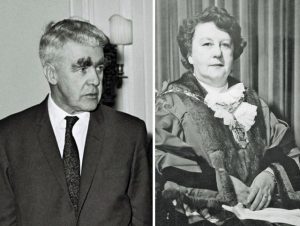
Left: George Woodcock (photograph via Wikipedia, public domain)
Right: Laura Woodcock, as Borough Mayor (photograph courtesy of Epsom & Ewell Council)
George Woodcock was born on 20 October 1904 in Bamber Bridge, three miles south of Preston, Lancashire, the second child of Peter Woodcock and Ann (née Baxendale). Both parents were from Bamber Bridge, and were working in the town’s cotton industry when, in their late 20s, they married there in Q1 1903. The 1911 Census records the family (now with four children) at 8 Mounsey Road, Bamber Bridge with 37 year old Peter listed as an “Overlooker Weaver” in the local Cotton Mill.
The family was Roman Catholic, and George’s schooling was at the local Brownedge St Mary’s Roman Catholic Elementary School. In 1916, aged 12, George began part-time work in the local cotton mill – and worked there full-time from the age of 13. In 1924, he became an official of the Bamber Bridge and District Weavers’ Union, and was also active in the Labour Party. In 1929, he won a TUC scholarship to Ruskin College, Oxford – in 1931, moving on to New College, Oxford in where, in 1933, he was awarded a first class degree in Philosophy, Politics & Economics.
In Q3 1933, George (now aged 29) married 26 year old Laura Mary McKernan, the marriage being registered in her home District of Bolton, Lancashire. Laura had been born on 18 Jan 1906, the second child of Francis McKernan and Margaret (née McNamara, the couple had married in the Bolton District in Q2 1902). Sadly, the couple’s first child, Winifred, had died in Q4 1904 on about her first birthday The 1911 Census records the family living at 8 New Brunswick Street, Horwich – a couple of miles northwest of Bolton, and about 10 miles south of Bamber Bridge. Laura’s parents were in their mid/late 30s: Francis is listed as an “Engine Fitter, Locomotive Works”; and, as conventional, no occupation is listed for housewife Margaret. In addition to 5 year old Laura, Francis and Margaret had had another child – Francis, who was now 3 years old. Living with the family was Margaret’s 67 year old widowed mother, Mary McNamara, listed as “Wife’s help (no other occupation)”. Margaret was, in fact, terminally ill, dying in Q2 1911 aged only 38. Her mother stayed on to help raise the two children.
To revert to George, his academic success at Oxford had won him a Jessie Theresa Rowden Senior Scholarship, and he went on to postgraduate study at Manchester University. In 1934, he joined the Civil Service and worked as a National Savings Assistant Commissioner until 1936 when he went back to trade unionism by becoming the head of Research and Economic Development at the Trades Union Congress (TUC).
George and Laura appear to have moved into the Borough at about that time: their first appearance in the readily available local Electoral Rolls is in 1936 at “Plot 48” (later No 97) Green Lanes, West Ewell. It was here that their first child, Peter Anthony, was born on 31 January 1936. He was presumably named “Peter” after George’s father. Their second and only other child, Vilja Teresa, was also born locally in Q1 1937. Her unusual Christian name (pronounced “Veelya”) was presumably taken from the famous aria about the wood nymph of that name in Franz Lehar’s The Merry Widow. (A recording of this was one of the eight chosen by George for his appearance on BBC Radio’s Desert Island Discs in May 1967 – and, indeed, was his “favourite track”.)
In mid-1939, George and Laura moved half a mile west from 97 Green Lanes (still their address for the 1939 Electoral Roll) to 6 Beaufort Way, Ewell – the address where the 29 September 1939 Register recorded the 34 year old George (“Secretary, Research Dept”). However, on the day the Register was taken, Laura and the two children were at 2 Edward Street, Horwich, Lancashire with her now 62 year old father – Francis, now a “Motor Engineer (Inspector)” – and 64 year old stepmother, Louise. Francis and Louise Conway (née Ratcliffe) – both widowed – had married in Q2 1917, registered in the Bolton District.)
The family lived at 6 Beaufort Way, Ewell until 1960 when they moved to 24 Lower Hill Road, Epsom. As part of the Borough’s Golden Jubilee in 1987, the Council placed a plaque on the house to note, as illustrated below, what had been the home of a “Notable Resident”.
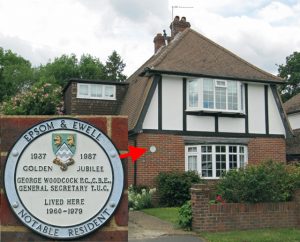
24 Lower Hill Road, Epsom, and its memorial plaque
Photograph © Roger Morgan 2019
But that gets us rather ahead of ourselves. George worked in the TUC’s Research and Economic Development section. Towards the end of WW2, he worked with the famous economist John Maynard Keynes about how to meet the staggering costs of the conflict. In 1947, George was appointed as the TUC’s Assistant General Secretary (and it was during this time that George was influential in the career of Jack Ashley who, from 1964, was another notable Borough resident). In recognition of his work, he was awarded CBE in the Queen’s Coronation Honours of 1 June 1953. (It is understood he was later offered a peerage, but declined to accept this from a Conservative government.)
George’s talents gained him recognition beyond trade union circles. Amongst other things, he served as a member of: the Royal Commission on Taxation of Profits and Income 1952-55; the British Guiana Constitutional Commission in 1954; the Radcliffe Committee on the Working of the Monetary System, 1957-59; and the BBC advisory council. In 1952, he was appointed as Vice-Chairman of the National Savings Committee, a post he held until 1975.
In September 1960, George became the TUC’s General Secretary (succeeding Sir Vincent Tewson). He had long sought to move the trade unions away from concern with the minutiae of Labour Party politics and towards a broader role in the formulation of national economic policy. He joined battle with the “old guard” (complicated by his unusual combination of shyness and a fierce debating style) and led a successful fight in 1963 to endorse the view of the National Economic Development Council (the Government’s planning body involving representatives of both labour – of whom George was one – and management) that Britain needed to expand production, with the corollary that rises in wages would have to be slowed. All this chimed in with the thinking of the Labour Party under the leadership of Harold Wilson who, on becoming Prime Minister after the 1964 General Election, set about seeking a transformation of industrial relations through a Royal Commission on Trade Unions and Employers’ Associations (the Donovan Commission – 1965-68).
After something of a bumpy ride (not all the old guard of trades unionists had been won over), a new settlement began to emerge and, on standing down as General Secretary of the TUC in 1969, George was appointed as the Chairman of the Commission on Industrial Relations. That continued into the first months of Edward Heath’s Conservative government that had come into power after the June 1970 General Election. However, the 67 year old George resigned in 1971 after the introduction of the new government’s Industrial Relations Act. (With hindsight, opportunities were lost in the late 1960s which paved the way for a more aggressive resolution of the long-standing issues in the early 1980s under Margaret Thatcher’s Conservative government.)
In the meantime, George and Laura’s children had grown up. Son Peter became something of a whizz in the rapidly developing field of computers – in the late 1960s, spending some years in California’s “Silicon Valley”. Sadly, he died (in Epsom Hospital) of a rare disease on 11 May 1985, aged only 49. His Death Certificate cites his occupation as a “Computer Manager” and his “usual address” as his parents’ 24 Lower Hill Road, Epsom. (However, the Probate record of his £76,756 estate gave his address as his longer-term 31 March Court, Warwick Drive, Putney.)
Daughter Vilja had graduated MA from the University of Oxford. While there, she met Ricardo L A E Villa and, in Q3 1962 (and registered in the local Surrey Mid Eastern District), the couple got married. They moved to Ricardo’s native Mexico where he pursued a career in textile manufacture. Vijla was an educationist and pursued a career in teaching alongside bearing their three children and occasional return to Epsom to visit her parents. (It was during one of these visits that younger brother Peter died in 1895, and it was Vijla that formally registered his death.) George and Laura also visited Vijla and family in Mexico on a couple of occasions.
In 2000 – and styling herself as Mtra Vilja Woodcock McKernan (McKernan being her mother’s maiden name) – Vijla established the Woodcock British School, run with one of her daughters. The school’s website notes that this establishment followed “more than 40 years of experience in education in both England and Mexico” and that the institution “was founded with an attempt to present an alternative to traditional models of education. With small groups and a personalized education, the graduates have managed to be successful in their university careers“.
While George Woodcock had engaged in national matters, his wife, Laura was active locally. On 1 November 1945, she was elected as a Labour Councillor for the Court Ward of Epsom. She served on the Epsom & Ewell Borough Council in a wide range of capacities until her retirement in May 1983. This included a year as Mayor in 1964/65 – as pictured at the head of this article. She did not feel she could ask George (who was fully occupied with TUC General Secretary duties) to be her official consort and, instead, nominated daughter Vilja (who was visiting from Mexico for a spell) as her “Mayoress”. Laura also represented the Council on a wide range of external bodies. In 19 May 1980, her fellow Councillors made her an Honorary Freeman of the Borough “in grateful recognition of eminent service to the Borough and to the community, and as an expression of admiration and esteem.”
Part of that engagement with the wider community had been as a Justice of the Peace, first appointed in December 1958. She was also active in education matters, as a school governor and otherwise. In recognition of her work in the field of education, she was awarded the Papal Benemerenti Medal in March 1966.
George died on 30 October 1979, just 10 days after his 75th birthday. The widowed Laura outlived him by 18 years, dying locally (like George) in Q1 1997, aged 91. Together with their son, Peter, they are buried in Epsom Cemetery.
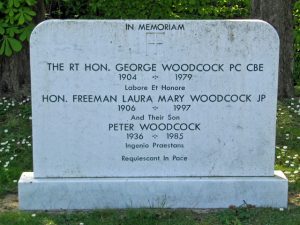
The headstone in Epsom Cemetery
Photograph by Roger Morgan © 2019
Roger Morgan © 2019 & 2022
with special thanks to George and Laura’s grandson, Ricardo Villa