
TURNER’S BAKERY
 Edward Turner in the bake house, Epsom
Image courtesy of Bourne Hall Museum
Much of the material in this article has been assembled from an account written in 1991 by the late Louis Raymond Turner (who died in 1998) and a supplementary account originating from his father, Arthur ‘Ted’ Turner, both of which are now in the possession of Bourne Hall Museum. Most of the photographs come from a Turner family album, which is also with the Museum.
The original baking Turner
This was Edward Turner, born on 26 January 1872. According to his marriage certificate, his father was Joseph, a bootmaker, and he was born in Stonham Asphall, Suffolk, the elder son of Joseph and his first wife, Eliza (née Denny). In the paperwork lodged with the Museum it is mentioned that the Turners were Suffolk people. Edward had left home by 1891 and was working in West Croydon as assistant to baker and confectioner Charles Gentry, who will reappear in due course. In 1901 Edward was in Penge, described as a bootmaker, but by 1911 he was baking again, working for an Alfred Dawes in Wallington (Mr D will return later too).
Edward married Kate Tidy on 3 June 1895 at St Mary, Oxted; he is described on the certificate as a baker and Kate is a servant. They weren’t together on the 1901 and 1911 censuses, the reason being that Kate had ‘lost her mind’ after the birth of her second son and had to be ‘put away’. The family attributed this to ‘milk fever’ and, perhaps, to being a ‘change of life baby’ herself. There is a patient who fits the bill in Croydon Mental Hospital at Chelsham in 1911 – this later became Warlingham Park Hospital – and Kate was definitely in Cane Hill Asylum in 1901, described as a lunatic. The two sons of Edward and Kate grew up with the Tidy family in Oxted: they were Arthur Edward ‘Ted’, born 16 March 1896 Purley, and William Ernest ‘Will’, born 31 October 1897 Bromley, Kent. The latter was presumably named after his father’s younger brother, also a William Ernest. Kate died in 1913, aged just 39.
Almost immediately after Kate’s death Edward married Nelly/Nellie Knight, who was originally from Sutton and, apparently, a fairly ardent Baptist, which Louis tells us had a significant effect on the family in due course.
Turner’s bakery opens in Epsom
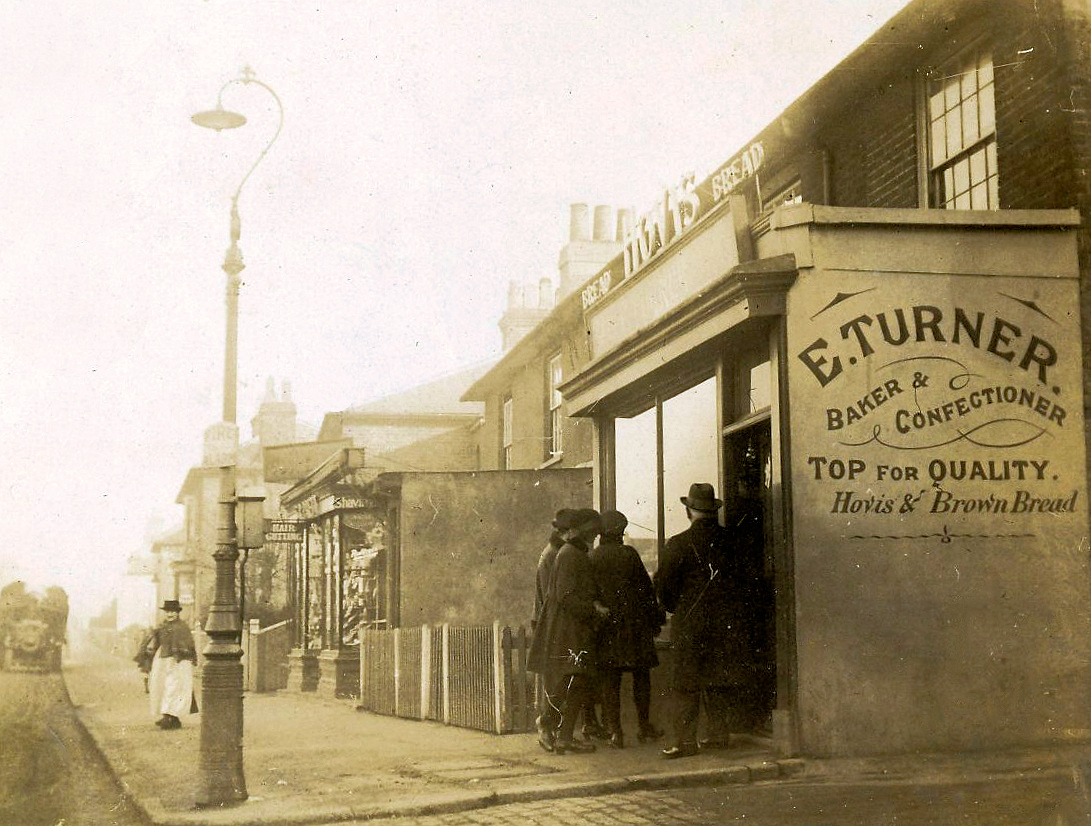
An early photograph of the East Street bakery
Image courtesy of Bourne Hall Museum
The first appearance of the Turner bakery is in the 1922 Kelly’s Directory, where it is listed at 72, East Street. Edward was already around 50 at the time, so it would not be an easy life. Ted had joined the Royal Navy as a regular in 1912 and served until 1926. His original intention was to emigrate to Canada and farm, but Edward offered him a partnership in the business and he reluctantly accepted. At this stage Ted had a wife, Betsy (née Reed), and two youngsters, Stanley and Joyce, to support. We shall return to Ted in due course.
Louis emphasises what hard work the bakery was for the Turners. He says that Ted ‘often related how, while his step-mother was feeding the enormous ovens with bread in one room, his father would be stoking the coal fire to heat them in the next (later these ovens were converted to coal gas). Work started at five in the morning and only finished after eight at night; six days per week and no holidays.’
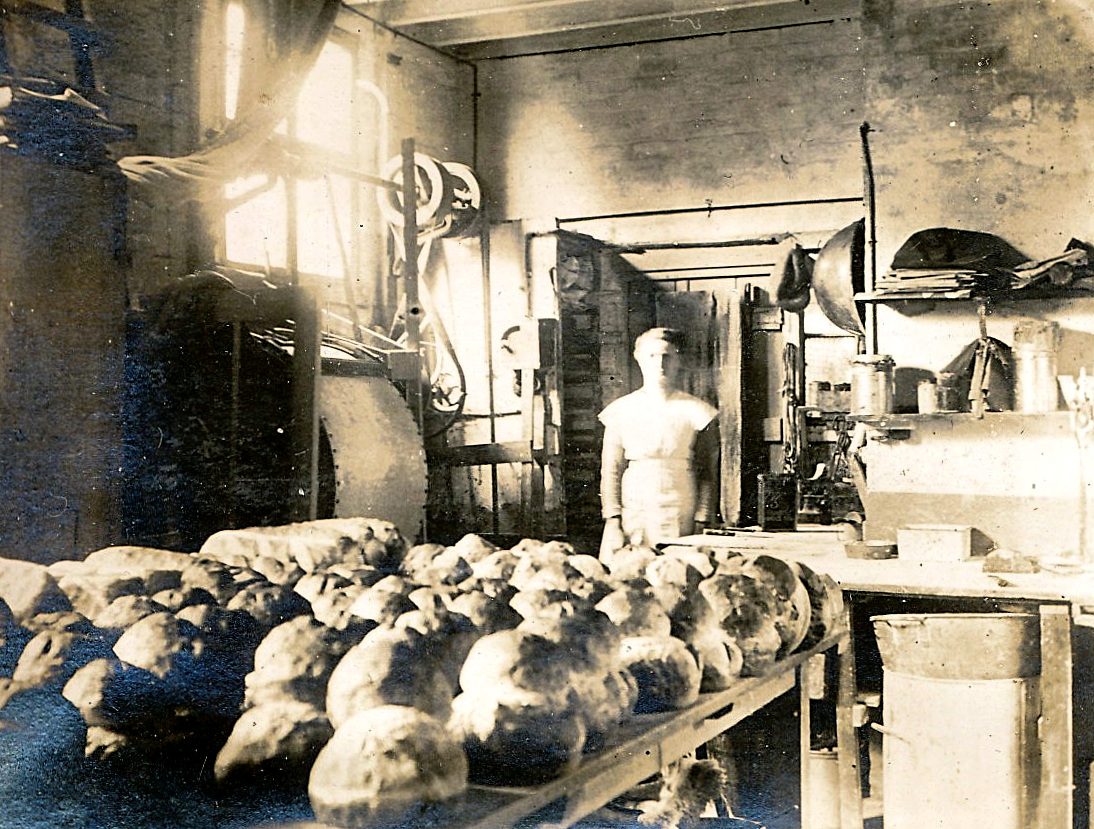
Nelly Turner in the bake house, Epsom
Image courtesy of Bourne Hall Museum
It was soon after opening the bakery that Edward developed a stomach ulcer, which eventually burst. Fortunately, surgery saved his life, but Louis says that it changed him. Having come so near to death, Edward became deeply religious, giving up smoking and alcohol and becoming a strict practising Baptist. The different situation was too much for Will Turner: he left home and they never saw him or heard from him again. In fact, he married and moved to Essex, where he died in 1974.
Mr Turner builds a house
Ted’s family was growing and Edward, who lived at 4, Windmill Lane, Epsom, decided to build them a house modelled on his own. The new house, completed in 1924, was at 83, West Street, Ewell and the deal was that Edward would retain ownership but Ted would take care of maintenance, rates etc.
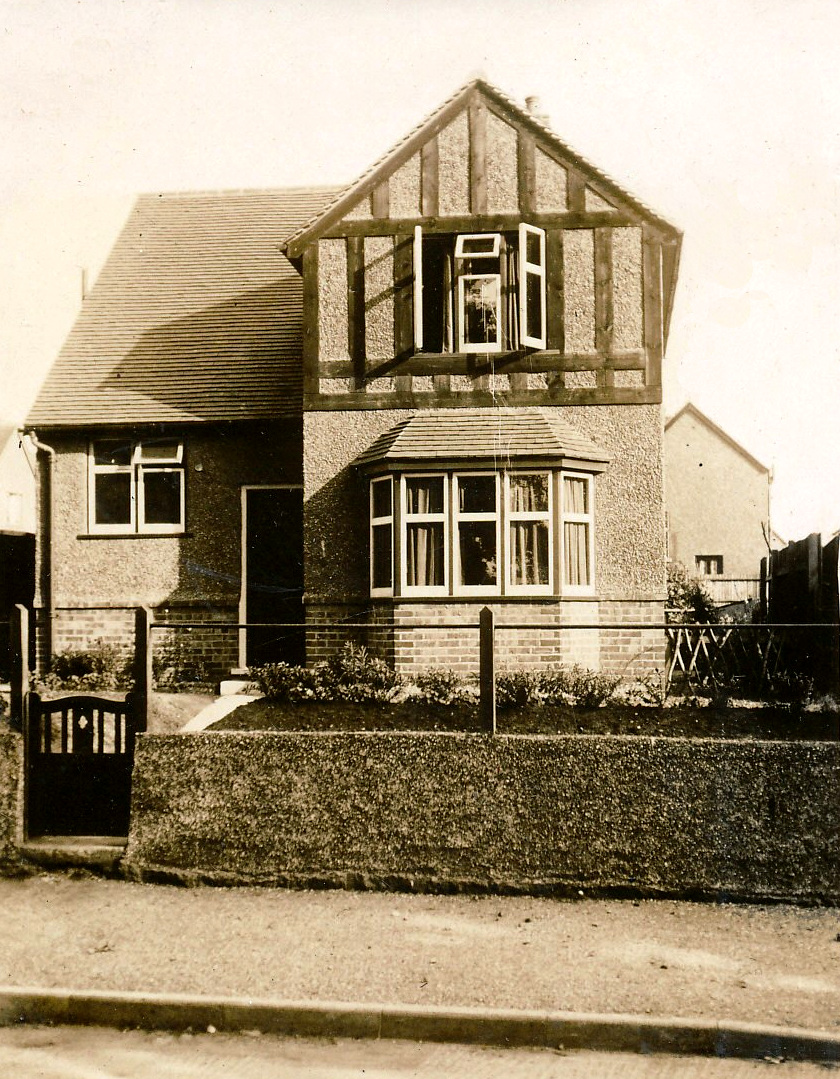
83 West Street, Ewell
Image courtesy of Bourne Hall Museum
Business booms
In succeeding years Edward took in partners and opened more shops. His old boss, Charles Gentry, ‘an elderly, heavy built man with a white walrus moustache’, bought a stake and worked in the cake bake house. A baker from Bognor named Reid also bought in and took charge of the office – ‘a corpulent man with small, piggish eyes and a moustache, the ends of which were always waxed into points in the fashion of the day; invariably he wore a trilby hat and was rather fond of whisky’. Mr Reid’s son, Tom, became a partner later on, as did Alfred Dawes, the Wallington baker, who did the accounting. Having brought partners into his original business, Edward acquired more properties on his own account, which were 26, High Street, Ewell and 220, Chessington Road, West Ewell.
26, High Street, Ewell had existed in some shape or form since the 15th century and had been a bakery since at least 1760, passing through the hands of the Picknells and John Turner Wilkins on its way to becoming a Turner premises in about 1934.
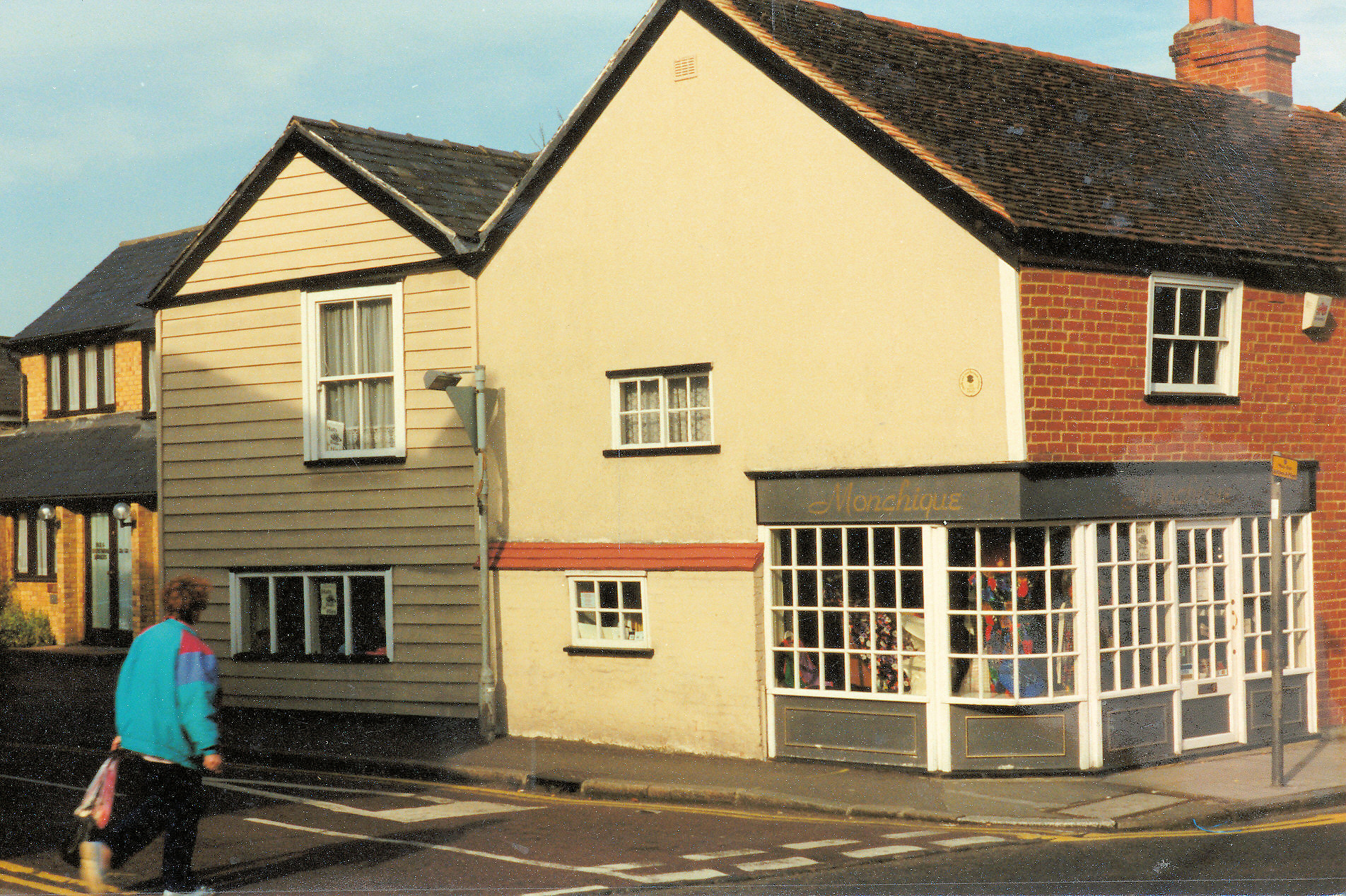
26 High Street, Ewell in a later incarnation
Image courtesy of Bourne Hall Museum
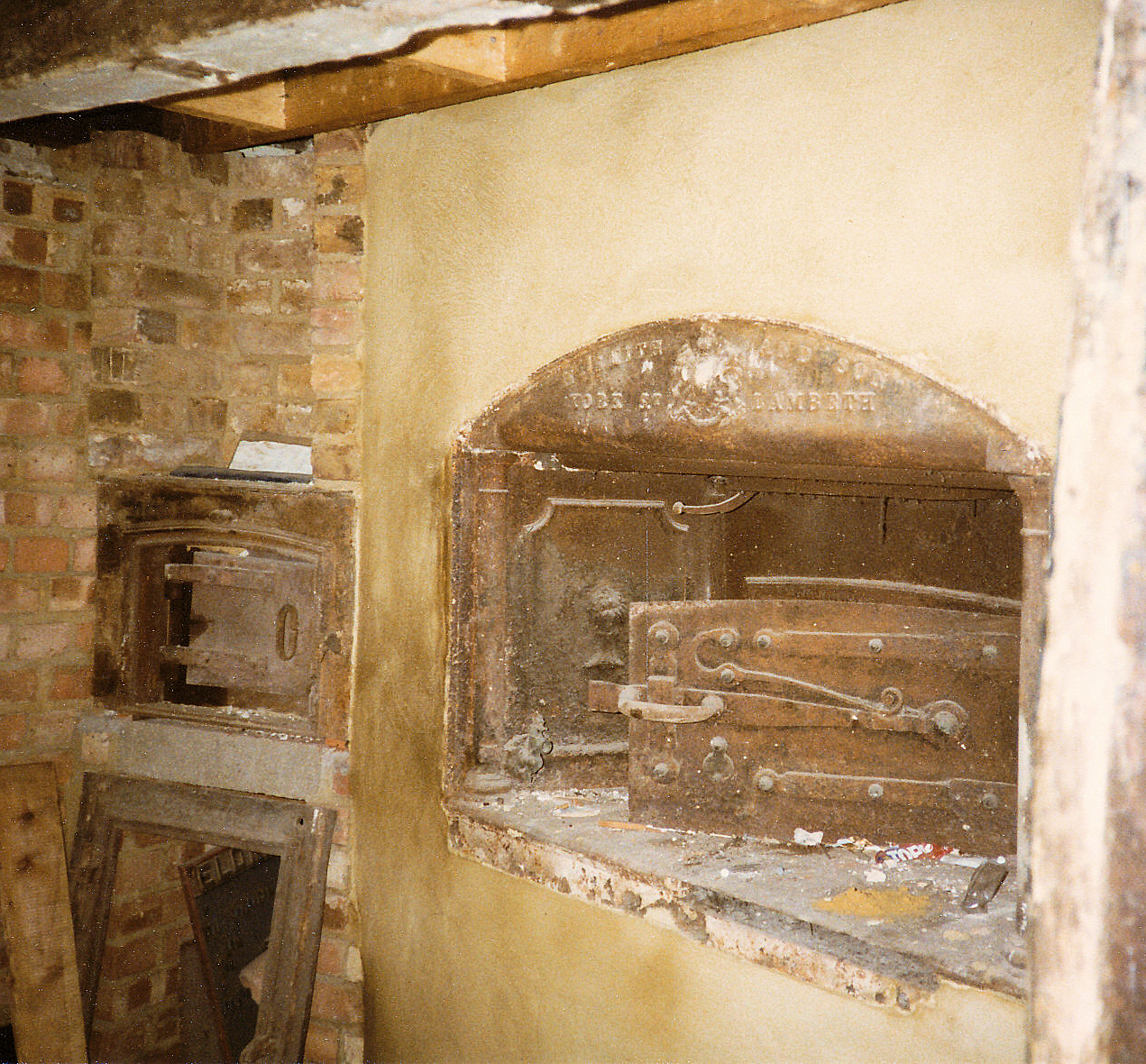
The old bread ovens at 26 High Street, Ewell
Image courtesy of Bourne Hall Museum
I notice that Edward Turner liked corner premises, presumably so that his wares could be spotted from multiple angles, and 220, Chessington Road (currently a branch of ‘The Personal Agent’ estate agency) was another one. Apart from the shops just mentioned, branches were opened in Cheam and Sutton. In due course the original East Street shop was the main branch and office, but the bake house was eventually used for cakes only and a new, modern bake house with conveyor belts opened at 92, East Street – on a corner, of course.

Turner’s bakery at 92 East Street, Epsom
Image courtesy of Bourne Hall Museum
Transport
My interest in the Turner Bakery (the original premises) was first aroused by the transport. Turner’s really did have some nice vehicles, as you are about to see.
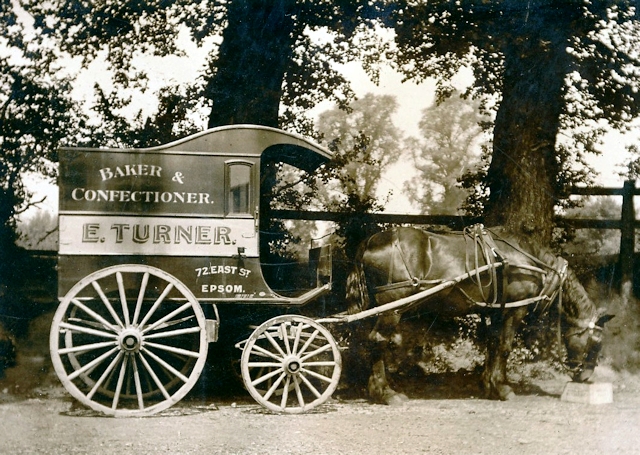
Edward’s horse and cart taking a breather in West Street, Ewell
Image courtesy of Bourne Hall Museum
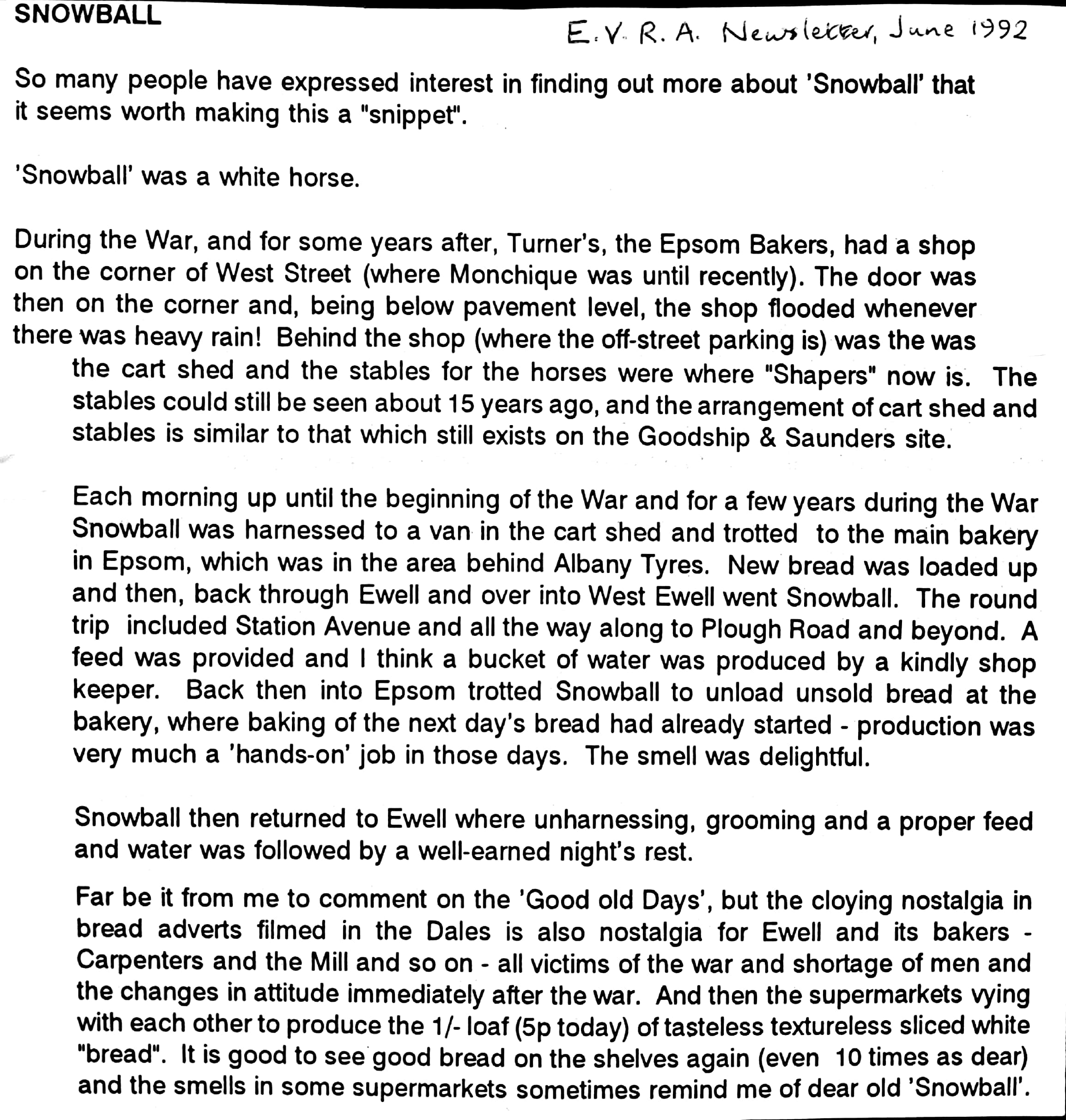
Whilst on the subject of horses, Turner’s had a celebrity one locally, which was white and called Snowball, so obviously not the animal in the photo above. The Ewell Village Residents’ Association published this item in June 1992.
There were also some very smart motors.

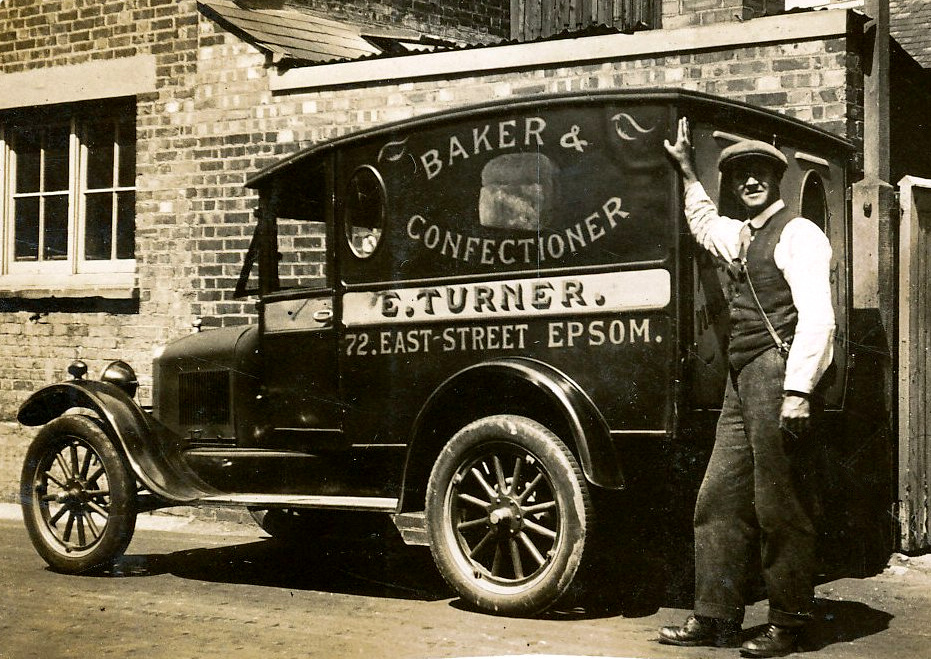
Images courtesy of Bourne Hall Museum
Wartime
Edward wanted to retire just before the war and stopped putting in full days at the business, although he still kept a keen eye on his investment and spent time in the office. Louis reports that the business didn’t suffer much during the war, although some of the male workers were called up, but they were replaced by women. Incredibly, the bakeries held sufficient stocks of flour that had been bought in from Canada to carry on baking throughout the whole conflict. By the time war broke out, Ted and Betsy had six children – another one followed in the middle of the hostilities – and it’s probably time to introduce you to them all.
We have quite a few photos of Ted, Betsy and their family, but I don’t know which child is which. We’ll have a table first to get them in the right order.
| Name | Born |
| Stanley Arthur | 1923 Portsmouth |
| Joyce Iris Violet | 1924 Portsmouth |
| Nellie A | 1927 Epsom/Ewell |
| Ian Owen Edward | 1929 Epsom/Ewell |
| Louis Raymond | 1934 Epsom/Ewell |
| Arthur E | 1936 Epsom/Ewell |
| Bessie E | 1941/1942 Epsom/Ewell |
Let’s start with a picture where there are only two children, who could well be Stanley and Joyce. This is definitely the back of 83, West Street, Ewell (by comparison with another photo the Museum has), but as yet the garden looks bare, so I would guess that they had not long moved in, since it looked much more cultivated in later photos containing more children.
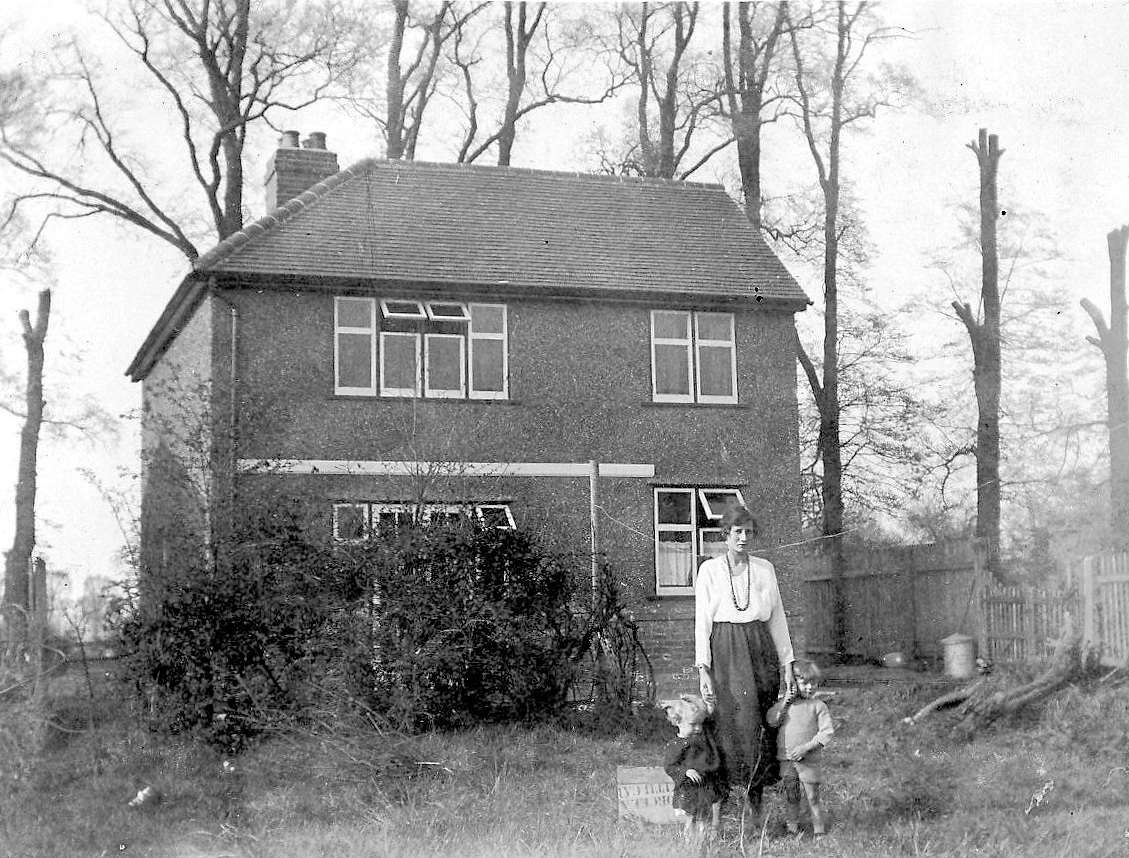
Betsy Turner with (probably) Stanley and Joyce, possibly c.1926
Image courtesy of Bourne Hall Museum

Ted Turner with three of the children
Image courtesy of Bourne Hall Museum
This next one has five young children, which means that it must have been taken before the war, since there weren’t five small children in residence during the war.
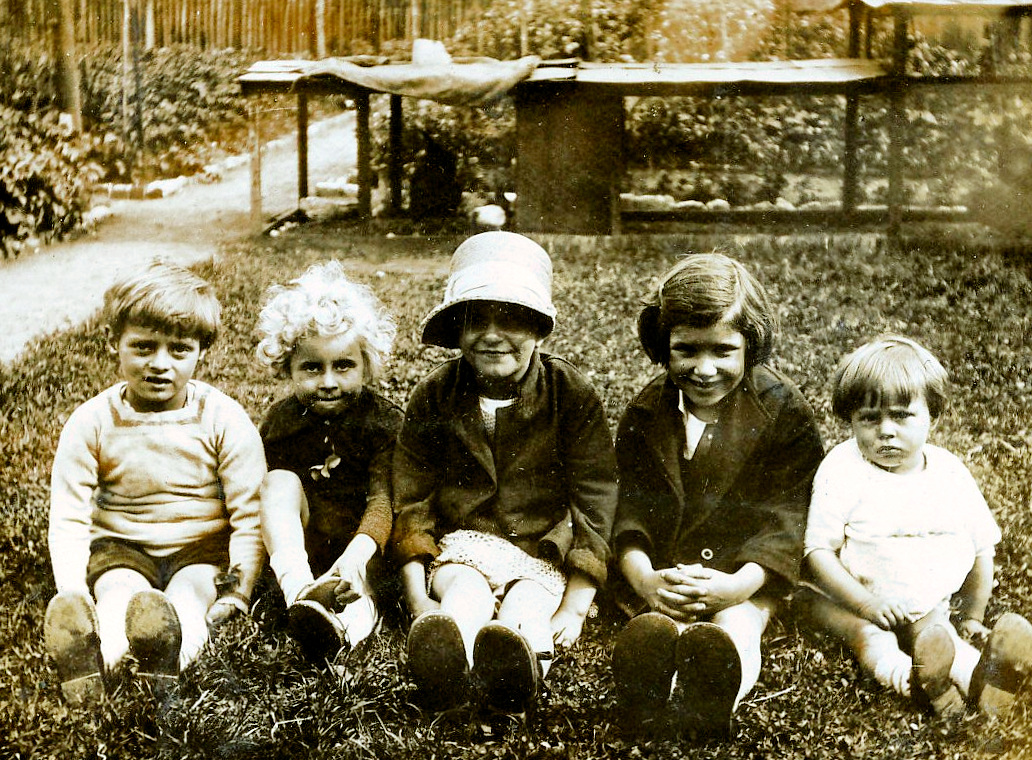
Five of Ted and Betsy Turner’s children
Image courtesy of Bourne Hall Museum
Betsy Turner had family in South Africa and it was decided that some of the children should go there for the duration of the war, although only Nellie and Ian actually went. In due course Stanley became a Royal Marines Commando and Joyce joined the Women’s Royal Naval Service. Ted, being too old for military service, became a Fire Watcher, a job he took to with enthusiasm; he also constructed an Anderson shelter in the garden, fitted out with bunks and electric light. All kinds of vegetables were grown and Ted reared ducks, rabbits and chickens. At one point he had an allotment in Epsom.
By the time the war ended, Stanley was married and in 1945 Joyce wed (Frank) Jim Beecher, who was a Ewell lad. In October 1945 Nellie and Ian returned from South Africa, regaling their parents with tales of how good the life was there. Ted’s desire to emigrate and farm was rekindled and he applied to several countries, with South Africa accepting his application first. He was rather like his father in this respect – attempting a new beginning at the age of 50, and in his case it did not work out too well. Edward had given 83, West Street to Ted and it was sold to finance the emigration.
South Africa
In 1947 Ted, Betsy and the younger children arrived in South Africa, subsequently joined by Joyce and Jim Beecher and their son, and by Nellie and her husband, Arthur ‘Jim’ Norwood’. (Stanley never saw his father again, as he stayed behind in England.) There was no question of acquiring a farm, on financial grounds, and nor could they afford a house. Work was hard to find and eventually Ted threw in his lot and his cash with a man called Victor Woods, who had a small engineering business. Louis says about Mr Woods: ‘At that period he was about 45 years old and bore a striking resemblance to Hitler. He was also a little like him in nature’. Louis comments that, as time went on, it became more and more apparent that Ted had not inherited his father’s business acumen. In 1948 Ted’s money ran out and he tried a variety of jobs, before ending up as a barman.
At one stage, in desperation, Ted asked his father for financial help and received two one pound notes in response. Edward Turner would have been bitterly disappointed with his son, whom he must have hoped would continue the bakery business back in England.
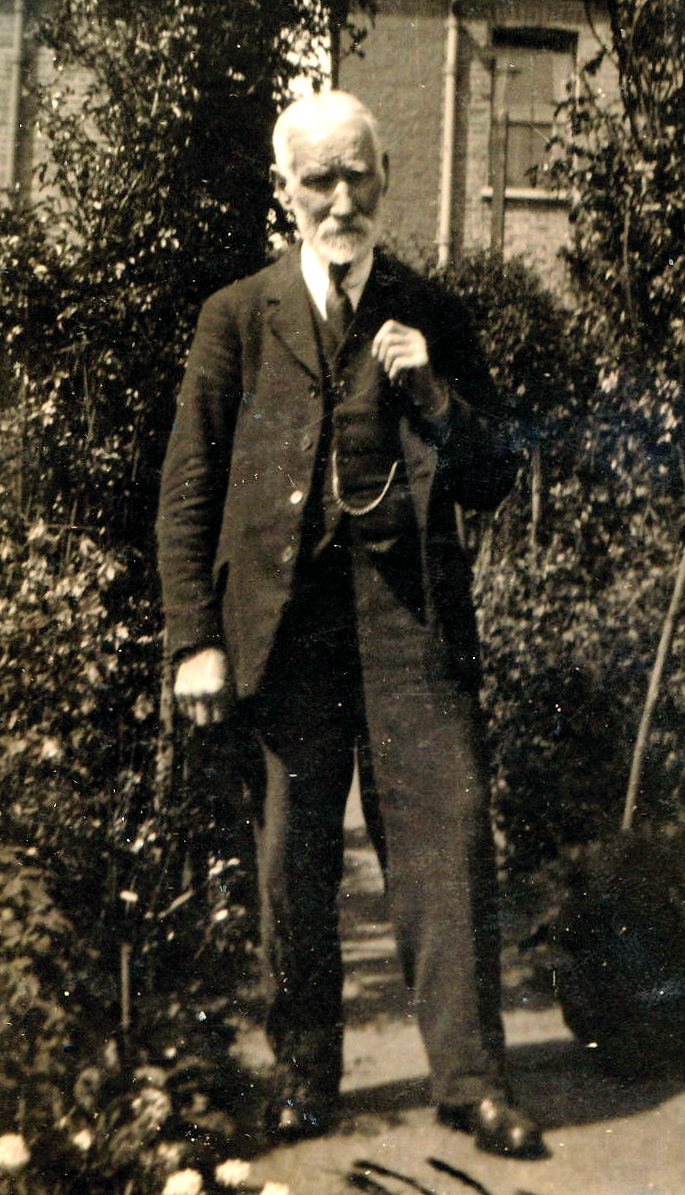
Edward in later life
Image courtesy of Bourne Hall Museum
Final curtain
Edward died on 24 January 1955. Ted, who suffered from stomach ulcers and had begun to age visibly, had also received bad news about his own health, which he didn’t disclose. He had, though, expected to be left Edward’s money, but the will had been changed and he would receive only the interest on the capital. Furthermore, after Ted and Nelly were dead, everything would be apportioned among Ted’s children. Betsy was not specifically provided for at all. It seems that Edward had extracted his final revenge for what he and Nelly saw as a very upsetting desertion.
Ted then made the decision to return to England and planned to settle near Portsmouth with Betsy and their youngest child, Bessie, the others being old enough to fend for themselves. But, sadly, Ted never made it. He died from advanced lung cancer on 2 May 1955. Betsy and Bessie did come back to England in the end. Nelly died in 1962 and was buried in Epsom Cemetery with her husband (Grave L176).
Linda Jackson 2020