
Micajah Perry
The Cock(e) family connections to Epsom, and Micajah Perry.
A marriage agreement involving Richard Cocke and Anne, daughter of Abraham Wessell, merchant, of London, and Anne, daughter of John Crawford, leatherseller, of London, and the acquisition of a messuage etc, in the Parish of St Leonard’s, Shoreditch. appears to have been drawn up on 18 September 1683.
During 1686 Richard is to be found trading as a wholesale linen draper, in partnership with Godfrey Cock, ‘at the sign of the Bell in Aldgate’, London.
The Registers of St Mary Woolnoth contain the baptism of numerous children from the union of Mr Richard and Anne Cock between 1 October 1696 and 1710, two of whom died respectively in 1705 & 1707 and were taken for burial at St Leonard, Shoreditch. Richard’s business as a wholesale Linen Draper was reportedly conducted in ‘The Stocks Market’ which functioned between 1282 and 1737 before becoming the Mansion House site.
The death of Richard Cock on 26 December 1712 was recorded at St Mary Woolnoth before his remains were carried to Shoreditch for interment. The Will of Richard Cocke, Merchant Taylor of London, of Hackney was proved on 29 December 1712 [PROB 11/530/327]. It mentioned his late mother to have been Mrs Elizabeth Raper and went on to make provision for his 12 surviving offspring.
A case in Chancery followed during 1714/1715, ‘Cock v Cock’: –
Plaintiffs: Leonard Cock, gent of London and Josiah Cock, John Cock, Elizabeth Cock, Sarah Cock, Dorothy Cock, Rebecca Cock, Ann Cock and Judith Cock (nine of the children of Richard Cock citizen and merchant tailor deceased late of London), infants (by the said Leonard Cock, their next friend).
Defendants: Richard Cock, Abraham Cock, William Cock, Sir Thomas Scawen, Henry Kelsey and Ann Cock.
[Sir Thomas Scawan is presumed to have been interested because he had married Martha Wessell, another daughter of Abraham Wessell, London merchant, on 8 September 1691.]
Sometime after 1716, Sir William Stewart, a member of the Company of Barber-Surgeons and Director of the East India Company, established two messuages on what had been land of the New Inn. At his death on 29 April 1723, in his 80th year, he was living in one recently built which later became Hylands House. The other [Hylands/Whitmores ], with outhouses, yards, gardens and appurtenances and two pightles (small pieces of enclosed land) of 6 acres and 20 acres dispersed in the common fields had been let to Anne Cocke. Evidently Richard Cocke’s widow had moved to Epsom after her husband’s demise presumably with younger members of her brood. Her daughter Elizabeth Cock, born 8 December 1699 and baptised the same day at St Mary Woolnoth, had married Micajah Perry (III) probably about 1720.
Robert Parker (1) of Epsom, brewer, had a son Robert (2), apparently christened in Epsom on 22 November 1696 although the mother’s name has been recorded as ‘Ellen’. Robert (2) married Sarah Cock, at Banstead on 24 July 1722, and they had three sons, Robert (3), Micajah and Thomas, baptised at Epsom, respectively on 13 May 1724, 29 August 1726 and 14 September 1729. Robert (2) pre-deceased his father and so Robert (1)’s will, dated 10 November 1737, left his estate to the widowed daughter in law, Sarah Parker (nee Cock), following his death in 1741.
Sarah Parker and her eldest son, Robert (3), re-mortgaged a ‘Messuage lying on the E. side of Church Street, Epsom, with the brewhouse, chambers, cellars, vaults, stables yards etc.’ by lease on 19 November 1743. It appears that they may have been encountering financial difficulties because in 1745 they leased the Epsom property [LINK to The Brewery & Stone House ] and ‘Messuage near Headley Church known by the sign of the Cock, with the stables, outbuildings etc.’ for a year to spinsters Judith and Dorothy Cock [her sisters]. The arrangement was in essence a mortgage to raise £1500 repayable to the Misses Cock with interest. The capital sum with interest was not in fact paid and what became Epsom Brewery in Church Street & The Cock Inn, Headley passed to Sarah Parker’s sisters, the Misses Cock, during 1748 . They continued to hold equity in the premises up to 1766 [Surrey History Centre, SHC 831/8-9].
In 1731 Miss Rebecca Cock married Samuel Porten, only son of the late Sir Francis Porten in the chapel of Somerset House. In 1727, Micajah Perry had been elected an Alderman for Aldgate Ward in Farringdon Without in place of Sir Francis Porten.
Madam [Anne] Cocke is recorded as having been buried at St Martin of Tours churchyard on 21 May 1734.
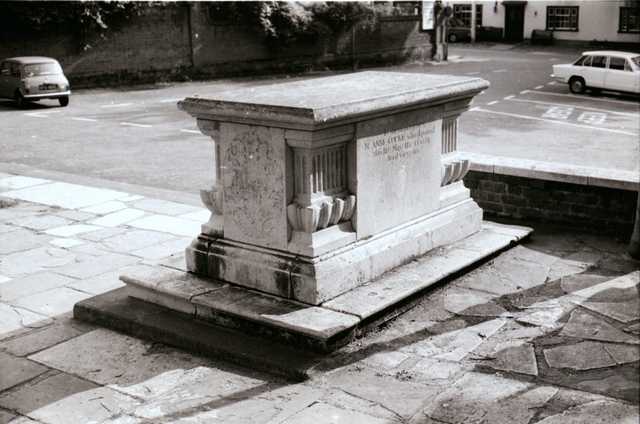 The tomb of Mrs. Anne Cocke in St Martins
Cloudesley S Willis’ article Ironwork in Epsom and Ewell from Surrey Archaeological Collections (Vol. XLVIII, 1943), mentions that:-
‘In Epsom Churchyard the armorial table tomb of Mrs. Anne Cocke, who died in 1734, had a tall grille with arrow pointed heads; but this ironwork was swept away when the western approach to the church was altered a few years ago’.
South Face Inscription
‘Sacred to the Memory of ELIZABETH Late Wife of MICAJAH PERRY Esq. Daughter of Mr. RICHARD and MRS. ANN COCKE who was posses’d of many great and good qualities Being a tender faithfull and affectionate wife; An agreeable compansion A wise and sincere friend A kind and generous relation A foe to no one Benevolent to all She lived many years in this Parish. Esteemed, Beloved, and Honoured by all who knew her, And Died Universally lamented On the 10th day of October 1738 In the 39th year of her age. ‘
North Inscription.
‘To the Memory of MRS. ANNE COCKE who departed this life May the 14th 1734 Aged 68 years.’
Other family members remained active in Epsom, at least with involvement in financial transactions.
A Deed Poll, on 22nd May, 1736, stated that Abraham Cock, gent., of London and Dorothy Cock, Anne Cock and Judith Cock, spinsters, were paid £50 in respect of the Cock family’s claim for compensation in respect of a mortgage assigned to Abraham Cock. [Northey Papers, SHC reference 3636/Box 5]. There are also numerous references and papers relating to the Cocks and their disputed claim in another bundle of papers [SHC reference 2238/10/45/1- 33].
Abraham Cock ‘of London’ may be identifiable with someone of that name, from St George the Martyr, who had married Ann Bachelor on 27 September 1731 at St Benet’s, Pauls Wharf. Abrahan Cock, Esq., of Little Grosvenor Street, Bedford Row, died on 1 August 1770.
[Hylands/Whitmores], formerly in the possession of Anne Cock had been sold on 28 July 1744 by Micajah Perry for £700 to Ann Cock of Epsom, spinster, – ‘a messuage, outhouses, stables, coach houses, buildings, yards. gardens and orchards, two pightles of land with 6 acres, and 121 acres of land in the common fields’. Anne Cock sold this property on 26 May 1747 to Samuel Smith, citizen and goldsmith of London. [Lehmann 3B1]
The Will of Anne Cocke, Spinster, of Epsom came to be proved on 27 September 1785.
Micajah Perry III (1694 – 1753)
A biography of this gentlemen may be found in The History of Parliament.
The first Micajah [Micaiah] Perry was admitted as an apprentice for seven years in the London Haberdashers Company during 1656, his father then resided in Glasgow.
Becoming a Freeman of the Company, Micaiah Perry of the parish of Mary-le-Bow, London, “haberdasher” was licensed on 20 October 1663 to marry Ann Owen of the parish of St Swithin, London, spinster, daughter of Dr. Richard Owen, an Anglican clergyman. About 1666 Micaiah Perry began to trade in tobacco with Virginia. By 1673 he had become associated with Thomas Lane and in 1694 the firm was operating as Perry, Lane & Co, having been reorganized to include a son Richard Perry.
Perry, Lane & Co came to be paramount the tobacco trade: the company owned and operated ships which were sailed back and forth to the Jamestown Colonists, bringing food and supplies over from England and taking back tobacco, lumber, and other items that were available in the New World. The fim were involved with The Royal African Company (founded in 1672), becoming responsible for the ‘freight and care’ of slaves. Micajah Perry had several brothers, sisters and other relatives in Virginia. His brother Peter Perry, a resident in York County, Virginia, was the local or New World representative for the large commission business in which colonists at Tidewater, Virginia, consigned their tobacco and other produce for market.
As noted above, Micaiah (I) married Ann Owen and Richard became their only surving son. He married Sarah Richards, the daughter and sole heir of another major tobacco importer, George Richards.
Richard and Sarah had two sons, the elder Micajah (III), and three daughters.
The Will of Richard Perry [Micajah III’s father], dated 15 April 1720, was proved at London, 4 May following. [Wife Sarah. ‘My father settled his estate in Leadenhall Street on me’. Sons Micajah and Philip , daughter Sarah Perry, daughter Mary Perry, 3,000l. , daughter Elizabeth Perry, 1,000l.]
“He had already provided for his eldest daughter Sarah (1702-1763) on her marriage in 1719 to William Heysham (1691-1727), M.P. for Lancaster, son of William Heysham (1666-1716), M.P. for Lancaster and London. Of an old Lancaster family, the senior William Heysham and his older brother Robert had become major West India merchants of London. To his next daughter, Mary, Richard Perry IV left £3000 in Bank of England stock, and to his youngest daughter, Elizabeth, £1000 in South Sea stock.His half interest in the partnership with his father went one-third to his older son, Micajah III, one-third to his younger son, Phillip, and one-third to his wife, Sarah.
Richard’s son, Micaiah,junior, became head of the firm, aged 26, upon his grandfather’s death in 1721, Richard having predeceased. It was then indisputably the leading tobacco importing firm in London and all Britain, probably in the world. However, young Micaiah was not the man his grandfather had been and trade began to suffer. His role in politics also became less circumspect and he earned powerful enemies through his Whig policies.”
Will of Micajah Perry I, London, 22 December, 1720.
Micajah Perry [I], Virginia Merchant, died at his house in Leadenhall Street on 1 October 1721
“This I leave as a Scheme of my last Will and Testament tho’ intend to do it in a more ample Forme but if any way diverted by any accident Do declare this to be my last Will and Testament written by my own hand (that is to say) I give to Christ’s hospital One hundred pounds, I give to the workhouse One hundred pounds, I give to Mary and Susana Low each Fifty pounds, I give Sister Elizabeth Evans twenty pounds p Annum during her Naturall life. I give to my two Grand Daughters Mary and Elizabeth fifteen hundred pounds between them out of the money due to me from the cash in trade to be paid as their father what he hath left them by his will, I give to my said grand daughters further my lease of Eaton in Bedfordshire that I hold of Trinity College in Cambridge with all the Profitts from the time of my death I say my grand Daughter Mary and Elizabeth, I give grandson Micajah Perry my third part of Chester’s Key [warehouses etc, on the River Thames at Allhallows, Barking, London] to him and his heirs for ever. I give and bequeath to my two Grand Sons Micajah and Phillip Perry all the rest of my Money due to me and half part in Trade and all my Interest in Shipping and Debts due in trade and in any place what ever the Just Debts being first paid. I give to my Grandson Phillip all my household goods of what kind soever and do desire to be buryed in Bishope Church in the Middle Isle near the Step into the Chancell, where my dear wife lyes. This is all at present that I shall mention till I may have an opportunity to do and Settle in forme and do appoint my daughter Sarah Perry with her two sons Micajah and Phillip Perry my Executors.
Witness my hand the day
and Year above written Micajah Perry.
Signed, Sealed, published and declared to be the last Will and Testament of Micajah Perry in the
presence of us this 27th September, 1721, John Warr, James Johnston, Jonathan Walker.
Following the testator’s death in the parish of St Catherine Cree, London, his Will was proved 3 October 1721 by Executrix Sarah Perry, widow. Old Micajah Perry was interred at St Botolph’s Bishopsgate on 10 October 1721.
About the time Micajah III came into his inheritance he married Elzabeth Cocke. Their families had various local connections, in particular the Cock(e)s traded in Aldgate and The Stocks Market either end of Leadenhall Street where the Perrys’ premises were located.
Diary of Micajah Perry, Lord Mayor of London, 1738-9
In the preface to A Lord Mayor’s diary, 1906-7, to which is added the official diary of Micajah Perry, Lord Mayor 1738-9, Sir William Purdie Treloar (1843 – 1923) explained that:-
“[The grandson] Micaiah (or, as he wrote his name, Micajah) Perry was a merchant residing in St. Mary Axe, in the Ward of Aldgate. He was elected Alderman on the 24th of February, 1728, and, almost at the same time became Master of the Worshipful Company of Haberdashers. In the previous October (1727) he was elected one of the three Whig Members of Parliament for the City, the fourth being a Tory.
He served the office of Sheriff in 1734-1735, and on Michaelmas Day, 1738, was elected Lord Mayor, assuming office on the 28th of October following, when he was forty- three years old. He lost his wife on the 10th of October, 1738, and he lost his seat in the House of Commons at the General Election in 1741 perhaps because he had the support of the Dissenters, although he was then the Ministerial candidate. He was never knighted, probably because up to 1741 he had persistently voted against Walpole and the Government.
He was Colonel of the Orange Regiment 1738-1745. The City Train Bands were then divided into regiments distinguished by colours, the territorial limits of the Orange Regiment coinciding with my own Ward of Farringdon Without.
[In 1743, it was reported that Micajah was ‘Dying of Dropsy’ (elsewhere ‘The Palsy’) and had withdrawn to Bath.] He surrendered his office of Alderman in November, 1746, on account of ill-health, and at the same Court his brethren voted him two hundred pounds per annum, which payment was continued until he died in January, 1753. His ill-health is evident from the fact that the document was signed with his mark, and witnessed by Sir John Bosworth, the City Chamberlain, and Ann Cocke, a relative [sister] of his deceased wife.
I cannot discover the cause of the change in Perry’s circumstances; but I find that on the 2nd of December, 1746, the Chamberlain acquainted the Court ‘that Micajah Perry, Esq., late Alderman of the Ward of Aldgate, desired him to return his most humble and hearty thanks for their generous and kind concern for him and for the seasonable support they have given him in his present necessity’.
The family of Perry must have been well-to-do at one time, as is evidenced by a notice in a contemporary newspaper, announcing the marriage of a Mr. Cade to Miss Perry * , sister of Mr. Alderman Perry, a young lady of £10,000 fortune.
There is a fine full-length portrait of Perry in his official robes at Haberdashers’ Hall.
On the 28th of October, the day Perry left office, he records that, ‘The day being Sunday, no ladies were invited, and I only entertained the Aldermen above the Chair, the Officers of Guildhall, and the Haberdashers’ Company’.Apparently, after paying this easy tribute to their true Sabbatarian instincts, the gentlemen contentedly enjoyed their dinners as well as they could without the ladies. Three days before he left office he laid the chief corner-stone of the present Mansion House. It seems to have been a very quiet affair. He says, ‘ After attending adjourned Quarter Sessions at Guildhall Violet I afterwards put on the Scarlet Gown, and went to Stocks Market, attended by several Gentlemen of the Committee appointed to erect a Mansion House for the Lord Mayor of this City in their Gowns, preceded by the City Musick and my Officers with the Sunday Sword and Mace, and laid the chief corner stone of the said Mansion House, and placed therein copper plate with an inscription engraved thereon, and afterwards returned home’.”
‘The Corpse of the Lady of Micajah Perry, Esq., Lord Mayor Elect, was privately interr’d at Epsom Church in Surrey’, 17 October 1738.
Reportedly trained as a clerk in a Philadelphia merchant house, Micajah lacked the business acumen of his forefathers and proved unable to compete with incursions of Scottish merchants into the Chesapeake tobacco trade. His merchant house suffered from growing debt problems of the planters and a misjudged decision to use his own ships which often sailed uneconomically half-full. He also had became diverted from his mercantile business by duties as an alderman and political activities.
On 17 January 1730, Woolwich Ropeyard was reported to have received 3 hogsheads of Virginia hemp from Micajah Perry, which has been surveyed and worked up to make an experiment of its nature, strength and usefulness for the Service. It was found ‘inferior’ [National Archives ADM 106/825/106].
The need for sale of Hylands House , Epsom, on 4 December 1734, and his quays and warehouses in the London docks during 1735, indicate a decline in Micajah’s fortune.
Alderman Micajah died 22 January 1753, intestate, in relative poverty, and was buried at St Martin of Tours, Epsom, the 26 January following. He was survived by his mother, brother, and two sisters [Philip, the brother, was a merchant of London. Sarah, his first sister, born 31 August 1702, of St. Catherine Cree Church, married on 1 October 1719 in the Gray’s Inn Chapel, William Heysham, of E. Greenwich , M. P. for Lancaster, who was born 10 December 1691, and died 14 April 1727; M. I. at St . Paul’s, Waldon, Herts; will dated 22 April 1725, proved 28 June 1727. Elizabeth * , his second sister, married, 1733, Salusbury Cade, Esq. The arms of Perry as impaled on the Heysham tomb are: On a bend between two cottises ermine three lions passant granted in 1700.]
Brian Bouchard 2019