
Sir John Bosworth, Knight (1694 – 1752)
Chamberlain of London, 1734 – 1751
John Bosworth had married Hester Neale about 1713. A nunber of their children died in childhood, including Katherine born 1 September 1717 & Noah born in 1721, but John, junior, baptised at St Stephen Coleman, London, 21 March 1722/3, survived, as did the eldest som, Richard from c. 1719 until 1745.
The elder John became a merchant in Newgate Street, Lomdon, in partnership with Morrice/Maurice Griffith, from Maesyed [New Radnor], Wales, importing tobacco from Virginia.
A Topographical Dictionary of London and Its Environs …, by James Elmes, 1831, recorded:-
“The office of Chamberlain of London* was anciently vested in the crown, and appears to have been a profitable office… in 1734, there was a severe contest between the partizans of the ministry and the independent members of the livery. The candidates were Mr. John Bosworth, a tobacconist, of Newgate-street; Mr. William Selwin, a silkman, in Paternoster-row; and Mr. John Thomas, a fishmonger, near the Monument, who, having no shew of hands at the commonhall, withdrew. The numbers, however, for the other two candidates appeared so equal, that a poll was demanded by the friends of Mr. Selwin against Mr. Bosworth, who was declared, by the sheriffs, to have the majority. Mr. Selwin having solicited the ministerial party to oblige all their dependants to vote for him, offended the independent liverymen, although he had been previously as well respected by his fellow-citizens as his competitor. The contest lasted seven days, and was the warmest then ever known, the citizens being determined to preserve their freedom of election against any ministerial influence. On the close of the poll, the numbers appeared so equal, that a scrutiny was demanded, and when the final declaration was made, it appeared that Mr. Bosworth’s number was 3212, and Mr. Selwin’s 3208. In consequence of which, to the great satisfaction of the independent part of the citizens, Mr. Bosworth was declared to be duly elected Chamberlain of the City of London, and was subsequently knighted by the king. The ministry, however, resented it, by taking away the office of receiver-general of the land tax from the Chamberlain, and conferring it on their disappointed friend Mr. Selwin.”
The London Magazine, Or, Gentleman’s Monthly Intelligencer, Volume 3 for 1734, reported the death –
‘At Stamford in Northamptonshire, Noah Neale, Esq; Steward for many Years to the Earl of Exeter; he was Father of Mrs. Bosworth, Wife of John Bosworth, Esq; Chamberlain of London’.
‘Micajah Perry [of The Hylands, Epsom, another Virginia Tobacco Merchant ] surrendered his office of Alderman [in the City of London] during November, 1746, on account of ill-health, and at the same Court his brethren voted him two hundred pounds per annum, which payment was continued until he died in January, 1753. His ill-health is evident from the fact that the document was signed with his mark, and witnessed by Sir John Bosworth, the City Chamberlain, and Ann Cocke, a relative of his deceased wife’ [both fellow residents of Epsom]. In 1746 Miss Anne Cocke, sister of the late Mrs Elizabeth Perry, was living at Hylands, later Whitmores: her Will, spinster of Epsom, came to be proved on 27 September 1785.
Sir John Bosworth’s country estate in Epsom
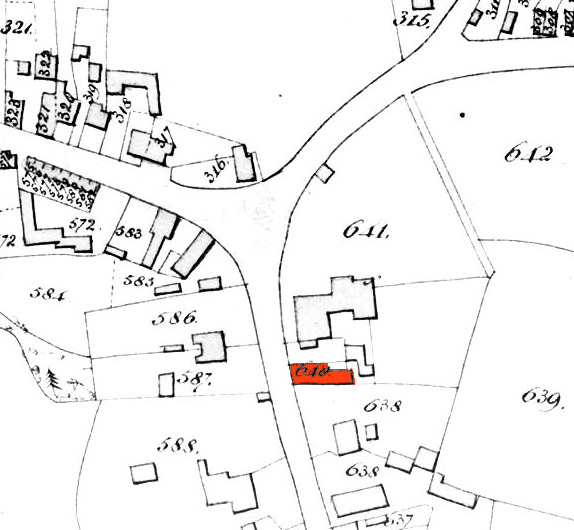 Plot 640 from 1843 Tithe Map.
During 1740, plain John Bosworth (knighted 1745) purchased an estate in Epsom on what was then Church Street, but has become part of East Street, lying between Clayton Road and the present railway bridge.
The RESIDENTIAL COPYHOLDS of EPSOM, from the Records of the Manor of Ebbisham 1663 to 1925 , by H.L. LEHMANN details the transaction in the following extract: –
“9B19. Thomas Tegge’s messuage in Church Street descended with his other properties (6B6, q. v.) to Henry Cooke of Byfleet, maltster, who on 24 Mar. 1740 sold to John Bosworth Esq, Chamberlain of the City of London, the messuage on the east side of Church Street, together with the buildings, garden, orchard, courts, yard and ground thereunto belonging, as the same now are in the possession of the said John Bosworth, William Dawson acting as attorney. John Bosworth surrendered the property to uses: to himself and Hester, his wife, and to his will. The Lady Bosworth died on 5 Sept. 1749 (Gentlem. Mag.1749,429), and Sir John Bosworth on 3 Aug. 1752 (ibid.1752, 384). In his will dated 22 Feb. 1752 he devised his· messuage on the east side of Church Street lately in his possession, to his dear wife Dame Elizabeth Bosworth for life, and after her decease to his son the Revd. John Bosworth, and on 4 Oct. 1752 Dame Elizabeth was admitted to the property, and John Bosworth to the remainder expectant. In 1755 Dame Elizabeth Bosworth held a messuage, coach house, stables and other outhouses, and a garden, half acre, abutting on Church Street on the south-west part, on lands uf George Eastland on the east and south-east parts, and on land of the said Lady Bosworth (9B20) on the north part.
9Cl9. On 14 Jun. 1756 the Revd. John Bosworth of Oriel College, Oxford, actmg on his own behalf and on that of Dame Elizabeth Bosworth of Epsom, widow, sold the messuage and garden (9C20) now in the occupation of Dame Elizabeth Bosworth, to Priscilla Holden of Bedford Row in the parish of St. Andrew Holborn, Middx, spinster.”
Memorial Inscriptions
Christ Church, Newgate Street, London, was gutted on 29 December 1940 during the Blitz. Londinium Redivivum: Or, An Antient History and Modern Description, Volume 3, 1803, by James Peller Malcolm had recorded amongst the memorials there, including:-
“Between the South-east corner and a window in the chancel is a handsome tablet, with a pyramid, urns, and drapery for the inscription.
Sacred to the memory of Sir John Bosworth, knt. chamberlain of the city of London, receiver general of the land-tax for the cities of London and Westminster, and county of Middlesex, and one of his Majesty’s justices of the peace for the county of Surrey; whose extensive capacity, sound judgement, and unbiased integrity, rendered his publick charaćter universally admired; whose conjugal affection, paternal love, and social virtue, were the distinguishing ornaments of his private one. The former recommended him to the regard of his King, to the veneration of his fellow citizens, and to the honours conferred upon him by both; while peace of mind, and serenity of temper, with the happy train of domestic joys, crowned the latter. It is difficult to determine whether the discharge of his high trusts gave more satisfaction, or the resignation of them more concern, to his constituents; but both reflected the greatest honour on himself. He died August 3, 1752, aged 58.
Sacred to the memory of Dame Hester Bosworth, daughter of Noah Neale, of Stamford Baron, in the county of Northampton, esq. and wife to Sir John Bosworth, knt. chamberlain of the city of London, with whom she lived upwards of thirty-three years, happily united by conjugal affection and the sincerest friendship; and had issue eight children, of whom only two sons, John and Samuel, survived her. She was amiable in her person, and in her conduct prudent, her piety exemplary, her charity diffusive, and her benevolence universal. She died Sept. 5, 1749, aged 56
In memory of Dame Elizabeth, the second wife of Sir John Bosworth, whose eminent virtues procured her universal esteem in this life, and will obtain a better reward in that which is to come. She died without issue, Aug. 30, 1758, aged 55.
[Sir John Bosworth’s second marriage to Elizabeth Searle had taken place during 1750.
An assignment in trust (Sir John Bosworth to John Bosworth and Charles Searle) from 1752 may be found at Kent Archives Office, reference U513/T23]
On the pavement before this monument is a blue stone, inscribed:-
In memory of Richard Bosworth, esq., eldest son of Sir John Bosworth, kt, and Dame Hester his wife. He married Mary, the youngest daughter, and co-heiress of Richard and Barbara Johnson, by whom he left two sons and one daughter. He died Jan. 22 1745 in the 27th year of his age.
On another adjoining stone is an ardent collection of praises, dedicated to the memory of Katherine, sister to the above gentleman, who was born Sept. 1, 1717, and died Jan. 26, 1731.”
Richard Bosworth (c. 1719 – 1745)
A copy of the Marriage Articles of Richard Bosworth and Mary Johnson is held by Surrey History Centre, SHC G43/464, dated 18 December 1740.
A draft agreement to advance money for co-partnership; Richard Bosworth and John Bosworth of Newgate Street, London, tobacconists, from 1741 is held in Kent Archives Office [amongst Smith-Marriot papers], under reference U513/B1. This appears to have been a separate enterprise which traded as Richard Bosworth & Co.
Richard is recorded as Master of the Worshipful Company of Musicians in 1745 but as noted above he died on 22 January in that year.
Miscellaneous receipts and accounts including list of clothes, jewels, horse furniture, arms etc belonging to Richard Bosworth are held in Kent Archives Office, reference U513/E/9
A release and quitclaim dated 23 March 1768, related to Richard Bosworth’s complicated Will, is lodged at Surrey History Centre under reference SHC G43/469.
His two sons, Richard & John, and daughter, Catherine, are found mentioned as grand-children in the Will of Sir John Bosworth but the boys seem to have died before 1773. Catherine Bosworth married the Rev. James Marriott (b. 24 October 1743) of Spelmonden, Kent on 19 May 1767. ‘In the chancel, [of Horsmorden Church] on the north side, a neat marble monument to the memory of the Rev. James Marriott, LL.D. twenty-four years Rector of this parish, who died July 31st, 1809, aged 65 years: adjoining it, another for Catherine, relict of the above, last representative of the family of Bosworth, of London, who departed this life 9th Jan. 1819, aged 76 years’.
The Will of Sir John Bosworth of Epsom , Surrey, was proved 12 August 1752. [PROB 11/796/386]
It had opened by specifying that he should be ‘buried in the shirt and breekin [breeks, breeches or pants] in which I shall happen to dye, and not to be exposed to indiscreet handling by Undertakers or others, at Christ Church, City of London, near Dame Hester Bosworth… present wife to lye on the other side of me…’
At that date the firm, Bosworth & Griffith, was capitalised at £10,000 and Sir John’s 1/3rd interest passed down to Samuel.
Executorship papers of Sir John Bosworth, Chamberlain of London, are preserved in Kent Archives Office, reference U513/E/6.
The Dawson/Searle connection to Epsom
Mr William & Mrs Ann (nee Searle) Dawson, appear to have shared a home with her two sisters Susanna and Elizabeth. ‘On 24 Jun.1738 [Henry Cooke] obtained a licence to let all his messuages and lands for 21 years to William Dawson, citizen and merchant taylor of London. On 20 Mar. 1740 Henry Cooke sold his properties… The messuage on the south side of the church footway, erected on part of one acre of land in Dulls shott, together with the buildings, gardens, orchards, courts, yards, and inclosed ground thereunto belonging, in the tenure of William Dawson, together with some pieces of land, he sold to William Dawson’. These premises descended to Samuel Bosworth as detailed below. Sir John Bosworth had married secondly Elizabeth Searle in 1750.
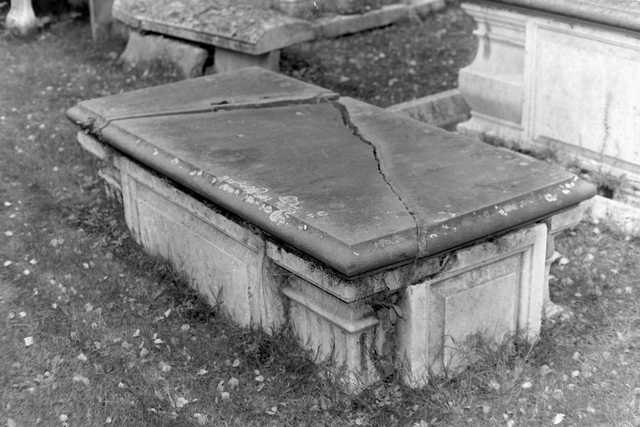 The Searle tomb in St Martins Graveyard
An altar tomb in St Martin’s churchyard bears the following inscriptions: –
North Face
‘Here lieth the Body of MRS. SUSANNA SEARLE who died the 1st of June 1751’
Top
‘Here lieth the body of WILLIAM DAWSON Citizen Merchant Taylor of London Many years Deputy Alderman of Aldgate Ward. He was A man of singular piety and goodness and in every station of life Behaved with a religious uprightness and integrity of mind A kind Master A Sincere Friend An affectionate Relation which good qualities Adorned with an uncommon sence share of Modesty and Humilty procured him the esteem and respect of all that knew him He married ANN Daughter of JOHN SEARLE (of Farnham) in the County of Surrey Esq. and died without Issue the 15th of November 1750 in the 66 Year of his Age’
Rev John Bosworth (1722 – 1785), Fellow of Oriel College
Born 15 March 1722 and attended Merchant Taylors’ School before going up to Oriel College, Oxford.
Admitted Commoner, 15 Dec. 1741 : Caution received 19 January 1741, aged 18. Matric. Oriel, 17 Dec. 1741, fil. Joh. de Civ. Lond.arm. B.A. Oriel, 18 June 1745. Entered at Lincoln’s Inn, 24 May 1739, son of John Bosworth, Chamberlain of the City of London. Elected Fellow, 24 April 1747. M.A. 9 July 1748, B.D. 29 January 1768, D.D. 11 February 1768. Rećtor of Tortworth, Gloucestershire.
Between 1768 and 1770 John Bosworth served as a Trustee/Curator of the British Museum.
About 200 seventeenth- century and eighteenth-century books labelled ‘Tortworth Rectory’ and containing usually the book-plate of John Bosworth (Rector, died during 1785) are in the library of Oriel College, Oxford, including an Aldine De Rustica, 1514, and a Coverdale Bible, 1540.
On 20 October 1779, at the Old Bailey, “LEA JOSEPH SOLOMONS was indicted for that she on the 21st of August, about the hour of twelve in the night, wickedly, maliciously, and unlawfully, did set fire to a certain pair of wooden chest of drawers, and to a certain chest being in a certain room up two-pair-of-stairs, in the house of John Bosworth , D. D. of which house she was tenant, with an intent feloniously to set fire to the said house” . These premises were at 1 Oxford Arms passage Warwick Lane, off Newgate Street, London. [Fire insurance papers for houses in Warwick Lane1788 & 1795, are held by Kent Archives Office, reference UI513/E/13.]
John Bosworth, D.D., Fellow of Oriel College, son of Sir John Bosworth, Chamberlain of the City of London, died 17 October 1785, aged 63. A memorial was erected in Tortworth Parish Church, by Wood of Bristol, plain plaque with urn – ‘Sacred to the Memory of the Revd. John Bosworth, son of Sir John Bosworth, knt. formerly fellow of Oriel College, Oxford, Rector of this Parish, and one of the proctors in Convocation for the Diocese’.
Samuel Bosworth (1726 – 1795)
Having attended Merchant Taylors’ School, on 22 February 1742, Samuel was bound apprentice to his father, Tobacconist and member of the Musician’s Company. He became Master of the Worshipful Company of Musicians in 1753.
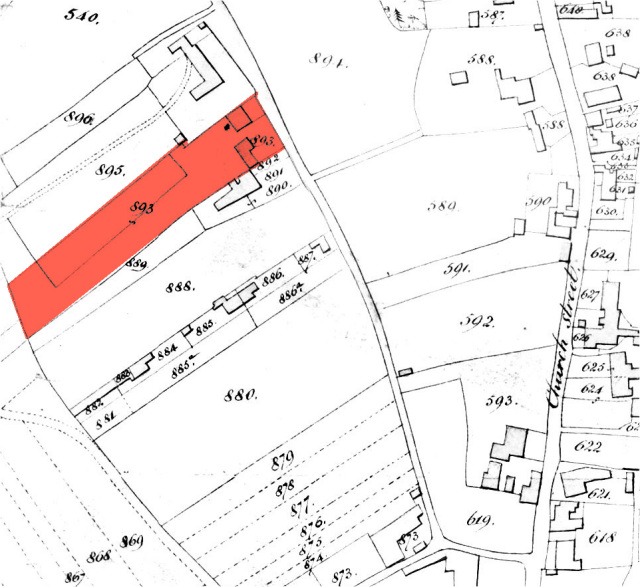 Epsom Tithe Map Plot 893
Samuel’s house on Church Parade, Epsom: Lehmann’s compliation of the copyholds of Epsom includes at 6B6: –
The messuage on the south side of the church footway, erected on part of one acre of land in Dulls shott, together with the buildings, gardens, orchards, courts, yards, and inclosed ground thereunto belonging, in the tenure of William Dawson, together with some pieces of land, [Joseph Shaw] sold to William Dawson. At the death of William Dawson of Epsom Esq [see Memorial inscription above], the property came under his will dated 6 Mar. 1746 to his sister [in law] Susannah Searle, who was admitted on 4 Dec. 1750, and on 3 May 1751 Charles Searle of the Inner Temple, London gen, acting for Susannah Searle, spinster, (sic) devisee of the last will of William Dawson, sold the property together with the half acre of land adjoining (6B7) to James Gibbon of Epsom Esq, who sold it on 4 Jun. 1751 to Samuel Bosworth, the younger son of Sir John Bosworth of London, Knt. (see 9B19).
In 1755 Samuel Bosworth held a messuage, coachhouse, washhouse, stables and garden, 1 acre, formerly common field land and part of Dulls shott, and half acre of inclosed ground (being formerly part of Dulls shott), abutting on the house and garden of the said Samuel Bosworth on the north-west part.
Samuel Bosworth of Epsom Esq. sold on 25 Jul. 1763 his messuage erected upon 1 acre of land in Dulls shot, together with the buildings garden orchard, courts, yards and enclosed ground thereunto belonging… [later the site of Rosebery Cottage, 14 The Parade, Epsom]
Evidently , after Sir John Bosworth’s second marriage to Elizabeth Searle in 1750, Samuel set up his own establishment in Epsom, acquiring a property inherited by his stepmother’s late sister.
Samuel Bosworth & Griffiths continued as a firm of tobacconists in Newgate Street in London. On 15 December 1752, it was announced :-
“The Snow [snow, snaw or snauw, a square rigged vessel with two masts, complemented by a snow- or trysail-mast stepped immediately abaft (behind) the main mast] ‘Fanny’, Capt. Charles Thomas, will be ready in Rappahanock to take in Tobacco by the first of April at 7 l. per Ton, to Messrs. Bosworth and Griffith, Merchants in London. All Gentlemen who are inclinable to open a Correspondence with those Gentlemen, are desir’d to send their Orders to the Hon. Philip Grymes, Esq; in Middlesex, Col. Francis Willis in Gloucester, Mr. Benjamin Grymes, in Spotsylvania, or to the Captain at Norfolk, and they may depend on having their Orders punctually executed”.
An alleged diversion of a tobacco consignment is reflected in the following letter:-
“Messrs Bosworth & Griffith.
Gent.
Your Letter of the 10th of August, 56 came to Hand. I think one of such a stamp enough to convince me who I had to deal wth Gent if I may so stile you pardon my boldness, you mention my having drawn on you for a sum of money and shipped my Effects to another House but this you say without foundation for I never shipped Messrs Stanbury a pd. of Tobacco my Days and what he had by the Swift was ship’d him by my Father’s Executors I wrote you a letter after the Swift had sailed from hence to acquaint you that those Tobacco I did propose sending you were neglected by the Capt: indeed I must own it now does not give me any uneasiness for I’d rather pay ten pr. ct. for such a sum of money than be concerned wth you. Indeed I never had thought of it, had I not been overpersuaded by a worthy Gent. who had he lived would have been surprized at such Behavior from persons who I believe he entertaind a great opinion : a man of means you likewise tell me what is known and that is that my word should be my Bond..
I am Yours George Braxton.
I’ve always acted to the best of my Knowledge consistent wth the strictest Rules of Honour & Justice wch when I deviate from may I deservedly censured and rebuked by even you. G. B.”
[Probably George Braxton the third (1734 -1761) of Newington Plantation, King and Queen Co., Virginia, brother of Carter Braxton, who died heavily indebted to London Merchants.]
The firm was mentioned in a letter from George Washington to Robert Cary & Company, 13 June 1763:-
“You leave me in suspence about sending a Ship into Potomack this year, and whether I am to keep my Tobacco in expectation of this event or not, I cannot easily determine; I have already refused some offers on liberty, and if no Vessel comes from you, or timely advice of the contrary, I may possibly encounter another disappointment in the disposal of my Tobacco: Inclosed is a Bill of Exchange on Messrs Bosworth & Griffeth for £194.5s.5d. which please to receive & credit my Account for. I am Gentn Yr Most Obedt Hble Servt Geo, Washington”
The Stamp Act of 1765 (Duties in American Colonies Act 1765; 5 George III, c. 12) imposed a direct tax on the American colonies. After much ado, a resolution was introduced in Parliament on 21 February 1766 to repeal the Stamp Act, and it passed by a vote of 276–168. The King gave royal assent on 18 March 1766. Messrs Bosworth and Griffith opined in correspondence with suppliers in Viginia that this provided ‘a return to tranquillity’ but the American War of Independence followed, lasting until 1783.
The Compleat Compting-house Companion, 1763 – 1767, has Samuel Bosworth & Griffiths trading as tobacconists in Newgate Street – in 1779 at 18 Warwick Court, merchants.
Samuel Bosworth was buried ‘in the south choir at Christ Church, Newgate Street’, 7 March 1795. The Gentleman’s Magaazine had reported his death in Essex Street, last surviving son of Sir John Bosworth, knt., late chamberlain of the city of London.
Morrice/Maurice Griffith (1715? – 1777)
Few personal details have been established for the Bosworths’ business partner. Maurice is thought to have married Mary Parker in Norfolk on 30 June 1736. He and his wife Mary had a daughter, called Elinor (born 22 July 1742, baptised Christ Church, Newgate Street, London, 4 August 1742) who married John Turner on 25 January 1765. Between 1751 and 1775 the Griffith’s abode seems to have been 5 Shorter’s Court, Throgmorton Strret, London – where he was described as ‘Virginia Merchant’.
Joshua Johnson’s Letterbook, 1771-1774 [ Letters from a Merchant in London to his Partners in Maryland, ed. Jacob M Price (London, 1979), pp. 23-40.British History Online http://www.british-history.ac.uk/london-record-soc/vol15/pp23-40] mentioned, in 1772,
‘ I was applied to by Mr [Maurice] Griffith to get someone to settle an account with the Revd R. Ried for him. I recommended you and hope you will oblige me in doing it; should there be any occasion of a suit, commence it immediately and transmit me an account of expenses as they accrue. Mr Griffith is a manufacturer of tobacco and a Virginia merchant; on the whole he is a plain old fashioned gentleman and is fond of giving me any instruction in his power’.
In 1775 an Act was passed (15 Geo. 3, cap. 58) ‘for Lighting the streets, lanes, roads, and public passages within the Town of Hampstead, and parts adjacent within the Parish of Hampstead ; and for establishing a nightly Watch therein, and a Patrole between the said Town and London’. Commissioners were appointed to carry the Act into execution, consisting of the minister and church-wardens of the parish for the time being, the resident Justices of the Peace for Middlesex, and thirty-three inhabitants including Maurice Griffith named amongst the latter.
The Will of Maurice Griffith, Merchant of Shorters Court Throgmorton Street , City of London, dated 8 July 1773, came to be proved on 3 April 1777 [PROB 11/1030/25]. His interment at St John’s, Hampstead, had taken place on 29 March 1777.
Brian Bouchard 2019
* The Chamberlain of the City of London is an ancient office, dating back to at least 1237 and is the financial adviser, accountant, receiver and paymaster and is responsible for the City of London’s local and private / trust funds.