
2nd Ewell (Rainsters) Scouts
1929–2019
 2nd Ewell (Rainsters) Scouts
Image courtesy of Bourne Hall Museum
1857. February sees the birth of Robert Stephenson Smyth Powell, later Baden-Powell.
1899. B-P becomes a national hero during the Siege of Mafeking. During the Second Boer War in South Africa he has successfully defended the town of Mafeking through a siege that lasted seven months. Because his troops were vastly outnumbered, he used local boys to administer first aid, carry messages, and run errands. On returning to the UK, he realises that boys at home could benefit from the same activities. These skills form the basis of the Scouting movement.
1900. Two boys write to tell B-P that they have formed the ‘Baden-Powell Scouting Society’.
1907. August sees an experimental camp set up on Brownsea Island.
1908. B-P writes up his ideas in Scouting for Boys, one of the top ten best-selling books of the 20th century. Scouting takes on a life of its own as groups of boys across the country begin to organise themselves into Patrols, using B-P’s book as the basis for camps and activities, and persuading adults to become their leaders. B-P tells them to ‘Be Prepared’ (based on his initials), still the Scout motto today. The first issue of The Scout in April includes a competition to attend General Baden-Powell’s holiday camp in Chollerford, Northumberland; one of the winners is Ronald Rawson, age 15, of Durdan Lodge in Epsom. Durdans was the home of the former Prime Minister Lord Rosebery. Ronald is the first local known Scout; he went on to be the Assistant Scout Master of the Christ Church troop.
1908. August sees the first official Scout Camp run by Baden-Powell at Humshaugh and in October the first warrant is issued for a Scout Master in Epsom, made out to L. Longhurst of Stamford Cottage, West Hill.
1909. In May the ‘British Boy Scouts’ are formed. A camp on TS Mercury leads to the formation of the Sea Scouts.
1910. Girl Guides begin in January. In June the Epsom and District Boy Scout Association is formed after a meeting at in the Church Rooms at West Hill.
1910. The First Ewell troop is formed followed in March by the Christ Church troop. The first annual census in September finds that there are 100,298 Scouts and 7,688 Scouters.
1911. There are eight troops in the area with 144 Scouts and 17 Scout Masters.
1914. During World War 1, Scouts volunteer for coast watching, supporting the coast guard and signing to ships; for farm work at harvest time, including work in France; to be on call at Government offices and Police Stations acting as messengers by foot and bike; to raise funds
for ambulances; to guard railway stations and telegraph and telephone cables; and to act as stretcher bearers on the Home Front for wounded soldiers in hospitals. There is a Scout camp on the Fair Green at West Hill to guard railway bridges at West Street and Castle Road.
1916. Scout Jack Cornwell is posthumously awarded the Victoria Cross, aged 16. The Cornwell Medal is instituted in September. December sees the Wolf Cub Section started.
1918. Senior Scouts are renamed Rover Scouts.
1920. The First World Scout Jamboree is held at Olympia, London, in July.
1922. The Epsom and District Boy Scouts Association is newly formed with Lord Rosebery as President, and their Jamboree is held in the field off Horton footpath.
1923. The woggle is introduced.
1929. The first meeting of 2nd Ewell in the Music Room at Glyn House in November is attended by sixteen Scouts. The 2nd Ewell will later become known as the Rainsters as it always rains when they go camping. Les R.J. Absolon is the first Scout master and Len Yates is picked out to be one of the first patrol leaders. There are three patrols: Rattlesnakes, Rams and Tigers. The first uniform is khaki shirts and shorts with green scarves. In November there is a public rally at the Ebbisham Hall where a film of the 1929 Jamboree is shown.
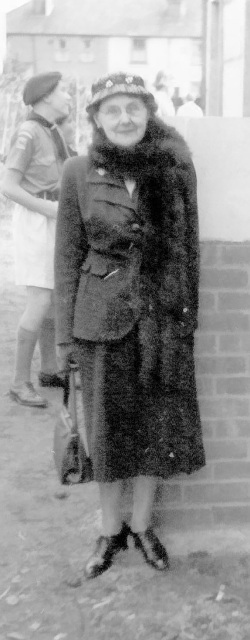 Mrs. Absolom – first Akela of 2nd Ewell
Image courtesy of Bourne Hall Museum
1930. In January, the first five Scouts of 2nd Ewell get their uniforms; on March 23rd they hold their first Church Parade. They are divided into Snakes, Tigers, Rams, Bulldogs and Hawks. In April colours are presented by the Ewell Rangers, the guides at St Mary’s Church Ewell by Miss Perkins. 1st Ewell join with 2nd Ewell in April. The summer camp is held at Palmers Farm near Ryde
1932. The first Gang Show is produced by Ralph Reader in October.
1934. In January there is low attendance at a meeting because of a dance in the village. The August camp is held at Niton near Ventor. Len Yates goes to National Scout Service at Windsor Castle, which is attended by the King and other members of the royal family.
1935. A new design for the Thanks Badge is designed, replacing the old one with a swastika.
1937. The summer camp is held at North Farm near Worthing.
1939. The slogan during World War 2 is ‘Boy Scouts are still carrying on’. 53,000 Scouts are trained to undertake 170 different war service jobs. They collect 35,000 tons of waste paper; work in forestry camps and at harvest time on farms; act as messengers for Police and Civil Defence; become firemen and stretcher-bearers; and rescue the injured from rubble. A National Service Badge is introduced for service during the War.
1941. In January the Air Scouts are officially recognised. 2nd Ewell invests £175 in National War Savings. The troop has 2 first class Scouts including a King Scout, 21 second class Scouts, 12 tenderfoots, and 3 new boys.
1945. Germany surrenders. Ewell Castle troop hold the record for collecting the most used razor blades: 30,000 of them. Scouts raise money by waste paper collection and by doing shopping for potatoes and chicken feed; local people used their egg ration to get chicken feed. All these activities count towards a National Service Award.
1946. An organisation for British Scouts in Germany is formed. 2nd Ewell looks for a new HQ, first at land in Old Schools Lane which has been used by Surrey County Council as a wartime Day Nursery, and then at the old barn behind Rectory Farm in Church Street. They decide they want to buy and not rent, and plan to buy an ex-army Nissen Hut. In the meantime they use Pitt House for social events.
1947. P.L. Hemmelt goes to the Jamboree in France at a cost of £17. Land in West Street behind cottages becomes available as it is turned down for factory building; the troop approach the intended purchaser of the land, Mr. Goodship of Goodship and Sanders, who agrees to £100 subject to the approval of council planning permission and as long as Scouts pay legal charges.
1948. In October Len Yates becomes Group Scout Master. He is given the Scout Wood badge.
1948. In June 2nd Ewell win every Scout and Cub trophy in the district. The summer camp is held at Charmouth. The troop discovers that it will cost £4000 to build a new HQ but can only afford £1200. They offer £35 to buy adjoining land but the asking price is £125.
1949. The first Bob-a-Job week is organised. 2nd Ewell come first in the District Patrol Competition. Work begins on the new HQ. The troop go bell ringing at St Mary’s. Night games are called off because of bad weather but the Scouts enjoy the cider they have taken with them. A St. George’s Day dance is held at Ewell Castle. Roger Pennington leaves to do National Service; he serves with a Gurkha troop and sets up a Cub Pack for Gurkha children.
1950. Scouts are forbidden to hitchhike unless in an emergency. 2nd Ewell go to Northern France with 14th Croydon Scouts; they cycle to Paris and get the train back. They go rifle shooting at Epsom College and build a raft and a catamaran out of oil drums. These look quite serviceable as long as they are on dry land in the Scout Hut. A burglar alarm is built consisting of the entire contents of the hut suspended so that it falls to the ground when a window is opened. Summer camp is held at Solton Manor near Dover. Plans for a new HQ are turned down as they would be injurious to the adjacent properties. In November games are very lively and Otter Patrol break two windows. There is a coming-of-age dance at the Epsom Baths.
1951. Summer camp is held at Milliards Farm, Chichester. As the Festival of Britain is on and there are lots of American celebrities in London they try to get one to open the fete at Glyn House but have to settle for the Mayor of Epsom & Ewell instead. The troop starts clearing and fencing the HQ site. Mr. Goodship gives the adjoining plot of land to the Scouts. In October Len Yates becomes District Scout Master.
1952. 2nd Ewell collect clothing to relieve the Canvey Island flood disaster. Summer camp is held at Charmouth. The uniform changes to maroon and grey scarf. Cubs now meet at Ewell Infants School, Scouts at West Street Ewell, Senior Scouts at the Mission Hall in 129 West Street, and Rover Scouts in West Street. The fete at Epsom Football Ground includes mass country dancing with Ewell Girls School, Stoneleigh East, Stoneleigh West, Hook Road Girls, West Ewell, All Saints Leatherhead and Riverview. Santa opens the Christmas bazaar at West Street School.
 Collecting clothes to relieve Canvey Island Flood Disaster 1952
Image courtesy of Bourne Hall Museum
1953. In February Len Yates becomes Assistant District Commissioner. Work on HQ is begun by 7 Scouters, 40 Scouts and 20 lay volunteers. Summer camp is held at Charwater.
1954. The Christmas bazaar is opened by Councillor R.D. Hodgson the Chairman of Ewell District Scouts, Santa being otherwise engaged.
1956. The summer fete is held at Epsom Football Ground with an archery display, maypole dancing, Judo, and trek cart competition.
1957. The Christmas bazaar makes £76 17s 5d.
1958. The summer fete at Epsom Football Ground is opened by Ralph Reader of the Gang Show. It features Hook Scout Band, country dancing, the Nonsuch Bowmen and obedience dogs. Dick Richens comes along with his own bath and soap but needs a suitable young lady to scrub his back.
1959. The Boy Scout Association joins the Duke of Edinburgh Award Scheme. The HQ is officially opened by Alderman Mann JP. The summer fete is held on the hockey field at Bourne Hall Girls School.
 Laying foundation stone for 2nd Ewell HQ.
Image courtesy of Bourne Hall Museum
1961. Long trousers are made optional for Senior Scouts and Rovers. Len Yates is presented with the Medal of Merit
1963. There is a burglary at Scout HQ and the tent is taken.
1965. 2nd Ewell visit Sutton Telephone Exchange. In June the colour of scarfs is changed to light blue with navy or black edging: those with old scarves pay 2/6 and those who need new scarves 3/-. Day and night hikes are held in the New Forest. The Rover Scouts go to France and Spain.
1966. Summer camp is held at Downe near Orpington. There are now a Cub Pack, Senior Troop and Rover Troop. Len Yates is presented with the Silver Acorn.
1967. Summer camp is held at Dinder near Wells. The bus breaks down two miles from Stonehenge and takes five hours to repair. In September the Advance Party Report is published, changing the nature of Scouting in Britain.
1968. The troop get to be finalists in the local Scout football cup and win the swimming gala. They visit London Airport. Summer camp is the wettest in years but despite living in mud the boys win the Batman Combat Course. A Cowboy Day is held. In October there is a service at St. John’s Stoneleigh with the troop meeting at the Rembrandt Cinema and parading up Stoneleigh Park Road.
1969. In February Len Yates becomes District Commissioner. Summer camp is held at Kingsdown near Dover.
1970. The Baden-Powell Scouts Association breaks from the Boy Scout Association. The Woodpeckers win gold award in the district camping competition, and the Badgers get silver.
Summer camp is held at Bear Cross outside Bournemouth. A letter home reads: ‘Arrived OK weather is muddy. Food is OK hedgehog steaks taste better now. Phillip received huge food parcel from loving parents. Scouter is OK now he has lost whip. Tell Michael’s parents he will be able to write soon when he is let out of the stocks. Your loving son, Tim’. The troop decides to go and see the Stewpot Show televised but the show is closed down before they can book a place. There is a sponsored walk to send a Scout to the Jubilee in Japan; money is raised by collecting Green Shields stamps. In September they enter the district conker competition.
1971. The first mixed unit is set up with Scouts and Ranger Guides. Summer camp is held at Charmouth with 2nd Stoneleigh. Bob a Job week raises £15 40p in new money. The Venture Scouts go to the Tyrol. In November the Rainsters have their own song written for them.
1971. The troop acquires a new hut, a sectional timber building 36×16 feet. A Scavenger Hunt is held to find the largest piece of grass which turn out to be six feet long but the biggest attraction on the evening is the apple tree behind the hut. The Ewell Mixed Unit goes on a venture by minibus to Austria via Liechtenstein, Switzerland, German, France, Luxemburg and Belgium. The football team wins the Scout district cup. Summer camp is held outside Charmouth with weather changeable, from wet to very hot wind to a force 9 gale which flattens the camp. Scouts visit Weymouth instead for the day, with 25p for lunch. More bad weather destroys the tents and Rick Hoye nearly has his eye ripped out and is taken to hospital. Guides come over asking for Gerald Rideout who has become the camp’s heart throb. Scout uniform now costs 30p for a scarf with 3p to 7p for the woggle, £1.50 to £2.10 for a green shirt, and £3.70 to £4.45 for trousers with 45p to 50p for the belt.
1972. In April eight Venture Scouts from Ewell Spring Mixed Unit set a record for the longest recorded carrying of a stretcher case at 21.22 miles. There are now ten sets of brothers in the pack and troop. Bob a Job makes £10.86. The troop produces its own Gang Show. September sees the official opening of the new HQ building.
1973. Beavers are founded in Canada. In March Peter Faulkner, Cub Scout, collapses and dies at his school, Peter is greatly missed by the pack and Scouters. The new HQ is named Rainlands. An all-night stunt takes place, each team representing a police squad, and these have a busy night dealing with bears stuck up a tree, cries of help from a man with a broken leg on the slopes of Box Hill, and a lady who has lost her memory. The team decide that she is drunk and do their best to put her on the last train to Waterloo. A Scouter spends an uncomfortable half-hour studying the fangs of four Alsatians from a tree. Ray Soper and Kevin White obtain Golden Arrow awards. Len Yates is presented with the Silver Wolf. Scouts help to clear rubbish from the pond around the Long Spring; most have water coming over top of their wellies so they take half the pond home with them. 2nd Ewell holds the biggest firework display in area and decide to buy in a proper display next year instead of those meant for back gardens. A new T-shirt has the Scout badge on front, 55p for small, 77p for medium, 80½p for large. The HQ is rented by a day nursery. The troop tries to raise money for their own van.
1974. 2nd Ewell win the under-14 orienteering competition, the district cycle rally and the district Air Eye competition for recognising different types of aircraft. They go on a gliding course. One boy attends the Jamboree at Norgen in Norway. Finally the troop gets its own van.
1975. Due to rain the outdoor Spanish barbecue is held indoors, where the intricate footsteps of the Barn Dance are confused by Spanish wine. A new double garage is almost erected, the supplier having delivered wrong parts and the wrong number of bolts.
1978. In Tune-a-Radio week, Scouts help elderly and housebound people to retune to the new BBC radio wavelengths. Len Yates becomes an Honorary Scout.
1979. 2nd Ewell win the Ewell District Group swimming gala.
1981. The summer fete is held at HQ.
1984. Summer camp is held at Broadstone Warren.
1985. In July the troop take part in Epsom and Ewell Carnival and community day in Hook Road Arena. The procession leaves Blenheim Road at 2pm and arrives in the Arena at 4.50pm.
1986. Summer camp is held at Boldre Hurst. Beavers take part for the first time in the St. George’s Day Parade at St. Martin’s.
1989. James Fletcher becomes the first Beaver to go into Scouts.
1991. The troop combine with Ewell Rotary on a bike ride to raise £15,000 to build a bigger HQ. Summer camp is held at St. Ouens Bay in Jersey. Mr. Pledge, headmaster of Ewell Castle School, resigns as District Scout Commissioner after many years: his King Scout badge had been presented by B-P himself.
1995. 2nd Ewell stage a sponsored bike ride for the Mayor’s Charities.
1998. Rory Woodbridge wins a mountain bike as a prize for designing the show house for Kingsmead development in Ewell.
1999. The troop pays a 70th anniversary visit to the Mayor at Town Hall.
2002. Len Yates dies. The first WFIS Jamboree is held in Denmark with over 850 Scouts attending from all over the world
2003. The troop prepare plans and elevations for the planning application for the new HQ.
2007. In July the B-PSA Centenary Camp is held to mark the centenary of the Brownsea Camp. The second WFIS Jamboree is held in Medellín, Colombia.
2008. Jamboree 2008 marks the centenary of the first Scout Camp.
2009. B-PSA UK launches its new website.
David Brooks © 2019