
SKYWRITING – a first for Epsom
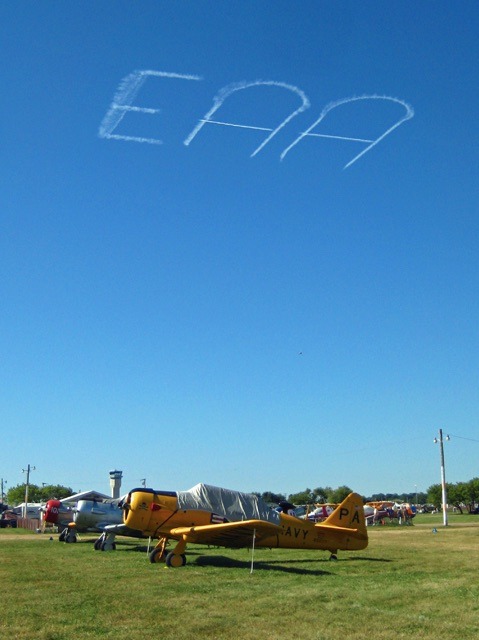 Skywriting over Oshkosh, Wisconsin during the 2008 “Airventure” of the Experimental Aircraft Association (EAA).
Photograph (via Wikimedia) by FutureUApilot – own work, CC BY-SA 3.0
In 2018, during one of his occasional rummages around the internet, our late webmaster Peter Reed came across the following from the USA’s National Air and Space Museum.
Skywriting, defined as the process of writing a name or message with smoke from an aircraft against a blue sky, began in England after World War I, the brainchild of Major John C. Savage, RAF.
His first successful demonstration was at the Derby at Epsom Downs, in May 1922, when Captain Cyril Turner wrote “Daily Mail” above the racecourse.
Turner then went to the United States in October 1922 and wrote “Hello U S A ” above New York City.
Peter normally turned such nuggets into an article for this site. On that occasion, however, the above was simply noted as a matter of interest in the June 2018 edition of the History Centre’s Lives & Times. Having recently come across the item again, I felt it deserved the following expansion.
First, a bit of background. The long-standing dream of self-powered heavier-than-air flight was first realised on 17 December 1903 when, near Kitty Hawk in North Carolina USA, the Wright Brothers’ years of experimentation resulted in the Wright Flyer taking off and flying 120 feet in 12 seconds. Its maximum altitude was about 10 feet and, flying into a headwind gusting to 27 miles per hour, its speed over the ground was just short of 7 mph.
Things developed rapidly thereafter and, by the outbreak of WW1 in 1914, aeroplanes were just coming into military use. This was initially for reconnaissance purposes but new models with ever better performance paved the way for their aggressive use as fighters and bombers.
It had been discovered (doubtless the result of an early technical failure) that oil leaking into the engine’s hot exhaust resulted in the aircraft trailing a thick white mist. During WW1, some aircraft were modified to enable this effect to be put to use in creating smokescreens as cover for military and naval operations. A particular exponent of this was Major John Clifford (“Mad Jack”) Savage of the Royal Naval Air Service – who transferred to the RAF on its 1 April 1918 foundation when he was permitted to retain the rank of Major, which he continued to use in post-war civilian life.
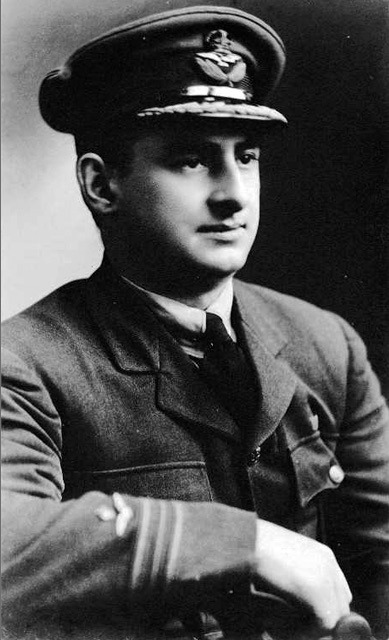 Major John Clifford (“Mad Jack”) Savage
Photograph via Ancestry UK, copyright acknowledged.
After the Armistice, Major Savage spotted the commercial opportunity of using smoke trails to write aerial advertising slogans and, at a bargain price, bought some now surplus Royal Aircraft Factory S.E.5a biplanes – one of which (G-EBIB, pictured below) he gave to the Science Museum in 1939. It is nowadays displayed in the Museum’s Flight Gallery, as below.
 One of Major Savage’s skywriting S.E.5a biplanes, in the Science Museum.
(Note the extended exhaust to minimise disruption of the smoke trail.)
Photograph by Alan Wilson from Stilton UK, CC BY-SA 2.0, via Wikimedia Commons
.jpg)
As noted at the head of this article, the first public display of skywriting was over Epsom Downs in 1922 on Derby Day,. The S.E.5a biplane was piloted by WW1 ace pilot, Captain Cyril Turner.
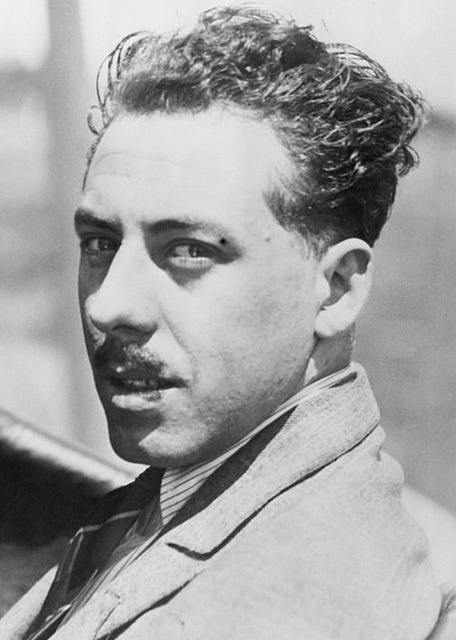 Captain Cyril Turner.
Photograph via the Daily Mail, copyright acknowledged.
Skywriting is best done at an altitude of about 10,000 feet / 2 miles and a typical vertical stroke of a letter would be about a mile long. The operation requires careful planning of the pattern that needs to be flown, and the points at which the smoke needs to be turned on and off. It also needs great skill in execution: as the pilot is flying at the same level as what he is creating, he can see very little of what he is actually writing – which, in any case, has to be written as a mirror image so that the message reads correctly when seen from the ground.
Viewed from above, the route taken by the pilot to write the “EAA” in the photograph at the head of this article is likely to be as below.
 Graphic by Roger Morgan.
In the above graphic, the aircraft’s route begins and ends top right, with smoke being turned on and off to make the letters as shown. To minimise disruption of the smoke already laid down, the pilot would climb above it and swoop down to write the horizontal elements. In preparation for the Epsom premiere, Cyril Turner put in a lot of practice off the Kent coast, intriguing those on the shore.
On the day of the 1922 Derby, Wednesday 31 May, there were clear skies over Epsom (more than the lightest cloud is a contraindication for skywriting) and reasonably still air (meaning that the message would remain legible for some 10 minutes). The race meeting was attended by the usual massive crowd, members of which were astonished to see a silver speck arrive overhead and slowly write DAILY MAIL in giant smoky letters.
Sadly, no photographic record has been found of this, which the Daily Mail subsequently reported as “the greatest single development in outdoor advertising” and that “everyone within an area of a hundred square miles – and there were millions – gazed spellbound at this fascinating sight.”
Among those in the VIP enclosure for the 1922 Derby was none other than the leading novelist of the day, Virginia Woolf. Her experience that day was doubtless the inspiration for the skywriting episode in the opening chapter of her 1925 masterpiece, Mrs Dalloway. It is beyond the scope of this article to delve too far into the author’s intended symbolism, but the sequence in Central London begins with alarm at the sound of what is thought to be a shot (in fact a car backfiring) then compounded by the sound of a plane overhead (all bringing back wartime memories) – but resolving to bathos when the result of the aircraft’s aerobatics is a skywritten advertisement for KREEMO TOFFEE.
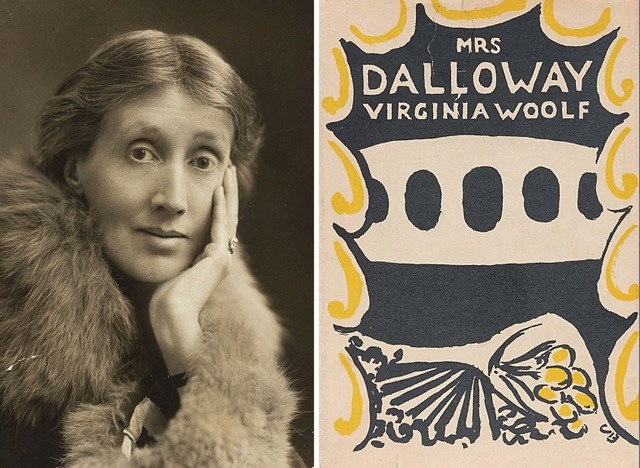 Virginia Woolfe in 1927 and the dustjacket of her 1925 “Mrs Dalloway”.
Public domain images via Wikipedia.
As noted in the snippet at the head of this article, Messrs Savage and Turner then took their skywriting to America and announced their presence by writing “HELLO USA” over New York. Sky writing then became a significant means of mass advertising on both sides of the Atlantic. Major Savage, who lived (with his wife and two children) in North London, became a wealthy man – owning a Rolls Royce, driven by a chauffeur. He died in Elstree on 17 September 1945, just short of his 54th birthday. He left an estate valued at £18,402.
For obvious reasons, skywriting ceased during WW2. With the advent of other means of mass communication, particularly television, skywriting did not return to the same level after the war (indeed, it was not permitted in the UK from 1960 to 2022). It is, however, still available – with a significant use apparently being for marriage proposals – but there are now only a few pilots with the necessary high skills to do it.
Roger Morgan © 2023