
PETER REED
Founder of this EEHE website, and its long-serving webmaster
23 August 1952 – 19 October 2023
 The late Peter Reed in Bourne Hall Museum.
Family and friends were deeply shocked and saddened by 71 year old Peter’s sudden death on 19 October 2023. We lost a generous, warm-hearted and gifted man, and have collaborated in the following tribute.
Peter’s gift to the local and wider community was the 2006 creation of this Epsom & Ewell History Explorer website, of which he was the driving force and webmaster until his death. Given the site’s many broad-ranging and fact-packed pages, it is fitting to repeat the epitaph on Sir Christopher Wren’s tomb in St Paul’s Cathedral, “Si monumentum requiris, circumspice” (“If you want a monument, look around you”).
= = = = =
Peter Charles Reed was born in Epsom General Hospital on 23 August 1952, the third (and last) child of James Joseph and Evelyn (née Gibb) Reed. He was a large baby and grew to be a large man – but a “gentle giant” and with a big heart.
His father’s family had moved to the Borough in the 1930s, being recorded in the 1939 Register living at 73 Northcroft Road, West Ewell – with the nearly 25 year old James having followed his father into the printing industry. During WW2, James was in the RAF as a Leading Aircraftman (specialist Radar Technician) serving at both home and in what is today’s Bangladesh, near the border with Burma.
During a posting in Scotland, James accompanied a friend to a wedding where he happened to meet fellow guest Evelyn Gibb, a State Registered Fever Nurse. That chance meeting quickly blossomed, and the couple married (in Evelyn’s home town of Mintlaw, Aberdeenshire) in 1944. After the war, and with their first child (Ronald, born in 1945), they made their home in Stoneleigh’s Cunliffe Road – not far from where James’s parents still lived and where his now-married brother had also settled down. Daughter Pat was born in 1948, and the family was completed with Peter’s birth in 1952.
From an early age, and encouraged by his technically-minded father (who had returned to his pre-war print trade, now as a process engraver), Peter was fascinated by how things worked. He would dismantle his toys and, aged 8, startled his mother when she set off the burglar alarm he had constructed in the landing outside his bedroom door! Many family holidays were spent in Scotland with his mother’s extended family in Mintlaw where, on its nearby beaches, Peter enjoyed building sandcastles and damming the streams running down to the sea.
 Young Peter with his parents and older brother and sister.
Peter attended the local schools and, in his teens, had a part-time job at Mr Bradbury’s nearby hardware shop. On leaving school in 1968, Peter joined the Civil Service and was assigned to the Inland Revenue, working in its Epsom Office. Earning a proper salary meant that Peter was able to buy his first vehicle – a blue van, which he cared for lovingly. (His ease with mechanical things meant that he had needed only one Driving Test.)
In the late 1970s, Peter was hit with a bout of viral pericarditis. This left him with heart problems for the rest of his life – about which, and so typically, he did not make a fuss.
His fascination with how things worked had drawn Peter to the Inland Revenue’s increasing use of computing (in those days, using mainframe computers, the performance of which would be trumped by the most modest mobile phone). Finding his niche, he was transferred to the Revenue’s London HQ in Holborn as a “Senior Knowledge Engineer and Team Leader”. He progressed through “Senior Programmer” and “Systems Analyst” and ended up by researching Expert Systems – the first steps in AI. (Outside work, computing became something of a compulsion and quickly extended to include all IT equipment and other gadgets: Peter was, of course, well ahead of the curve as home computing took off around 1980.)
In the mid-1980s, the Inland Revenue began planning a major decentralisation. Peter did not want to move away from London and, in June 1987, moved to join the London Borough of Lambeth’s Information Systems Group. There, he developed and introduced a range of information systems for the Social Services Directorate, and also designed and developed a laboratory system for the Environmental Health Laboratory. In February 1990, he was promoted to Group Manager.
Peter’s health had long been less than robust and, in early 1991, a bout of particularly bad health led to his early retirement from Lambeth on medical grounds. Later that year, as his health recovered, Peter took a job with a GP Practice where, in addition to procuring, installing and supporting for a 14 terminal clinical system, he also produced health promotion material and dealing with claims to the health authority for funding for the practice. Still based in his Vauxhall flat, he was generous in giving his time to various local charities and small businesses sorting out their computer systems and problems.
Moves to develop his nearby Vauxhall Park piqued Peter’s interest in its history. He joined the Friends of Vauxhall Park and, for them, researched and wrote a well-regarded “A Brief History of Vauxhall Park” published in 2000. He had truly caught the local history bug!
Peter’s father, James, died in 1994. In 2001, Peter returned to the family home in Stoneleigh to help his sister, Pat, to care for their ailing mother, Evelyn, who died in 2006.
Given his interest in local history, Peter joined the Epsom & Ewell Local and Family History Centre at Ewell’s Bourne Hall in 2005. Bringing his usual enthusiasm, he quickly became a valued member of the team. Other members gladly accepted his 2006 offer to complement their work by setting up a local history website to make information available over the internet.
The first stage was the cataloguing and digitisation of the History Centre’s various records and photographs, in which Peter was greatly helped by others in the History Centre, to whom he referred as “his angels”. On setting up the website itself, Peter was assisted by a tech-savvy friend that he had first met in Vauxhall. As to the website’s individual pages, Peter encoded these manually in html (HyperText Mark-up Language).
In addition to basic records, a circle of contributors also began to contribute articles on particular aspects of local history that interested them. That has continued to be a feature of the website. Rare examples of centrally co-ordinated initiatives were the recording of all the Borough’s WW1 and WW2 memorials, together with biographies of the 1,079 named on those (or otherwise connected with the Borough) who lost their lives in those wars. The outcome is a wonderfully rich patchwork of information about local characters and places that continues to attract much interest locally, from across the UK and, indeed, internationally.
Peter’s already shaky health took a significant knock when he was found to have non-Hodgkins Lymphoma – at one point being told that he might have only six months left. Fortunately, the treatment was successful.
For his initiative in setting up the website and his work in maintaining and developing it, Peter was nominated for – and awarded – one of the Borough’s 2013 “Local Volunteer Awards”. The nomination noted that the website already had 654 pages which, over the previous 12 months had been accessed on nearly 50,000 occasions, and was highly regarded by the wider community of local historians. In his typically modest style, Peter responded to the award by saying, “I would like to thank those who nominated me and everyone who has helped me achieve this award. As far as I am concerned the award is not just for me but for all the volunteers at Epsom & Ewell Local and Family History Centre.”
 Peter receiving his 2013 Local Volunteer Award.
The website continued to grow and, in September 2018, Peter stood down from the Local and Family History Centre to concentrate on its management and further growth – although not at the expense of maintaining his many friendships and giving generously of his time in helping others, particularly in solving knotty computer problems with astonishing speed.
Things evolve quickly in IT and, by 2019, Peter was clear that what had been a “state of the art” website in 2006 had become very dated, using a format that was being overtaken and in danger of becoming redundant. With further help from his tech-savvy friend from Vauxhall, the website’s 1,200+ pages were transferred to WordPress (a modern Content Management System). The new website was formally launched in early 2020 and, with Peter’s dedicated hand at the helm, continued to grow. (At the time of writing this in November 2023, it contains 1,650 pages with some 14,600 photographs and other media items.)
There was profound shock at the news of Peter’s sudden death on 19 October 2023. On 7 November, family and friends said goodbye to him at Randall’s Park Crematorium and then, over refreshments at Bourne Hall, shared many happy memories of the much-missed man. Typical remarks were:
A dear and most generous friend – lovely, genuine, and talented . . .
A great problem solver with a quiet, but wicked, sense of humour . . .
Kind, caring, intelligent and thoughtful . . .
He will be missed not only by his family, but also by all those whose lives he touched . . .
Responsibility for the maintenance of what we will always remember as “Peter’s website” has been taken on by a small group of “The Friends of EEHE”. True to Peter’s vision, that group will also oversee its continuing development.
November 2023
= = = =
While the above was being prepared, we were pleased to post (with permission) the following published in the 1 November edition of the on-line Epsom & Ewell Times, and we retain it here for the record.
LOCAL HISTORIAN PETER REED WILL BE MISSED
In Loving Memory of Peter Reed (23/08/52 – 19/10/23)
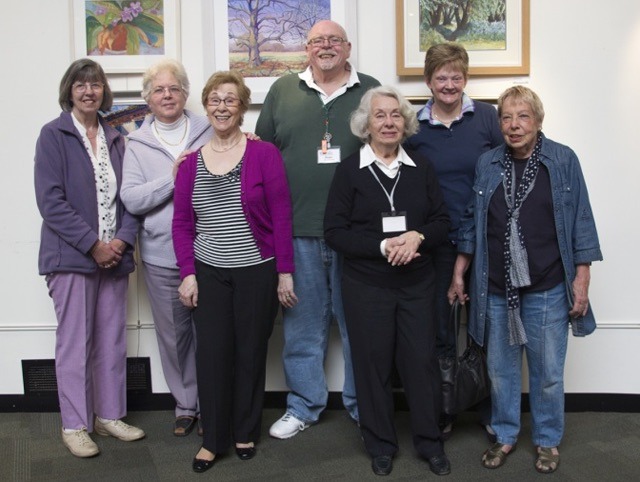 Peter with his History Centre “Angels”.
Peter Reed passed away on October 19, 2023, leaving a void in the hearts of many. Born and raised in Epsom and Ewell to James and Evelyn Reed, Peter’s journey was defined by his unwavering dedication to his family and his profound impact on the community.
A man of generous spirit and unwavering kindness, Peter’s life reflected a passion for understanding the inner workings of the world around him. From an early age, his curiosity led him to disassemble toys, cultivating an interest in creation, particularly in woodworking and exploring historical contexts. His inquisitiveness matured into a fascination with the evolution of technology, particularly in the realm of computers and their historical significance. His career path led him to utilize his technical acumen at the Inland Revenue, Lambeth Council, and a London medical centre, where he not only honed his skills but also used his expertise to benefit various charitable causes.
Peter’s profound love for history propelled him to join the Epsom and Ewell History Centre at Bourne Hall in 2005. There, he spearheaded the creation of the website and served as the dedicated webmaster for the Epsom and Ewell History Explorer. His commitment extended beyond mere content creation; he tirelessly assisted countless individuals, locally and internationally, with historical inquiries, demonstrating his wealth of knowledge and willingness to help others.
Recognized as the driving force behind the History Explorer website, Peter’s collaborative efforts with local experts and his encyclopaedic knowledge of the area facilitated an invaluable resource for researchers and history enthusiasts. His significant contributions were felt and appreciated by numerous individuals and organizations, symbolizing his profound impact on the preservation and promotion of local history.
While Peter leaves behind no immediate family of his own, he leaves a lasting legacy in the hearts of his sister, nieces, and a community that deeply appreciated his dedication and expertise. His loss is deeply felt, but his remarkable contributions to the Epsom and Ewell community will forever be remembered and cherished.
Peter Reed’s passion, dedication, and selfless commitment to preserving local history have left an indelible mark. His legacy lives on in the continued work of those he inspired, ensuring that the Epsom and Ewell History Explorer remains a testament to his invaluable contributions to local heritage. He will be greatly missed, but his impact will resonate through the cherished memories and the enduring legacy he leaves behind.