
Alfred Withall ASTON JP (1853-1929)

Alfred Aston in the early 1900s.
Alfred Withall Aston was an important resident of Epsom from the mid 1880s to the mid 1920s. This website has long carried a brief biography of him and, more recently, we have added profiles of his two sons, Norman (who died tragically young) and Harold (who saw service in both World Wars, dying during the second). This article expands appropriately on the life of their father and his contribution to the life of the town.
Alfred was born on 20 March 1852, the fifth of eleven children born to barrister Benjamin Richard Aston QC and his wife Charlotte (née Burt) who had married on 4 April 1844 at St Mark’s, Clerkenwell. Alfred’s birth was registered in the Lambeth District, consistent with him (as a 9 year old) and his family being recorded in the 1861 Census living at 24 Binfield Road, Stockwell. The parents’ first child – the now 16 years old Benjamin Richard – had followed his father (confusingly, of the same names) into the Law and is listed as a “Solicitor’s Clerk”. The family was supported by two domestic servants.
Unlike his father, Alfred went into stockbroking. The 1871 Census records the 19 year old – listed as a “Clerk to member of the Stock Exchange” – staying/lodging with his uncle and aunt (Frederick – an “Attorney” – and Mary Aston) at their home on the Portsmouth Road, Kingston upon Thames. Also staying/lodging there was Alfred’s older brother, 22 year old Murray and his new wife, Mary. Murray is listed as a “Stock Broker”. Was Alfred clerk to his brother?
Both of Alfred’s parents died, in their early 50s, within a few weeks of each other in 1872.
Alfred’s next appearance in the readily available records is his 2 October 1879 marriage to Frances Amy Hennell at All Saints, Paddington. The couple set up home at 7 Stanhope Place, Paddington where they were recorded in the 1881 Census – and in which 29 year old Alfred is listed as “Member, London Stock Exchange”. (An 1880 London Directory notes that his City address was “1 Shorters Court”.) Alfred and 22 year old Frances were doubtless proud parents of their first child, 8 month old Dorothy who had been born on 3 August 1880 and baptised in All Saints, Paddington on 29 August. Parents and daughter were supported by four staff – Page, Housemaid, Cook and Nurse.
The parents were still at 7 Stanhope Place when their second child, Norman, was born on 3 March 1883. On 7 April 1883, he was also baptised in All Saints, Paddington. The family then moved to 41 Bryanston Square where the third child, Harold, was born on 29 September 1884. He was baptised in St Mary’s, Bryanston Square on 6 November that year.
A few years later (and certainly in time for Alfred to be listed in the local 1887 Electoral Roll and that year’s Kelly’s local directory), the family moved from London and took up residence in West Hill Lodge, West Hill, Epsom. This was a grander house than its name suggests and, as shown on the map below, was close to Christ Church Epsom Common which came to play a large part in the family’s life.

Extract from the 1896 Ordnance Survey map.
The best picture we have of West Hill Lodge (which was demolished in 1959 and the homes around 35 West Hill built on its site) is as arrowed in the interwar photograph below.
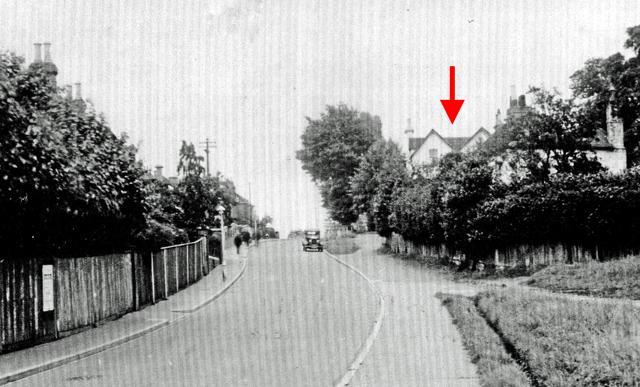
The best available view of West Hill Lodge, thought to be from the 1920s.
(From the writer’s collection, with apologies for the quality, being the scan of a scan.)
We do, however, have the following 1890s postcard view of Christ Church taken from about outside West Hill Lodge. This would have been the view that the Astons had when they lived there.

The roof and tower of Christ Church (far centre) seen from outside West Hill Lodge in the 1890s.
Photograph from the writer’s collection.
The family was quickly drawn into the life of Christ Church: for the two years 1887-89, Alfred served in the significant position of Churchwarden alongside Henry Willis of Horton Lodge. (After a four year break, Alfred – again alongside Henry Willis – served as Churchwarden from 1899 to 1912.)
The 1891 Census records 39 year old Alfred (“London Stock Exchange (Employer)”), 32 year old Frances and their children (Dorothy, Norman and Harold – aged, respectively, 10, 8 and 6), together with four visitors, at West Hill Lodge, supported by six domestic servants and a groom.
It was doubtless through Christ Church that Alfred became friends with Lord Rosebery, a regular worshipper at Christ Church when at his Epsom home of The Durdans. Alfred’s friendship with Lord Rosebery seems likely to be the explanation for the couple’s fourth child, May (born on 7 May 1895 and baptised at Christ Church on 1 June) being given “Primrose” (Lord Rosebery’s family name) as one of her Christian names.
Alfred began to cast his net more widely in local affairs. In 1895, he was elected to the newly formed Epsom Urban District Council (over time, serving two years as Chairman and taking credit as the driving force in securing “a perpetual supply of water for the town”. He was also active at County level, being made a Justice of the Peace.
The record of May’s baptism notes the family address as West Hill Lodge, but they soon thereafter moved to the yet grander Woodcote Grove in Chalk Lane, Epsom being recorded at that address in Andrews’ Epsom Street Directory for 1895.
 Woodcote Grove, as seen from Chalk Lane.
Image courtesy of Brian Bouchard © 2012
This move was doubtless facilitated by Lord Rosebery who had acquired the property earlier in 1895. As shown on the map below, Woodcote Grove (1) adjoined the Durdans (2) estate and was not far from the home of the Northeys (another significant Epsom family) at Woodcote House (3).

Extract from the 1896 Ordnance Survey map.
(For the key to 1, 2 & 3, see the preceding paragraph and, for A & B, see the paragraphs below.)
As will be seen, the grounds of Woodcote Grove at the time extended all the way to Ashley Road. The photograph below is taken from A on the map above.
 Woodcote Grove, Epsom.
Photograph from the Ashley Road boundary of its grounds.
An ornamental feature of the grounds was an avenue of lime trees running from near the house to double gates in the estate wall on Worple Road – see B on the map above and the photograph below.
 The Avenue, Woodcote Grove, Epsom
Residential use of Woodcote Grove ended in the mid 1950s when the property and most of the grounds were sold to W S Atkins. Part of the estate bordering Ashley Road and Worple Road was developed for what are today St Martin’s Infant & Junior Schools. While most of the lime tree avenue was felled in developing the rest of the site for Atkins’ use, a half dozen pairs of the limes (now the subject of Tree Preservation Orders) remain in the grounds of St Martin’s Infant School.

All that is left of Woodcote Grove’s avenue of lime trees, and
what were the estate’s gates onto Worple Road.
Photograph by Roger Morgan © 2021
On 22 June 1897, the country celebrated Queen Victoria’s 60 years on the throne. Epsom’s Diamond Jubilee celebrations were coordinated by a committee chaired by Alfred’s near neighbour, the Revd Edward Northey. Alfred did his part by giving over his grounds at Woodcote Grove for entertaining children during the day with entertainments, sideshows, races and a tea.
Alfred was keen to break into national politics, and is recorded as being unsuccessful in his bid to be elected as an MP for the Conservative Party in 1899. There was no General Election that year and it is understood that he was one of the shortlisted candidates for the seat of Epsom in the by-election called in 1899 as a result of Sir Thomas Townsend Bucknill (who held the seat from 1892 to 1899) standing down on his appointment as a judge. Alfred lost out to William Keswick – about whom we shall hear more when we get to the 1906 General Election.
Alongside these local activities, Alfred was active in the City – of which he was a Freeman. He was a member of the Skinners’ Company and, in 1909-10, served as its Master. (He also served as a governor of the Company’s School at Tonbridge.) He was also a member of the Stock Exchange Benevolent Committee; Vice-President of the Railway Benevolent Institution and of the Orphan Working School; and was involved in a number of other institutions. In 1899, Alfred was admitted as a Freemason to the United Lodge of Prudence.
Great sadness hit the Aston family with the death, at Eton College, of their 17 year old son Norman on Good Friday 13 April 1900. All that is set out in our article about Norman, which also describes the splendid memorial to him that his parents commissioned at Christ Church.
On 24 July 1900, just four months after Norman’s death, Alfred’s oldest child, 19 year old Dorothy, married 27 year old Francis Joshua Wortley who is described in the Register entry as a “Stockbroker”, and who seems likely to have got to know Dorothy through work connections with her father – described in the Register as a “Stockjobber”. The Register records Francis as being of Ashtead, but he was originally from Sheffield, where his father was a Chartered Accountant. Perhaps because the date was so soon after Norman’s funeral in the family’s Christ Church Epsom Common, the wedding was, unusually, held in the bridegroom’s parish church (St Giles, Ashtead) – although it was conducted by the vicar of Christ Church, Canon Archer Hunter.
 Alfred’s signature from the Register entry of daughter Dorothy’s 1900 wedding.
Dorothy was, of course, shown as being of “Woodcote Grove, Epsom” in the Marriage Register. The couple set up home at 16 Orsett Terrace, Paddington – although the 1901 Census records them (with Francis listed as “Stockbroker, London (Employer)”) staying with Dorothy’s parents at Woodcote Grove. To round off this couple’s story, they returned to 16 Orsett Terrace in time for the birth of their first child, Elizabeth on 27 May 1901. They were still at 16 Orsett Terrace for the 1911 Census, but with two more children – Peter (registered Q2 1903) and Leopold (registered Q2 1908). Francis was recorded as a “Member of Stock Exchange (Principal)” and, more specifically, as a “Home Railway Stock Dealer”. This was a prosperous household: the family were supported by five live-in domestic servants. Their fourth and last child, Dorothy, was born on 4 July 1912. The family later moved to Hertfordshire.
(In passing, it’s worth noting that Dorothy and Francis’s four children were Alfred and Frances’s only grandchildren. Oldest son, Norman, had died young; son Harold – of whom more below – married but had no children; and youngest daughter, May, never married.)
In 1905, presumably to reinforce his presence on the social scene, Alfred commissioned a portrait from the artist James Prinsep Beadle. Prints of this, such as the one below, were quite popular locally being hung in most of the town’s pubs.

Alfred Aston on horseback in the grounds of Woodcote Grove.
Print of the picture by J P Beadle, courtesy of Bourne Hall Museum.
As noted above, Alfred and now neighbour Lord Rosebery had formed a close friendship. (The biography of Lord Rosebery by his son-in-law Lord Crewe mentions that Lord Rosebery was “on the pleasantest of terms with . . . Mr and Mrs Aston of Woodcote Grove” and notes that “Mr Aston was . . . Rosebery’s frequent companion on long walks“.) Lord Rosebery was, of course, a prominent Liberal politician having been a successful Foreign Secretary in Gladstone’s cabinets in the 1880s and early 1890s, but a less successful Prime Minister in 1894-95.
It may have been on their long walks together that Lord Rosebery persuaded Alfred – rather against his natural inclination – to stand in the 1906 General Election as the Liberal Party candidate for the Epsom Constituency. The sitting MP, William Keswick (who, as noted above, is understood to have beaten the then Conservative Alfred to the nomination for the seat – which he then won in the 1899 by-election) and his team made great fun of Alfred’s switching parties, putting up many scathing posters round the town. One of these, as shown below, was a cruel parody of the J P Beadle portrait shown above.

One of sitting MP William Keswick’s 1906 election posters mocking Alfred’s change of party.
(The original cannot now be found and, with acknowledgements, the above is scanned from a copy of a copy reproduced on page 130 of “Old Views of Epsom Town” by George Cockman and John Marshall, 1988.)
The 1906 General Election resulted in a Liberal landslide. Of the 670 seats in Parliament: the Liberals won 397, more than doubling their 183 seats from the 1900 election; and the Conservatives won 156, less than half their 402 seats gained in 1900.
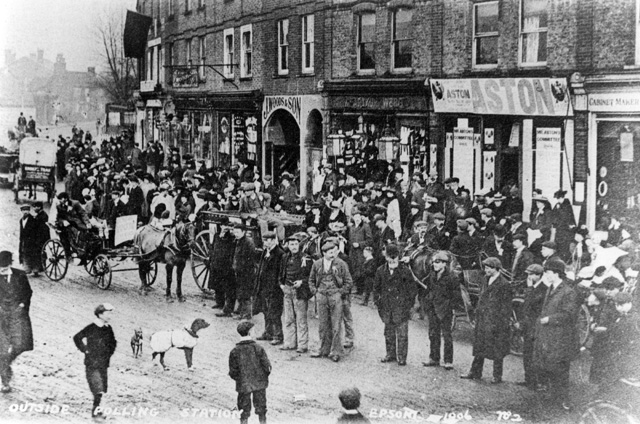
Postcard entitled “Outside Polling Station, Epsom 1906”.
(Note the Aston campaign HQ at No 6, East Street.)
Photograph courtesy of Bourne Hall Museum.
However, while the Liberal vote in the Epsom constituency increased, it was not enough to unseat the sitting William Keswick. The Epsom seat had not been contested since the 1892 General Election when the Conservative/Liberal vote split was 65:35. The Conservative/Liberal vote split for Epsom in 1906 was 54:46, compared to the national 47:53.
Alfred then retired from the explicitly political scene, but did not go altogether quietly. On 29 January he wrote the following letter (emphasis added here) published in the West Surrey Times of 3 February.
TO THE PARLIAMENTARY ELECTORS OF THE EPSOM DIVISION OF SURREY
GENTLEMEN – It is my duty and pleasure to thank all my friends who voted for me on Friday last. Where I am best known, and where the principles which I advocated are understood and appreciated, I am well aware that I had a large majority of votes. It was in the outlying districts, especially in the north-western parts of the constituency, that misrepresentation, intimidation and aspersion had their effect.
I am, however, very glad to think that I was successful in reducing the Conservative majority so considerably. That result showed a great turnover of opinion, and for that I am greatly indebted to the arduous work of my many supporters. To them I desire to return my warmest thanks. I shall always cherish the memory of their kind attachment and devoted labours, without which I could not possibly polled so large a number of votes.
Your faithful servant,
ALFRED WITHALL ASTON
Returning now to the family history, Alfred’s other son, Harold, had gone on from Eton to study at Christ Church, Oxford. In 1906, he was commissioned as a 2nd Lieutenant in the Surrey Yeomanry (Queen Mary’s Regiment). However, he had resigned the commission well before 8 November 1910 when, aged 26, he married 24 year old Evelyn Langham Reed in St Thomas, Portman Square, Mayfair. The register entry notes Harold’s address as his parents’ Woodcote Grove, Epsom and, indeed, the marriage service was (like Dorothy’s 1900 wedding at St Giles Ashtead) conducted by the Revd Archer Hunter, Vicar of the family’s Christ Church Epsom Common. The register entry notes Harold’s “Rank or Profession” as “Gentleman” – as it did his and Evelyn’s fathers. To round off this couple’s story (which is set out in more detail in our article to record Harold’s service in both World Wars), they made their first home in Sawbridgeworth, Hertfordshire, later moving to their long-term home in Iwerne Minister, Dorset. They were more than comfortably off, most records continuing to refer to their “private means”, but we know that Harold was an Underwriter at Lloyd’s of London.
Returning to Alfred, the 1911 Census records this now 59 year old (“Member of the Stock Exchange (Employer), Justice of the Peace Surrey”) at Woodcote Grove, together with 57 year old Frances and their 15 year old daughter, May. They and three visitors were supported by eight domestic servants.
Over the next decade, Alfred actively continued his stockbroking career and benevolent activities both locally and in the City. In 1917-18, he served as High Sheriff of Surrey.
Alfred, Frances and daughter May (who never married) remained at Woodcote Grove until the mid-1920s when, with Alfred’s health failing, they retired to Court House, Exford in Somerset. Alfred died there, aged 77, on 4 October 1929. Frances and May remained at Court House, being recorded there (aged, respectively 81 and 44 – and both of “Private means”) in the September 1939 Register. Frances died there on 26 July 1944, aged 86. Daughter May then continued living at Court House, dying (at a nursing home in Exeter) on 17 November 1966, aged 71. No record has been found of any of their burials, and it is assumed that these were local to Exford. As noted in our article about their son, Norman, Alfred’s and Frances’s names were added to his grave marker in Epsom Cemetery, but the Cemetery records make no mention of their burial there.
On Friday 11 October 1929, a week after Alfred’s death, a memorial service was held for him at St Michael’s, Cornhill – in the heart of the City of London. The Times of Monday 14 October 1929 carried a 500 word obituary by Gordon Home (author of the 1901 “Epsom: its history and surroundings“) in which he endorsed the words in the tribute by the Hon Chaplain to the Stock Exchange (the Revd John H Ellison) that Alfred had upheld the City of London’s great tradition of gentlemanliness linked with religion. Gordon Home continued: “His religion was a very real thing. It was not a thing he talked about; he preferred to let it be a driving force towards duty. ….. His friends were many, and his City acquaintance enormous. It was impossible not to be drawn towards and to remember such a genial and kindly personality. ….. All who knew him intimately could trust him as a staunch and warm-hearted friend.”
This article is nicely rounded off by the following undated photograph of Alfred together with Frances (seated) and their two daughters, Dorothy and May. All are dressed up for an occasion, and this may have been son Harold’s 1910 wedding, when May (behind her mother) would have been aged 15.
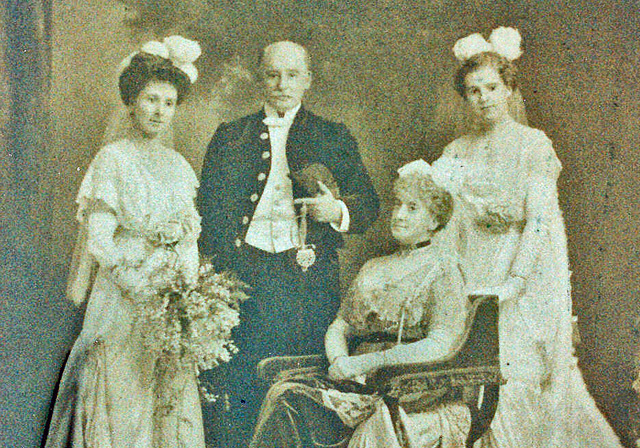
Photograph courtesy of Bourne Hall Museum.
Roger Morgan © 2021
POSTSCRIPT
During Spring 2023, Catherine Haynes was walking on Box Hill and, by the first bend of the Zig Zag Road up the north (Mickleham) side, came across a tree, at the base of which is a plaque registering an interest of Alfred Aston that is not to been found in any of the readily available sources. I am most grateful to her for the pictures below – particularly as, by February 2024, the sign had disappeared.
 The tree on the Zig Zag Road up Box Hill (looking towards the west) and its memorial plaque.
Photographs courtesy of and © Catherine Haynes, 2023.
The wording on the plaque was “This tree / was planted in 1930 / in memory of / Alfred Withall Aston / 1852-1929 / who loved Box Hill / and was Chairman of the Committee in / 1924-1925”. (Alfred held the Chairmanship in his early 70s. He was 77 when he died in 1929.)
Roger Morgan, 2023 & 2024