
The Ven Mark Wilson (1946-2013)
Chaplain & Head of RE at Epsom College 1977-81;
Vicar of Christ Church Epsom Common 1981-1996;
(during which he was also Rural Dean of Epsom for 1987-92); &
Archdeacon of Dorking 1996-2005

The Revd Mark Wilson in 1990.
(He became “the Venerable” on appointment as Archdeacon of Dorking in 1996.)
Mark (whose full name was Mark John Crichton Wilson) was born in the Brentford District on 14 January 1946, the son of the Revd William Hubert Wilson (a CMS missionary and Vicar) and Gladys Margaret (née Goode – they had married Q3 1939 in Birmingham).
His musical abilities got Mark admitted to St Paul’s Cathedral School, and he rose to be the cathedral’s Head Chorister.

Mark in 1959 as Head Chorister at St Paul’s Cathedral
Mark’s secondary education was at St John’s School, Leatherhead where his examination success gained him admission to Clare College, Cambridge. His love of singing led him to join a Christian choir, the Icthyian Singers, and it was here that he met a musical fellow-undergraduate (and his future wife), Mavis French.
After graduation in 1967, Mark undertook theological training at Cambridge’s Ridley Hall. Having completed his studies there, he was ordained to the stepping-stone role of Deacon in 1969, and took up his first post as a Curate in Luton and East Hyde. In the Spring of 1970, Mark and Mavis married in her home town of Tunbridge Wells and set up home together in Luton where, later that year, Mark was ordained as Priest.
The couple’s first child, Naomi, was born in Luton in late 1971. In 1972, the family of three moved to the busy parish of Ashtead for Mark’s second Curacy. During this time, they had two more children – Edward in 1973 and Susannah in 1976.
Following a couple of Curacies (to get thoroughly versed in the practicalities of parish ministry), the next step would normally be to take on a parish as Vicar. Instead, in 1977, Mark moved to become Chaplain and Head of RE at Epsom College. While there, Mark and Mavis’s last child, Rachel, was born in 1979.
Arrival at Christ Church
In 1981, after 15 years as Vicar of Christ Church, the Revd Derek Bedford decided to move on. Mark successfully applied to fill the vacancy. He, Mavis and their four children moved into the Vicarage and, on Wednesday 16 September 1981, Mark was inducted as Vicar – accepting the solemn responsibility for the “cure of souls” in the parish of Christ Church Epsom Common.
The 35 year old Mark brought great energy, vision and experience to his ministry at Christ Church. On a particularly relevant point, he was closely involved with the Church’s Ministry of Healing – as shown by his chairmanship of the Guildford Area Association of the Guild of Health. This chimed in well with Christ Church which, having been consecrated in 1876 on the Saint’s Day of Luke the Healer, had long – and not least under Mark’s predecessor – had the healing ministry as an important strand of its work. Indeed, Mark was for a time the Bishop of Guildford’s Adviser on the Ministry of Healing which involved him in much work outside the parish.
With Mark at the helm (and ably assisted by Mavis, of whom more below), Christ Church grew spiritually, socially and numerically – to the point where it became possible to tackle some long standing practical issues.
The new Church Hall
The first of these was the siting of the Church Hall. Christ Church did not have its own church hall until 1899 when one was built at the bottom of West Hill – on land generously donated by George Longman of the nearby West Hill House. While the building was fine, the half mile distance from the church increasingly hampered the development of work with children and families. In the early 1980s, trying to integrate Sunday morning work with children with provision for their parents necessitated making use of rooms in the Epsom Common Working Man’s Club and the Vicarage.
The answer was to build a new hall alongside the church but, as Mark’s predecessor had found, delivering this was less than straightforward: both finance and (to harmonise with a Grade II* listed church) design were significant issues; and another was reconciling conflicting views within the congregation. With a steady hand and assisted by a third “Church Hall Investigation Committee”, Mark steered a way though all these. Finances were given a head start with arrangements to sell the old Hall and the former Verger’s house (also in West Hill, about midway between the church and the original hall). Thanks to the generosity of the congregation in response to an appeal, the remaining monies were secured and the new hall was, with great celebration, opened in 1986.

Left: Logo for the Church Hall Appeal
Right: The just-completed new Hall, 1986.
A couple of asides
In 1987, Mark was – alongside his duties at Christ Church – appointed Rural Dean for the Epsom Deanery, consisting of the 15 or so Anglican parishes in Epsom and adjoining areas. As such, and for the usual five-year term until 1992, he provided leadership for mission and ministry in the deanery as well being a friend and support to local clergy and – particularly when parishes were in vacancy and awaiting a new vicar – the lay leaders of the parishes.
Mention should also be made of Mark’s other interests outside family and church. He was a keen singer and an accomplished flautist. In the garden, he showed real expertise – having a special affinity with fuchsias. He enjoyed the countryside, the sea and walking with his dogs. He was often found in lively and warm conversation. He was a keen cricketer, and was twice captain of the diocesan clergy cricket team. He also played with Christ Church’s cricket team and, in the summer of 1990, mustered a side to play the Christ Church Youth Group. (His side won and, in the photograph below, Mark is holding aloft the trophy – being a Ninja Turtle Frisbee!)

Summer 1990 cricket match between the Youth Group and the Vicar’s XI
In 1992, Mark also encouraged and supported the then Curate, Revd Clive Potter (who was also a qualified football coach), in setting up a church-linked football club to offer training to boys and girls. Named Christ Church United, this grew rapidly and has long been recognised by the Football Association as a Mini-Soccer Centre.
“Re-ordering” the Victorian interior
With the new Church Hall in place, the second long-term matter to which Mark turned his attention was the proposed “re-ordering” of Christ Church’s interior to accommodate worship styles that had changed significantly from the mid-Victorian practices which had informed the 1876 configuration. (There was a brief moment in late 1990 when there could have been the need for a rebuild rather than reordering. At a service to mark the centenary of the Christ Church branch of the Mothers’ Union, the event was marked by lighting 100 candles. Before long, the heat had melted the candles to the point where their flames merged into a roaring fire – appropriately during the singing of the hymn that includes the line “Blaze, Spirit, blaze”. Fortunately, some were quick enough off the mark to extinguish the blaze before any damage was done.)
As noted elsewhere, the Revd Richard Falkner had made a start on “re-ordering” shortly before his departure from Christ Church in 1966 but, as the Revd Derek Bedford found shortly after his arrival, that was without having secured the full-hearted consent of the congregation – making it prudent to let the matter rest for the time being.
The starting point for the new scheme Mark and the project team devised in 1990-91 was to move the Rood Screen so that the beautifully decorated chancel was opened up to the congregation in the nave. The modest platform erected in the Rev Derek Bedford’s time would be replaced by a larger one at the same height as the chancel as a base for a new Nave Altar plus plenty of space for contemporary music and drama.

Left: Christ Church as seen from the NW corner.
(Photograph from the 1976 Centenary History.)
Right: The proposed reordering.
(Watercolour by local architect and member of the Project Group, Chris Hyde.)
The Victorian pews had a large gap between the fairly narrow seat and the back rest. They had long been thought uncomfortable for adults – and were hazardous for children who all too easily fell out backwards. These were to be replaced by more comfortable chairs, which would also allow seating to be rearranged as necessary for different purposes.
The local importance of the Rood Screen (erected in 1911 as a memorial to William Sampson Trotter) was such that the Diocese would not permit its removal from Christ Church. The compromise was to allow it to be moved to the other end of the church. There, it would form an entrance to the main worship area from a new welcome area to be created from the Baptistry and made more inviting by improving the lighting with glazed doors in place of the solid oak ones and adding a rooflight. It was also proposed to add a covered walkway from the south side of this new welcome area to the still new Hall.
The Memorial Chapel (that had been created from the North Transept in 1920 to house the parish’s Great War Memorial) was to be revamped by levelling the floor and adding glass screens to make it a quiet undisturbed chapel ideal for mid-week services and other small gatherings. The vestries were to be improved by adding much-needed storage arrangements and, in the case of the choir vestry enlarged (making it also usable for other purposes) by taking in the space filled by the original organ console that had been replaced by a detached one in the 1936 organ rebuild. (See our separate article about the organ and its wandering console.)
In addition to those changes, the 50+ years since the 1936 organ rebuild meant that another complete overhaul of the instrument was urgently needed to keep it fit for purpose. Work was also urgently needed in the Bell Tower to replace the peal of eight bells installed in 1890. These had proved to be too heavy, over time damaging the bell frame and now threatening the integrity of the Tower itself.
Finally, the adjacent HQ of the Scouts & Guides (which then had seven groups with 150 members meeting weekly and with strong links with Christ Church) had been badly damaged by ground heave. To assist them in the project, Christ Church promised them 10% (up to £20,000) of funds raised for the “reordering”.
These items were collectively called “Project 2000”, and estimated to cost £288,000. With the strapline “Open for God”, an appeal was launched in November 1991 – the explanatory brochure carrying endorsements from the Archbishop of Canterbury and the Bishop of Guildford.
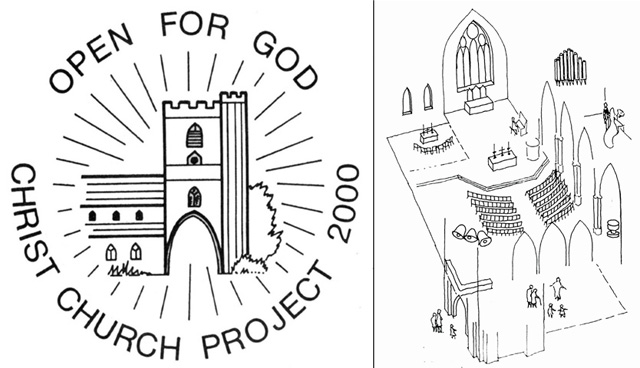
Left: Logo for the Appeal.
Right: A graphic from the 1991 appeal brochure illustrating the project’s key elements.
Whatever the logic behind moving the Rood Screen, the proposal proved extremely controversial among the wider congregation. Things escalated to the point that the then Archdeacon of Dorking was called in to chair a well-attended parish meeting at which, to defuse things, it was agreed to leave the Rood Screen in place and rethink the original plan. The upset damaged the fundraising potential, and two other elements of the original “Project 2000” (conversion of the Memorial Chapel and the Church/Hall link) were left for a later – and still to be reached – date.
In the meantime, the planned work on improving and enlarging the Vestries had been completed, as had work on the bell tower and replacing the eight bells. Work on refurbishing the organ had also begun, but was proving to be a more complicated job than anticipated. In early 1993, an appeal was launched for the completion of the modified “Project 2000”, the key elements in which were:
• a larger dais across the front of the retained Rood Screen and Memorial Chapel;
• a new movable Nave Altar (of which more below);
• replacing the pews with chairs;
• improvements to the West End, much on the lines of what had originally been proposed for a designated “welcome area” to be separated from the nave by the relocated Rood Screen; &
• although the organ had been brought back into limited use in late 1992, there was some way to go in completing the complicated rebuild.
The Phase 2 Appeal brochure had on its cover a sketch of the proposed Nave Altar. The brochure noted that “this design is original and hints at openness to God, the manger at Bethlehem and you might even see some fish in it!” (It was later understood that within the altar’s legs was also the concept of Alpha and Omega.) What the brochure did not say was that the concept had come from Mark. (The design was finalised by local architect Chris Hyde and the craftsman – Graham Laird of Ashtead – who then made the article using cedar from a tree that had fallen in Ashtead in the 1987 storms.)
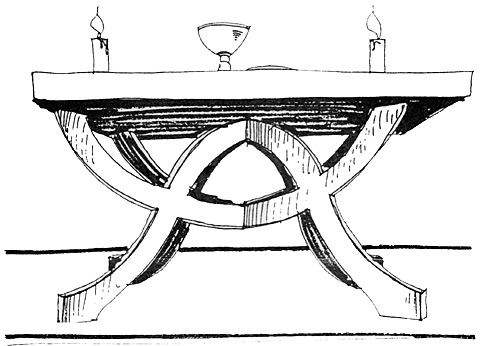
Sketch of the proposed new Nave Altar from the 1993 Phase 2 Appeal brochure.
Work then began in earnest. The new dais was built. To prepare for the new chairs, the pews were lifted and the floorboards on which they stood were sanded and sealed. Until the chairs arrived, the pews were replaced in a more sociable herringbone formation, and the lighting was also improved.

The old Victorian pews temporarily replaced on the diagonal.
Various milestones in the re-ordering were celebrated over the next couple of years. Except for the organ rebuild (which, after a change of contractor, was not completed until 1999), all was in place by the end of 1994, and all enjoyed the new opportunities provided by the revamped interior.
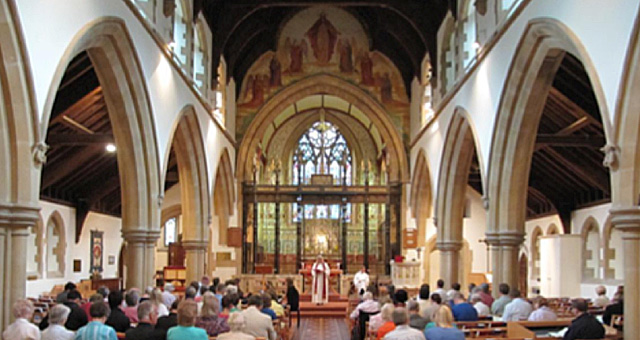
The fully reordered interior of Christ Church.
It is worth noting that the controversy over the reordering proposals had not hindered Christ Church’s growth in spiritual, social and numerical terms. (Among particularly notable developments was the substantial flow of parishioners progressing to ordained ministry.) Nor was Mark’s standing damaged: indeed, in 1993, he was elected by his peers as a delegate to the Church of England’s national assembly, the General Synod.
The Revd Canon Mavis Wilson
As noted above, Mavis provided powerful support for Mark in his work. Originally, this was in an entirely lay capacity. Shortly after the birth of their last child in 1979, she began training as a deaconess – at the time, the most senior role available to women in the Church of England. She was licensed as Deaconess in October 1986, shortly after the couple’s arrival at Christ Church. In addition to her support for Mark in Epsom, she began work in the Diocese – in a role that grew to be the Diocesan Adviser on Mission & Evangelism.
After many years’ debate, the Church of England finally agreed in 1992 that women could be admitted to the priesthood – to allow time for training, scheduling the first ordinations for 1994. Mavis started down this path. As the usual interim step, she was ordained Deacon and, in January 1994, was one of the first two women to be admitted as honorary Canon of Guildford Cathedral. Also at the cathedral, on the morning of Sunday 24 April 1994, she was one of the first 32 women in the diocese to be ordained priest. At a special service at Christ Church that evening she, for the first time, was celebrant at a Communion service.
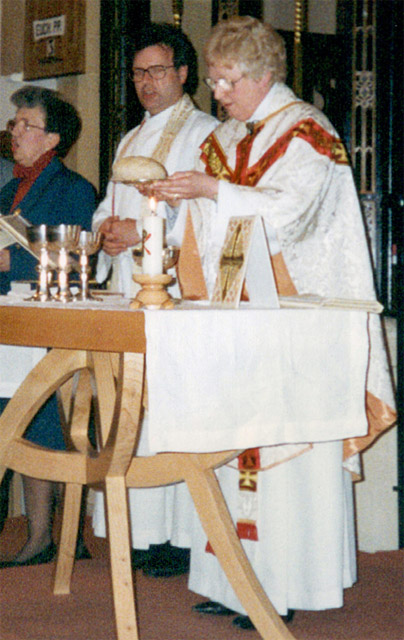
Mavis, with Mark alongside (at the new Nave Altar he had helped design), leading the 24 April 1994 Communion service to
celebrate her ordination as priest that morning.
In addition to her continuing work as the Diocesan Adviser on Mission & Evangelism, Mavis’s work alongside Mark at Christ Church was recognised by formalising her role as a non-stipendiary minister. It was a great joy to Mark and Mavis to share in the conduct of their daughter’s wedding in September 1994.

The 10 September 1994 Christ Church wedding of Naomi Wilson to Andrew Symons
was conducted by both her parents.
After Christ Church
Given Mark’s talents, energy and experience, Christ Church parishioners were not particularly surprised when, in 1996, he was selected to be the new Archdeacon of Dorking. The warm good wishes that sent the redoubtable team of Mark and Mavis on their way were inevitably coupled with a sense of loss at the end of a remarkable 15 years in the life of the parish.
In the role of (a now “Venerable”) Archdeacon, Mark brought the same levels of insight, energy and empathetic care to the many clergy and parishes within his Dorking Archdeaconry. (Alongside his work, Mavis was installed as Rector of Frimley.) In 2003, Mark’s continuing interest in the healing ministry led him also to take on the wardenship of the Community of St Peter (a religious community in Woking of women dedicated since the Victorian era to a Rule of Life centred on prayer and nursing the sick), a post he held until 2007.
In addition to pastoral work, an Archdeacon’s role includes oversight of the fabric of the many parish buildings. These included his former Christ Church, and it was good that Mark was able to lead the 2005 dedication of the new clock mechanism.
When, after a decade as Archdeacon, the 61 year old Mark resigned to continue his long-standing commitment to the healing ministry by becoming a trained psychotherapist, the Church Times article announcing this was headed “Archdeacon quits drains for couch”. The article noted that Mark saw no conflict with his ministry as a priest and quoted him as saying, “As a parish priest . . . there are things I could do that a psychotherapist could not, and vice versa . . . I had access to the wider community, and was often immediately involved in a time of need. As a psychotherapist, I could be working with people years after a crisis.”
That new career path was, in 2008, blown out of the water with the diagnosis of a brain tumour. Defying the poor prognosis for over four years, Mark was eventually admitted to the Burrswood Christian Hospital, in Groombridge, Kent. On 5 October 2013, the 67 year old Mark died peacefully there, surrounded by his family and supported by the care and compassion of the staff. On 18 October, Guildford Cathedral was packed for the funeral of this remarkable and sadly-missed individual.
Roger Morgan © 2020
This article has drawn heavily on the file of “memories” that parishioners
presented to Mark and Mavis on their move from Christ Church,
and an obituary by the Revd Sue Curtis.