
The Bells (and Clock) of Christ Church, Epsom Common
When Christ Church was consecrated in 1876, shortage of funds meant that it lacked the planned bell tower over the main entrance. After a fundraising drive begun in 1885, work to complete the tower was commissioned in mid-1887, being completed in October that year.

Main: A 1900 postcard view of Christ Church from the NW, when the main building was nearly 25 years old
but the top two-thirds of the tower just 13 years old.
Inset: Part of a 1905 postcard showing the tower from the SW.
(It comes as a surprise to many that the clock has no faces on the tower’s South and West sides.)
Further fundraising then began for the bells and the clock to go in the completed tower. By March 1890, sufficient had been raised to place an order for the bells with Messrs Mears & Stainbank of Whitechapel, at a cost £456 10s 3d. (£456.51)
The resulting eight bells, weighing about 2¾ tons, carried the following dedications.
| BELL | WEIGHT | DEDICATION |
|---|---|---|
| Treble (F#) | 4-0-27 | DAY BY DAY WE MAGNIFY THEE |
| 2nd | 4-1-0 | LET CHRIST BE KNOWN AROUND AND LOVED WHERE’ER I SOUND |
| 3rd | 4-3-13 | THERE SHALL BE UPON THE BELLS HOLINESS TO THE LORD |
| 4th | 5-0-25 | GLORIA IN EXCELSIS DEO |
| 5th | 6-1-22 | SOLI DEO GLORIA PAX HOMINIBUS |
| 6th | 6-3-10 | BENEDICITE OMNIA OPERA DOMINI DOMINO |
| 7th | 7-3-17 | DEO GRATIAS |
| Tenor | 10-3-9 | NUNC DIMITTIS |
|
NOTE: By convention, bells’ weights are shown in the imperial measures of hundredweights (112 pounds or one twentieth of a ton), quarters (28 pounds) and pounds. |
||
The bells were consecrated on Thursday 31 July 1890. This was recorded in the Parish Magazine for September 1890 in the following terms:
“On Thursday, the last day of July, a large congregation assembled at Christ Church, Epsom, for the purpose of taking part in the service of consecration of the new ring of eight bells. The Vicar (the Rev. Archer G. Hunter) having commenced the service, the act of consecration was performed by the Suffragan of the Bishop of Winchester (Bishop Sumner, of Guildford). This took place at the altar, after which the Bishop gave a short and very appropriate address on the use of Church Bells. After his address, a short touch (a course of Grandsire Triples) was rung; and very impressive it was, the bells being acknowledged by all to be particularly sweet toned and musical.”
This dedication – and the first major (immediately post-service) peal – is commemorated on the oldest board in the ringing chamber – see below.
 Board commemorating the 1887 completion of the Tower and the 1980 dedication of the Bells.
Photograph © Roger Morgan, 2017
(In 1876, during Bishop Sumner’s time as parish priest for Old Alresford, his wife Mary founded the Mothers’ Union – initially as just a parish organisation. The organisation grew, and the Bishop was known to take every opportunity to speak of his wife’s work. Indeed, Mary Sumner may have accompanied her husband on his visit to Christ Church in July 1890. It seems unlikely to be a total coincidence that Christ Church’s MU branch was established a few months later, in December 1890.)
The ringing chamber contains a number of other chime boards recording particularly significant peals. The next four oldest are pictured below.
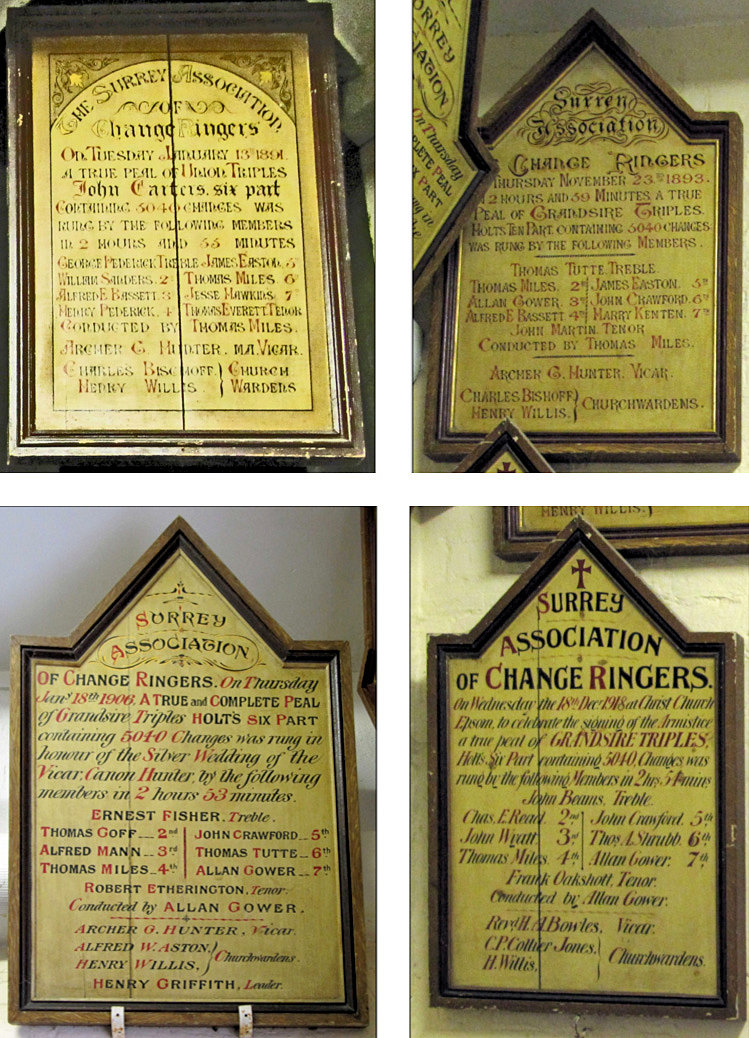 Boards commemorating some early major peals on Christ Church’s Bells.
Top left: 13 January 1891 – Union Triples in 2 hours 55 minutes.
Top right: 23 November 1893 – Grandsire Triples in 2 hours 59 minutes.
Bottom left: 18 January 1906 (to mark the Silver Wedding of the then Vicar,
the Revd Archer Hunter) – Grandsire Triples in 2 hours 53 minutes.
Bottom right: 18 December 1918 (to celebrate the WW1 Armistice) –
Grandsire Triples in 2 hours 54 minutes.
Photograph © Roger Morgan, 2017
The Clock
As noted above, the fundraising had been intended to cover the cost of not only the new bells but also a clock. However, even when the “Bells & Clock Fund” Committee published its final accounts in May 1891, there was a deficit of £16 1s 9d just in relation to the bells and their installation. In its covering report, the Committee invited further donations to meet that shortfall and said, “As regards the Clock, we have great pleasure in informing you that a Parishioner has most kindly and generously offered to present this to the church.” That Parishioner was Basil Braithwaite, and the fine clock (by Gillett & Johnson of Croydon) was given in memory of his father Isaac (1810-90), from whom he had just inherited Hookfield Grove.
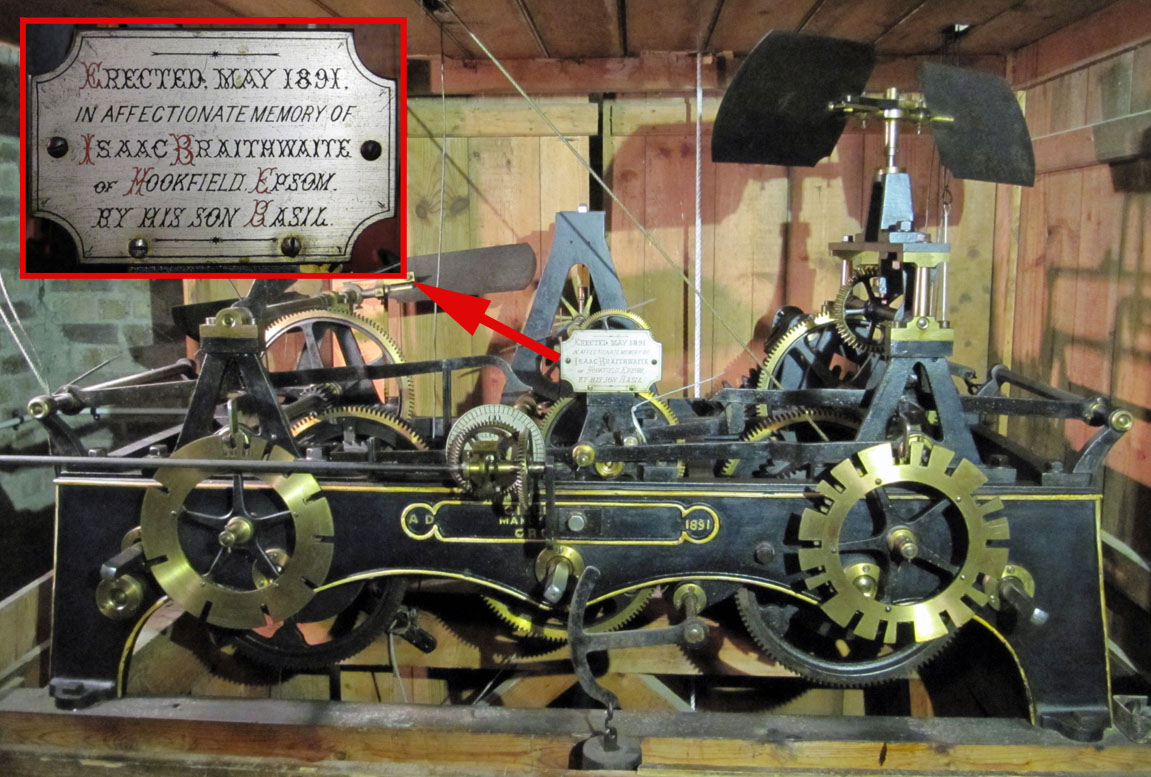 The 1891 clock mechanism.
(This high-maintenance mechanism remains in place but, since 2004,
has been superseded by a radio-controlled electric system.)
Photograph © Roger Morgan, 2017
In addition to driving the external clock faces the mechanism was, through a series of wires and pulleys, linked to small hammers by the bells (at rest in their “down” position) to sound the hours – and the quarters – with the familiar Westminster chimes. Those chimes are now generated by the new mechanism, although the small hammers are now electrically-operated.
After many years exposed to the elements, the two clock faces were in a poor state. In line with his wishes, a small part of the late Richard Shortman’s generous legacy was used for their restoration in late 2020 – see below.
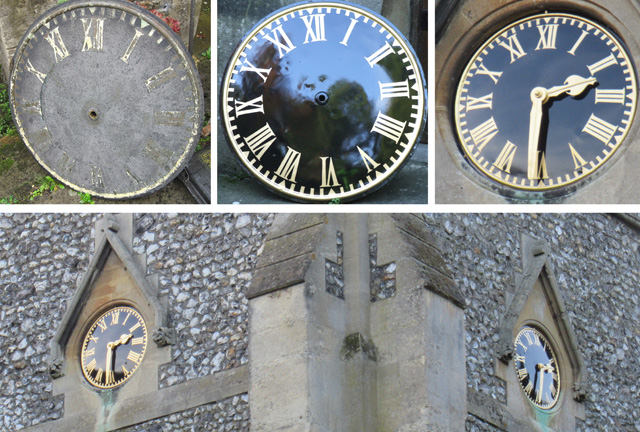
Clockwise from top left: one of the weather-beaten dials taken down ready for renovation;
as renovated with real gold leaf; as reinstalled with similarly re-gilded hands; and a view of both the new clock faces in situ.
Photographs by Andy Hards & Roger Morgan © 2020
Back to the Bells
For normal – and traditional – “change” ringing, the team of ringers use the bell ropes, as in the following animation.
 Animation of traditional bell ringing.
© Dr James Bryant, University of Texas – via giphy.com
Notwithstanding some significant maintenance of the bell mechanism in 1930, by the late 1980s the near century’s use was beginning to tell on not only the bells’ fittings but, more importantly, the tower’s structural integrity – the latter meaning that a lighter peal of bells was needed.
Initially, all options seemed prohibitively expensive: Christ Church was already committed to very substantial expenditure to “re-order” its effectively unchanged Victorian interior (to meet modern liturgical and other needs) as well as a major rebuild of its original William Hill pipe organ.
Serendipitously, a considerably less expensive option became available through the complementary needs of Holy Trinity Church, Hawley (near Camberley) which was also wanting a lighter peal of eight bells. Through the agency of Guildford Diocesan Guild of Church Bell Ringers, it was arranged that Christ Church’s bells should, after re-tuning, be refitted in Holy Trinity’s tower, and that Holy Trinity’s bells should be melted down and recast to make the lighter set needed at Christ Church, with the unused metal helping to offset the costs.
Thanks to significant local fund-raising – not least through sponsored dedications on the individual bells – and much volunteer practical effort, the Christ Church end of the scheme (overseen by Tower Captain Don Baptiste) got under way on 3 January 1992. (The old bells had been rung for the very last time at Epsom on New Year’s Eve, and their passing marked more formally with a peal of Spliced Surprise Major on 28 December 1991.)
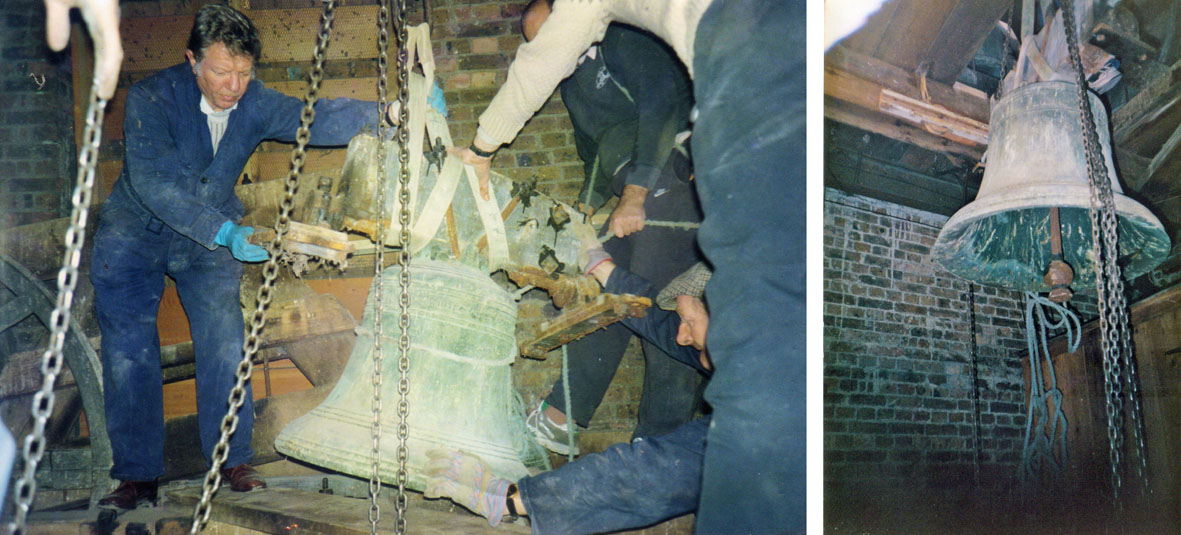 Left: Lifting one of the old bells from its pit.
Right: Lowering it down the tower
Both photographs byMaureen Morris © January 1992
After the old bells had gone, a few volunteers hauled an industrial cleaner up into the belfry and took a few days to clear out the mass of dead pigeons and pigeons droppings that still remained behind and under the frame. (Live pigeons has been cleared from the belfry by a contractor three years previously, and the louvres – through which the bells sound over the surrounding area – made bird-proof.) The frame and floors were then washed with disinfectant ready for the new bells.
These arrived, in all their pristine glory, on 24 February and were left in the church for a day to enable the sponsors and others to see the new bells. Greatly reinforced by the under-16 rugby squad of Glyn School, the eight new bells were then hauled back up the tower ready for careful work by the experts in installing the bells in their pits with their attendant fittings.
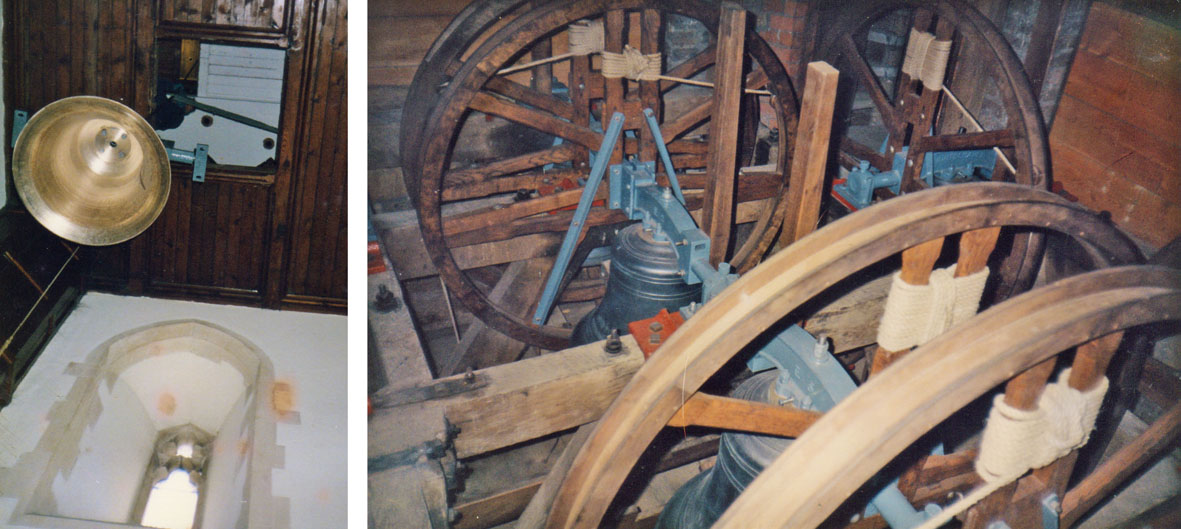 Left: One of the new bells on its way up the tower, 25 February 1992
Right: The new bells ready to be rung, 25 March 1992.
Photographs by Maureen Morris © 1992
The specification of the new bells and the dedications (which were cast into the bells) are set out below.
| BELL | SIZE | NOTE | WEIGHT | DEDICATION |
|---|---|---|---|---|
| Treble | 1′ 11″ | A | 2-3-22 | I PRAISE THE LORD AND IN MEMORY OF ADRIENNE HEYWORTH |
| 2nd | 1′ 11¾” | G# | 3-0-22 | I PRAISE THE LORD AND IN MEMORY OF ROBERT GILL GIBSON |
| 3rd | 2′ 0¾” | F# | 3-1-14 | IN LOVING MEMORY OF HARRY AND BESSIE ROLL AND THEIR SON JOHN WHO WORSHIPPED AND WORKED IN THIS CHURCH |
| 4th | 2′ 2″ | E | 3-2-9 | IN LOVING MEMORY OF MARGARET COOMBES 26.1.1887-8.3.1988 AND HER SISTER MAY WAYLAN 24.5.1888-23.6.1978 |
| 5th | 2′ 4″ | D | 4-1-19 | I RING THE SANCTUS AND IN LOVING MEMORY OF AMY OAKESHOTT AND HER SON VICTOR |
| 6th | 2′ 5½” | C# | 5-0-11 | IN LOVING MEMORY OF RON BATHGATE, COLIN CRADDOCK-JONES, JENNY JACKSON, MAGDALENA TARGETT-ADAMS |
| 7th | 2′ 8½” | B | 6-2-18 | THIS BELL IS DEDICATED TO THE GUILDFORD DIOCESAN GUILD OF CHURCH BELL RINGERS |
| Tenor | 3′ 0″ | A | 8-2-2 | GLORY TO GOD IN THE HIGHEST AND PEACE ON EARTH |
| NOTES:
1. By convention, bells’ weights are shown in the imperial measures of hundredweights (112 pounds or one twentieth of a ton), quarters (28 pounds) and pounds. The total weight of the new peal is 35-3-13 or 1.8 tons – about third less than the original bells. (An imperial ton is only 0.02% more than a metric tonne so, for everyday purposes, they can be taken as the same.) 2. The dedication on the 7th reflected the Guildford Diocesan Guild Of Church Bell Ringers’ significant practical and financial help with the whole operation. 3. It is understood that the Tenor was sponsored by the Tower Captain, Don Baptiste, who was instrumental in organising the complicated project – but too modest to add his name to the bell itself. |
||||
On Sunday 29 March 1992, the bells were dedicated by the Archdeacon of Dorking, the Ven Christopher Herbert, who climbed to the belfry to perform the ceremony which was broadcast to the congregation by radio. The new bells were, of course, rung during the service and their first full peal (of Plain Bob Triples, in 2 hours 44 minutes) was rung on Sunday 2 August 1992 – all as recorded on a chime board in the ringing chamber, see below.
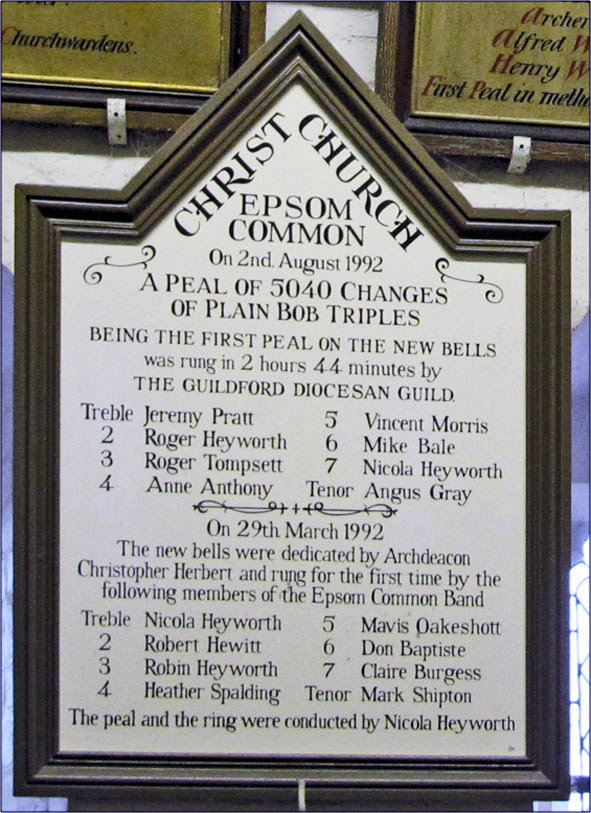 Chime board recording the new bells’ dedication and first full peal.
Photograph © Roger Morgan, 2017
As for the last century and more, Christ Church’s bells continue to be rung before Sunday morning services and for other special occasions, including weddings. Click here for more details.
Roger Morgan © 2017 & 2020