
THE MULLINS FAMILY
of Summerdale, 14 Burgh Heath Road, Epsom
Introduction
This article was to be about the eldest Mullins child, Ann Gwendolen, better known as Dr Ann Dally, psychiatrist and medical writer: however, there was a wide range of talents in the family, so the subject-matter has been broadened to include others. The parents, Claud and Gwen Mullins, were at Summerdale for roughly 20 years, from about 1928 to 1947/48.
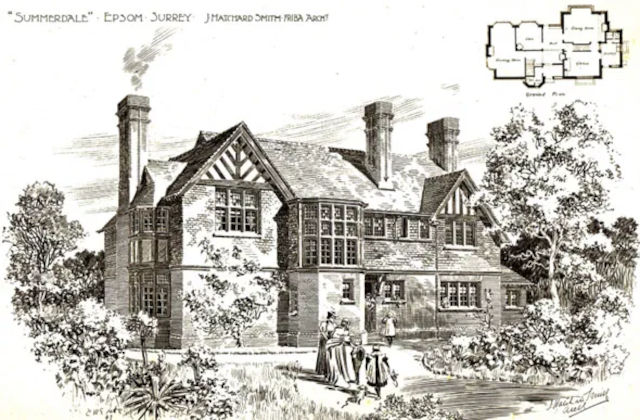
Drawing of Summerdale from The Building News, January 1898
Image source: The Internet Archive
Background
The Mullins family was not ordinary and I must go back to Claud’s father, the sculptor, Edwin Roscoe Mullins (1848-1907), to show you one of his more spectacular works, which resides in Woodvale Cemetery, Brighton. This stunning piece adorns the tomb of the Ginnett family, who were circus folk, and the whole thing is Grade II listed. Here’s the sculpture in situ.
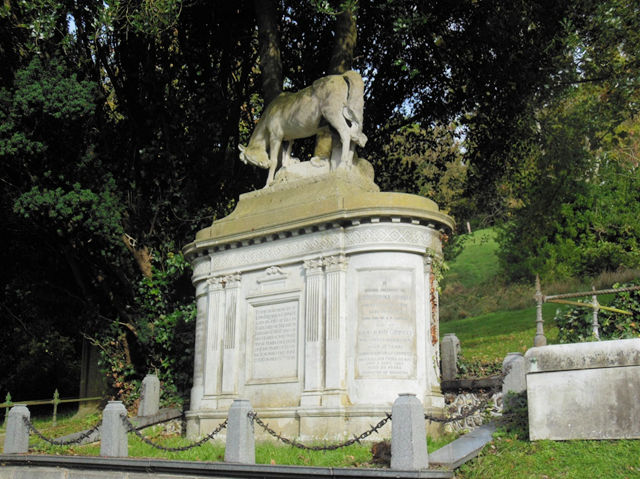 The Ginnett tomb in Woodvale Cemetery, Brighton, photographed in 2013
Photograph by Linda Jackson ©2020
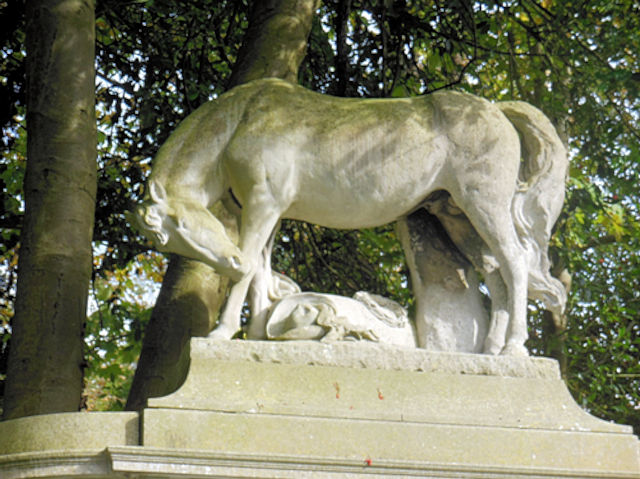
Close-up of the horse sculpture created by Edwin Roscoe Mullins in 1893
Photograph by Linda Jackson ©2020
Claud William Mullins (1887-1968) was Edwin’s eldest son and started out as a clerk for the London County Council, but, like legions of people before him, and since, he didn’t find office life that exciting intellectually, so turned to the study of law, being called to the bar in 1913 – not an opportune moment to build a career as a barrister, and he spent subsequent years in the army, ending up as a Lieutenant in the Royal Army Ordnance Corps.
 Claud Mullins
Image source © NPG (MW102265) (CC BY-NC-ND 3.0)
In 1925 Claud married Elizabeth Gwendolen (‘Gwen’), daughter of merchant banker, Augustus Philip Brandt, and his wife, Janie Champion (née Garmany), who was from Savannah, Georgia. Mr Brandt was a partner in the family firm of William Brandt & Sons and the couple had abodes in London and Bletchingley. According to Gwen’s obituary in The Independent of 11 February 1997, Mrs Brandt ‘insisted on ignoring the English climate by dressing her daughter – Southern style – all in white. Thanks to the mud of a Surrey garden, the child’s clothes would be changed three times a day by her personal maid. From the London house in Kensington, Gwen was driven to school each day in a pony-trap. At weekends the first family car would stop on Putney Hill on the drive home from London to Bletchingley so that the chauffeur could light the headlamps’.
The Brandts had five children in total, of whom only two daughters survived, Gwen being the younger of them (born 1904).
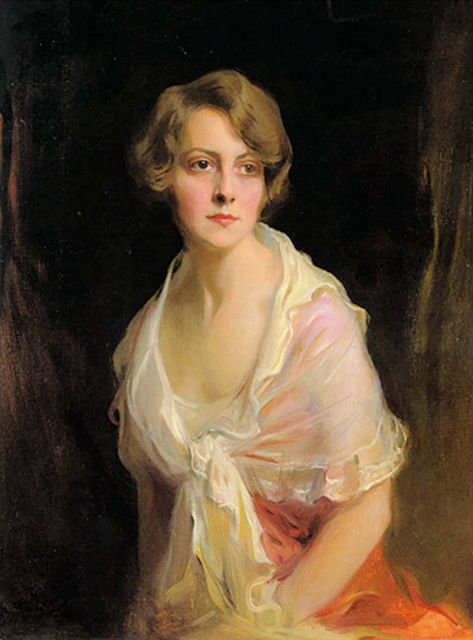
‘Mrs Claud Mullins’
By Philip Alexius de Laszlo, c.1925
Claud and Gwen’s first daughter, Ann Gwendolen, was born on 29 March 1926 in Marylebone, followed by Barbara Kyra (1927) and Edwin Brandt (1933). When Ann was two years old, the family moved to Summerdale at 14 Burgh Heath Road, Epsom: it had been built for a colonial merchant named Thomas Wood in the 1890s, to a design by John Hatchard-Smith.

Edwin Mullins playing cricket in the snow in the back garden of the Epsom house, c.1946
Image Source Jason Mullins via Flickr (CC BY-NC 2.0)
Claud
Owing to his shortage of legal work, Claud began to write books, which mainly expounded his views on the English legal system. Essentially he was ahead of his time, because the legal establishment was stuffy and his ideas for reform and modernisation were too radical. Nevertheless, he was appointed a Metropolitan Police magistrate in 1931.
One of his main beliefs was that more should be done to treat marital disputes as social, rather than legal, problems and he was not a fan of the adversarial nature of matrimonial issues, whereby the ‘dirty linen’ was aired publicly in court and plastered all over the newspapers. His efforts in this area did meet with some success – the Summary Procedure (Domestic Proceedings) Act 1937, which separated domestic hearings in magistrates’ courts from criminal prosecutions.
Claud also felt that there was far too much use of the power to imprison people for minor debt and he had some success with this too, leading to the Money Payments (Justices’ Procedure) Act 1935, which provided that people who did not pay fines, affiliation orders or rates should not be imprisoned without inquiry into why they had not paid. These were obviously not giant leaps for mankind, but they were little steps on the road to a fairer and less draconian system for matters which were more civil in nature than criminal. His pronouncements and activities did rub people up the wrong way – his colleagues on the bench and people in government particularly – and he retired in 1947, which is when the family moved from Epsom to Graffham (near Petworth) in West Sussex.
Claud died on 23 October 1968 in Chichester and, in a nice touch, his ashes were scattered in the woods where he enjoyed walking.
Gwen
We shall have a quick rewind on Gwen, going back to the time before her marriage to Claud Mullins. She found life as the daughter of a prominent banker and his wife rather constricting, filled with social gatherings, house guests and suchlike – she seems to have been a free spirit, longing to break out, and she did, decamping to Italy. On returning home, she began to paint and draw, inspired by what she had seen and absorbed.
She then took a course at the London School of Weaving in Kensington, but, although she learned the basics there, much of her craft was self-taught. The School had been founded in 1898 by a woman who wanted to revive the art of hand weaving and in 1919 it amalgamated with the Kensington Weavers, which had been set up by two sisters who believed that the craft would be therapeutic for men and women whose lives had been badly affected in some way by WW1.
I can’t show you any of Gwen’s work for copyright reasons, but if you go to the website of VADS, there are three examples, plus one rug made by her daughter Barbara (click on the images to enlarge). As you will see, the designs are abstract and these particular rugs date from the 1970s, when Gwen was utilising linen and wool.
With the outbreak of WW2, Gwen undoubtedly recalled the therapeutic benefits of weaving, which had been espoused in Kensington, and set up looms at Horton Hospital for use by the military inmates. There was also some abandoned bookbinding equipment and, with the help of a bookbinder who was teaching at Epsom School of Art, she learned this craft too.
I must continue to the end with Gwen, or else her activities will keep popping up disjointedly in the narrative. Following Claud’s retirement and the move to Graffham, where initially she set up bookbinding classes for locals, the enterprise then grew into a village crafts workshop, housed in old farm buildings at the end of the garden. The property was known as ‘Glasses’.
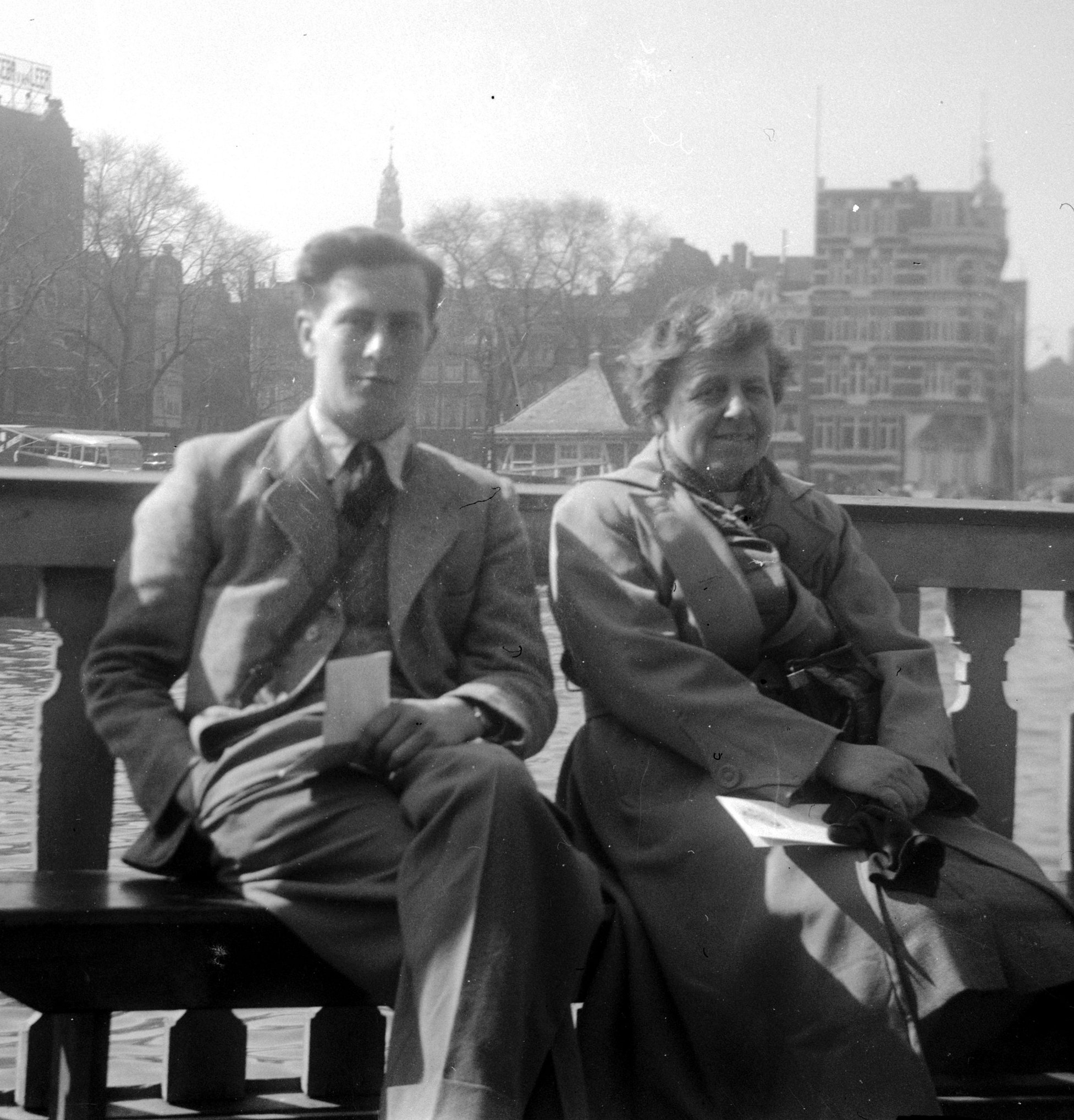
Gwen Mullins and her son Edwin on holiday in Amsterdam, 1953
Image Source Jason Mullins via Flickr (CC BY-NC 2.0)
Barbara Mullins was integral to the Graffham enterprise and here she is on a trip to the USA around 1950.
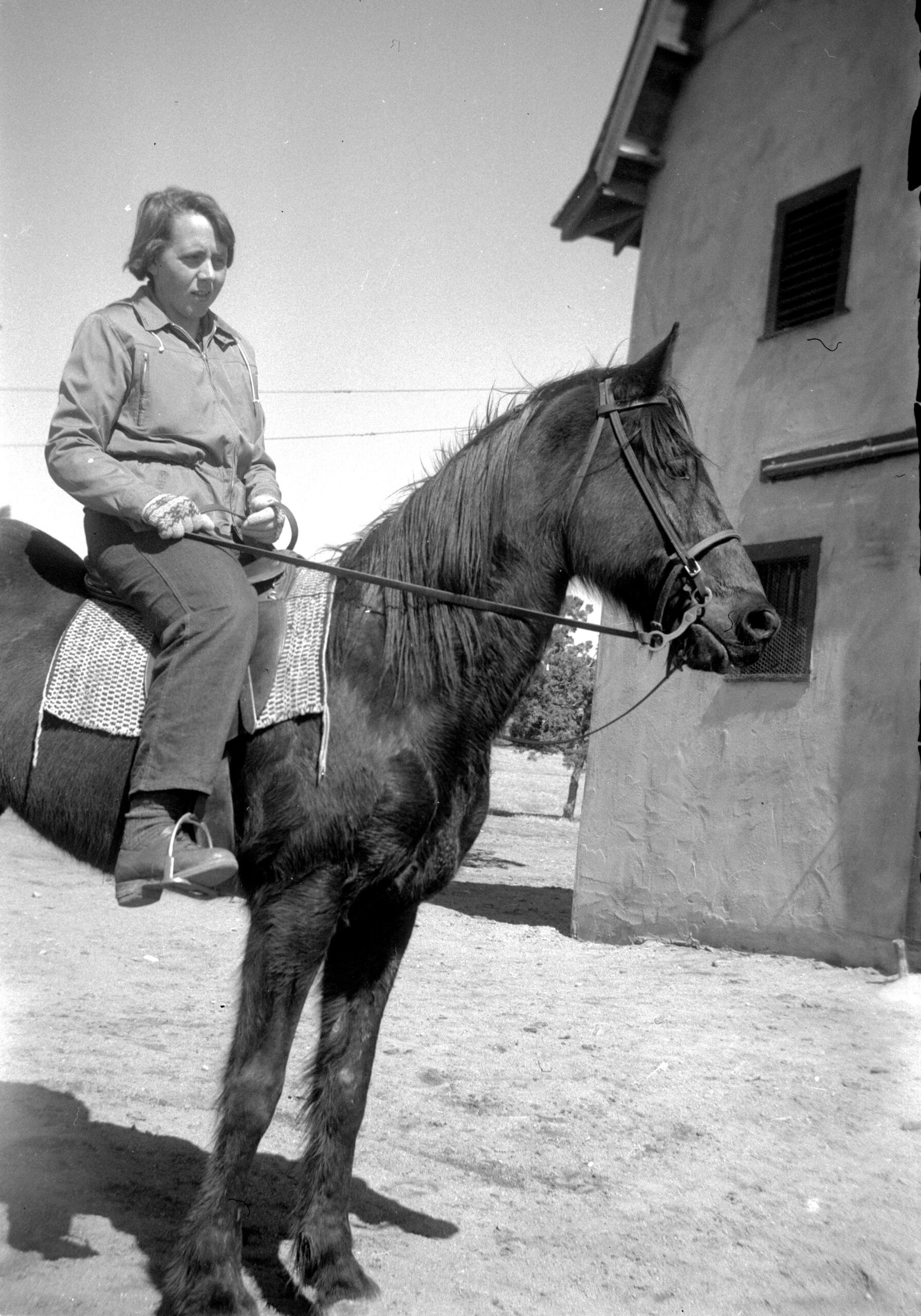 Barbara Mullins in the USA c.1950
Image Source Jason Mullins via Flickr (CC BY-NC 2.0)
As the breadth of the craft activities increased, Gwen focused on weaving and experimented with vegetable dyes derived from local plants. Graffham Weavers eventually took overseas students, exhibited widely and carried out important commissions. Something else she did, which was a lifeline to young craftspeople, who were usually struggling to practise their art, was to establish the Gwen Mullins Trust, which financed training/apprenticeships and awarded grants for equipment/materials etc. In the 1960s there was no public funding for this kind of work. The assistance the trust provided covered not just weaving, but ceramics, jewellery and other crafts. One of those who benefited was Peter Collingwood (1922-2008), who is rated by many as the pre-eminent weaver of the second half of the 20th century, or even the whole century. His father was a doctor, who died when Peter was 12, and the lad was a pupil at Epsom College. Subsequently Peter qualified as a doctor, but his heart wasn’t in it and one day he found an old loom in a hospital cupboard. The rest, as they say, is history.
Peter Collingwood working at a loom c.1965
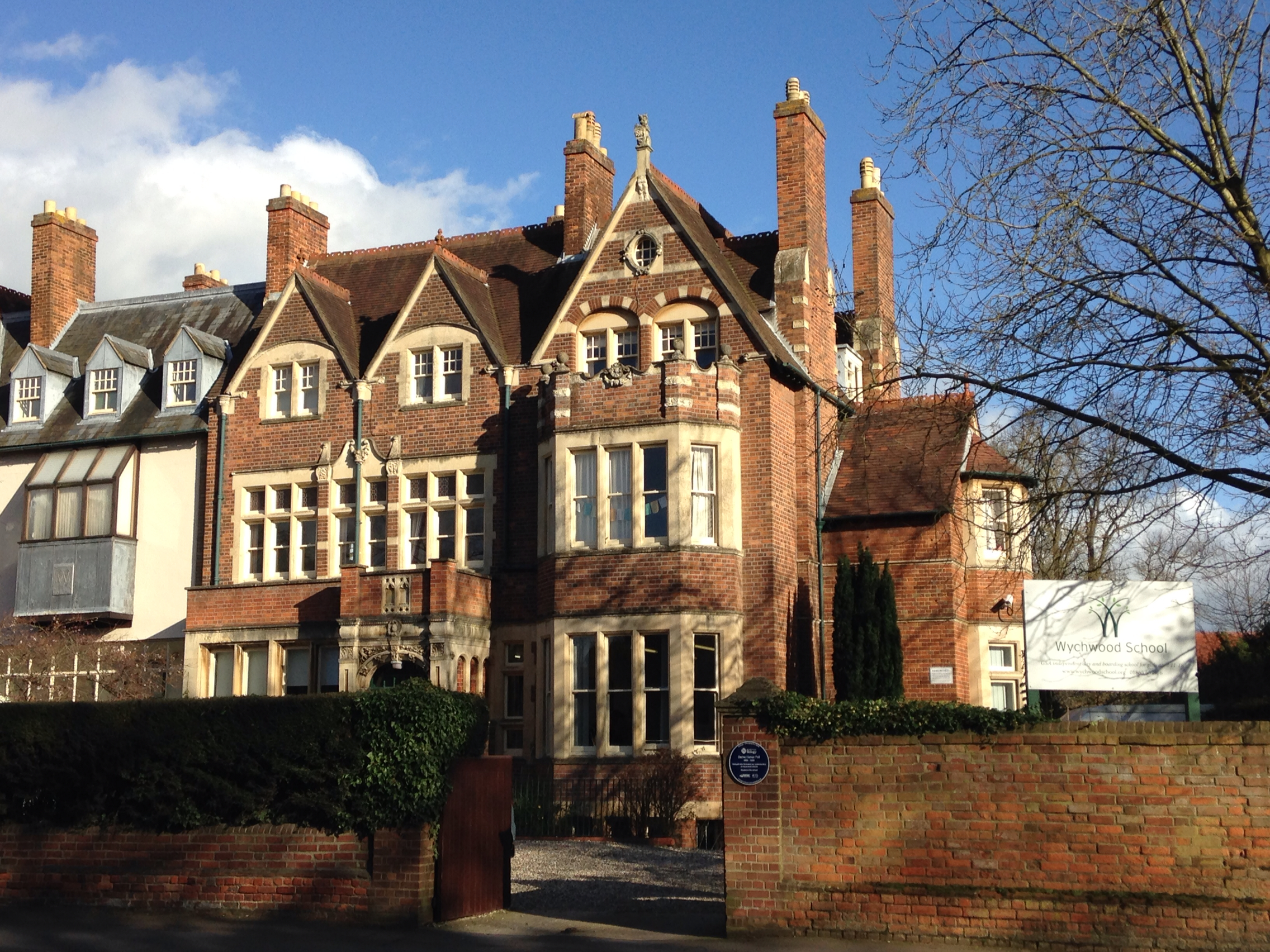
Wychwood School, 74 Banbury Road, Oxford
By Owen Massey McKnight via Flickr (CC BY-SA 2.0)
Ann did well at Wychwood, but remained resistant to authority and control and was duly expelled at age 16; she went on to Oxford High School, which says very prominently on its website that it ‘has been educating brilliant, fearless and outspoken young women since 1875’. Alumni include Dame Maggie Smith, Dame Cressida Dick (currently commissioner of the Metropolitan Police) and the actress Miriam Margolyes, none of whom could be described as shrinking violets. Ann was not necessarily less rebellious whilst at the High School, but she did knuckle down to the work and won an open exhibition to Somerville College, Oxford (which also does not do bashful – past students include Margaret Thatcher, Indira Gandhi and the chemistry titan, Dorothy Hodgkin). She graduated with a history degree in 1946 and, after a brief spell with the War Office lecturing to British troops in occupied Austria and Germany, started medical training at St Thomas’s Hospital in 1947, the first year that women were admitted. Peter Dally was in the same year and in 1950 he and Ann were married. At Oxford Ann was described as ‘very bright, opinionated, untidy and indifferent to fashion’; she knew Margaret Thatcher whilst there, which was to become significant later on. The author Dame Margaret Drabble, by no means an intellectual slouch, who was a friend for decades, said of Ann, ‘I think she may have been the cleverest person I have ever known. She was a formidable and monumental figure of immense strength and character, often controversial in her opinions and indeed in her actions, but always stimulating and never dull. For me, she was an alternative mother figure as well as an intellectual guide’.
Peter Dally was the son of a senior naval dentist and had been keen to play a part in WW2, although his parents wanted him to be a doctor. He was sent to Dartmouth Naval College and passed out as a midshipman, participating in the Allied invasion of Italy. He was also on a British ship that visited Nagasaki after the atom bomb had been dropped in August 1945 and never forgot the devastation he saw.
Ordinarily Peter would not have been accepted for war service at all, since he suffered severely from inherited duodenal ulcers, but the Navy needed officers badly and he covered up the effects as best he could. However, he was invalided out after the war and began studies at St Thomas’s. Curiously he was soon to have a significant connection with our borough, for in 1955, whilst undertaking his first appointment in psychiatric medicine at St Ebba’s Hospital, he contracted polio. He declined to be placed in an iron lung (a type of mechanical ventilator), which was the norm for serious cases at that time, and, after a period of intensive physiotherapy he was able to resume his career. I will return to Peter later on because his work was relevant to other medical items we have on this website and will show us another facet of psychiatric medicine.
Ann and Peter had six children in the period between their marriage and 1961 and here is a photo of Ann with the two eldest, Simon and Mark.
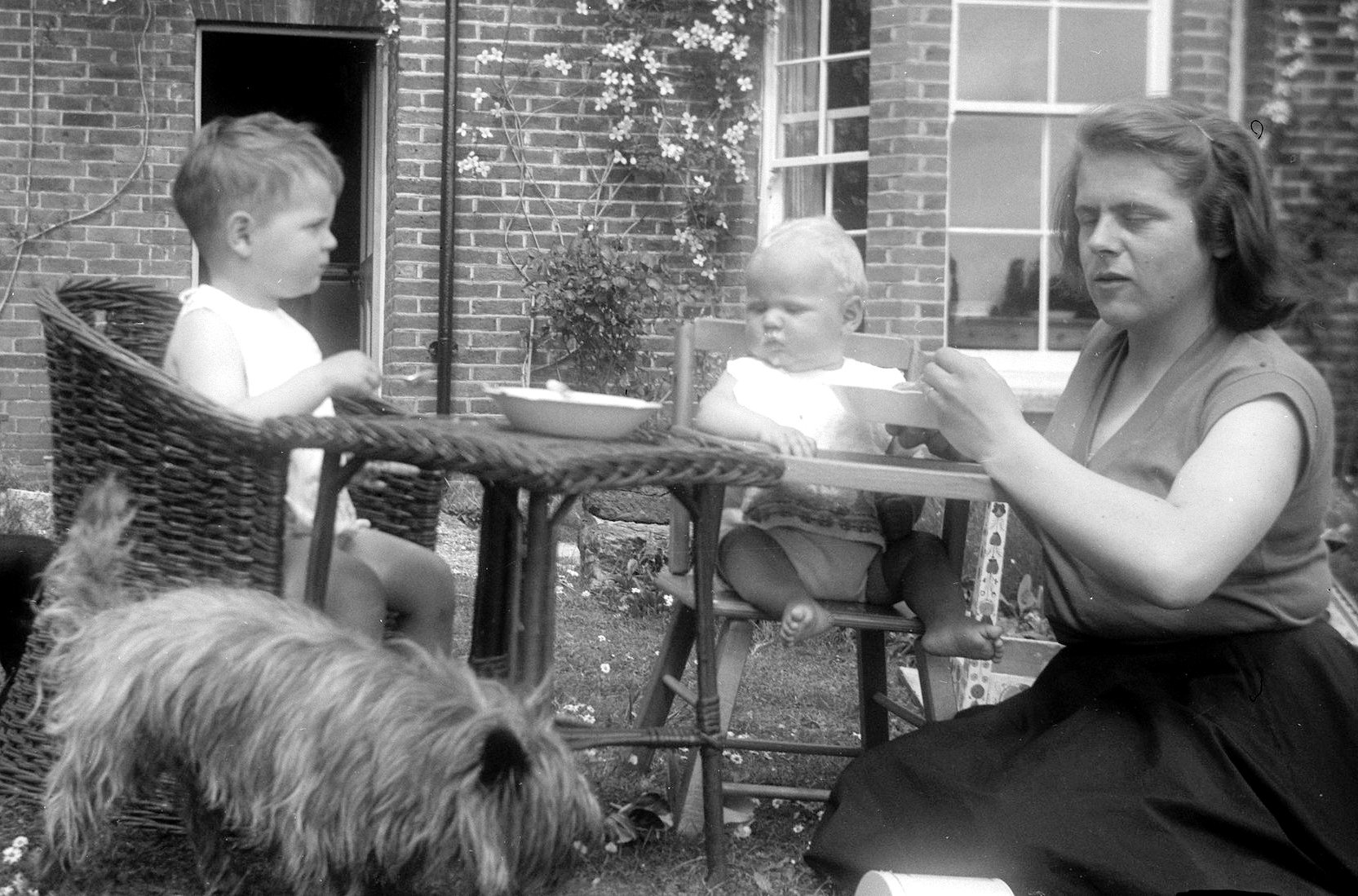 Ann, Simon and Mark Dally, c.1953
Image Source Jason Mullins via Flickr (CC BY-NC 2.0)
Although the family lived in London, they had a bolthole in Graffham called ‘Wiblings’, where they spent a lot of time.
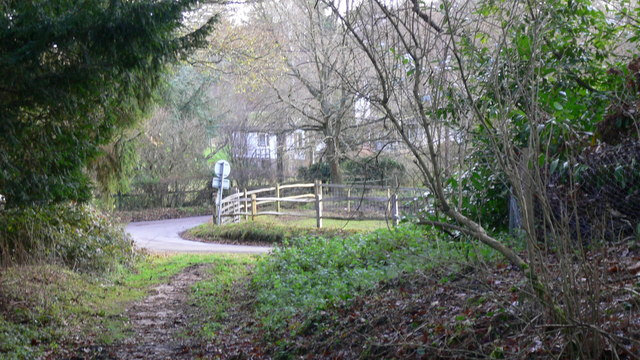 Wiblings Farm, Graffham
cc-by-sa/2.0 – © Shazz – geograph.org.uk/p/1069793
Until 1959 Ann worked as a hospital doctor, but then became a part-time GP, combining this with broadcasting, writing on medical subjects and baby clinics/ family planning. She also went into private psychiatry practice with Peter. They divorced in 1969 but continued to work together.
In the 1980s Ann got into big trouble with the General Medical Council (GMC) over prescribing for drug addicts and we’ll have a quick look at the background to this before continuing with the story. The UK had had an ambivalent and changing attitude towards drug addiction for a long time. An upsurge in cocaine /opium addiction in the early years of the 20th century led to the Defence of the Realm Act in 1916 (see our articles on Billie Carleton and Robert Fabian for a flavour of what was happening after WW1).
By 1928 only doctors were permitted to prescribe opiates as part of a treatment regime for addiction; by 1967 they were required to report addicts to the Home Office and restrictions were placed on prescribing heroin and cocaine. This extract from a report by the Joseph Rowntree Foundation describes in a nutshell what the problem was.
”Concerns about the increase in numbers of known heroin users led to the establishment of the Second Brain Committee. The Committee (Interdepartmental Committee on Drug Addiction, 1965) blamed the increase in heroin use on the doctors who were overly generous in their prescribing, stating that ‘the majority source of supply has been the activity of a very few doctors who have prescribed excessively for addicts’ (Ministry of Health and Scottish Home and Health Department, 1965). At the time of report, several doctors were prescribing heroin and cocaine in very large quantities. The Brain Committee recommended that restrictions should apply to the prescribing of heroin and that ‘treatment centres be set up, mainly in London and might form part of a psychiatric hospital or the psychiatric wing of a general hospital’. In effect, the report recommended that, to control the problem, the right to prescribe heroin for the treatment of addiction should be restricted to psychiatrists working at special drug clinics. This report informed new legislation. In 1967, the Dangerous Drug Act restricted the prescribing of heroin and cocaine in the treatment of addiction to doctors holding licences from the Home Office. Prescribing heroin in the treatment of other medical conditions was unaffected. In 1968, new specialist drug dependency units (DDUs) were established by the Ministry of Health – mainly in London. The licensed doctors were mostly NHS psychiatrists in charge of the DDUs – thus effectively excluding general practitioners from prescribing heroin for the treatment of opiate dependence.”
That extract sums up how Ann Dally fell foul of the GMC. There was, of course, a major flaw in the arrangements, because long-term addicts who did not reduce or stop their dependence were not accepted by DDUs, so needed to find a doctor who would prescribe for them and assist with a gradual withdrawal. Otherwise, they would have to obtain the drugs from illegal sources, with all that followed from that. Ann felt strongly that such people were entitled to treatment, becoming a drugs treatment adviser to Margaret Thatcher, and she was part of a committee that set up guidelines in 1984. As you might expect, she didn’t agree with the majority view of the committee. Although she avoided being struck off the medical register, she was barred from prescribing controlled drugs for 14 months because, it was said (effectively), that she had far too many patients on her books and could not monitor them properly. Eventually she retired from practice and joined the Wellcome Institute as a medical historian.
Ann remarried in 1989 and, having survived a stroke, died on 24 March 2007.
Peter Dally

Peter Dally
Source not known
Peter did much of his early training in psychiatry under the auspices of William Sargant, who was pioneering, if controversial. You can read more about him and the general subject of treatments for psychiatric disorders in our article on Psychosurgery. In that same article we touched on the subject of anorexia nervosa with particular reference to the actress Celia Imrie (who was treated by Sargant) and the singer Lena Zavaroni: that is the main illness that Sargant and Dally worked on together.
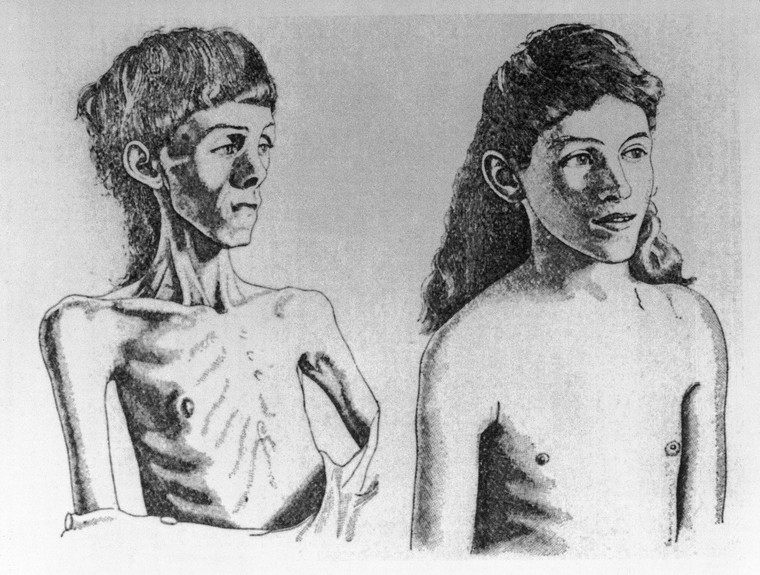
Two ‘before and after’ portraits of young girl with the condition anorexia nervosa, 1936.
Image source Wellcome Collection
Initially Sargant and Dally advocated the use of modified insulin and electroconvulsive therapy (ECT), but Peter Dally later moved away from this view and, in many cases, used persuasion and the award of extra privileges as weight increased. He was well-liked and respected by patients, students and staff. After his retirement a facility for eating disorders, the Peter Dally Clinic, was opened by the NHS; sadly it no longer bears his name, as there was a major scandal concerning the manager of the clinic, who was apparently committing gross misconduct with female patients. It is no part of this article to elaborate on that, but if you want to know more, there is a full report at https://www.verita.net or an article in The Guardian of 17 July 2008. I stress that Peter Dally had nothing whatsoever to do with the practices/abuse at the clinic – he had retired – but his name was removed therefrom.
Peter died in Chichester on 25 June 2005.
Edwin
We began this saga with Edwin the sculptor, so we’ll finish with another Edwin, distinguished art historian/critic, author and broadcaster. He’s the lad playing snowy cricket and also the young man in Amsterdam with his mother in 1953, pictured earlier, and is the last surviving offspring of Claud and Gwen Mullins.
You may possibly remember Edwin from the BBC television series called ‘One Hundred Great Paintings’, which aired in 1980, and his later series entitled ‘The Woven Image’, which dealt with the history of tapestry. He was also art critic of the Sunday Telegraph for many years and has written many books, including an account of Van Gogh’s year in an asylum, during which he produced ‘Starry Night’, arguably his best-known painting.
As I said at the outset, the Mullins family was not ordinary.
Linda Jackson 2020
A letter from 15 year old Ann Mullins
to Picture Post 03 May 1941:
Bombs are Good for You,
I have come to the conclusion that it is good for people to be bombed. I live part of the time in a bombed area, and part time in a town that, as yet, has had no air raids. Those who have experienced bombs do not, on the whole, think totally about themselves, but throw them- selves heart, body and soul into the struggle. But many of those who so far have not had bombs seem to be negative about the whole war. They leave good food on their plates and “can’t be bothered” to save it for the pigs, they refuse to use envelope savers because they don’t look “tidy,” they are furious with a shop if it hasn’t the right kind of biscuits, they refuse to save any more money than they need, and so on. What use are these people? They give little to defend their freedom, yet our Merchant Navy risks and loses its ships and men to bring them food and clothing, our armed forces risk and lose their men to defend them, and our workers work overtime to provide them with necessities. We can’t shoot them. We can’t transport them because it would waste shipping space. Perhaps the best remedy would be to send them to a bombed area or drop a hint to Hitler to bomb them at home.
A. G. Mullins, Summerdale, Epsom, Surrey.