
Randall and Measures

Randall & Measures stone jar for ginger beer or similar
Image courtesy of Bourne Hall Museum
These two families are on the same page because they were in business together for a long time.
The Randalls
The Randalls allegedly started their soda and mineral waters business in 1837, which date appears on company stationery etc, but I can find nothing to substantiate it, unless James Randall, who seems to have founded the firm, acquired an existing business. James, who was born c.1835 in Crookham, Hampshire, came from a family of agricultural labourers; he married Jane Hawes (born 1835 Vauxhall) in 1854 at Kennington. By 1861 they were in Basingstoke, with James described as a railway carman. There were three children at that point, who were James William (5), Jane Hannah (3) and the newly-born Alfred Hawes (1 month). I can’t find them in the 1871 census but during the 1870s James re-materialised in directories, described as a travelling or static draper, variously at 124 and 130 Curzon Street, Leicester. There were three more offspring – Mary Elizabeth (1868 London), William Henry (1872 Leicester) and Amy Lucy (1874 Leicester).
James probably saw a limited future in waged railway work, hence the drapery enterprise in Leicester. However, by 1881 he was a soda water manufacturer in Addlestone, assisted by James William. Alfred was still up in Leicester, now a chemist’s assistant.
1881 was a tragic year for the family. The two youngest children, William and Amy, died of scarlet fever and Mrs Randall herself expired shortly afterwards, all three having died in a period of less than three months and being buried at Addlestone, St Paul. There was a falling out between James and his two surviving sons, for the Surrey Advertiser of 14 January 1882 reported that James Randall and his brother, William, had been charged with assaulting James William on 31 December 1881. Apparently James William and Alfred Hawes had gone to work at the manufactory as usual and their father had stopped them, saying he would not let them having anything further to do with the business unless they returned some company books they had taken away. The sons returned in the afternoon and tried to take out the van, whereupon James struck James William around the head and face with a whip and William joined in with a heavy stick. There were mutterings of ‘self-defence’ by the two older men, but it was they who were fined £10 each and bound over to keep the peace. The firm of Randall & Sons was dissolved almost immediately, with the county court ordering all the equipment to be sold at auction.
What happened to James Randall Senior after that I don’t know, but I suspect he may have died in the mid-1880s. Mary was with her uncle, William Randall (he of the 1881 assault), at Wimbledon in the 1891 census and I can’t find Jane Junior. Elsewhere in 1891, we have James William at the Addlestone end of the mineral water operation and Alfred Hawes in Epsom. Randall Brothers, as the firm now was, not only brewed up soft drinks but also sold chaff, produced from hay by a steam cutter.
Mary Elizabeth Randall, known in the wider family as ‘Auntie Totts’, married a Jack Day.
 Mary Elizabeth Randall c.1895
Image courtesy of Roy Lourens © 2020
James William and Alfred Hawes Randall

Two views of a Codd* bottle produced for Randall Brothers of Epsom
Image courtesy of Bill Owen. Photo by Clive Gilbert
*Codd bottles were designed by Hiram Codd so that aerated waters were perfectly sealed in.

Three views of a Codd* bottle produced for George Thorns, a grocer and
mineral water manufacturer in High Street, Ewell during the 1870s/80s
Image courtesy of Bill Owen. Photo by Clive Gilbert
James and Alfred had more in common than being brothers in mineral water – their wives were sisters from the Leicester days. James married Anne/Annie Jane Andrew in 1878 and Alfred wed Ellen Maria Andrew in 1882. It looks as if James stayed in Addlestone and Alfred ran the Epsom side of things. You’ll see that the two bottles at the beginning of this section say Randall Brothers, Epsom & Addlestone.


Two photographs of the Randall Brothers shop and works at 18 South Street, Epsom
Images courtesy of Bourne Hall Museum
In the second shop photo we can see two posters promoting Mikado Sauce, flanking a poster for Horniman’s tea; the gates to the left say Randall Brothers Mineral Water Manufacturers and Mikado Sauce Works respectively. Mikado Sauce was a kind of Worcestershire Sauce, first developed in Japan in the mid-1880s for Western tastes, so it was a novel product to find in an Epsom store. Alfred went to town on Mikado advertisements up and down the country in the mid-1890s.
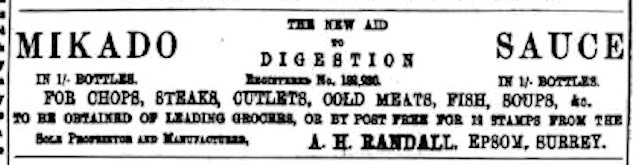
Newspaper advert for Mikado Sauce, mid-1890s

Two views of another example of a Randall Brothers stone bottle
Image courtesy of Bill Owen. Photo by Clive Gilbert

Alfred Hawes Randall
Image courtesy of Bourne Hall Museum
The picture below is Alfred Hawes Randall with his wife Ellen and three of the children, who are probably Alexina, Florence and Percy (Alfred Percival): it would have been taken in the very late 1880s/early 1890s, before the other three children arrived.


Alfred and Ellen Randall with all six of their children
Image courtesy of Roy Lourens © 2020
This next photo shows Percy with his youngest brother, William, so it would date from about 1901 or so.

William Henry and Percy Randall
Image courtesy of Bourne Hall Museum
Alfred became ill and by 1911 he was living in retirement in Southwick, Sussex (a small place just west of Brighton) with his wife and all the children except Percy. He died in 1912 and James William Randall sold the business to Alfred Ernest Hyde and emigrated. Hyde was already a mineral water manufacturer in South Street by the 1911 census; he soon emigrated, so Percy decided to stay in Epsom. After service in WW1, during which he was badly wounded by shrapnel, Percy went into partnership with Charlie Measures.

Randall & Measures business card, showing that Percy and Charlie were ex-servicemen
Image courtesy of Bill Owen.

Percy in his army uniform
Image courtesy of Bourne Hall Museum
We’ll leave Percy temporarily to look at the Measures family.
The Measures family
Charles Measures Senior, who hailed from Bedfordshire, had been a domestic coachman at West Hill House (working for George H Longman of the publishing family in the 1901 census), but then set up as a jobmaster in South Street (i.e. he ran a horse-drawn cab operation). He had a son, also Charles, who was a cab driver in the business, and it was the younger Charles who went into partnership with Percy, although the older version subsequently became involved as a mineral water salesman. They had a traveller called Claudio Joseph Bayetto (son of an Italian immigrant), who was already a motor mechanic when he fell in with Charles Measures Senior and then married his daughter, Edith Sarah, and became a partner in the South Street cab business.
Claudio and Edith had four children and the only reason we know anything much about them is that Claudio had a brother, who had a dashing and derring-do career in the Royal Flying Corps/RAF, only to come to an untimely end in a fatal aircraft accident at Beaulieu in 1918. The brother was Captain Toné Hyppolite Bayetto, sometimes nicknamed ‘Mad Jack’ Bayetto, and he is discussed on war forums, so we know roughly what happened to Claudio and Edith, courtesy of a relative.
Claudio went on to be the proprietor of the Epsom Daimler Hire establishment at 4 Woodcote Road. According to the relative, there was an explosion caused by Claudio lighting a pilot light on an old car and Daimler sued him for everything he had. ‘He died soon afterwards’ (in 1936). I can verify the next development, as an impoverished Edith became a lady’s companion to one Lady Alexandra Mina Hardinge, widow of a former British diplomat Arthur Henry Hardinge. Apparently the two became firm friends and, when Lady Hardinge died in 1949, Edith became companion to her daughter, Mary Pamela Hardinge, who seems to have been a barrister.
Percy and Charlie in partnership
There isn’t much to say about the Measures & Randall car hire business, since it was exactly what it said on the tin, but here is one of their business cards.

Business card for Measures & Randall, Car Proprietors
Image courtesy of Bill Owen.
The garage was in Woodcote Road and the office in South Street.

Measures & Randall billhead
Image courtesy of Bourne Hall Museum
The more interesting business was the other one – Randall & Measures, which mainly produced mineral waters, but was also into many other things, judging from their cards.

Randall & Measures business card
Image courtesy of Bill Owen.
It will not have escaped your notice that everything seems to involve South Street and Woodcote Road, so, having seen the above card listing all the wares being purveyed from Reliance House (behind Number 55, which was The Shrubbery) in South Street, I was wondering if the Tutte family (tea rooms and confectioners at 20 South Street, next door to the mineral water manufactory before it moved to Reliance House) had anything to do with the confectionery. I don’t know, but I can tell you that Florence Ivy Tutte, daughter of the proprietors, married Percy’s brother, James Ernest, in 1924. The couple remained in Epsom, living at 7 Dudley Grove (which they named Epswick, presumably to signify his ties with both Epsom and Southwick), and James was a master grocer/shopkeeper, but I have yet to discover precisely how and where he practised his trade.
In 1922, in Steyning district, which included Southwick at the time, Percy married local Epsom girl Doris Elizabeth Thirza Eley (born 1894), daughter of Samuel James and Elizabeth Eley; her younger brother, Samuel George, had been killed in the war. (Note: there is more information about Percy’s war service on the linked page.) Percy and Doris had no children, but there was a stillborn baby in 1927.

Percy and Doris on their wedding day, 1922
Image courtesy of Bourne Hall Museum
Note: Bill Owen, tells us that the badge on Percy’s lapel looks like a WW1 Silver War Badge also known as a Services Rendered Badge – these were awarded to service personnel who were no longer fit to serve as a result of wounds, sickness or a disability, to be worn when in civilian dress to show they had done their bit.
 A WW1 Silver War Badge
The products
We need to return to Randall Brothers for an idea of the range of liquid products and here is an order form dating from when they had premises in the High Street.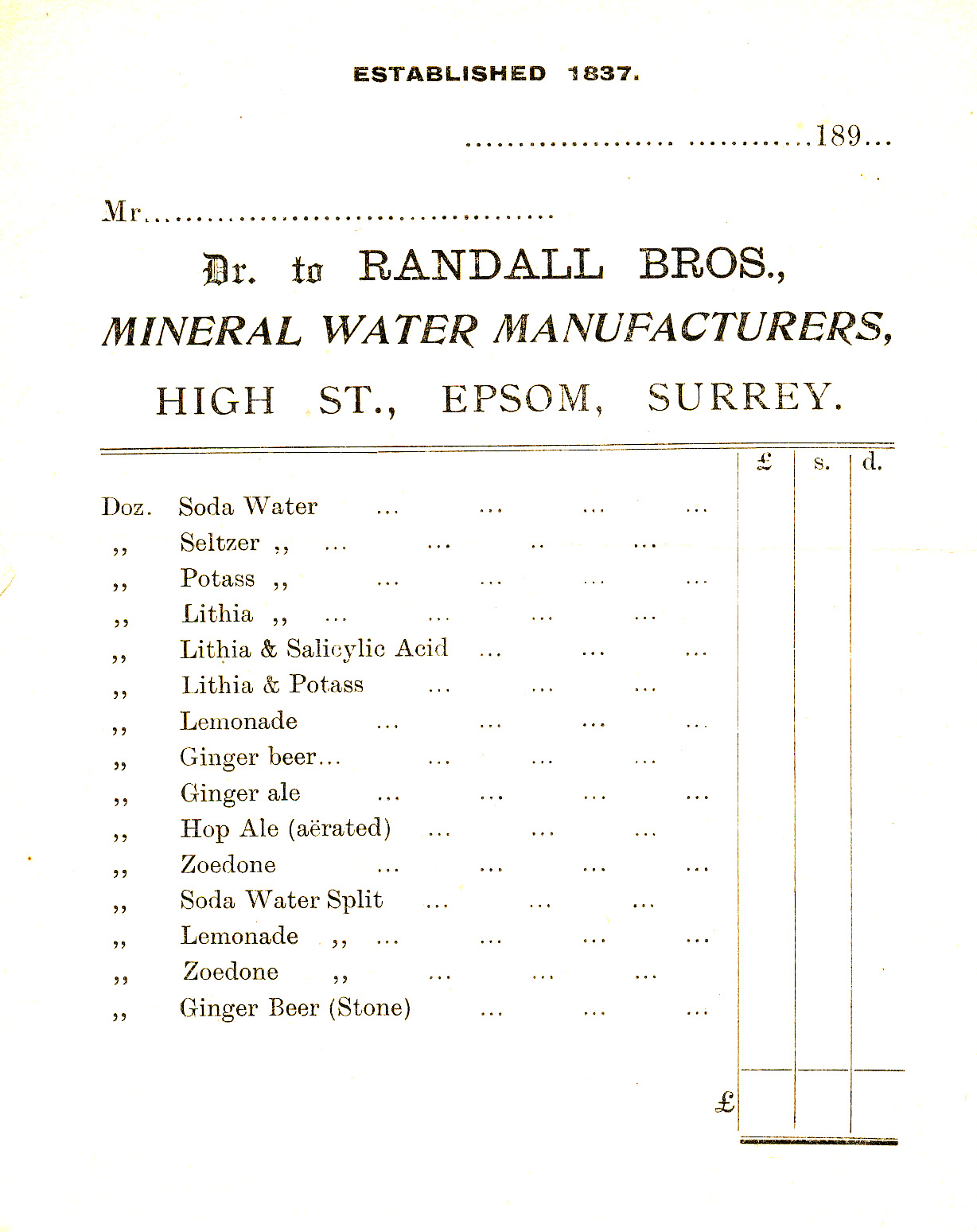
Randall Brothers order form
Image courtesy of Bourne Hall Museum
If, like us, you had not heard of some of these drinks, here’s an explanation.
Soda Water = carbonated water with sodium bicarbonate (may also include sodium citrate, disodium phosphate, and occasionally sodium chloride)
Seltzer Water = Made by carbonating water with carbon dioxide (CO2)
Potass Water = carbonated water with potassium bicarbonate added
Lithia Water = carbonated water with lithium bicarbonate
Lithia & Salicylic Acid = carbonated water with lithium bicarbonate & Salicylic Acid
Lithia & Potass = carbonated water with lithium bicarbonate and potassium bicarbonate
Lemonade = carbonated water with lemon
Ginger Beer = ginger, water, a starter culture and sugar brewed and fermented.
Ginger Ale = carbonated water flavoured with ginger
Hop Ale (Aerated) = carbonated water flavoured with Hops
Zoedone = carbonated water flavoured with phosphates and iron
Soda Water Split = a small bottle of Soda Water [a split is a wine bottle holding one quarter the usual amount or about .1875 litres (6 to 6.5 ounces)]
Lemonade Split = a small bottle of Lemonade
Zoedone Split = a small bottle of Zoedone
Ginger Beer (Stone) = Probably Ginger Beer in a stone jar.

Randall Brothers label for Lithia Water
Image courtesy of Bill Owen.

AP Randall label for Gingerola
Image courtesy of Bill Owen.

Randall & Measures bottle
Image courtesy of Bill Owen. Photo by Clive Gilbert
Randall & Measures also did rather a nice line in siphons.

Two Randall & Measures siphons
Images courtesy of Bourne Hall Museum
Charlie Measures had water interests in more than his enterprise with Percy: he became a Councillor and was Chairman of the Water Committee.

Councillor Charles Measures
Chairman of the Water Committee

Invitation to inspect the East Street Waterworks on its centenary, 1953
Image courtesy of Bourne Hall Museum
Since a visit to the Waterworks may not have seemed all that riveting or celebratory to some invitees, I assume that a selection of R&M tipples would have been available – or perhaps something stronger!

East Street Waterworks 1950
Image courtesy of Bourne Hall Museum
Charles Measures Senior had died at the end of 1947 and Charlie followed in 1957. It’s not clear when Percy retired from the business, but he died in 1981 at the grand old age of 96, although he was not at all in good health; Doris survived until 1984. By then they were living at 95 Albert Road and thereby hangs a tale.
Ted Measures
As with several things in this article, it’s not clear if Charlie’s son, Ted (Edward Charles) was actually involved with the Randall & Measures firm, and by the same token, we don’t know if Percy’s brother, James Ernest, who died in 1960, had anything to do with it either. As I said earlier, James was a master grocer/shopkeeper (1939 Register), but there is no clue as to the whereabouts of his premises. In 1939 Ted was a wholesale grocer and confectioner, so there’s an implication that they were in the same line of business and perhaps in partnership.
Nevertheless, we do know where Ted Measures plied his trade in the 1960s (and it may be that J E Randall was there previously), thanks to a former neighbour, who happened to contact us just as we were thinking about doing this piece. At the time Ted and his wife Iris (née Winslet) lived in 95 Albert Road, which they later sold to the Randalls, and the Cole family lived at Number 93. Tim Cole, who was born in 1959, clearly remembers Ted and Iris and says they were very kind to him and his two siblings. He doesn’t remember J E Randall, but he would have been too young, as James Ernest died in 1960. Ted and Iris retired in the late 1960s and moved to Effingham, but before that Ted ran a general grocery and confectionery store at 10 Woodcote Road.


10 Woodcote Road, when it still contained a shop
Top image courtesy of Bourne Hall Museum
Bottom image courtesy of Epsom & Ewell Local & Family History Centre
Tim said that in the mid to late 1960s he was in the cubs, latterly the scouts, and during bob-a-job week he would go to the Woodcote area to earn his bobs. The houses were bigger, so he used to get more than a bob/shilling (5p) for each job. They needed to raise 15 shillings (75p) to cover their annual membership of the Scout Association and anything above that went to cub pack funds. Tim continued as follows:
‘At the end of bob-a-job week Ted used to tell me to call by his shop when he would give me 5 shillings (25p) towards the pack funds. He used to let me have a selection of penny sweets too. This is why I remember his shop so well. Happy days!
So in the mid-late 1960s Ted was running the shop as a general store/grocer. I’m not sure if he was still wholesaling, after all I was only interested in his retail sweets! Also I don’t remember there being anyone else running the business in the shop at that time. It was always Ted who was there when I was out on my bike with my friends to Woodcote Green Pond and Barons Pond further up in Wilmerhatch Lane.’
Tim’s father took the next two photos and they show the backs of both 93 and 95 Albert Road on a particularly snowy day.
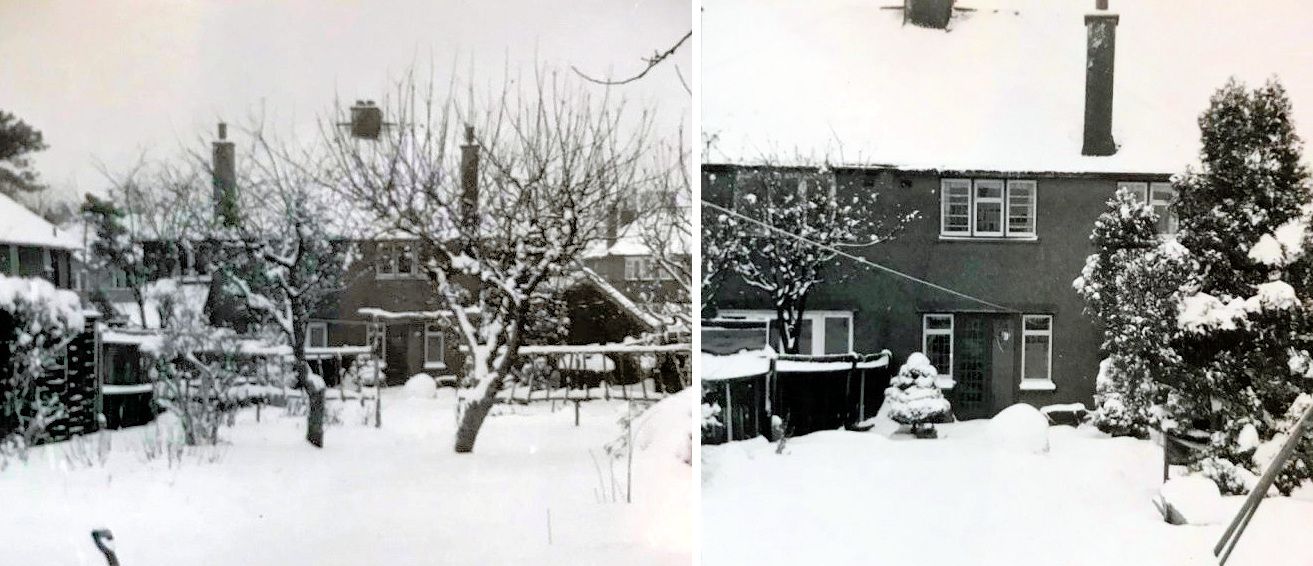
The backs of both 93 and 95 Albert Road
Images courtesy of Tim Cole © 2020
Tim observes how few cars there were back then, as can be seen in this general shot of Albert Road, looking towards the playing fields of Epsom College. Mr Cole used a Lambretta scooter to go to work in Purley.

Image of Albert Road courtesy of Tim Cole ©2020
The company of Randall & Measures Ltd was dissolved in 1981.

95 Albert Road in February 2020

93 and 95 Albert Road in February 2020
Linda Jackson 2020
With thanks to Tim Cole, Bill Owen and Peter Reed
ADDENDUM
James William Randall and family – after Addlestone
Thanks to Roy Lourens, great-grandson of James William Randall, we can now shed light on what happened to Jane Hannah, sister of Alfred Hawes and James William Randall; we also know much more about the latter and what he did after leaving Addlestone for South Africa.
It was Jane Hannah who first went to South Africa: she had married Ernest Elliott Brackett (born 1867 Redhill) and they lived in Cape Town.

Ernest Elliott and Jane Hannah Brackett in Cape Town c.1890
Image courtesy of Roy Lourens ©2020
Roy remembers:
‘Ernest Brackett was a successful tea merchant and owned a coffee shop in Wale Street, central Cape Town; he was very much the gentleman businessman who knew everyone that mattered. He had the confident manner that success can bring and looked after Jane well. I recall that Ernest never failed to leave me a small red Nestlé chocolate on the visiting card table whenever he visited his sister in law Gertie at her Claremont house during the 1930s & early 1940s. That visiting card custom survived in some polite society until around World War 2.’
 Ernest and Jane Brackett in Cape Town c.1937
Image courtesy of Roy Lourens ©2020
Contrary to what I said in the original article, borne out by such evidence as was available at the time, James William (known for some reason as ‘Jumbo’) did not emigrate when the South Street mineral water business was sold to Alfred Hyde in (possibly) about 1912 – he had gone there in 1894, now proved by a shipping passenger list amongst other things. Perhaps he retained his stake and drew a share of profits until Alfred Hawes Randall died and then sold out to Hyde – or maybe not. Anyway, beyond doubt, in 1894 James, his wife Annie and their three children – James Andrew (known as Andrew), Gertrude Annie and Alfred Ernest embarked for South Africa. Another child, Ernest Edward, was born there. Roy says that James never worked again after his arrival in Cape Town.
As to why James William and family emigrated, it had always been thought in the family that the reason was the poor health of young Gertrude Annie (Gertie) – she was likely to die unless moved to a better climate. However, now that Roy knows what had happened previously, with James’ mother and younger siblings dying and the big falling-out with his father, maybe it was a combination of all these things, plus the fact that Jane Hannah was already settled there and prospering.
The frail Gertie, as it happens, lived to the grand age of 94, so the change of climate obviously suited her.
 Gertie with brother Ernest c.1902
Image courtesy of Roy Lourens ©2020
 Gertrude Annie Randall, c.1900 (aged about 17)
Image courtesy of Roy Lourens ©2020
In 1906 Gertie, now looking pretty robust, married baker William Curgenven, who had been living in Addlestone with his widowed mother and siblings when the Randalls were still there.
 Wedding photograph of William Curgenven and Gertie Randall,
8 February 1906, Claremont, Cape Town
Image courtesy of Roy Lourens ©2020

Family group 1920s
Back row, L to R: Alfred Ernest and James William Randall, William Curgenven, Ernest Brackett, Ernest Randall
Front row, L to R: Madge Randall (wife of Andrew), Annie Jane (wife of James William), Gertie Curgenven, Jane Brackett
Image courtesy of Roy Lourens ©2020
And just to prove Roy Lourens’ family credentials for you, he is in the next photo and not difficult to spot.

Family group on holiday at Franschoek 1936
James William Randall, Gertie Curgenven, Annie Randall (seated with baby Roy)
and Roy’s mother, Enid Lourens (daughter of Gertie)
So, what sort of person was James William Randall? Let’s return to Roy’s memories.
‘Shortly before he left Addlestone in 1894 he was given a clock for his services as a volunteer with, I understand, the Addlestone Fire Brigade. He certainly had a showy fireman’s helmet which he brought with him, which impressed all of his grandchildren!
He was past his prime when I knew him, but I recall James as a somewhat slightly built, medium height, energetic, sharp and pleasant, well dressed and polite person. The only oddity was his habit of chewing each mouthful of food 32 times, which I understand was a current health fashion, promoted by nutritionist Horace Fletcher the Great Masticator about 1903. And if, in addition to long dinners, that led to a long life, living to 92 proves it works! In Cape Town he played the part of a self-funded gentleman well, though, as someone who had lived through several wars and depressions, he could never be accused of waste. We always enjoyed our holidays in the French Hoek mountains with him and Annie Jane, who were devoted to one another. ‘
And here’s another nice photo.
 James William and Annie Randall, 1930s
Image courtesy of Roy Lourens ©2020
(James) Andrew, the eldest son, was a mighty daring and resourceful young man. In 1901 he was postmaster at Vanrhynsdorp in Western Cape province; the Second Boer War was going on and Jan Smuts invaded the Cape Colony with the intention of causing an uprising. Smuts and his men captured Vanrhynsdorp, cut the telegraph wires and destroyed Andrew’s equipment.

Andrew Randall 1901
Image courtesy of Roy Lourens ©2020
‘But Postmaster Andrew Randall was still able to warn the next station, Clanwilliam, and Cape Town, only 160 miles to the south, by constructing new apparatus from such old parts as he could gather, climbing the telegraph poles at night, and sending off a Morse message to the Cape, so warning them of the enemy attack and occupation. Andrew said he had no receiving equipment, but could feel and decipher the reply through the shocks on his fingers. Eventually, after he had completed 5 weeks of clandestine communications with Cape Town under the noses of the Boers, they discovered what was going on, and as a civilian prisoner, Andrew was tried by court martial. He was lucky to escape being shot by the annoyed Boers – the commandant, Manie Maritz, was known for his cruel punishments! Andrew was warmly commended by the Postmaster General later on, but he complained of the loss of his new BSA bicycle, only recently received from England!’
‘Andrew Randall was the lively one in the family. Alert, smiling, always with a twinkle in his eye, slim build suited to climbing telegraph poles at night, and ready to try something new. He had what was probably one of the best 78rpm record collections in South Africa, complete with the best audio equipment of the day. This ranged from the old His Masters Voice acoustic Speakers, so big that one could climb inside them to clean them, to the latest technology such as Leak amplifiers. He had a wonderful opera collection and held frequent music evenings at his house, which a wide circle of admiring audiophiles enjoyed. Always lovely company and a bit impish.’
Andrew’s wife Madge, seated front left in the large family group shown earlier, had been engaged to the author Edgar Wallace during his time as a war correspondent in Cape Town, but she broke it off and married Andrew in 1905. Family lore has it that William Curgenven was also smitten with Madge and that Gertie, his eventual wife, prolonged their engagement until he got over it.
Quite possibly, English readers don’t know too much about the role of the South Africans in World War 2: they played a very significant part, as they had in World War 1. Andrew’s son, Petty Officer Owen Randall (born 1916) was in the Navy and, to give you an idea of the state of the South African Naval Service when war broke out, it apparently had just three officers and three ratings. However, they soon got their maritime act together and Owen became a Radio Operator (this must have been a breeze for him, with Andrew as his father). Early in 1945 the new Royal Navy frigate Loch Cree was handed over to the South African Naval Force as HMSAS Natal and completed her fitting-out in March, with Owen as one of her crew. On 14th March 1945 she was in the Firth of Forth with HMS Wivern, hunting for German submarine U714. Natal depth-charged her, assisted by Wivern, and the submarine sank with all hands. There is some dispute about which ship dealt the ultimately fatal blow to U714 but Natal was credited with the kill.
Mrs Annie Randall died in 1941, but James William survived until 1946. Andrew, having escaped death at the cruel hands of Manie Maritz, lived on until 1970, although, sadly, he had lost Madge in 1924.

Andrew and Madge Randall, with children Clarice Freda and James Andrew* c.1923
Image courtesy of Roy Lourens ©2020
*James Andrew the younger is Owen Randall of HMSAS Natal

James William Randall in 1942 with his great-grandsons, Keith and Roy Lourens
Image courtesy of Roy Lourens ©2020
Reluctantly, I need to wrap this up, as we have strayed far from Randall Brothers and mineral water, but I do want to say a bit more about Gertie, who was not expected to live at one point. Here she is in about 1970, looking pretty well and twinkly.

Gertrude Curgenven c.1970
Image courtesy of Roy Lourens ©2020
She was much loved in the family and, it seems, hugely cool in a crisis.
‘Gertrude and William had 8 children, the first stillborn. She was a real dear, loved by everyone in her very extended family. After her husband William died in 1942 and she sold her house, “Ladock”, about 1946, her children vied for years for their turn for her to stay with them. Her mantra to me as a child, was that “if you can’t say something nice about someone, it’s better not to say it…” My father witnessed an act of bravery by her when one of her neighbours was so incensed by the bad behaviour of her habitually difficult boy that she rushed outside with a pistol, threatening to shoot him! And she meant it! Everyone frantically dived for cover, except for Gertie who, according to my dad, quietly walked over to the distraught neighbour with soothing words and gently took the gun out of her hands. To my father it was the bravest act he had seen, for in his view the neighbour was completely out of control and ready to shoot at any moment. ‘
*The Curgenven family originally came from Ladock in Cornwall.
As I said, Gertie lived until the age of 94 and here she is one more time, a few years before her death, with Roy’s children in 1974.

Gertie Curgenven with Geoffrey, Gillian and Alan Lourens
Image courtesy of Roy Lourens ©2020
Linda Jackson 2020
With very grateful thanks to Roy Lourens