
Captain Frederick Secker Bell C.B., R.N.

Captain Frederick Secker Bell C.B., R.N.
Frederick, known as ‘Hookie’ (or ‘Ding-Dong’ when he spent some time in Australia), was born in Soho on 17 August 1897, the youngest child of provision merchant Frank Burnman Bell and his wife Minnie (née Wootton), who were married in 1878. Frederick was only six when Frank divorced Minnie on the grounds of her adultery with one Duff Steele, whom she later married. The children were quite spread in age and some were already grown up at the time. There was a large gap between the three elder children and the three younger ones, and the latter – Frank Junior, May and Frederick -, were placed with their uncle and aunt in Epsom. Frank Senior had been given custody of the children in the divorce proceedings and said at the time that he had sent them away. Only May was in Epsom at the 1911 census; Frederick was a naval cadet at the Royal Naval College, Osborne and Frank was at Haileybury College.
Uncle and aunt were goldsmith Henry John Bell, Frank Burnman Bell’s brother, and his wife Minnie Caroline (née Houle), who had been married since 1886 but were childless. They originally lived at Linden House in College Road – now a care home. I shall return to the Epsom connections later, but we need to follow Frederick for the time being.
Early naval career
After his time at Osborne Frederick attended the Royal Naval College, Dartmouth and passed out just in time for the Battle of Jutland, which occurred on 31 May – 1 June 1916. He was aboard HMS Canada (formerly the Almirante Latorre), which did engage with the enemy, but suffered no damage or casualties. However, in June 1918 he was second-in-command of the submarine D6, patrolling off Ireland and hunting for UB-73, which had sunk a considerable amount of merchant shipping. D6 was on the surface when she was torpedoed by the submerged UB-73 and rapidly sank. Frederick and the captain, the only survivors, were captured, spending the dying days of the conflict as prisoners of war in Germany. This was the first of several lucky escapes for Frederick, as you will see later on. The wreckage of D6 is on the seabed off Donegal, which has the dubious distinction of being ‘one of the best places in Europe to wreck dive’.
Royal Navy Submarine HMS D6
From 1923 to 1925 Frederick was First Lieutenant of HMS Scythe, which patrolled in Irish waters after the establishment of the Irish Free State. Subsequently he went on an exchange posting with the Australian Navy and served in HMAS Australia before becoming Director of Naval Intelligence at Naval Headquarters in Melbourne. In 1935 he became executive officer of the battlecruiser HMS Repulse until being promoted to Captain in 1938. Whilst on Repulse he was sent to Haifa in 1937 – this was at a time when the British still controlled Palestine and there was a large amount of violence between Palestinian Arabs and militant Zionists (the Irgun). There is a fairly succinct account on Wikipedia of what was happening.

HMS Repulse on manoeuvres in the 1920s
By Underwood & Underwood – Official U.S. Navy photo NH 57183
from the U.S. Navy Naval History and Heritage Command. Public Domain
In 1935 Frederick had married Australian divorcée Mrs Dulcie Carmel Cohen (née Barnet) at Portsmouth. They first met when he was stationed in Australia. During his stint on Repulse Dulcie live in Malta, but when he returned to England she resided in Woking doing war work.
The reason I am fast-forwarding the earlier part of Frederick’s career is that I need to get him to the Second World War as quickly as possible, so that I can concentrate on his main claim to fame, which happened in 1939.
The Battle of the River Plate
This engagement is hugely significant because it was the first naval battle of the Second World War. In August 1939 Frederick took command of the heavy cruiser HMS Exeter.

Royal Navy heavy cruiser HMS Exeter (68) off Coco Solo, Panama Canal Zone, circa in 1939
Official U.S. Navy photo NH 60814 from the U.S. Navy Naval History and Heritage Command
In December the ship was off the River Plate estuary in company with the light cruisers HMS Ajax and HMS Achilles (Achilles was still technically a British ship at this point but operated on the New Zealand station and later became HMNZS Achilles).
 Map showing the Río de la Plata drainage basin including major tributaries and cities.
via wikimedia
The ships were searching for the German cruiser (known as a ‘pocket battleship’) Admiral Graf Spee, commanded by Captain Hans Langsdorff, which was in the South Atlantic attacking merchant shipping.

The German cruiser Admiral Graf Spee 1936
Image Source German Federal Archive (Deutsches Bundesarchiv) via Wikimedia
Embed from Getty Images
Captain Hans Langsdorff, the Commander of the German battleship Graf Spee.
In the early morning of 13 December they found Graf Spee. Langsdorff was rather hasty in his actions, believing at first that the three ships were escorting a convoy. It was only when he had committed himself to all-out attack and was within range of their weaponry that he realised there was no convoy. The cruisers spread out, but Exeter suffered fatalities and damage when a shell burst nearby, killing the crews on the torpedo tubes. Almost immediately afterwards she took a direct hit on one of the gun turrets and all personnel, bar three, who were on the bridge at the time were wounded or killed. Frederick, amazingly, was unharmed. A little while later she suffered two more direct hits, which took out another turret and set the hull on fire. Exeter was listing and flooding, but she managed to achieve a hit on the Graf Spee and destroy her fuel processing system. The upshot was that the German ship had insufficient fuel to get back to a friendly port. The stricken Exeter still went at her, as did Ajax and Achilles, and then Exeter suffered another hit and had to disengage. Ajax and Achilles followed Graf Spee, but eventually, at just past midnight, she made Montevideo harbour in neutral Uruguay. Except that the Uruguayans weren’t as neutral as all that and, had they entered the war at that stage, it might well have been on the Allied side. (In 1945 Uruguay declared war on both Germany and Japan.)
Under the Hague Convention a belligerent warship in a neutral port was permitted to stay whilst carrying out repairs, but, once repairs were completed, the ship could not leave until 24 hours had passed following the departure of an enemy merchantman. The British wanted to keep Graf Spee in port for as long as possible, since the cavalry was coming, in the form of a large Allied force including the aircraft carrier Ark Royal and the battle cruiser Renown. However, they were a long way off still, so the British devised a plan. Every 24 hours a British or French merchantman would depart from Montevideo, which kept Graf Spee in port for the ensuing 24 hours.
The only Allied warship in the area, apart from Ajax and Achilles, which were damaged and short of ammunition, was the heavy cruiser HMS Cumberland, which had rushed (for a warship) from the Falkland Islands to assist. At the same time rumours were planted with the Germans to make them think that a large British force was waiting just outside Uruguayan territorial waters; the ships that were actually there made a lot of smoke to reinforce the myth. After consulting his High Command, Langsdorff was given various options, but ceding his ship wasn’t one of them. He decided to scuttle the Graf Spee in the estuary.

After the battle
Exeter carried out emergency repairs in the Falklands and then returned to Devonport for a refit, not going back into service until March 1941. We will stay with her for the moment and park Frederick, who, fortunately as it turned out, was not her captain when she was re-commissioned. In February/March 1942 Exeter was part of an Allied force fighting the Japanese in the Java Sea. The Allies had lost the first encounter (known as the First Battle of the Java Sea) and Exeter was badly damaged. She was ordered to proceed to Colombo under the escort of the destroyers USS Pope and HMS Encounter. They were intercepted by the Japanese, who converged on them. Exeter was ultimately torpedoed so critically that she capsized and sank. Pope and Encounter also perished. The Japanese rescued the captain of Exeter and many hundreds of the crew, all of whom were interned as prisoners of war. Exeter has been found fairly recently and, although she was a war grave, looting has taken place and very little of her remains.
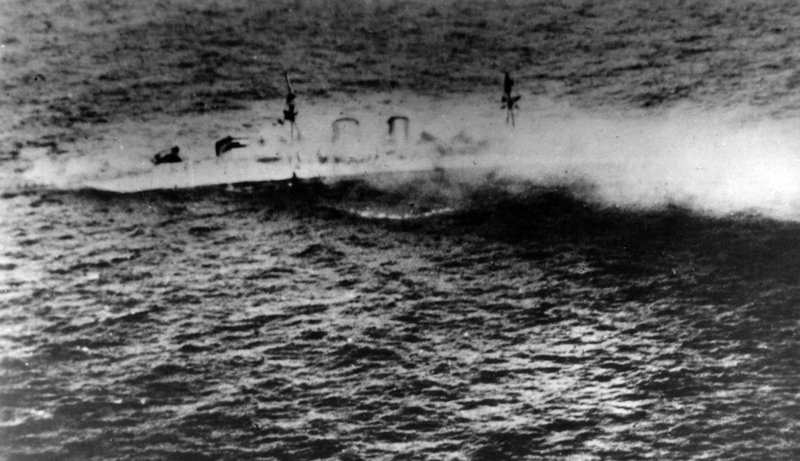
The Royal Navy heavy cruiser HMS Exeter sinking after the Battle of the Java Sea, 1 March 1942.
Photo taken from a Japanese aircraft via wikimedia
We shall now return to Frederick, who received a hero’s welcome on his return to England and was greeted by no less a personage than Winston Churchill, who was then First Lord of the Admiralty, but soon to be Prime Minister.
Embed from Getty Images
Churchill And Captain Bell
Frederick was awarded the Order of the Companion of the Bath (C.B.) for his gallantry during the Battle of the River Plate. There was also a march through London, from Waterloo to the Guildhall, on which he was accompanied by Captain Charles Woodhouse of Ajax (who was later knighted and reached the rank of Admiral) and officers and crew of Exeter and Ajax. Towns and cities often have a strong bond with ships named after them and in this case Frederick and his officers and men marched through Exeter, cheered by a large crowd, and received the freedom of the city.
Embed from Getty Images
Royal Navy officers
(R) Captain Frederick Secker Bell (1897 – 1973) of the ‘HMS Exeter’
(L) Captain Charles Woodhouse (1893 – 1978) of the ‘HMS Ajax’
Two Epsom men served on the Ajax in the action against Graf Spee and they were William John White (20) of Woodlands Road, a radio operator, and Walter Herbert Field (30) of South Street, an able seaman. William had been on the Exeter before joining Ajax and, sadly, perished in January 1942 when the submarine Triumph was lost with all hands. There is further information about William on our War Memorials page.
Postscript to the Graf Spee affair
There was a well-known postscript to the Graf Spee affair, referred to as the Altmark incident, and I shall deal with this briefly for the sake of completeness. Before she was cornered in Montevideo, Graf Spee had taken around 300 Allied prisoners from the merchantmen she had captured or sunk and in February 1940 they were being transported to Germany by the German tanker Altmark. At the time of the incident Altmark was in neutral Norwegian waters. The Norwegians had searched the ship, but not, shall we say, too thoroughly and found nothing out of the ordinary. The Royal Navy was incensed and the First Lord of the Admiralty (Churchill) was consulted; he approved a raid on the Altmark, if necessary, to recover the prisoners, who were locked in the hold. Captain Philip Vian of HMS Cossack followed the instructions and, when the Norwegians declined to accompany the Royal Navy on another (proper) search and really didn’t want to be involved at all, the British, armed with bayonets and we know not what else (cutlasses are mentioned in some accounts and there were some ceremonial specimens on Cossack, but this could be apocryphal) boarded the Altmark, which had run aground in the meantime. Several German sailors were killed, but the prisoners were released. Technically, all of this was illegal, as it had occurred in neutral waters, but Vian was awarded the D.S.O for it and subsequently he rose all the way to Admiral of the Fleet. The Altmark incident might well have contributed to the Germans’ decision to occupy Norway in that same year, but they had bigger and more strategic motives than that.
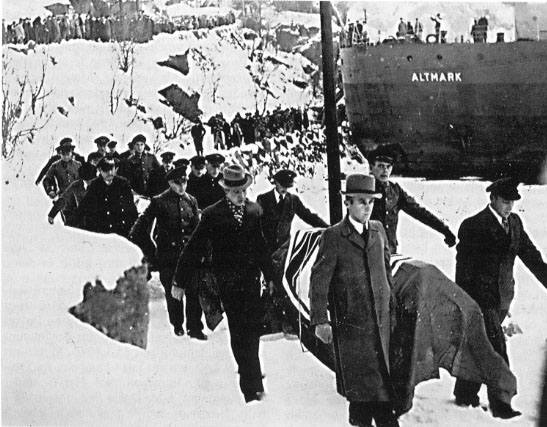
Flag-draped coffins containing German dead are brought ashore for burial
after the Altmark Incident in Jøssingfjord, Norway.
Via Wikimedia
What Frederick did next
Details of Frederick’s subsequent career are hard to find, but we do know that he became Flag Captain to the Flag Officer Malaya and pulled off what was probably his greatest escape of all, from a fate which, literally, would have been worse than death – internment by the Japanese. There is an excellent article by the late Lt. Col. P.A.B. McKerron on The British Empire website, telling us about the fall of Singapore to the Japanese in February 1942 and how Frederick ‘borrowed’ a boat from the Singapore Yacht Club and sailed it to Sumatra.
In January 1946 Frederick took command of the battleship HMS Anson and from 1947 he was ADC to King George V1; he retired on health grounds in January 1948.
The film
If you’re a bit of an oldie, like me, or you just like vintage British films, you may well be aware that there was a 1956 film of the Battle of the River Plate, starring John Gregson as Frederick Bell and Peter Finch as Hans Langsdorff, plus a host of other stalwarts of the British screen: it did very well at the box office.
Embed from Getty Images
Captain Frederick Secker Bell (1897 – 1973, left) of the Royal Navy meets
actor John Gregson and his wife Thea Gregory at the premiere of the film ‘
The Battle of the River Plate’ at the Odeon Leicester Square,
London, 30th October 1956.
Later years
Frederick was not in good health during his later years and ended his days in the Royal Star and Garter Home on Richmond Hill, where he died on 23 November 1973. Dulcie returned to Australia and died in 1978.
We return to Epsom
It’s been a long time since I mentioned Henry and Minnie Bell of Linden House, but we are going back there now. As I said, May Bell was with them in the 1911 census, with Frederick and Frank away at naval college and Haileybury respectively. Henry died at home in 1917. Minnie seems to have remained at the address for many years afterwards, although I imagine she was rather rattling around in it.
In June 1921 May married surveyor Ellis Morris at St Martin’s. Ellis died in 1944 and there is more information about him on our War Memorials page. May died in 1981, then living at 67 Longdown Lane South. On the subject of residences, in the 1939 Register Ellis, May and Minnie were all together at 18 Burgh Heath Road. Minnie was described as semi-invalid, but she managed to continue until 5 February 1954, when she died in the Wilmar Lodge Nursing Home, Ewell.
As for Frank Bell Junior, who was properly Frank Robert Jaques Bell, he served in the Honourable Artillery Company and then the Royal Welsh Regiment and was in France during WW1. In 1923 he married Eveline Mallia. The couple appeared in electoral registers at 14 Downside for some years, ending up at 9 Lynwood Road. Frank died in 1958 and was survived by Eveline.

14 Downside, Epsom
Image courtesy of Bourne Hall Museum

9 Lynwood Road, Epsom
Image courtesy of Bourne Hall Museum
Odd facts
A couple of oddments cropped up while I was researching this piece. Firstly, Frederick Bell seems to have been well-acquainted with the politician Neville Chamberlain. The National Maritime Museum at Greenwich has a piece on Frederick, which contains a telegram from Chamberlain, then the Prime Minister, about the River Plate exploit, saying, ‘ Well done Fred am proud to claim friendship of old Epsom days’. I know nothing further about this friendship but I suppose it could have concerned horse racing.
The other oddment is that 18 Burgh Heath Road later became the family home of well-known footballer Allan Harris, older brother of the rather more famous Ron ‘Chopper’ Harris, both of whom played for Chelsea.
Linda Jackson 2019