
SHERWOOD SCHOOL, EPSOM – 1931-1950
AND ITS “NEW” REINCARNATION – 1950-1961
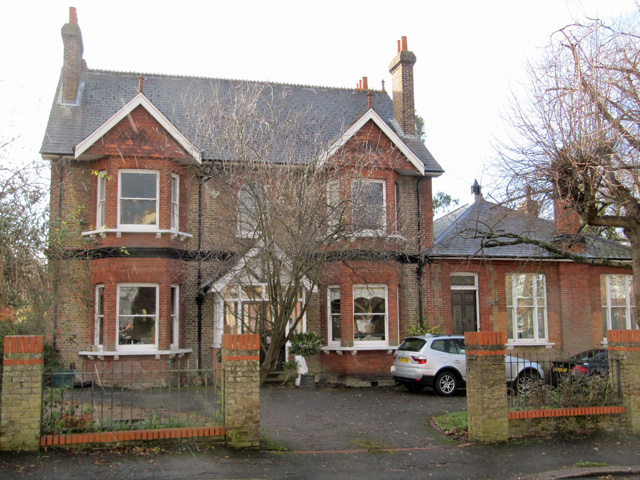 6 Burgh Heath Road, Epsom
Photograph by Roger Morgan © 2019
The current owners of the substantial early Edwardian house pictured above inherited the name plate (sized about 18” x 9” or 45cm x 18cm) shown below, and this article explores the interesting earlier life of their property.
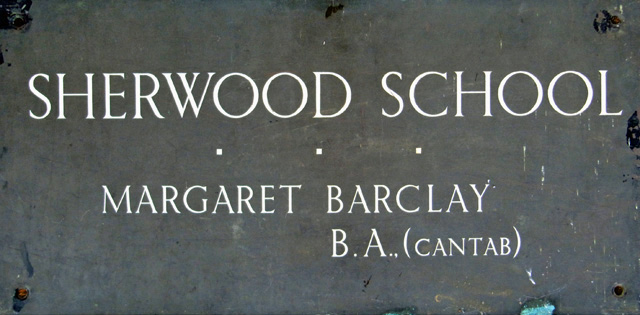
The original Sherwood School name plate
(As noted further below, the reverse was used for an update in 1942.)
Photograph by Roger Morgan © 2019
Margaret Barclay, the Principal of Sherwood School, was born in Hereford on 29 May 1903 as Margaret Alice Martin. In other than formal settings, she was known as “Peggy”, and we follow suit here. The 1911 Census records her as a 7 year old schoolgirl living with her parents (David – a Congregational Minister – and Alice) and three siblings at 102 Whitehorse Street, Hereford. David was a socialist and pacifist Congregational Minister, and the children grew up with a strong political influence in their lives. First born Irene became a noted campaigner for social housing; and second born [Basil] Kingsley became a journalist, best known as the editor of the left-leaning New Statesman magazine from 1930 to 1960
As indicated on the nameplate Peggy gained a BA degree at Cambridge. After her 1922-25 degree course, she did a teacher’s training course and then began work as a school teacher.
In Q1 1929, Peggy (aged 24) married 23 year old Arthur Christopher Barclay – he was apparently always known as “Chris”, and we do the same here. The marriage was registered in the Barnet District, where is where Peggy’s family had moved to: the 1930 Finchley and Friern Barnet Directory notes the Revd David Basil Martin MA (Unitarian) living at 23 Chislehurst Road, North Finchley – The place of his death 1940. Finchley was also where the 1911 Census had recorded schoolboy Chris living with his mother (Helen Ida Marion – née Barfield – a “Teacher”) and siblings at “Craigmonie” Nether Street, Finchley – the home of his Grandparents John (a “Retired Head Master”) and Mary Barfield.
For some years before his marriage, Chris had been living with siblings in Lewisham but. Immediately before the wedding is recorded living with his widowed mother and other siblings at “The Firs” in The Hoppety, Tadworth. It is perhaps not surprising that the now married Peggy and Chris made their home nearby, at “Dunromin” (probably now No 3), Rosebery Road in Langley Vale on Epsom Downs.
Peggy had always wanted to have her own school and she started teaching some of the neighbours’ children in her new home. (Meanwhile Chris, commuted daily from Epsom Downs station to London to work as a clerk in the Anglo-South American Bank.) Peggy’s little school flourished and soon outgrew the available space.
In 1931, the much more spacious 6 Burgh Heath Road came on the market. Originally built as a private residence, it had recently been in use as a Nursing Home: the 1930 Kelly’s Directory lists it as “Greylands Nursing Home (Miss Becker, Matron)”. With fingers crossed on finance by Chris (who continued his day job), they borrowed money, bought the property and moved in. Chris’s nervousness was misplaced: the school grew rapidly and, consistent with calling the school “Sherwood”, the children were divided into four teams: “Little John”, “Friar Tuck”, “Robin Hood” and “Will Scarlet”. The children wore uniform: green blazers with a badge, a yellow motif of Robin Hood with a bow and arrow; green pleated shirts (grey shorts for the boys) and green and white gingham frocks for the summer.
The map below locates the various sites mentioned in this story.
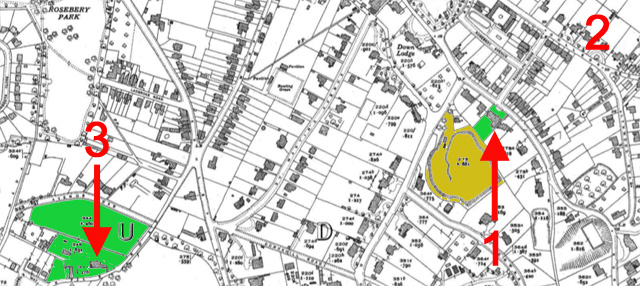
Extract from the 1932 Ordnance Survey map, in which:
1 is the original school at 6 Burgh Heath Road
(behind which, coloured light brown, is the old chalk pit);
2 marks the original “Croft House” at 11 College Road and “Flint House” at No 13 where some boarders were housed; &
3 is the original Sandown Lodge – home of the “New Sherwood School” – with its grounds of some 3 acres.
In these early days, the school catered only for day pupils in the preparatory age range. The 1934 and 1936 Kelly’s Directories both include the following:
“Sherwood School, boys’ & girls’ preparatory (Mrs M Barclay BA principal) 6 Burgh Heath Rd. TN 9125.”
The school had a progressive ethos: it set out “to develop the power of self expression” and, to this end, specialised in movement and dance as propounded by Margaret Morris.
The school continued to grow. Peggy recruited yet more staff and began to take girls through to school leaving as well as some some boarders. By the late 1930s, she moved the senior school to Croft House at 11 College Road – which the 1936 Electoral Roll shows was also the home of her mother in law. (While that property is now lost, the new flats built on its footprint are known as “The Croft”.)
The September 1939 Register recorded Peggy and Chris at “Sherwood School, Burgh Heath Road”. 36 year old Peggy (formally “Margaret”) is listed as “ Principal, Private School” and 34 year old Chris (formally “Arthur”) now as “Working Director & Secretary Private Company owning Bookshops and Stationers”. Their names are followed by two currently closed records which doubtless cover their two young daughters, Brigit and Gillian – born, respectively in Q4 1932 and Q3 1935. (A third daughter, Rosemary, was born Q4 1940.)
Those closed entries are followed by:
- 22 year old Stella Y Avery, listed as a “Froebel Teacher” (Friedrick Froebel’s method being about children’s early learning being best achieved through structured play);
- 43 year old divorced “Cook/Housekeeper” Florence Gowlland; and
- two more currently closed records.
Those last two closed records could may be Florence’s children – but they could also have been boarders which, as noted above, the school had begun to accept. Boarders were also housed in other nearby properties, such as the “Flint House”, the now-lost No 13 College Road (not the flint-faced one on the northern corner of Ashley and Worple Roads). Later, some boarding accommodation was also provided at 23 St Martin’s Avenue (to which Peggy and Chris moved when, in the late 1940s, she left the school.)
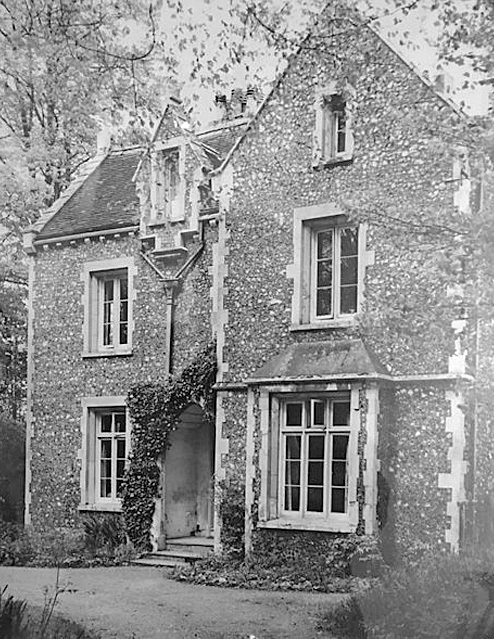
The now lost “Flint House” at No 13 College Road.
Photograph © Richard Morton 2020.
As WW2 got under way, Sherwood School suffered the blow of two thirds of the parents removing their children because of the school’s close proximity to London. Croft House had to be closed down, and several of the staff left. And, on a personal level, Peggy – who, like her parents and siblings, was a pacifist – found it hard to cope with Chris (who had been serving with the London Ambulance Service) accepting his call up into the Royal Artillery: she also missed his cheerful and constant support.
Early in 1940, Walter Birmingham – a prominent Quaker, a Conscientious Objector and a gifted teacher – placed an advert in the New Statesman (the left-leaning weekly journal edited by Peggy’s brother, Kingsley Martin) about his interest in forming an educational community to run on progressive, pacifist principles. Peggy contacted him immediately and he joined as a partner in the running of the school. They decided to reorganise the school and run it as a co-educational, progressive community: all staff on an equal basis (and paid “pocket money” rather than a proper salary) with the pupils involved in some of the decision-making as well. The school now catered for boys and girls up to eighteen years old (boarders and day pupils). All, both pupils and staff, were known by their first names or even nicknames. Sherwood School was originally seen as “enlightened but not freakish”. These changes completed the separation from the mainstream, the place now being quite explicitly a “free school” on the lines of A S Neill‘s well-known Summerhill with its philosophy of freedom from adult coercion and community self-governance
While the children were encouraged to join in lessons with discussion and questions, they were left to learn at their own pace. Most of the children (one of whom was Unity, daughter of the artist Sir Stanley Spencer) were very happy and thrived in the free atmosphere. Searching the internet has found the following reminiscence:
The Sherwood Pit – a Memory of Epsom.
During the war, I attended Sherwood Boarding School. … Behind the house was an abandoned and overgrown chalk quarry (The Pit) with an old cottage, our arts and crafts classrooms. The cottage is gone and it is now called “Elizabeth Welchman Gardens“.
On Saturdays we also went to the [then] Odeon morning matinée. One of our group would pay to get in then open the side door for the rest of us! Inside the door was a curtained entrance through which we would peek before taking turns to dash to get a seat unseen in the dark. Many times we would be caught and ushered “OUT” when the manager shone a flash light on the row we were sitting. We invariable made the mistake of all sitting together!
While Walter and Peggy worked very well together, Walter had some family problems and, in mid 1942, he reluctantly decided to leave Epsom – taking his family to live in Gloucestershire where he took charge of a youth hostel. Walter’s successor as Peggy’s partner was Harold Pratt, as was recognised by an obviously home-made – and, as illustrated below, now defaced – name plate hand painted on the reverse of the professionally executed name plate near the head of this article.
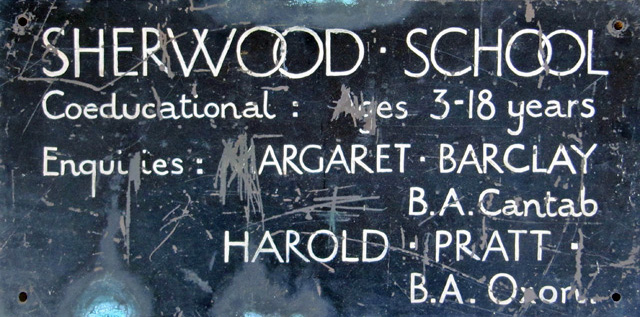
The amended Sherwood School name plate.
Photograph by Roger Morgan © 2019
When V1 flying bombs began falling in May 1944, Peggy arranged for half the school and some staff to go to her former partner, Walter Birmingham, in Gloucestershire for the rest of the summer. Harold Pratt took a party of children and staff to Yorkshire and the Wirral, leaving just a few children and staff in Epsom until July. Harold initially wanted to move the whole school permanently to Cheshire but, by autumn 1944, all were back in Epsom.
More space was needed for class work and, with Peggy’s fingers crossed on the financial side, the school rented the now-lost Sandown Lodge in Worple Road (on the corner with the south side of Avenue Road, Epsom) for use principally by secondary age pupils. Despite its name, this was not a lodge in the normal sense of a gatehouse to a larger property. It was described as a large, white, mid-19th century house with several good-sized classrooms and a large and airy art room. It stood in about an acre of grounds (which included a tennis court) with a two-acre paddock attached – large enough for a full-size games pitch. A huge wooden outbuilding was used as the dining room and theatre, and the stable block was converted into a science lab and workshop.
Things remained difficult in the immediate post-war period with fuel shortages, power cuts and bitterly cold weather. Peggy was unhappy with the way the community had developed. She wanted more structure and discipline, and found it difficult not being in command. She was also finding the financial burdens of the school increasingly hard to shoulder particularly as, while they were her responsibility, they were not really under her control: indeed she found it very difficult to get the community to make any firm decisions about anything. Peggy became increasingly frustrated and disillusioned.
When Chris came home from the Army in January 1947, Peggy decided that it was time for them to make a home together with their three daughters. The family moved into 23 St Martin’s Avenue and Peggy handed the school over to Harold Pratt. She felt bruised by the financial settlement of the property and its contents.
(After teaching at the school for a few more months, Peggy left to train as a children’s psychotherapist after which she worked as a part-time play therapist for Surrey County Council, in Sutton and Guildford, for many years. By 1956, Peggy and Chris had moved from 23 St Martin’s Avenue to 27 Links Road, Epsom. In due course, they moved away from the district: Chris’s Q1 1986 death was registered in the Exeter District, and Peggy’s in Q3 2005 was registered in East Devon.)
Sherwood continued with Harold Pratt in charge and, although its financial viability was always a major concern, the increasing popularity of the progressive school movement (due largely to the influence of A.S. Neill) helped the school grow. The roll increased to over a hundred pupils, some of whom were “school refusers” – funded by their local authorities, and providing much-needed income.
Another reminiscence, by a post-war junior pupil (son of the school’s cook), includes the following.
… 6 Burgh Heath Road differed from its neighbours in having a large area at the back known as “The Pit” – an old chalk quarry accessed by a steep path and containing an outbuilding which served as a workshop. I remember that users of the workshop were summoned at meal times by flashing the lights. The power supply was carried by an overhead cable from an upstairs bedroom, where it terminated in a naked lever switch. The procedure was to take hold (gingerly) of the insulated knob at the end and change it over from one contact to the other and back again, amid a hail of sparks!
In the corner of the main garden area was a small swimming pool which was the subject of much consternation and tut-tutting from the neighbours because people were wont to use it without benefit of bathing apparel. One of Mother’s earliest memories of her job as cook was that of a young man entering the kitchen door dripping and stark naked. He was picking his way very cautiously and he asked if she had seen his glasses. She found them on the table and handed them to him. “Ah,” he said, beaming. “That’s better,” and out he went again with the air of one who was now fully dressed!
… The school curriculum was somewhat loose and unstructured. I vaguely remember science lessons in which the girls boiled soap in beakers for hours, and stories by our teacher (one Hedley Drabble from Lancashire) about some characters in a sort of sub-spaceship which explored the world underground. … We performed plays of our own writing, we fought amazing wars between camps which we dug in the ground and covered with boards or sheets of corrugated iron, and we made bonfires and experimented with explosive devices. … I learnt very little academically. After a few years, lack of money brought about a revamp of the school under new management and Mother lost her last vestiges of confidence in it … and so I had to change schools.
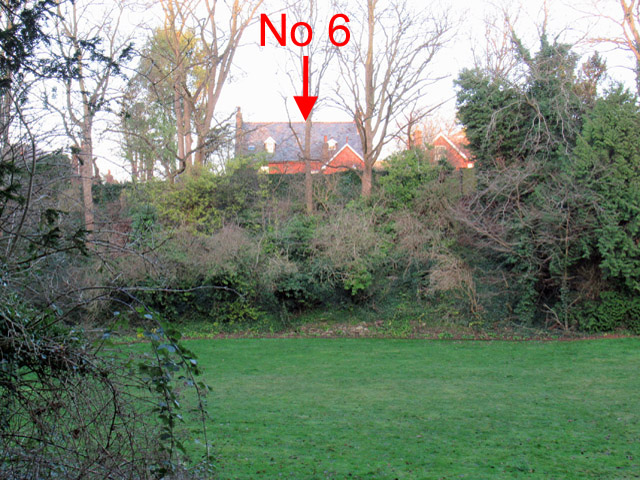
No 6 Burgh Heath Road from “The Pit” (today’s Elizabeth Welchman Gardens)
Photograph © Roger Morgan 2019
And here’s another reminiscence by someone who attended Sherwood from 1948 to 1950.
On my first morning, my fellow boarders told me that it was traditional for a “new boy” to kiss one of the girls at breakfast. Being a trusting six year old I did just that which, needless to say, resulted in a great deal of laughter.
The house had only two dormitories, one for the girls and one for the boys. Having built a miniature village in ours, we decided that we would like to acquire a few animals to add to the population and carried out a dawn raid on the model farm in the girls’ dormitory. Unlike some of the older boys, I had no idea why the adults were so upset. Punishment consisted of being required to sleep in a small bedroom attached to that of the school matron, a forbidding German lady.
I remember Sherwood as a wonderful school. Although no lesson was compulsory, you soon got tired of climbing trees and playing in the sand pit. Lessons were interesting and a desire to learn was created. Where else, at that time, would a six year old learn about electricity, circulation of the blood, French, and cooking? Not to mention budgeting pocket money at the Saturday kitchen hatch “bank”. I do recollect spending a lot of money at Woolworths on the day that biscuits came off ration!
I attended three schools after Sherwood, but none of them came anywhere near the quality of learning that I had been privileged to receive at Sherwood. It was ironic that, at the age of eleven, when I joined a county grammar school, who should be a history master there but my old headmaster at Sherwood, Harold Pratt!
New Sherwood School
By 1950, the school was facing serious financial difficulties, and Harold Pratt decided to step down. He returned to teaching in a conventional school and, with his family, continued living at 6 Burgh Heath Road – letting the whole school be concentrated in Sandown Lodge.
Some of the parents who had had children at the school for a number of years grouped together and managed to raise enough money to keep the school going as a parent-owned enterprise. (It was later established as an educational charity.) In August 1950, the school was re-established as “New Sherwood School”. The first job was to find a new head, and John (formally “Jonathan”) Wood was appointed. He and his wife, Irma, (who took on the role of New Sherwood’s school matron) had previously taught at the Neill-influenced “free school” in Kilquhanity in southwest Scotland, about 10 miles west of Dumfries. (A S Neill is reported to have been a good friend of New Sherwood and an occasional visitor – possibly connected with the fact that two of his grandchildren, Paddy and Angela Neustatte, attended the school.)
All this led to quite a turnover in staff. (Although the community concept, with staff paid only pocket money, had gone, the financial rewards offered by New Sherwood fell far short of the salary teachers could earn elsewhere.)
A pupil’s reminiscence of New Sherwood includes the following.
As a pipe-smoking, corduroy-wearing member of the Independent Labour party in the 1930’s, my father had read Neill’s prototype Summerhill book “That Dreadful School”. Recollections in the ’50’s of its cheerful, vernacular style and refreshing absence of cant were jogged by a small ad on the back of the New Statesman publicising a little independent progressive school in the nearby market-town of Epsom. It was called New Sherwood School and in the summer of 1953 we drove in Dad’s new Morris Minor to see the school and meet its headmaster John Wood.
… As we drove in through the front gates, the sense of a sprawling, bohemian family environment was immediately apparent. Thick climbing ropes hung from trees; there was a wooden climbing frame built against the bole of a huge beech tree; three gaily-painted cart-wheels mounted horizontally on three-foot high posts acted as roundabouts; doors in the house bore scuff-marks and windows were patched with corrugated cardboard. John Wood approached us along the gravel driveway that surrounded the house and he guided us over to the roundabouts. The interview was entirely informal: John – bearded, tieless and kilted, a dead ringer for Rob Roy – chatted gently about the philosophy and practice of the school, pushing himself to and fro on the wheel. Behind us, a tiny, dark-haired boy of about six ran tirelessly around the house, pausing only to yell, “F*** off!”, as he approached our small group. Initially, John ignored the demonstration. After one particularly shrill utterance John smiled and remarked that the boy had only just learned the phrase and that we mustn’t take the invocation too seriously.
So, in the autumn of 1953, I joined the sixty-odd pupils at New Sherwood School as a day-pupil. My initial reports home were ecstatic: no more beetroot, no more asphalt battleground, no more booming corridors, no more hymns. My perception of the school was determined at first by what it didn’t have. My experience was all of freedom FROM and, in my early days, I could make little sense of the implications of freedom TO. Day-to-day life was a process comprising fitful attendance at the voluntary lessons and long, absorbing periods in the sand-pit building castles and railway systems.
… I made friends and found that my fear of sport and competitive activity was offset by an ability to initiate and sustain imaginative games. When, after a year, I began to board, my relationship with, and understanding of the nature of, the school deepened. Slowly I began to recognize the teachers and other adults as congenial individuals, much as were one’s parents’ friends. Increasingly I came to see them as larger, wiser versions of us, providing security and support and yet immediately responsive at the intuitive, affective level at which we children operated. (John and his wife, Irma, would tend to refer to the adults in the community as ‘big people’, this somehow expressing the differentiation between staff and pupils in terms of physical size rather than status).
While John Wood had all the right progressive ideals for “New Sherwood” – which, as a garrulous Scotsman, he was good at putting across – he did not command the sort of respect and admiration that had characterised Peggy and Harold’s leadership during the 1940s. In 1958, John stood down and, on 29 December 1958, John and Irma (both now aged around 50) – together with their 12 year old son, Lindsay – emigrated from Southampton on the SS Southern Cross to make a new life New Zealand. The passenger manifest lists their last address in the UK as “New Sherwood School, Worple Road, Epsom”.
On John Wood’s departure, Gerry Williams took over as head of New Sherwood School. His relaxed style and gentle, unflappable nature made him much loved by the children, and gave the school a rather different character. However, “marketing” was not one of his strengths, and the roll dropped to fewer than 40 pupils.
When the lease on Sandown Lodge came up for renewal in 1961, there was no way the school could afford to stay on there. In spite of attempts to find alternative accommodation, New Sherwood School was forced to close.
The site was sold for development. The buildings were demolished and the present-day “garden estate” of seven three-storey blocks of apartments – which retains the name “Sandown Lodge” – was built. In the picture below, the block in the foreground is about on the footprint of the original Sandown Lodge.
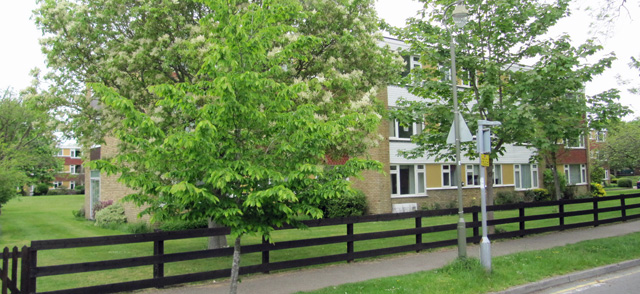
Part of the present day Sandown Lodge estate, seen from its corner on Worple Road.
Photograph © Roger Morgan 2020
There was a small amount of money left over at the wind-up of New Sherwood School. As it had been a registered charity, this had to be passed to a charity with similar aims. The beneficiary was a group of teachers and parents who were thus enabled to launch Kirkdale School in Sydenham.
_____________
Sherwood’s distinctive ethos led to the formation of many life-long friendships and, indeed, a number of marriages. In 2008 – nearly 50 years after New Sherwood School closed – a number of ex-pupils enjoyed a re-union convened by “old boy” Nigel Pavey. (In recognition of his service to the community as an Epsom & Ewell Councillor and otherwise, Nigel was created an Honorary Alderman in 2016. He died in 2019.)
Roger Morgan © 2020
with special thanks to Martin Cox (a former pupil), and
the unpublished 1998 history of the School by Brigit Morton (one of Peggy’s daughters)
on which this expansion of the original 2019 article has drawn extensively.