
THE SPENCERS, THE CARLINES AND MRS HARTER
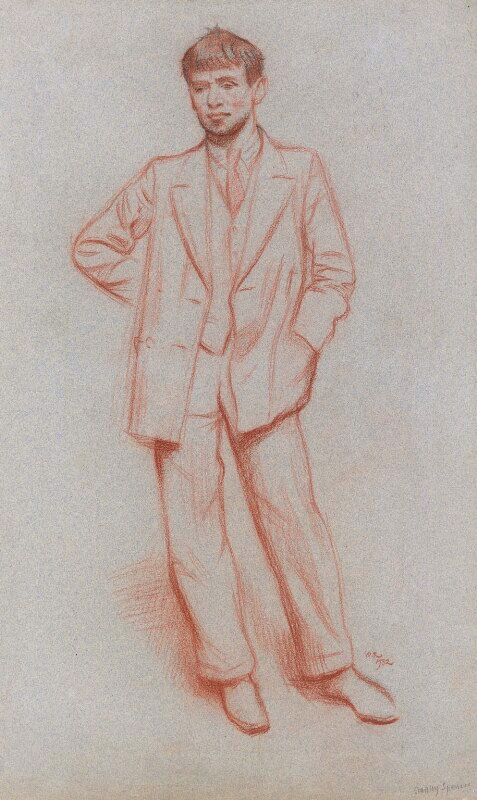
Sir Stanley Spencer
by William Rothenstein
sanguine, 1932
NPG 5499 © National Portrait Gallery, London (CC BY-NC-ND 3.0)
Background to this article
Early in 2018 BBC4 aired a documentary called ‘Stanley and his Daughters’, concerning the artist Sir Stanley Spencer CBE, RA and his daughters, (Mary) Shirin and Unity, by his first wife, the artist (Annie) Hilda Carline. Shirin and Unity, then elderly, were in it throughout and mentioned that Shirin was sent to live with Mrs Harter, a relative, in Epsom, later to be joined by Unity. The reasons for this were the breakdown of the Spencer/Carline marriage, Spencer’s infatuation with and eventual unconsummated marriage to a lesbian, and Hilda’s poor health. I meant to look into the Epsom angle more deeply, since I have encountered Mrs Harter before: she was formerly Muriel Northey, youngest daughter of the Reverend Edward William Northey of Woodcote House. Muriel was born in Epsom in 1880 and married army officer Oswald Birley Harter at Christ Church in 1903. Their elder daughter, Gwendolen, born 1904, married Sydney William Carline and he was the slightly older brother of the aforementioned Hilda.

Self-portrait by Sydney William Carline
Image source: Wikimedia Commons
_by_Sydney_Carline.jpg)
I forgot about this, but it resurfaced during the final episode of Sky TV’s ‘Landscape Artist of the Year 2018’, the prize being a commission from the Imperial War Museum (IWM) to paint the World War 1 battlefield of Kosturino, now in the Republic of Macedonia. The idea was not only to mark the centenary of the Armistice but also to add to the Museum’s range of artworks depicting less well-represented theatres of the war. There are a couple of examples on this website of men who served in the Macedonia campaign, but the vast majority of locally-linked casualties were elsewhere.
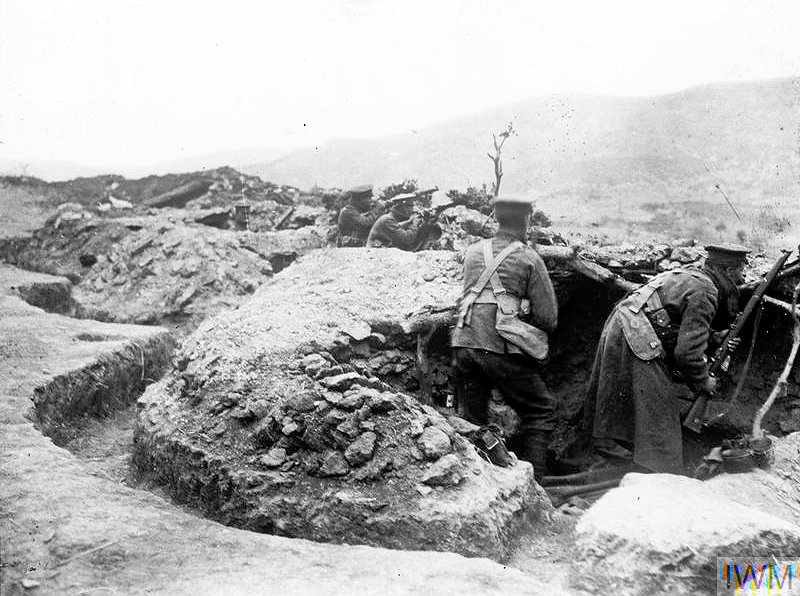 THE BRITISH ARMY IN THE MACEDONIAN CAMPAIGN, 1915-1918 (Q 62966)
Infantry manning part of the 10th (Irish) Division’s line on the Kosturino Ridge,
December 1915. Copyright: © IWM.
Stanley Spencer was in Macedonia as a hospital orderly (he was apparently too short and puny for actual soldiering, which was probably the art world’s gain) and one of his paintings of that area is ‘Travoys arriving with wounded at a dressing-station at Smol, Macedonia, September 1916’. The IWM suggested that the competition winner should research Spencer before setting off to Macedonia, in order to get a feel for the area, period and atmosphere, and one of the things she did was to meet Shirin Spencer and also Unity’s son, John. Unity had died between the making of the documentary and its broadcast and, at the time of writing, Shirin is well into her nineties, but she turned out enthusiastically at the IWM for the official unveiling of the commissioned painting.
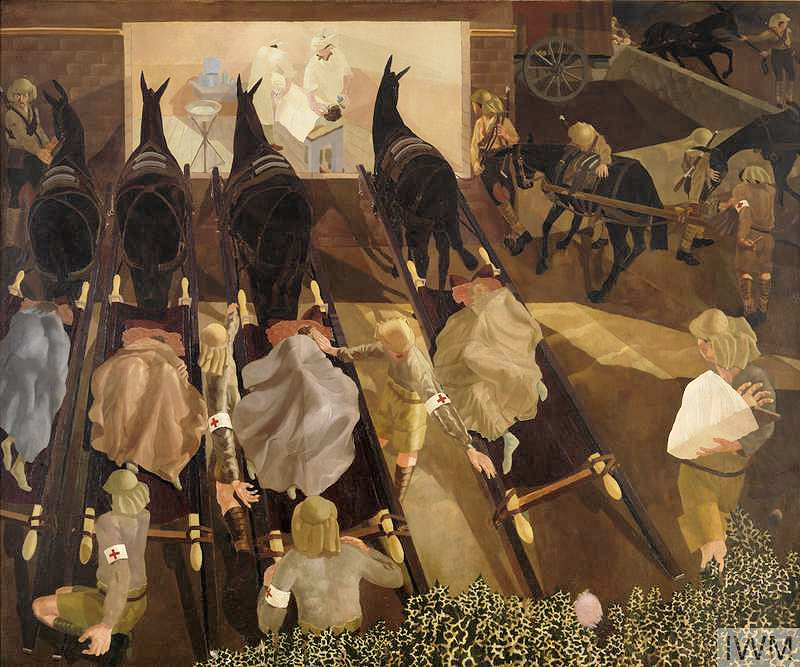 Travoys Arriving with Wounded at a Dressing-Station at Smol, Macedonia, September 1916
(Art.IWM ART 2268) image: A dressing station seen from an elevated position.
Four travoys pulled by mules wait in line outside the dressing station. Each holds
a wounded soldier covered in a blanket and they are attended by medical orderlies.
In the background is the bright glow of an operating theatre, where surgery is taking place.
In the lower right corner a man with his arm in a sling walks away from the scene, … Copyright: © IWM.
Where Mrs Harter lived
The 1939 Register had Muriel Harter at 6 Downs Road, Epsom (she subsequently moved to 38 Ashley Road), which is now St Christopher’s School. It looks likely that there was a house-swap of some kind, as, according to the school’s website, it started out at 38 Ashley Road in 1938 with eight pupils, but by the following year numbers had ballooned to 40 and the premises were too small, so the school moved to 6 Downs Road in 1942. Oswald Harter’s uncle, Alfred Edward, who died in 1915, had been the occupant of Number 6, known as Ingleside, having moved there from Woodcote Place with his wife, Isabella: she died in December 1934, still at Ingleside. Muriel’s elder daughter, Gwendolen Carline, by then widowed, was with her in 1939 and three names were blacked out for age reasons, one of whom must have been Shirin, who had been with Mrs Harter since the mid-1930s. Muriel was described as single in the Register, and I don’t think this was accidental, since Unity says that the Harters were separated, with Oswald mostly living in London. We shall return to Epsom shortly, after a brief foray into Stanley and Hilda’s marriage.
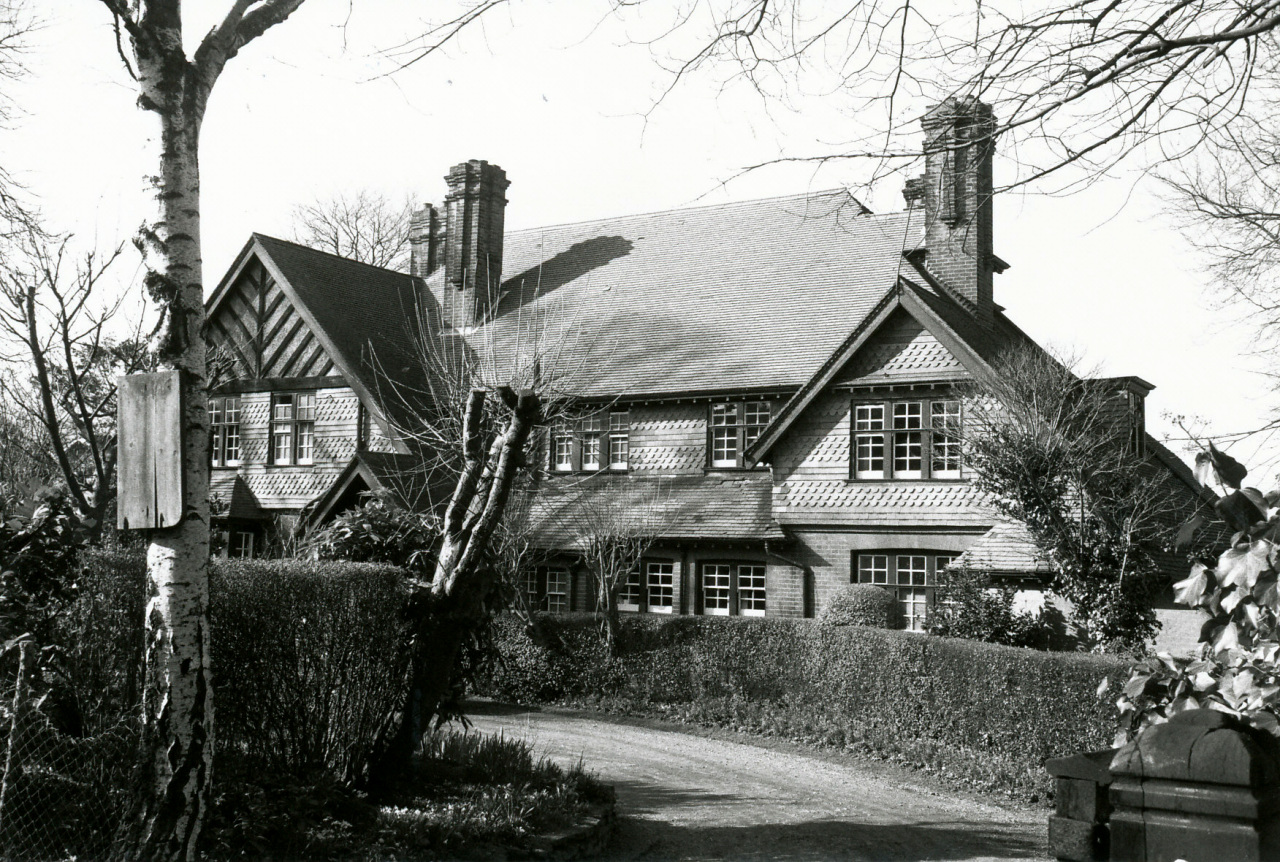
6 Downs Road, now St Christopher’s School
Image courtesy of Bourne Hall Museum
Stanley and Hilda

Sir Stanley Spencer
by Lady Ottoline Morrell
vintage snapshot print, 1925
NPG Ax142102 © National Portrait Gallery, London (CC BY-NC-ND 3.0)
Hilda was the daughter of artist George Francis Carline, who was a good landscape and portrait painter, so it’s no real surprise that three of his children also became artists. Stanley and Hilda had known each other since 1919 and became engaged in 1922, but prevarication on his part delayed a wedding until 1925. Shirin was born on 18 November of that year, with Unity arriving in 1930. However, in 1929 Stanley had met Patricia Preece, also an artist, who had been unwittingly responsible for the death of Sir W S Gilbert (the witty words man of Gilbert and Sullivan). Whilst swimming in his lake in 1911 she got into difficulties; Gilbert dived in to save her and suffered a fatal heart attack. Preece was attractive and Stanley became besotted with her, albeit that she had a lifelong live-in partner, Dorothy Hepworth. It seems that Stanley did not realise they were a gay couple, even though they were near neighbours of his in Cookham, Berkshire. It’s generally accepted that Dorothy was responsible for Patricia’s paintings but let the latter take the credit because she did not want to be in the limelight.
In the mid-1930s Hilda left Stanley permanently, taking the children with her, but Shirin was soon sent off to Mrs Harter. Hilda divorced Stanley and he married Patricia Preece as soon as the decree absolute was issued. The ‘marriage’ was a total disaster. There is a wedding photo that I can’t reproduce here for copyright reasons, but if you view it on Wikipedia you will see that this is a fairly odd-looking scene. Apparently, Patricia and Dorothy went on the honeymoon while Stanley stayed at home finishing a painting. However, Patricia managed to get Stanley to sign over his house in Cookham and she took control of his financial affairs, which seems to have been what the unconsummated marriage was all about for her. Patricia evicted him in the following year and he went to live in a room in Hampstead. He had regular contact with Hilda after that and wanted reconciliation, but she refused, having previously vetoed a ménage-a-trois with Stanley and Patricia. Her health, mental and physical, went into decline and, being a Christian Scientist, she tended to believe that illness could be healed spiritually. She spent some time in the mental hospital at Banstead following a breakdown and died of cancer in 1950. It seems that Stanley sometimes stayed at Mrs Harter’s in connection with Hilda and/or the girls, so perhaps Muriel was rather more understanding and tolerant than appears from Unity’s narrative. If we are searching for balance, then we don’t have any, since we do not have another side of the story.

The girls didn’t see much of their father or of each other for quite a while but the three of them were in due course reconciled. Stanley, who died in 1959, freely admitted his mistakes concerning Patricia Preece and the girls blamed her rather than him. Indeed, Unity made a similar kind of mistake, embarking on a relationship with a married man, Leslie Lambert, whom she later described as a conman. He was the father of her son, John, and she too suffered mental health issues, at one point attending a psychiatric day hospital and having John made a ward of court. Shirin and Unity ended up living together in Cowbridge, Glamorgan, until Unity’s death on 18 October 2017.
Life with Mrs Harter
Most of the published material covering the Epsom period comes from Unity’s book, entitled ‘Lucky to be an Artist’ (Unicorn, 2015): much of it was put together from diaries by her son, John, but she didn’t start those until 1943, so the earlier part is from recollection, which I think may be faulty here and there. For example, she implies that she lived in Ashley Road from 1939, but she couldn’t have done, because the school was at that address until 1942. The problem with the portions on Mrs Harter is that Unity’s perceptions are inevitably heavily influenced by what had already happened to her. The Spencers were not just a broken family, but utterly shattered and separated, with neither Stanley nor Hilda able to take proper responsibility for the children. Shirin had been with Mrs Harter from 1930, when she was five years old, and, although she visited Stanley, Hilda and Unity from time to time, she never lived with them permanently after that. Unity went with Hilda to London after the separation and was then sent to Epsom in 1939, at the age of nine, because Hilda was worried about the bombing. The diaries are somewhat disjointed but, as Unity said herself, she was shocked and bewildered about the move.
It’s difficult to know what Mrs Harter was really like, given that we have no other evidence to consider, but she was a Victorian and well into middle age when she ‘acquired’ the Spencer children; her only real connection with the Carlines was that she had been mother-in-law, very briefly, to Sydney William Carline, Hilda’s late brother, so it wasn’t that close a relationship. Sydney had married Gwendolen Harter in March 1928 and he was dead from pneumonia by February 1929. He had been a serving pilot during the war and, along with his brother Richard, was also a war artist of some note in the less-depicted theatres, as this next painting shows.
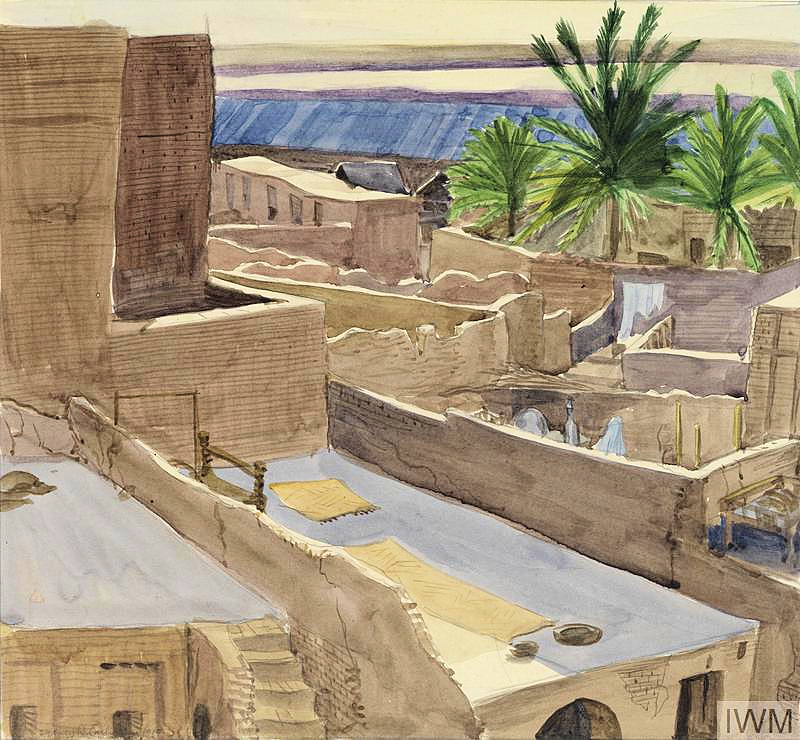 Kut-el-Amara, Mesopotamia, in Evening Light, 1919 (Art.IWM ART 4631)
Painting by Sydney William Carlineimage: a view across the flat roofs of Kut,
looking towards the River Tigris, which can be seen in the upper background
of the composition. To the right are four palm trees rising above the houses. Copyright: © IWM.
Unity says that Mrs Harter overpowered her with daily duties, problems and punishments, but she was allowed to have her school friends round as long as they were from Epsom. There was plenty of physical security but no emotional security – ‘Mrs Harter was a powerful and domineering woman and I was very frightened of her’. However, even though ‘she really was like a hard Victorian father’, she did teach Unity to play the piano. Apparently, Gwendolen would visit her father, Oswald Harter, about once a week, although Unity never met him. And perhaps one of the key issues was that the little girl didn’t understand that Hilda was mentally ill, since nobody would talk about it.
Unity does say, though, that there were many happy bits, like walking in the snow with Gwen Carline on a winter’s evening in Epsom, wrapped up against the cold to sing carols, and she was happy at Sherwood School (this was a mixed school with premises at 11 College Road and 6 Burgh Heath Road).
I have already mentioned Hilda and her worries about bombing and it so happened that, when she was on a visit to the children in 1941, a nearby house was destroyed by a stray bomb, whereupon she decided that they must be moved to a country boarding school. Mrs Harter wanted to keep them in Epsom but Shirin was sent to Badminton School, which had been evacuated to a hotel in Lynmouth, Devon, followed in due course by Unity. This was an interesting establishment, fairly progressive in its education of girls for the time. Indira Gandhi had been there briefly and the author Dame Iris Murdoch was a boarder from 1932 to 1938. It sounds as if, whatever you might be like academically, and Unity admits that she wasn’t good on that front, there was something else for you and she did well at artistic and physical pursuits. The sisters became quite close during the Badminton years and they returned to Epsom for the school holidays. In the meantime Hilda’s depression was getting worse, as she felt cut off from the children and Stanley.
Unity had developed a crush on an Epsom lad, but he became rather preoccupied and distant, and in February 1947, whilst at school, she was told that he had killed himself with a home-made bomb. Then, in July of that same year Hilda had a mastectomy because of the cancer that would eventually kill her and, once again, Unity’s world had fallen apart.
Afterwards
Hilda died on 1 November 1950 in a Hampstead hospital. Unity had just started at the Slade School of Fine Art and, as she said on the television documentary, she got home, found out that her mother was in a bad way and ran to the hospital. Hilda had died and Unity said she just howled. A few years later she started to suffer from depression. I have already mentioned Leslie Lambert and their son, John, but she was also painting and teaching art. Definitive recognition of her work came in an exhibition at the Fine Arts Society in London, which took place in 2015.
Shirin became a teacher and spent a number of years in Masasi, Tanzania. She was, and, as far as I know, still is, heavily involved in the community and her local church in Cowbridge.
Mrs Harter remained at 38 Ashley Road and died on 23 June 1965 in Epsom Hospital, Oswald having predeceased her in 1955. Gwen never remarried and died on 11 March 1980, her final residence being Oxford Court, Ashley Road. Mrs Harter was cremated, but her ashes are buried in the grave of her sister, Gwendolen, who had died in 1939: the grave is within the Northey enclosure at Epsom Cemetery.
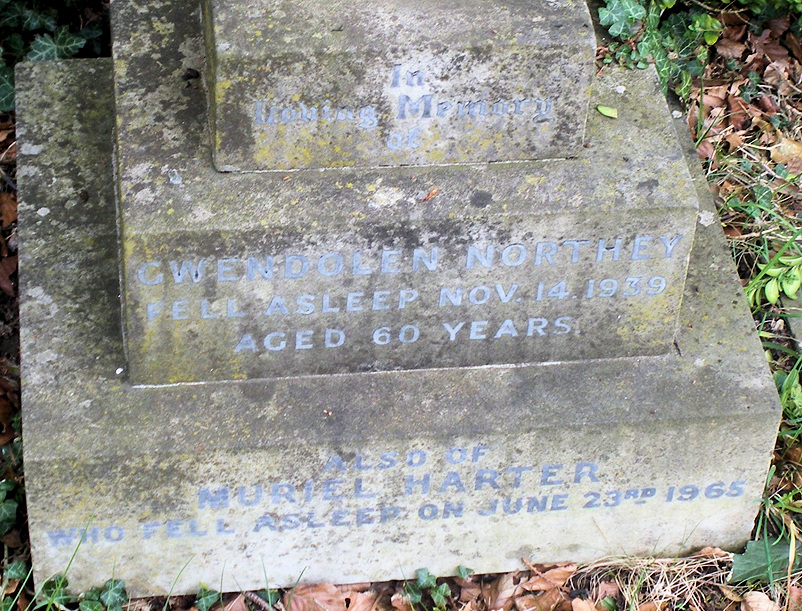 Grave of Gwendolen Northey showing memorial inscription to Muriel Harter
Image courtesy of Linda Jackson
Linda Jackson 2019
Postscript
Shirin Spencer died peacefully in Wales on 14 February 2022. Although frail, she had been ill only for a short period.