
William Sampson TROTTER (1839-1907)
& his memorial Rood Screen at Christ Church Epsom Common
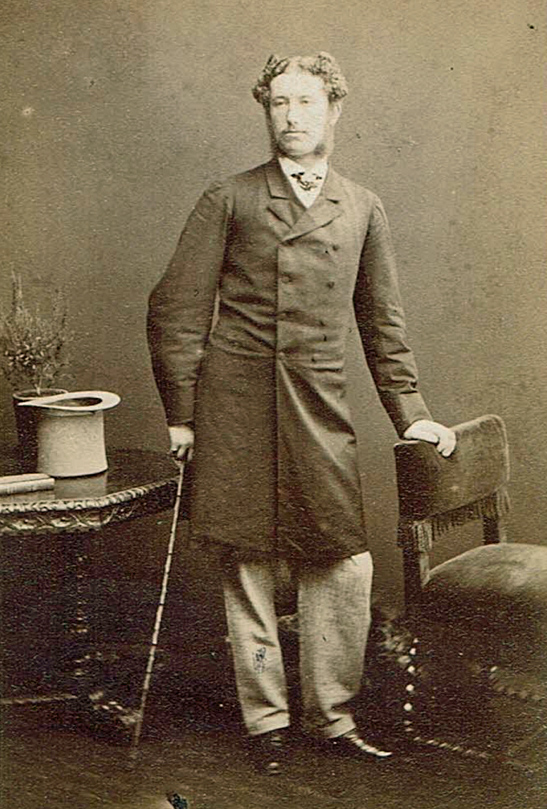 William Sampson Trotter in about 1864 (thus aged about 25)
Photograph courtesy of Bourne Hall Museum
William Sampson Trotter was the last of four generations of “Trotters of Horton Manor“, an important family in the early history of Christ Church Epsom Common. In brief summary, he was the great-nephew (on his mother’s side) of Elizabeth Trotter, known as the “Founder of the Parish”. The first Christ Church had been established in 1840 by Epsom’s then sole Parish Church, St Martin of Tours, as a “Chapel of Ease” to cater for the growing population on the Common and the hamlet of Horton. The local population grew to the point where the chapel was too small. Elizabeth campaigned unsuccessfully for a larger replacement that would be the centre of a new free-standing parish. She died in 1868, and maintained pressure from beyond the grave by leaving a substantial time-limited legacy to realise the dream.
The main beneficiary of Elizabeth Trotter’s will was her nearest surviving blood relative, niece Mary Elizabeth, daughter of her late sister, Ann. Mary Elizabeth (née Welbank) had long been married to William Brown, and had had 13 children, 10 of whom survived to adulthood. A condition of the inheritance was that the family changed their surname from “Brown” to “Trotter” – which they did. (The name change was not great news for the couple’s sixth child. His third Christian name had recognized Mary Elizabeth’s “Trotter” ancestry and, after the change of surname, his full name – as used on various legal documents – became Arthur Edward Trotter Trotter!)
William (now Trotter) vigorously continued Elizabeth Trotter’s campaign, and was instrumental in bringing it to a successful conclusion with the erection of the new building and its 1876 consecration as the centre of the free-standing parish of Christ Church Epsom Common. William and Mary Elizabeth were both actively involved in the life of the new parish until their deaths in, respectively, 1877 and 1875. Horton Manor then passed to their oldest surviving son, William Sampson Trotter born in 1837 as their fourth child. (Their first and third children had died in infancy and William Sampson took precedence over his surviving older sister, Harriet, born in 1836.)
That necessary background rather gets us ahead of ourselves. In 1850 – well before his parents came to Horton – the 11 year old William Sampson (still “Brown” – as he remained until 1868) was sent to Radley College, just south of Oxford. After a couple of years there, he was enrolled for artillery officer training at the Royal Military Academy, Woolwich. He proved to be the best of his intake and, in 1856, was accordingly awarded the Academy’s Sword of Honour.
Commissioned as a lieutenant in the Royal Artillery, William Sampson was sent to India in 1857 at a time when the British were seeking to put down the Indian Rebellion. Over the next couple of years, he was involved in: the attack on Bunterah; the capture of the fort of Birmah; the relief of Sundeala; and the relief, siege and capture of Lucknow. During all this he was wounded three times and “Mentioned in Despatches”. He then returned to the UK where the remainder of his service was less action-packed.
William Sampson resigned his commission in 1866, aged 27 – a couple of years after the photograph at the head of this article was taken. He moved to Horton Manor with his parents shortly after Elizabeth Trotter’s death in 1868. After the new Christ Church was consecrated in 1876, William Sampson’s father, William (who had been instrumental in getting the new church built) was elected as one of the Churchwardens, a significant office in which he served until standing down in 1882. William Sampson then followed his father in that office until 1886 – the year in which, as noted below, he moved away from Epsom. (It is likely that William Sampson is third from the right in the back row of the 1885 photograph of the Christ Church Choir in our article about George Good. It seems certain that his fellow Churchwarden at the time, Henry Willis, is fourth from the left in that picture.)
Horton Manor formally passed to William Sampson on his mother’s death in February 1885 (although it seems likely that his father remained in effective control until his death at Horton in 1887). In July 1885, William Sampson became engaged to a Miss Mabel Graves. However, it was rather curtly announced in The Morning Post of 11 September 1885 that the proposed wedding would not take place. Instead, on 6 March 1886, he married Constance Selina Feeney at All Saints, Cheltenham: he was then 36 and she was 28. The couple settled down in Herefordshire, where their two children were born: John Frederick Arthur in 1887; and Eileen Constance Beryl in 1889.
It is not clear why, although absent from Horton, William Sampson commissioned the eminent architect Sir George Gilbert Scott to remodel and enlarge the already grand house, almost to the extent of re-building. However, he seems never to have lived there. Having in some way secured a break in the entail – and perhaps having overreached himself financially – he sold the estate in 1892. (In 1900, the new owners sold the estate to the London County Council for development as part of the “Epsom cluster” of mental hospitals.)
William Sampson and his family remained in the West Country. After several changes of address, he died at “The Hill”, Batheaston, Somerset on 21 July 1907, aged 68. Notwithstanding his long absence from Epsom, the links with Christ Church remained strong enough for him to be brought back to Christ Church for his funeral and then burial in Grave A579 alongside his parents in Epsom Cemetery. His was the last interment in the family plot. In the photograph below, the headstones are – from left to right – his mother’s, father’s and his, on which the inscription is TO THE MEMORY OF / WILLIAM SAMPSON TROTTER / LATE OF HORTON MANOR EPSOM / DIED JULY 21 1907 AGED 68. (The only other burial on the plot, marked by the damaged headstone behind the main three, is that of Ann Cottle, the childhood nurse (and “valued friend”) of William Sampson and his siblings.)
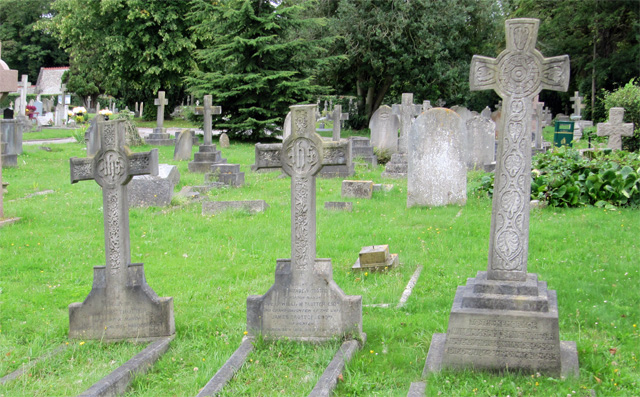 William’s headstone (on the right) in the family plot in Epsom Cemetery
Photograph by Roger Morgan © 2017
The link with Christ Church also remained strong enough for William Sampson’s widow and children to donate Christ Church’s splendid Rood Screen in his memory. The postcard illustration below dates from about 1910, shortly after the Screen’s installation in 1909.
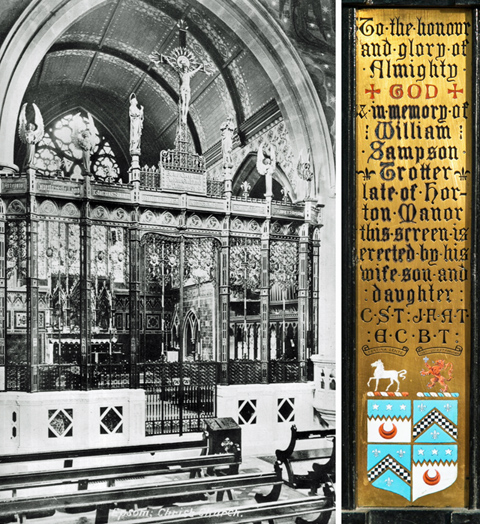 Left: A c.1911 postcard of the then recently installed Rood Screen
From the Christ Church archives
Right: The memorial plaque at the foot of one of the screen’s main columns
Photograph © Nishi Sharma of Light & Shade Photography, 2015
The screen was designed by the ecclesiastical architect George Fellowes Prynne (who designed, among many other parish churches, St Mark’s in nearby Purley, completed in 1910.) He was particularly noted for his work in designing rood screens, and the one at Christ Church is reckoned to be amongst his finest work. The manufacture of the screen was by Messrs Martyn of Cheltenham, at the time the premier firm of decorative craftspeople in the UK and, arguably, the world.
The newly installed screen was dedicated by the Suffragan Bishop of Guildford in mid 1911. Christ Church’s Parish Magazine for August 1909 noted:
“The screen is of wrought iron and bronze, with richly ornamented traceried panels. Immediately over the central gate rises a cross, twelve feet in height, carrying the figure of the Saviour, and supported on either side by the figures of the Blessed Virgin and St. John. There are also on either side of the cross angels carrying emblems of the Passion. The whole meaning of the rood [an old word for the cross], and a very beautiful one, is that only by passing under sufferings of the Cross can one reach the holy of holies. Beneath the cross, and in a large plaque, are the words, ‘By Thy Cross and Passion; good Lord deliver us,’ and running along the whole length of the screen are the following words from the Book of Revelation: ‘Alleluia! Worthy is the Lamb that was slain to receive power, and riches, and wisdom and strength, and honour, and glory, and blessing. Alleluia!’ On one side of the screen is the following memorial tablet: ‘To the honour and glory of Almighty God, and in memory of William Sampson Trotter, late of Horton Manor, this screen is erected by his wife, son, and daughter.’
The memorial plaque (as shown above) refers to William Sampson’s widow and children only by their initials. They were as follows.
- CST: Constance Selina Trotter (née Feeney) – 1857-1949.
- JFAT: John Frederick Arthur Trotter (subsequently Major and OBE) – 1897-1955. In August 1914, he married Ida Winifred Winsborough (1891-1980).
- ECBT: Eileen Constance Beryl Trotter – 1889-1974.
Neither child had any children – indeed, Eileen never married – so William Sampson’s line stopped with them.
At the bottom of the memorial plaque is the family’s coat of arms, being a quartering of the Trotters’ crescent moon and stars topped by a white horse and the Browns’ chequered chevron and fleur-de-lys topped by a red lion. In an amusing play on words, the Trotters’ white horse is shown as “trotting”!
In 2015, Christ Church’s many decorative features were formally “recorded” by what is now the Arts Society Epsom using protocols agreed by the national Arts Society and the V&A Museum. The required technically-detailed description of the intricate rood screen proved a real challenge for the volunteer recorders – and one of the details (one of the enamelled shields – as illustrated below – towards the top of each section of tracery) completely flummoxed them.
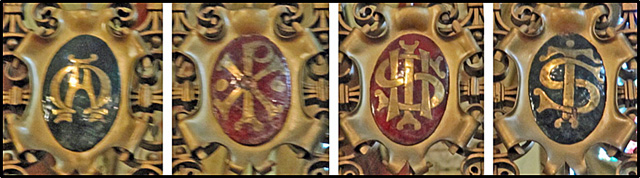 Examples of the screen’s four monogram shields
Photograph by Roger Morgan © 2019
Three of these monograms are well-known Christian symbols, using the Greek alphabet. From left to right above, they are:
- Alpha and Omega – an appellation of Jesus in Revelation 1:8, 21:6, and 22:13;
- Chi-Ro – the first two letters of “Christ” in Greek; and
- IHS (Iota-Eta-Sigma) – the first three letters of “Jesus” in Greek.
But what is the meaning of the intertwined TS or ST?
A couple of years after the recording was completed, Christ Church was visited by one of the sons of Canon Robins, Vicar at Christ Church from 1947 to 1960. He said that, only 40 years after the screen’s installation, the understanding among long-standing members of the congregation (who remembered the screen’s installation in 1909) was that, to avoid confusion with his father (who was plain William Trotter), William Sampson Trotter had normally been called “Sampson Trotter” – and, over-egging his status rather more than somewhat, the intertwined “ST” were his initials.
Finally, it is worth noting that the “very fine” Rood Screen is one of the factors which led to Christ Church being “listed” at Grade II*. The principal reasons for its designation at that level are, in full: “Architecturally of good quality with impressive east end decoration of the 1880s and a very fine rood screen of 1909; and its importance as a complete and ambitious late Victorian church of distinction by an eminent architect” [namely, Sir Arthur Blomfield].
Roger Morgan © 2019