
THE CONGREGATIONAL LECTURE HALL: 1883-1990
Upper High Street, Epsom
(see also our article about the parent Epsom United Reformed Church – as the Congregational Church was renamed in 1972)
 The Congregational Lecture Hall
Image courtesy of The Epsom & Ewell Local And Family History Centre
This article draws heavily on the 1983 Centenary History of the Hall by Alan & Valerie Wood, together with
Winifred and Phyllis Cary’s 1988 Tercentenary History of Epsom’s URC & 1988-2000 History Update.
Each of these (and particularly the first) contains much more detail than is feasible to present here.
As noted in our main article about the then Epsom Congregational Church, in 1850 some members of its congregation fell out with their eccentric Minister, the Rev Thomas Lee. A leading figure in the schism was Thomas Henry Norman (whose wealth came from his wholesale stationery business) and he was instrumental in the new group’s acquiring a wooden Chapel in The Parade, Epsom – near his home at “The Pines“, also in The Parade.
Mr Norman later acquired a site in what was then Station Road (today’s Upper High Street) with a view to providing a more fitting home for the breakaway congregation than the wooden Parade Chapel. However, in 1878 the two congregations managed to resolve their differences and recombined in the old Church Street building. The Parade Chapel began to be used to accommodate part of the Church’s large Sunday Schools.
 Extract from the 1896 Ordnance Survey Map – click image to enlarge
Red = Lecture Hall, Green = The Church Street Chapel,
Yellow = The Parade Chapel, Blue = Public Hall
Before long, even the combination of the Church Street building and Parade Chapel was proving too cramped for the growing Sunday Schools and other activities and it was resolved to build a new Hall on the Upper High Street site which, as noted above, had earlier been acquired by Thomas Norman to provide a permanent home for the Parade Street Chapel – and which, in 1882, he formally donated to the recombined church. On 27 July 1882, the foundation stone was laid by Evan Spicer (of Dulwich, a prominent Congregationalist and philanthropist – and, like Mr Norman a wholesale stationer), and memorial stones were laid by Mrs T Norman (wife of the donor) and Mrs Horace Marshall (understood to be the wife of wholesale newspaper magnate Horace Brooks Marshall – later Baron Marshall of Chipstead). Building (by Dove Brothers of Islington to designs by a little-known architect, Mr W T Church) progressed smoothly, and the new premises were formally opened on 8 February 1883 by Mr W Gage Spicer, a leading international Congregationalist. The building had cost about £2,800 and, thanks to generous giving by the congregation and others, opened debt-free.
As will be seen from the photograph at the head of this article it was a substantial building – larger than the Church Street parent and, externally, appearing to be a traditional church. It provided even more accommodation than might be thought since it had two floors: a lower level one, the principal access to which was from Depot Road, at the building’s rear; and the higher level, normally accessed via the main doors on what is now Upper High Street.
The first recorded Sunday School Meetings in the new Hall (it was always referred to as a “hall”) were on 7 January 1883. They proved to be very popular and were run in two sessions. Before long, typical attendances were: in the morning, 280 children with 34 teachers; and, in the afternoon, 356 children with 45 teachers. (In due course, the vacated wooden Parade Chapel became a gymnasium, and then continued in use for various purposes until its eventual demolition in the 1930s.)
When not used by the Sunday Schools, the new Hall soon became a focal point for the community, housing various groups and events. Demand for use of the hall increased further when the Public Hall, at the junction of Station Road (later called Upper High Street) and Church Street, closed in the early 1900s.
At the end of the Victorian era, thoughts began to turn to replacing the old Congregational Chapel in Church Street (with origins in the 1720s and most recently remodelled in 1805 and 1846) with a modern and larger building. During the 1904/05 rebuild, the congregation met in the Lecture Hall. To provide music for the services, the old chapel’s “Bishop” organ was moved to the Hall – where the gallery had to be strengthened to bear its weight. (In due course, the organ was reinstalled in the new Church Street building.)
In 1909, the then Congregational minister, the Rev Henry Atkinson, founded the Epsom Brotherhood as a branch of the national non-denominational (but Congregationalist inspired) organisation for men in trade. Until 1929 – when it built its own premises (of which more below) – this had a club, Library and meeting rooms in the Lecture Hall, and also staged many events there.
At the start of WW1, the Hall was for a short time requisitioned for recruitment activities and was then also no doubt used for other war-related activities. The Lecture Hall was officially registered with the Land Registry as “Congregational Church Hall” in 1917.
Epsom’s Congregational Church offered its young people uniformed organisations in the form of the Boys’ Brigade and the Girls’ Life Brigade. (It later offered both Scout and Guide groups.) We have the following 1926 photograph of the Girls’ Life Brigade assembled on the steps of the Lecture Hall.
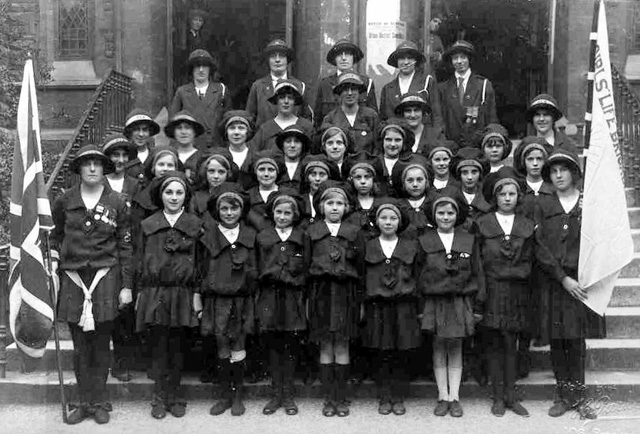
The Congregational Church’s Girls’ Life Brigade Company on the steps of the Lecture hall, 1926.
Image with thanks to the Bourne Hall Museum.
During WW1 and its immediate aftermath, Sunday school numbers had declined significantly. But they recovered and, by 1938, the Sunday school still had over 300 pupils and up to 20 Sunday School Teachers.
In 1923 a Miss Gray moved her Infant and Primary school into rooms in the hall from her home in West Street. During WW2 the school operated out of basement rooms. The Primary section of the school closed shortly after the war as Miss Gray was already in her eighties. The infants’ section carried on for a short while but it too eventually closed after over 20 years teaching local children.
In October 1929 Ebbisham Hall and the smaller Myers Hall were opened in Ashley Road by the Epsom Brotherhood. The Brotherhood moved from the heavily used Lecture Hall to the new building – as did a number of other groups, such as the Literary Society (which had moved in when the Public Hall in The Quadrant closed in 1900). This must have had quite an effect on the Lecture Hall finances. Accordingly, the early 1930s saw the erection of premises for two shops on the hall forecourt (the rent from which helped defray the Hall’s running costs) each side of a new entrance gate, clearly labelled “Lecture Hall”.
 The Lecture Hall with its 1930s facade of shops and entrance gate.
Photographed by L R James in 1971
Image held in The Epsom & Ewell Local And Family History Centre.
During WW2, the hall was again used for war-related activities including a Services Club, a Knitting Club, an Emergency Medical Unit for homeless refugees and a YMCA meeting place. With many children evacuated from the borough the Sunday School sessions were temporarily halted.
In peacetime – apart from Sunday Schools, and the usual youth activities of Girls and Boys Brigades, Scouts etc – the Lecture Hall was used by a wide variety of organisations for various events including:
• A Meals canteen for Epsom Boys’ County Secondary School until 1954
• Bazaars
• British Camp Fire Girls
• Christian Endeavour
• Chrysanthemum Society
• Concerts and Theatrical Events
• Crusader Class
• Demonstrations by Gas & Electric Companies.
• Fund raising for local charities
• Mission Work
• Regnal League
• Synagogue meetings for the local Jewish Community (which later – from 1954 to 1992 – took over the Bugby Chapel)
• The Band of Hope (from 1884)
• White Ribboners (A temperance organisation)
• Women’s Church Council
By the 1950s, nearly 70 years’ heavy use of the Hall (for both church and, even more so, community activities) had taken its toll on the building and thoughts began to turn to replacing its facilities with a new hall adjoining the church. Some land behind the Church came on the market in 1952, but the price was considered too high. It came on the market again in 1957, and fresh negotiations began – again coming to nothing. (As noted further below, the acquisition was eventually made in 1982.)
In July 1961, the main church building in Church Street was gutted by fire. Until that was rebuilt (to form today’s United Reformed Church), the Lecture Hall was – as during the 1905/05 rebuild – again used for church services.
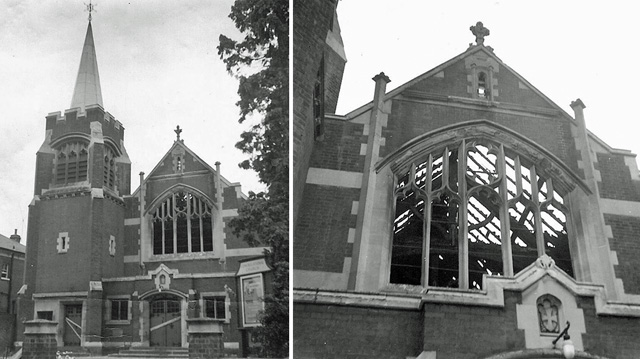
The 1904 Congregational Church as burnt out in 1961.
Images courtesy of The Epsom & Ewell Local And Family History Centre
Wear and tear continued to takes its toll on the Hall. In 1969, the church began to make plans to sell the Hall to developers for the erection a new building that would include a replacement Hall. Plans for the redevelopment were approved by the Council but, just before contracts were finalised in 1973, a subsidiary of the developers went into liquidation and the scheme had to be abandoned. Very shortly after that, the Hall was declared “unsafe” by insurers and fire authority. While urgent remedial work was undertaken (by a mixture of volunteers and professional builders), the extra accommodation available at the rebuilt parent church (following the 1972 merger of the national Congregational and Presbyterian Churches to form the United Reformed Church, now the Epsom URC) proved invaluable in helping to cater for the temporarily displaced youth and other activities.
Continuing problems with the Hall rekindled the 1950s interest in aggregating all activities on the Church Street site. In 1982, the parcel of land behind the church again came on the market. This time, the church was able to complete the deal, later covering the cost by selling an unwanted part of the plot to developers for the erection of two private houses in The Grove. Sadly, plans for building a Hall and committee room and a new minister’s vestry were rejected by the Local Planning Committee as was the subsequent appeal to the Department of the Environment. (A reduced project to build committee rooms and a minister’s vestry on to the rear of the Church was accepted and went ahead.)
In 1983, the Hall’s Centenary was marked by a Thanksgiving and Commemoration Service on the evening of Sunday 9 October – together with an exhibition of many artefacts, photographs, and personal reminiscences that day and Monday 10 October. For this, Alan & Valerie Wood (long-standing members of the Epsom church) wrote an invaluably detailed history of the Hall’s hundred years and the many, many activities it had hosted over that long period.
Between 1983 and 1987, the Hall provided a temporary home for Laine Theatre Arts on moving from its base in the about to be demolished Ebbisham Hall and while finding its present premises.
By the church’s 1988 tercentenary, the Hall in the Upper High Street was 106 years old. Heavy use by the church and, even more so, outside organisations had taken its toll on what was now a quite old-fashioned building. Indeed, there had even been minor fires, possibly caused by intruders, for the padlocks were broken more than once. Holes in the floor, leaks in the roof and broken windows all added to the query by 1989 as to whether, even with yet further patching, the Hall was fit to house the Harvest Lunch that September.
Accordingly, the 1970 thoughts of redeveloping the Hall’s site resurfaced and began to be vigorously pursued. A viable scheme was worked up with some developers and agreed with the planning authorities. Unfortunately, there proved to be a wrinkle with the Charity Commission over the sale of site in the light of the terms on which Thomas Norman had donated it to the church in 1882. As things dragged on, a double disaster struck: changes in the property market led the developers to withdraw from the scheme that had been worked up in great detail (such as colour schemes for the internal decoration); and then, on 7 October 1990, the Hall was gutted by fire – again understood to have been started by intruders.
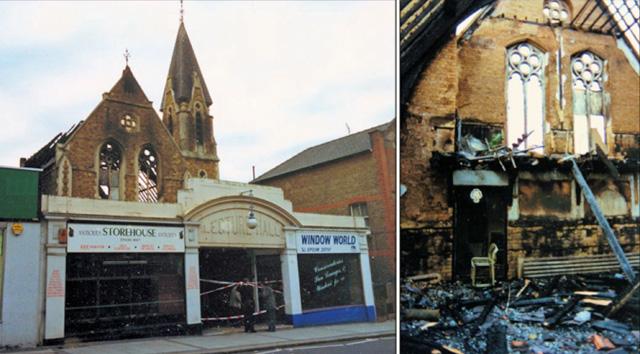
The burnt out ruins of the Lecture Hall 1990.
Images courtesy of Bourne Hall Museum.
The fire had left the Hall in a dangerous condition, and scaffolding was erected to support the walls. The scaffolding was expensive and, as there was no realistic prospect of repair, the old building was demolished and the site rented out as a private car park – income from which (together with that from the refurbished shops) helped offset the costs.
In 1992, a legacy enable the parent church to clear the remainder of the land at its rear acquired in 1982, and it erected some portable cabins to provide accommodation for the youth organisations that had been shoe-horned into a variety of temporary locations when displaced from the Hall. Over the next few years, there was no success in finding another developer interested in the Hall site, and thoughts again turned to building a new hall adjoining the church, and outline planning permission was gained in 1995.
There was then interest from developers to build a cinema complex on the old Hall site. With much nail-biting (and resolution of the legal difficulties about the terms of the 1882 gift of the site) the deal was done and – as pictured below, the Odeon multiplex was built. (The sale proceeds enabled the church to press ahead with the erection of Unity Hall adjoining the church, and this was opened in 2001.)
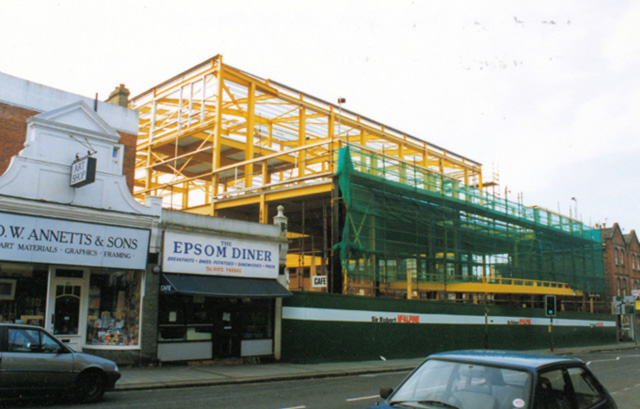
The steel structure of the cinema complex being built on the hall site.
Image courtesy of Bourne Hall Museum
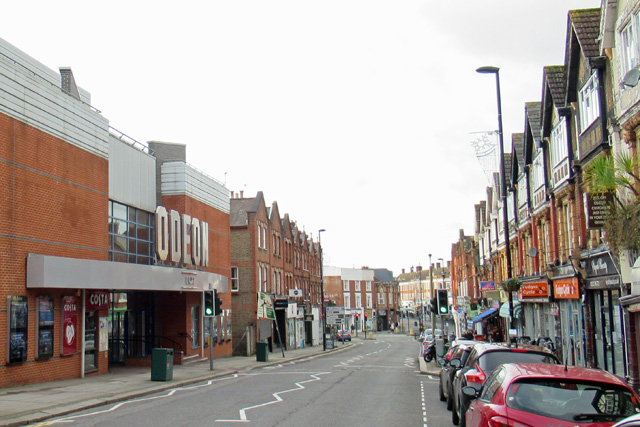
Today’s Odeon Cinema complex in Upper High Street.
Photograph by Roger Morgan © 2020.
The great majority of today’s cinema-goers are unlikely to have any idea about the site’s history and would probably be intrigued to compare the 2020 photograph above with the 1905 one below, taken from about the same spot.

A 1905 view of what was then Station Road, with the then 22 year old Lecture Hall at the far left.
Image from Peter Reed’s collection.
Peter Reed & Roger Morgan © 2020
(updated from Peter’s April 2013 article)