
Canon ARCHER HUNTER MA (1850-1939),
Vicar of Christ Church Epsom Common, 1881-1911
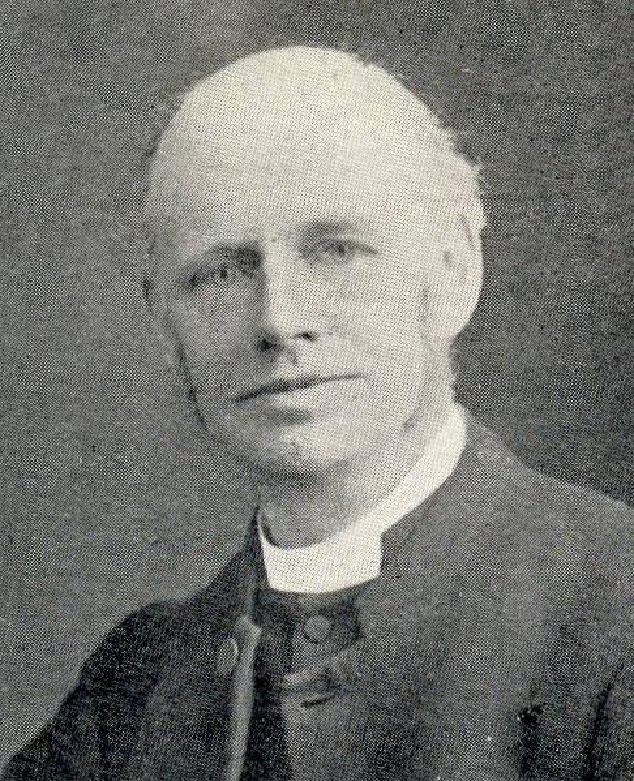 Canon Archer Hunter
Canon Hunter’s 30 years in post – 1881 to 1911 – make him far and away Christ Church’s longest-serving Vicar. Next in line, with 15 years each, are the Revd Derek Bedford (1966-81) and the Ven Mark Wilson (1981-96).
Archer George Hunter was born on 12 November 1850, the fourth child of Richard and Caroline Hunter. The 1851 Census records the family living at 29 Brunswick Square, London and that Richard was a solicitor in Lincoln’s Inn (where the firm of Hunters continues today). By the 1861 Census, four more children had arrived and the more than comfortably-off family had moved to Cottenham Park, Wimbledon.
Archer was educated at Marlborough College, and then at Trinity College, Cambridge where he gained an MA degree. He received his theological training at Cuddesdon College, just outside Oxford. His training Curacy was served at St Mary’s, Beddington (1874-77) – in which post he received, but did not accept, an invitation to Christ Church’s consecration in 1876. He then moved to be assistant Priest in Camden Town where he helped set up the new congregation of St. Michael’s.
1881 was a significant year for Archer. First, he married Marianne (daughter of the late Frederick Bray of Regent’s Park, London). More importantly for Epsom, he was appointed as Christ Church’s second Vicar – succeeding the Revd George Willes (1876-81). It is not known how quickly Archer decided that Christ Church would be his only parish as Vicar but (despite the attempts by Lord Rosebery – a regular worshipper at Christ Church – to get him to Mentmore in Buckinghamshire, another of the Rosebery estates) his obvious strong bond kept him in post for the next 30 years – with, indeed, some continuing involvement after that.
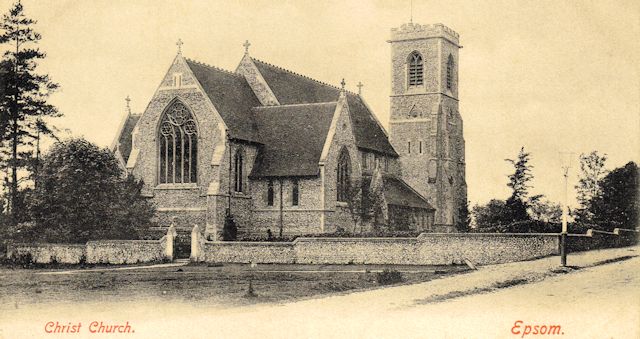 A postcard view of Christ Church, Epsom c.1900
Archer and Marianne had four children: Dorothy (b 1882); Richard (b 1884); Phyllis (b 1885); and Leonard (b 1897). Sadly – although far from unusually in those days – Leonard died on 20 February 1891, just short of his fourth birthday, and was buried in Epsom Cemetery. In the child’s memory, as recorded on the brass plaque pictured below, the organ console and the corona (under the organ pipes) were decorated together with the addition of complementary side panels (each measuring about 1.65 by 1.05 m). The artist was Henry (also known as “Harry” or “Hal”) Collier Jones, a member of the Christ Church congregation.
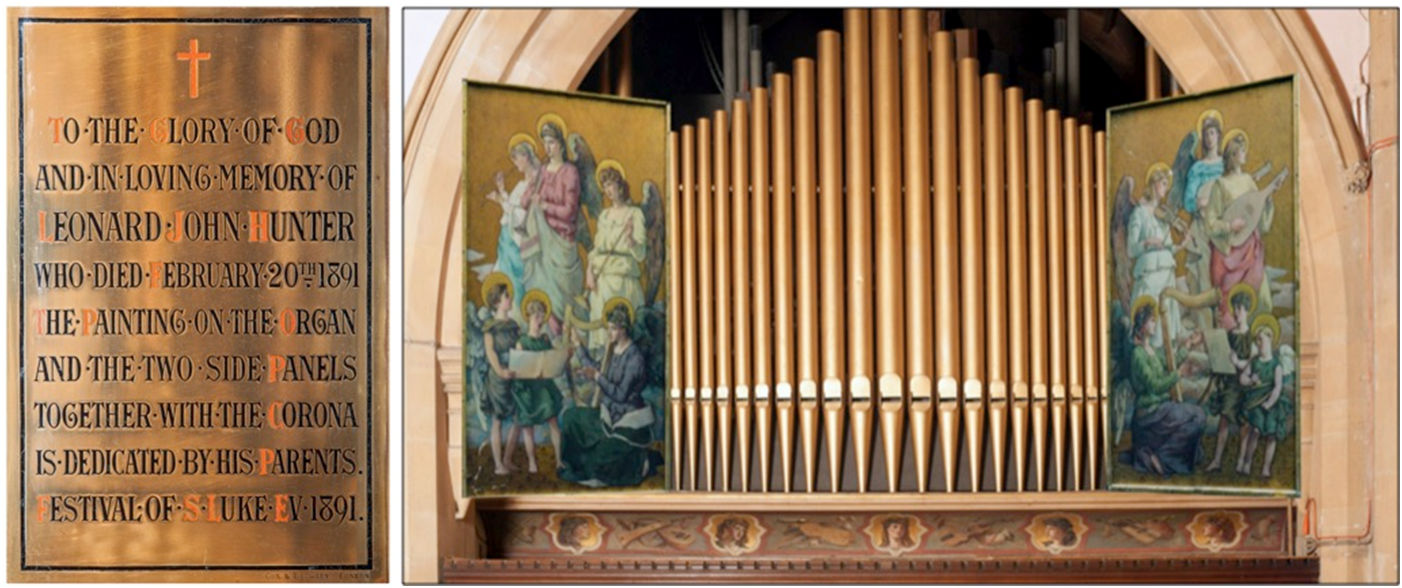 The 1891 Leonard John Hunter memorial plaque and organ decoration.
Montage of photographs from various sources by Roger Morgan © 2017
The decoration on the console was lost when it replaced during the rebuild of the organ in 1937. The side panels were removed in the 1970s at the request of the then organist because they muffled the instrument’s sound. Only the decorated corona remains in situ. While the side panels were later disposed of, they were photographed in the 1990s and the montage above recreates the original effect.
The picture of Archer at the head of this article comes from a privately published directory of the “great and good” in Epsom published in about 1908. Archer’s entry in that directory recorded his appointment in 1897 as an honorary Canon of Winchester Cathedral and (in 1906) as Rural Dean of Leatherhead. It also listed his recreations as “cycling and foreign travel.” (Foreign travel was certainly not for the masses at the time – and this pursuit reflected his relative affluence.) Not recorded in either place is his significant involvement, as Parish Priest, in Epsom’s pre Welfare State provision for the “poor”; his part in establishing St Barnabas to serve the expanding north of Epsom (from 1899 as a Chapel of Ease on Hook Road, moving to the new church in Temple Road in 1909 which became a parish in its own right in 1917); and, in 1908, taking under Christ Church’s wing – as St Michael’s – the 1880s Mission Church on Woodlands Road which closed in 1956.
Archer retired as a parish Priest in 1911, aged 61. He and Marianne moved to The Larch Wood in Park Lane, Ashtead – from where he continued in the unpaid post of Rural Dean for another 14 years, until 1925 – when he was aged 75. As such, he continued to be involved in the life of Christ Church. He was a guest at the 1922 wedding of his second successor as Vicar of Christ Church, the Revd Neville Stiff, and was particularly active in keeping things going after Neville’s tragic death in 1923.
Archer’s son Richard married Daphne (née Thompson) in 1909. Their first child, Paul, was born in 1911 but sadly died after two months. Although the family lived in London, Paul was buried in Epsom Cemetery – in the same plot (A70A) as Archer’s other son, Leonard who had died 20 years previously. In due course, the same plot also received Archer’s wife Marianne, who died in March 1931, aged 85 – and Archer himself, who died on 16 April 1939, aged 88. He left an estate valued at just over £20,000 – approaching £1 million at 2022 prices.
Just above the brass plaque mentioned above in memory of Archer’s son Leonard is a stone tablet (with bronze insert), as pictured below.
 The memorial tablet.
Photograph © Nishi Sharma of Light & Shade Photography, 2015
As will be seen, the tablet’s main text reads, “To keep in memory the faithful service in this parish of Archer George Hunter and Marianne his wife 1882-1912.” (Oddly, both those dates are a year later than every other record – including the authoritative Crockford’s Directory – of his term.)
Inset into the stone is a bronze plaque commemorating the 50th anniversary of Archer’s priesthood in 1925 – the text under the portrait reading, “To commemorate the fiftieth year of his priesthood in the Church of England 1874 to 1925 – Ministered in London and Christ Church Epsom, Hon Canon of Winchester Cathedral, Rural Dean of Letherhead.” (“Letherhead” is the old spelling of Leatherhead.) At the bottom corner of the plaque are the coats of arms for, on the left, the Diocese of Winchester (the diocese under which Christ Church came until the creation of the Diocese of Guildford in 1927) and, on the right, of the Hunter family.
On the face of it, those dates suggest a late 1920s date of installation. However, Christ Church records are clear that the tablet was installed in 1949 – although, as discussed further below, the bronze insert can be dated to 1927. Shortly after Archer’s death in April 1939, the Christ Church PCC noted that the church should have a memorial to this significant character in the life of the parish. It was noted that, as Archer’s work had extended far beyond the parish, an appeal to fund the proposed memorial should extend to the Diocese.
Given the approaching war and then the outbreak of WW2, the Diocese felt such an appeal untimely. The October 1939 PCC agreed that “for the present, a tablet should be erected in the church with a view to carrying out the larger memorial scheme later on” and that the wishes of Archer’s family should be ascertained. Given wartime difficulties, it took 10 years for this wall tablet to be installed – and the “larger memorial scheme” suggested in 1939 was not pursued further.
While the stone tablet dates from 1949, the bronze insert dates from 1927. It is the work of artist Madge Kitchener who, at the time, lived in Ashtead and ran The Little Gallery at 80 The Street. This was only a few hundred yards from Archer’s post-Epsom home in Park Lane and, from a mention in Archer’s 1935 memoir, it is clear that they were close friends. Madge Kitchener had two main claims to fame. The first is that she was the niece of “Kitchener of Khartoum”, the Lord Kitchener of the WW1 “Your country needs you” posters. Her second claim to fame is that she originated the “thrift” design on the reverse of the 12-sided threepenny bit introduced in 1937.
Madge Kitchener specialised in medallic work. For the 1927 Royal Academy exhibition, she is listed as displaying a couple of portrait medals, one of which was of Archer. It is clear that this insert in the tablet (which is typical of her work) is that portrait medal, doubtless donated by Archer’s family when approached about the proposed memorial.
 Archer’s signature, from the parish records.
Roger Morgan © 2014 & 2022
PS It is now little known that, as noted in the May 1964 Parish Magazine, “Hunters Close” (built off Marshalls Close by the then Church Hall at the foot of West Hill) was named to commemorate Archer Hunter’s 30 years in Epsom.
Towards the end of his full and interesting life, Canon Hunter wrote a short book entitled Incidents in my life and Ministry. Published in 1935, this has long been out of print but a recent transcription can be downloaded here.
In addition to the background material in his book, there are also some interesting recollections in the Epsom Common Association’s 1993 booklet, Epsom Common –
“In 1881, Canon Archer G. Hunter began his long period as Vicar of Christ Church, and he and his wife worked with unflagging energy to care for the people in the parish. They both visited regularly, especially when people were ill, they organised various forms of poor relief, they arranged outings for the children, they entertained in their enormous Victorian vicarage [as shown below – but replaced by the present more modest building in 1938] and, above all, they gave the greatest care to the maintenance of the year’s services. The organist, George Good, appointed in 1876, was another of the same quality, and the partnership of these three made Christ Church a powerful influence. The children were rounded up for Sunday School too, and most of them grew up to attach great significance to regular church-going. … Canon Hunter’s long service as Vicar (1881 to 1911) made a lasting impact. He and his wife are still vividly remembered, with affection and admiration.”
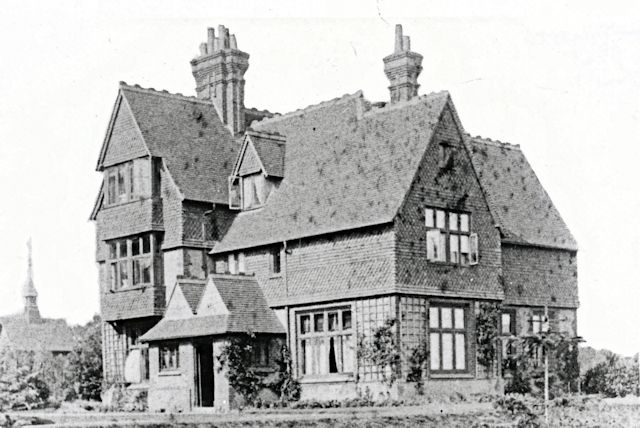 Christ Church Vicarage c.1880s
Image courtesy of Bourne Hall Museum