
Epsom Hospital Cluster – Introduction
 Edvard Munch’s The Scream
This page covers the general development of the five mental hospitals that made up the Epsom Hospital Cluster and the services and facilities they needed. We have created a page on the history of each hospital
And a page on The Patients and their treatments.
However, if you are just looking for more specific information on the hospital records please see the following research guides:
You may also like to see our Horton Cemetery and the Horton Cemetery Burial Registers pages.
Part 1 – General Background
In 1807, when the population of England and Wales was 9,690,000, there were 2,248 people classed as insane; by 1909 the population was 35 million and the number of insane 128,200. Put another way, in 1807 there was one insane person for every four thousand of population and in 1907 the number had risen to more than 14 for every four thousand!
The London County Council (LCC) was formed in 1888 and part of its responsibilities was the care of the mentally ill. From the start it was clear that their current asylums could not cope with the demand for beds. If they didn’t build new asylums they would have to continue shipping new patients to other parts of the country to be looked after in commercial establishments at two to three times the cost of an in-house solution. A major expansion was needed.
By the late 1880s mental health treatment had moved away from just tying up the insane out of sight of society; by then few were left half-starved to wallow in their own excretions on straw-strewn floors in unheated and poorly ventilated rooms. The relevant LCC committee wanted the sick to benefit from peace and quiet in airy grounds away from the hustle and bustle of the Capital. Of course, the cost of building and running establishments had to be taken into account so they decided to buy parcels of cheap farmland located outside, but within easy reach of, their area. Savings could also be made if the asylums could share common facilities, such as sewerage, and were of a functional, efficient and hygienic design. By making use of patient labour the asylums could become almost self-sufficient in food and give some of the patients occupational therapy. Patient labour continued until the 1960s.
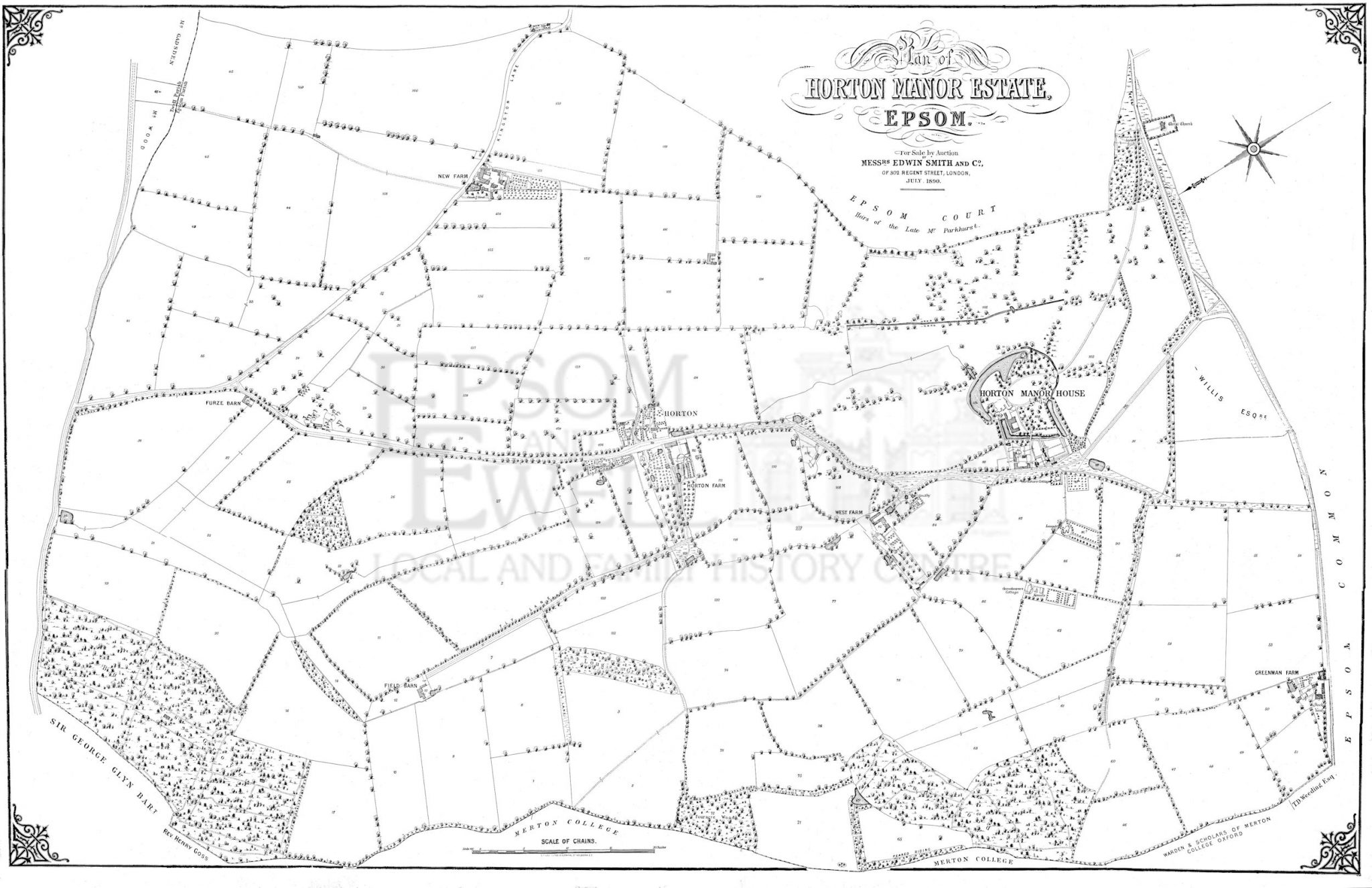 Plan of the Horton Estate July 1890 (shortly before the estate was purchased by the LCC)
Click image to enlarge but please do not copy
Image courtesy of Epsom and Ewell Local and Family History Centre ©2014
In 1896 the LCC bought a rundown estate called Horton Manor from Sir Thomas Buxton for £35,900 (say about £35m at 2012 prices). The Estate was 15 miles from the centre of London, covered 1060 acres of land and had a Mansion House, offices, gardens and grounds, woods, four farms together with land set aside for arable and pasture. The original plan was to build six large hospitals, each to hold two thousand patients. These twelve thousand inmates plus many hundreds of nursing, auxiliary, domestic and maintenance staff totalled more than the whole population of the local town of Epsom which in 1896 only had about nine thousand residents. Someone has rightly said that this was health care on an industrial scale. Over the next 30 years only 5 hospitals were built but the estate still became the world’s largest cluster of hospitals for the mentally ill. Initially the hospitals were used as follows:
- Horton Hospital catered for all stages of nervous and mental disorder.
- Long Grove Hospital catered for all stages of nervous and mental disorder.
- Manor Hospital mainly catered for people with learning difficulties and aimed at providing them with life skills. From 1948 the hospital concentrated on the training and behaviour modification of disturbed adolescents and young adults and gained an international reputation in the field of industrial and behaviour therapy.
- St Ebba’s initially catered for epileptics and children. From 1918 to January 1927 the institution served as a war hospital and treatment centre for ex-servicemen suffering from neurasthenia (a set of psychological and physical symptoms caused by injury or neurosis). On return to normal duties the hospital’s villa wards were well suited to handling voluntary patients who needed short term treatment (up to two years) without the usual stigma of a long stay in an old fashioned mental institution. After the Second World War it also cared for adolescents in a special unit. From 1962 it became a hospital for people with learning difficulties.
- West Park Hospital catered for all stages of nervous and mental disorder.
Embed from Getty Images
1907: A group of patients from the Horton Asylum in Epsom.
Photo by Topical Press Agency/Getty Images
The hospital cluster needed all the usual utilities and infrastructure that a new small town required and over time on-site facilities were to include:
- A number of separate villas used by parole inmates (as halfway houses for recovered/recovering patients)
- Acute hospital block (for inmates with acute surgical and medical needs)
- An un-consecrated burial ground (Horton Cemetery)
- Bakeries
- Cafeterias
- Central Boiler House (1960)
- Central Station for the supply of water, gas and electricity
- Chapels
- Cobblers’ Workshop
- Convalescence blocks
- Engineers’ Offices
- Farms
- Isolation Hospital
- Kitchen Stores
- Kitchens
- Laboratory
- Laundries
- Main Stores
- Maintenance Workshops
- Market gardens
- Mortuary
- Needlework Workshops
- Occupational Rooms
- Pharmacy
- Recreation Halls / Theatre
- Recreational Rooms
- Sanatoria
- Shops
- Staff accommodation (both in blocks and separate villas)
- Staff Rooms
- Tailoring Workshops
- Treatment Rooms
- Upholsterers’ Workshops
- Visiting Rooms
 The cobblers’ workshop in Horton. Date not known
Image courtesy of Eric Hill ©2014
Clean water was supplied from a 400-foot borehole (steel-lined to stop contamination) within the grounds, pumped via a Central Station built for water, gas and electricity supply. A sewerage system was installed and linked to the public system. Although gas was also laid on, the main heating was from coal-fired boiler houses. The 1930s saw the direct current electrical generators in the Central Station dismantled and all the hospitals in the cluster connected to the alternating current of the National Grid. In 1960 a Central Boiler House was opened on the site of the old Central Station to supply high-pressure steam to all the hospitals for heating.
 The former Power Station, now a Fitness Centre;
note the use of indigenous yellow Horton Bricks
Image courtesy of Nick Winfield ©2014
The narrow local roads were not built for such an influx of people, quickly becoming overcrowded, and the increased traffic during the early building phase caused ceilings to fall down and cracks to develop in roads and house walls. Much to the disgust of local ratepayers a special 6d in the pound local rate (2.5%) was levied to help pay for road improvements.
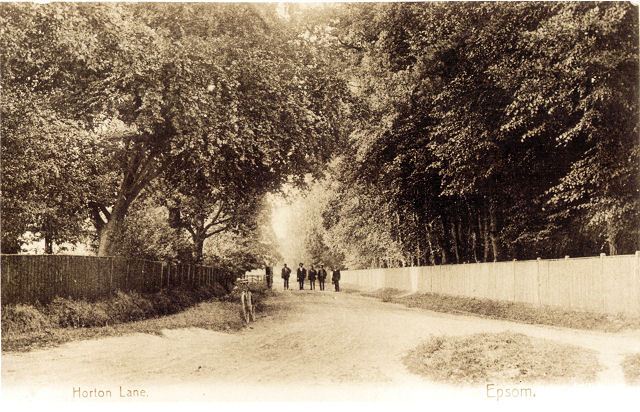 Horton Lane, Epsom c.1900
Image courtesy of Epsom & Ewell Local And Family History Centre
Aware of the numerous transport problems the previous contractors had experienced moving building materials on the narrow local roads, the builders of Long Grove applied for and were given a licence to lay a light railway. The route chosen for the single track meant crossing a bridle way and Hook Road, so complicated negotiations took place between London County, Epsom Rural District, Epsom Urban District and Ewell Parish Councils. The first locomotive was a 0-6-0 K Class saddle tank engine called Hollymoor built by Manning Wardle with the official date of completion given as 8 June 1905. It carted a load of bricks and cement from the sidings of the London South Western Railway at West Ewell to the building site where the material was off-loaded. A network of tramlines was then used to ferry the building supplies around the site. It was not long before Hollymoor was supplemented by an unamed 0-4-0 M4 saddle tank built by Peckett & Sons. Link to Railways Serving The Epsom Hospital Cluster.
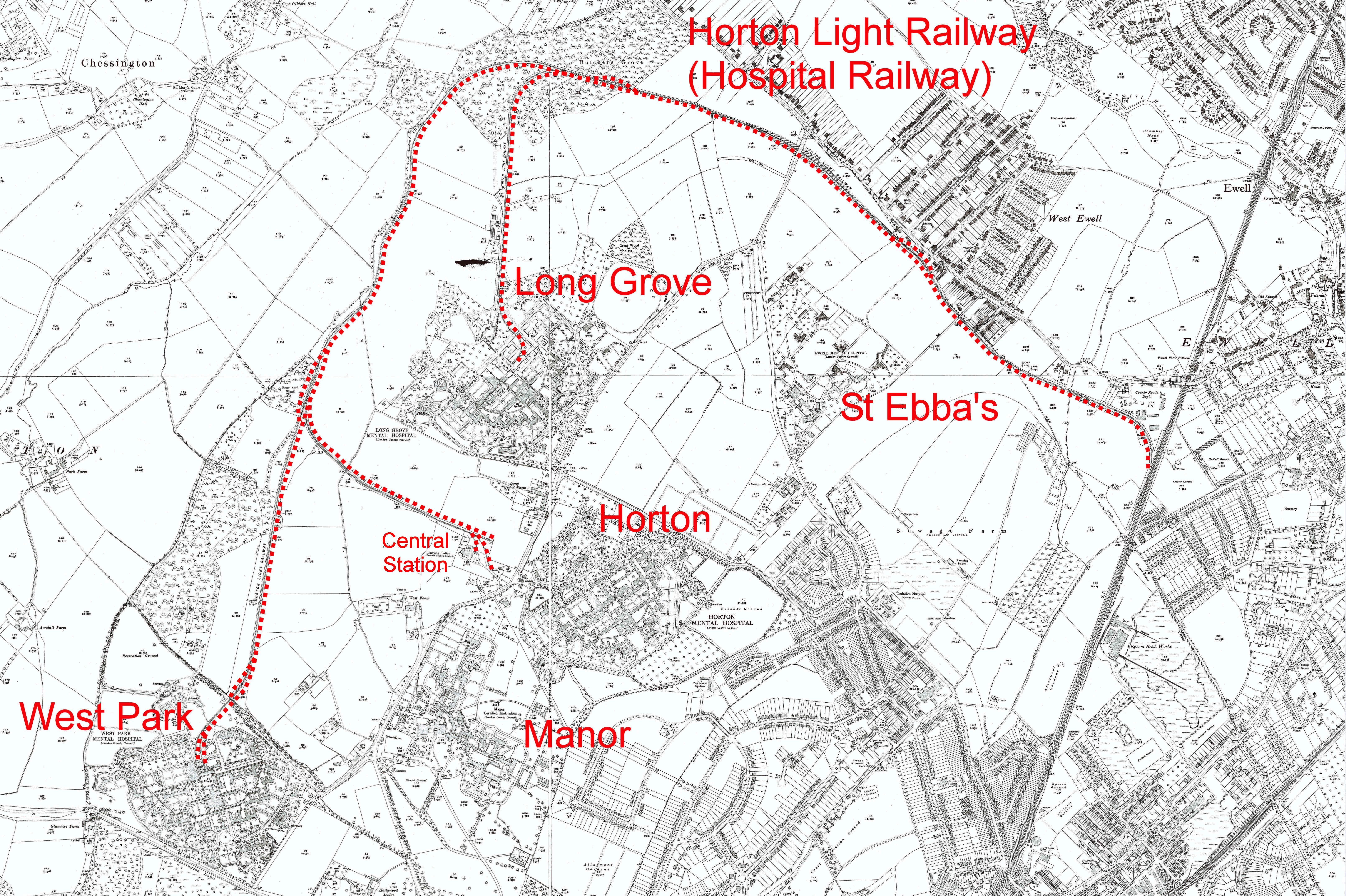 Composite 1930s OS Map showing the five Hospitals, Central Station and the Horton Light Railway
Click image to enlarge
Locals apparently referred to one of the locomotives as ‘Puffing Billy’ – this was assumed in the past to be ‘Hollymoor’, but it is possible it could have referred to the unnamed Peckett Tank as the existence of this second locomotive has only recently been ascertained. A runner was employed as a look out and sat in the front wagon when the train was being propelled from the back. This system went wrong when Mary Tobin was knocked down and killed by a trainload of 12 wagons being propelled by the engine. Against regulations the crossing gates had been left open and, being at the back, the engine driver could not see the front of the train. Neither could the ‘runner’, who was on the fifth wagon, due to the first four being covered over. The driver sounded the whistle but Mary was aged 64 and a bit deaf. The inquest found the builders guilty of ‘sheer neglect’.
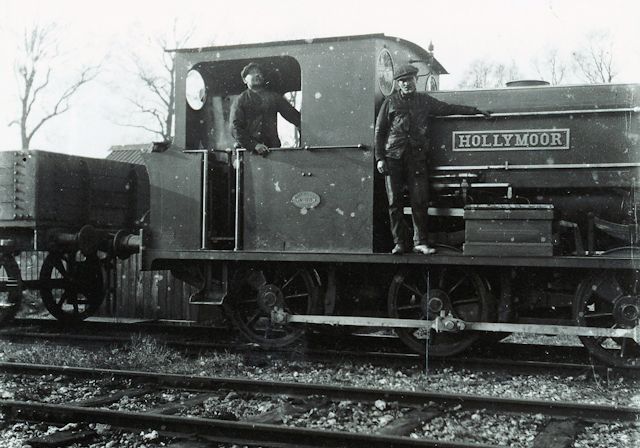 ‘Hollymoor’ at the Exchange Sidings, c1905
Image courtesy of Bourne Hall Museum
Despite this and another accident, caused by high winds blowing over a crane, which damaged one of the new buildings, the builders completed the building two months ahead of schedule. Hollymoor and the Peckett Tank were sold off and the LCC bought the railway line, subsequently purchasing another 0-4-0 Saddle Tank called ‘Crossness’. The line was extended to take building supplies to a new building site – to be called the West Park Asylum (Epsom Cluster No.5) – and to ferry about fifteen thousand tons of coal to the Central Station each year. In 1935 ‘Crossness’ was replaced by on 0-6-0 Saddle Tank called ‘Hendon’. In March 1947 a 0-4-0 Saddle tank engine from Robert Stephenson & Hawthorns Ltd, called Sherwood, replaced Hendon but was not a great success. Trains ran on the line till January 1950 when it was closed, dismantled and sold off to Nigeria.
Work on West Park Asylum was halted because of the outbreak of the First World War when the Canadian Military took over the buildings that had been completed. It was not fully completed until 1921. Both Horton Asylum and Manor Asylum were taken over from 1915 to 1918 for use as military hospitals called Horton (County of London) War Hospital and Manor (County of London) War Hospital. With much overcrowding the existing patients were shoehorned into other establishments at short notice.
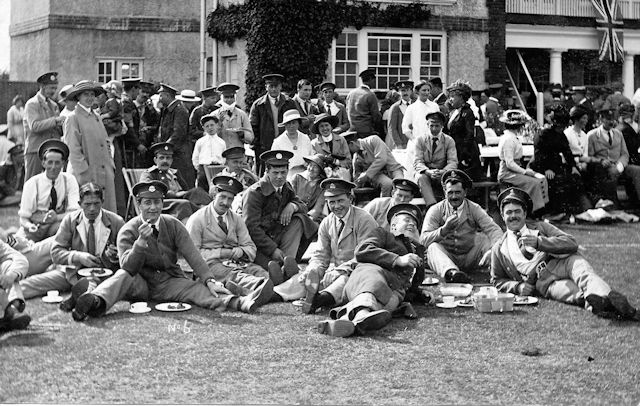 Postcard view of patients relaxing outside Horton (County of London) War Hospital. Date not known.
Image courtesy of Bourne Hall Museum
After the end of the First World War both hospitals reverted to treating the mentally ill but with new names – Horton Hospital and The Manor Certified Institution, the latter eventually becoming The Manor Hospital with (in 1960) one thousand two hundred beds.
The outbreak of the Second World War saw Horton taken over by the Military as Horton War Hospital. Again existing patients were crammed into other establishments at short notice – for example, Horton moved 400 patients to West Park in just 2 days! The hospital cluster needed all the trappings of war with air raid shelters, blackout regulations, extra fire drills and fire precautions such as extra sand and water buckets and the inevitable Stirrup pump. To cope with the patients from other hospitals some rooms and buildings changed function – for example,one of the West Park Sanatoria became a casualty station and another a ration store. One only has to think of the problems fitting gas masks to uncooperative patients whilst wearing a mask oneself to realise the extra burden the nursing staff had to cope with. Apart from having to cope with extra patients, the cluster also had to accommodate other departments – for example, the central pathology lab was transferred from the Maudsley Hospital in South London to a ward in West Park and parts of the central LCC Hospitals administration was also moved out of war-damaged London to the relative safety of Epsom. The cluster did not escape bomb damage and suffered from incendiaries as well as a high explosive bomb and even a flying bomb. It returned to its usual work in 1949 as Horton Hospital with about one thousand beds.
Hospital Farms
To supply the hospitals with garden produce, five farms were established, each called after the hospital it was supporting. Patients worked the farms under the supervision of an experienced farm manager.
 Horton Land Girls and some male colleagues c.1948
Image courtesy of Mrs N Pattison © 2014
From the start each Hospital had its own Medical Superintendent. Not a bad job as he (they were all male) was paid around 1000 guineas (£1050 or about £377k at 2012 values) a year plus free food, accommodation, coal and domestic help provided by inmates. By contrast, a matron in the early 1900s was only paid 90 guineas (£94.50 or about £34k at 2012 values) per year.
The closure of the hospitals was as a result of the care in the community policy of the 1990s:
- Horton Hospital closed in 1997; provision for some 60 former patients was made in Horton Haven, but the rest of the site has been developed into 460 private homes, in a mixture of houses and flats, called ‘Livingston Park’.
- Long Grove Hospital closed in 1992 and by 2002 had become the ‘Clarendon Park’ housing development.
- Manor Hospital made provision for some former patients in Ethel Bailey Close but the rest of the site has been developed into 340 private homes, in a mixture of houses and flats.
- St Ebba’s has been converted into a complex of old and new buildings housing about 60 patients. The rest of the site has been sold and developed into 280 private homes, in a mixture of houses and flats.
- West Park Hospital closed down progressively from 2005.
 Demolition of Napier and Nelson Wards, Long Grove Hospital. 1998
Image courtesy of Epsom and Ewell Local and Family History Centre ©2014
Main Sources
- Asylum, Hospital, Haven – A history of Horton Hospital by Ruth Valentine ISBN 0 95283006 0 4 published by the Riverside Mental Health Trust
- The Colonisation of Epsom – The building of the Epsom Cluster by the London County Council in its historical context. A paper by DA Cochrane for the Planning Division, South West Thames Regional Health Authority
- West Park Hospital – The First Sixty Years by Bryan C T Johnson F.H.A. published by the West Park Hospital Management Committee
- West Park History – an undated internal memo of Mid Surrey Health Authority
- Andrew Roberts’ The asylums index website (now defunct)
- Pete Cracknell’s County Asylums website (now defunct)
- Gordon K Tozer and Steve M’s UK asylums website (now defunct)
- Simon Cornwell’s Urbex website
- The Industrial Railway Society website
Original research and text by Peter Reed with some additions
to the sections concerning ‘The Patients’ by Linda Jackson © March 2014
Some extracts from the official reports on the early years of Horton Hospital can be read here Horton – Down the Years .
Please continue reading this article in part 2: Hospital Cluster – The Patients
Links to related pages on this website:
Horton Cluster – Introduction
Horton Cluster – Manor Hospital
Horton Cluster – Horton Hospital
Horton Cluster – St Ebba’s Hospital
Horton Cluster – Long Grove Hospital
Horton Cluster – West Park Hospital
Horton Cemetery (History)
The burial records are split into 26 parts: A B C D E F G H I J K L M N O P Q R S T U V W X Y Z
Railways Serving The Epsom Hospital Cluster
Other pages that you may be interested in:
Electrotherapy at Horton (County of London) War Hospital, Epsom, in WWI.
The Long Grove Psychiatrists Of 1911
Malaria Laboratory (1925-1975) – The Mott Clinic
Ogilvy, Dr David / Smith, Pollie Eaton
External Links (open in a new window)
Lost Hospitals of London
County Asylums
Index of English and Welsh Lunatic Asylums and Mental Hospitals
Industrial Railway Society
Exploring Surreys Past
Surrey History Centre
Hospital Records Database (Find out which archive holds which records)