
Epsom’s Horse Graves
Part 1: Lord Rosebery’s Derby winners
Epsom’s long history makes it unsurprising that the town has a good number of structures that, because of their importance for the national heritage, have been listed by Historic England. One of the town’s more unusual listings is the three horse graves on the old Durdans estate. The estate was broken up in the 1970s, and the graves are in a clearing in the woods which became part of the separate Durdans Stables. This is private land, and I am grateful for the owner’s permission to visit and photograph these graves and the others that are covered in Part 2 below.
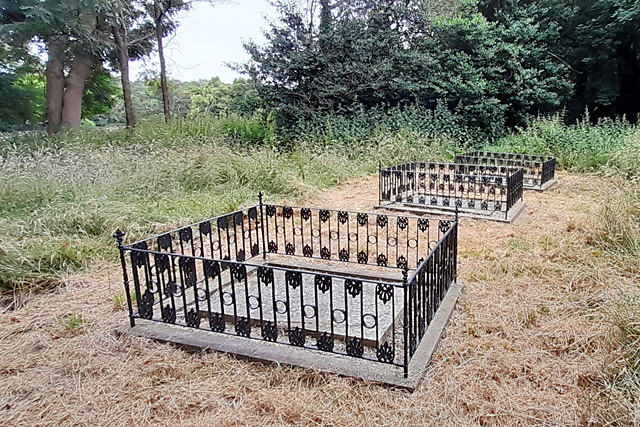
The three listed horse graves.
Photograph by Roger Morgan © 2024
The three graves were listed in January 1974, with the following details: ‘Three stone slabs surrounded by ornamental iron railings. Incised with horses’ names, viz:– Ladas (1891–1914) (Derby winner), Sir Visto (1892–1914) (winner of both Derby and St Leger), Cicero (1902–1922) (Derby winner). All three horses belonged to Lord Rosebery’. (The stones are now so weathered that it’s impossible to take a useful photograph of the inscriptions).
Lord Rosebery had an intense interest in horse racing. As a young man, winning the Derby was one of his three great ambitions –achieved in 1894, with repeats in both 1895 and 1905. The other two ambitions were to marry an heiress (achieved in 1878 by marrying Hannah de Rothschild, sole heir to her father’s enormous fortune) and to be Prime Minister (achieved in 1894–5).
Ladas (1891–1914).
The winner of the 1894 Derby was not the first Ladas. The original horse of that name was owned by Lord Rosebery’s father, the 4th Earl of Rosebery, who entered him for the 1869 Derby. This was while our Rosebery (to be the 5th Earl) was at university, and he tipped the horse to his fellow under-graduates. Mortified when Ladas came last – in a field of 22 – he told his friends that, if he ever had a horse with a prime chance of winning the Derby, he would name him Ladas so that they could all take the tip and place a better bet.
The second Ladas was bred by Lord Rosebery at the Crafton Stud (on the former Rothschild Mentmore estate inherited by his wife, who had died, aged only 39, in 1890). As a two-year-old in 1893, Ladas II made a successful Epsom debut in the Woodcote Stakes at the Derby meeting, and was unbeaten in his three other races that year.
As a three-year-old in 1894, Ladas II won the 2000 Guineas and Newmarket Stakes with ease and started the Derby as the clear favourite (with record low odds of 2/9). To Lord Rosebery’s intense joy, Ladas II won the race by a length and a half.
 1895 Derby winner, Ladas II, with (from left to right) trainer Mat Dawson, Lord Rosebery,
an un-named stable lad and jockey Jack Watts.
Public Domain image.
Lord Rosebery (now three months into his short term as Prime Minister) shared his joy with the town: about a month after the win, some 800 local people were invited to the Durdans for tea. As a benefactor of the Epsom Workhouse, Lord Rosebery arranged a party for the inmates with a meal of roast beef and plum pudding, plus fruit, tobacco and snuff and entertainment by two bands, a Punch and Judy Show, and dancing. He also presented the workhouse with a piano.
One of Lord Rosebery’s changes to the Durdans was a new carriage drive from Ashley Road, the entry to which he named the Ladas Gate. The win was also marked by the name of the pub on the corner of Chalk Land and Woodcote Road being changed from The Fox to The Ladas. (The pub closed in the early 2000s and has been converted into apartments).
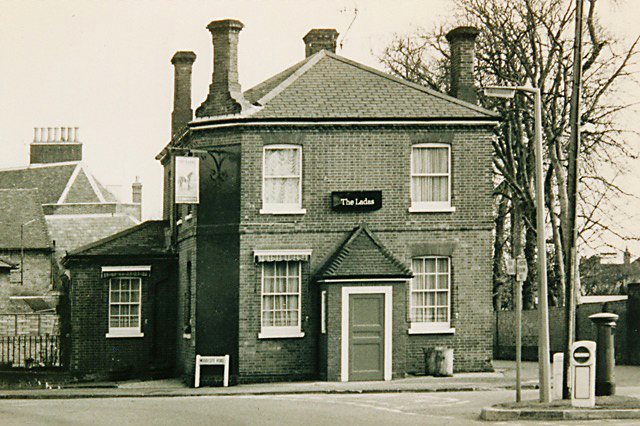 The Ladas Pub (when Chalk Lane was still two-way).
Image courtesy of Bourne Hall Museum.
While Ladas II did not win his next two races, he was placed. Hopes were thus high for the St Leger (the third leg, after the 2000 Guineas and Derby, of the English Triple Crown). While Ladas started the St Leger as the favourite, with odds of 10/11, he came second, beaten by three quarters of a length.
In 1895 (his four-year-old season), Ladas II was dogged by training problems and finished fourth in his first race that year. Lord Rosebery retired the horse to stud at Mentmore where he sired the winners of 196 races (including the Classic winners Gorgos and Troutbeck). Having become increasingly bad-tempered, Ladas II was retired from stud duties in 1912. He died at Mentmore in 1914 and was brought back to the Durdans for burial.
Sir Visto (1892–1914)
Sir Visto was also bred by Lord Rosebery at the Crafton Stud. He was a year younger than Ladas II and, like him, had his debut in the Woodcote Stakes. (This was at the 1894 summer meeting, the year that Ladas II won the Derby). Unlike Ladas II the previous year, Sir Visto put in a lacklustre performance and was unplaced. During four months off the course, Sir Visto made good progress in training and returned to the track with a good win in Kempton’s Imperial Produce Stakes.
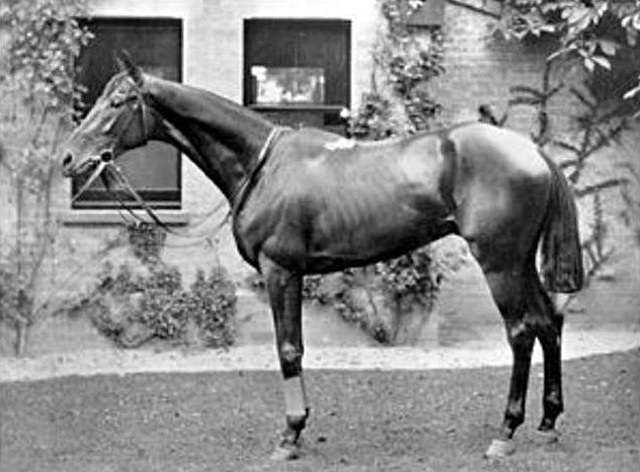 Sir Visto.
Public Domain.
Before the 1895 season began, Sir Visto was seen as one of the most-fancied Derby contenders. While that promise took a bit of a knock when he finished third in his first two races of the year (the 2000 Guineas and the Newmarket Stakes), Lord Rosebery and others saw him as a stayer and thought he would be well suited to the Derby course.
The 1895 Derby was run on 29 May. The fancied Sir Visto started with odds of 9/1 at the back of the 15 runners but slowly progressed through the field, taking the lead some fifty yards from the finishing line. He won by three-quarters of a length to give a jubilant Lord Rosebery (now nearing the end of his short term as Prime Minister) a repeat of his previous year’s Derby success. The 1895 Derby is understood to be the first ever filmed – see the last 25 seconds of the BFI’s restoration of the 44 second clip, of which the image below is a screenshot.
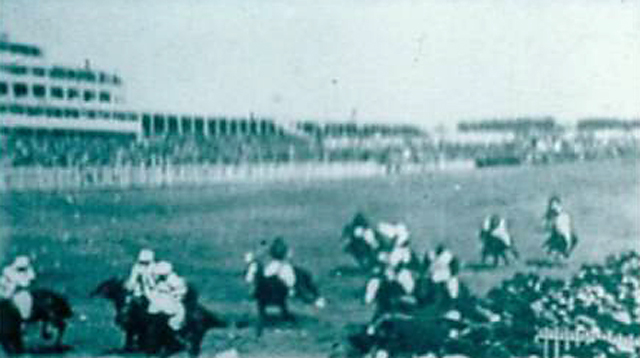 A screenshot from the film of the 1895 Derby. Sir Visto is bottom left.
Public Domain via BFI Player, CC0, via Wikimedia Commons

As with the previous year’s win by Ladas II, Lord Rosebery laid on a celebratory feast for inmates of the Workhouse, which he also attended, noting that, whatever their differences were in social standing, they should all try to rejoice as brothers.
For September’s St Leger, Sir Visto started as the 9/4 favourite. As for the Derby, he had to make his way up from the rear of the field, but took the lead a furlong out and won the race by three-quarters of a length.
That was the last race Sir Visto ever won. After an undistinguished season as a four year old, the horse was retired to stud, back at Mentmore. Unlike Ladas II, he made no impact as a sire and was retired to stables at the Durdans, where he was euthanised in 1914 – the same year that Ladas II died – and the two horses were buried side by side.
Cicero (1902–1922)
Cicero was (to summarise our article at this link) bred by Lord Rosebery at the Durdans, foaling in 1902. He was sent for training to Newmarket and showed great promise. As a two-year-old in 1904, he won all five of his races – and might have won more if his season had not been cut short due to an injury. Having recovered from that, Cicero started the 1905 Derby as the 4/11 favourite and, in a hard-fought race, won by three quarters of a length in a new race record time of 2:39.6.
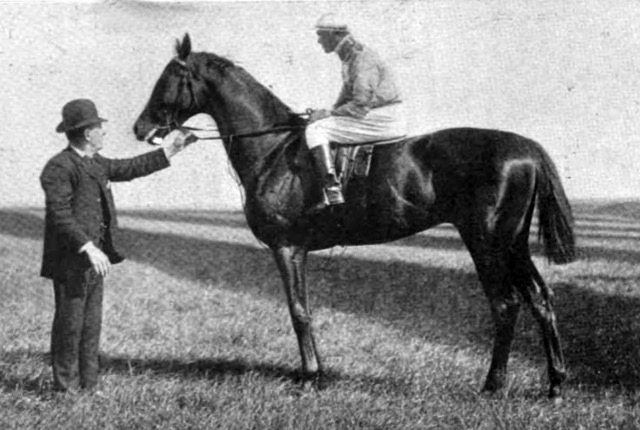 Cicero.
Public Domain
Having now won three Derbys, Lord Rosebery celebrated in extravagant style. Over 2,000 local people were invited to the Durdans to hear three bands, play sports and, in the evening, watch the fireworks. Lord Rosebery also provided yet another feast for inmates of the Epsom Workhouse. As a permanent memorial, Lord Rosebery installed a horse trough – simply inscribed CICERO – on the Chalk Lane boundary of the Durdans.
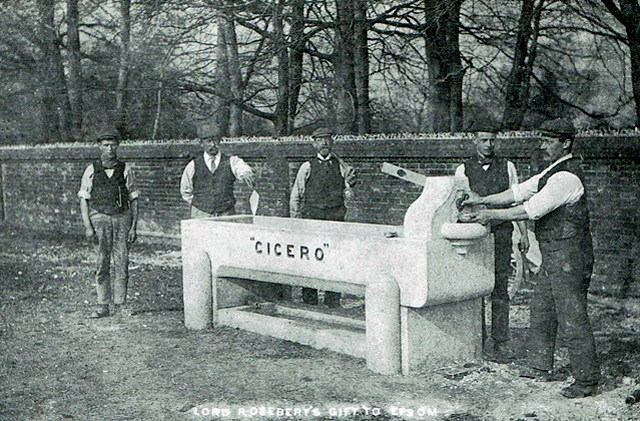 The newly-installed Cicero horse trough.
Image courtesy of Bourne Hall Museum
As seen below, this has since been moved up to the Downs, outside the Rubbing House – and within sight of Epsom’s finishing post.
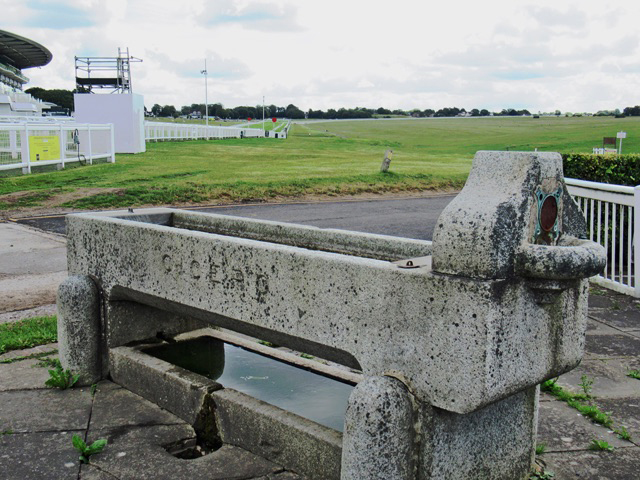 The repositioned Cicero horse trough.
Photograph by Roger Morgan © 2024
Cicero sought to continue his unbeaten record in Sandown’s Eclipse Stakes, but lost by half a length. He then developed leg problems and did not race again until 1906 when, in his first race as a four year old, he won the Biennial Stakes at Newmarket. He was then entered for the Ascot Gold Cup in which he started as second favourite. However, he faded badly and was unplaced. On the advice of his trainer, he was retired to stud at Mentmore, where he was a modest success as a sire. On retirement from that in 1923, he was moved back to his birthplace at the Durdans. Shortly after this, Cicero fell in his stall and, in struggling to get up, suffered an intestinal rupture. He was euthanised and buried alongside Ladas and Sir Visto.
It is understood that Lord Rosebery (who died at the Durdans in 1929) would often visit the clearing in which the now three graves were situated to sit and reflect on these horses’ past glories and his Derby hat-trick.
Race days and Constables Yard
A key factor in Lord Rosebery’s purchase of the Durdans in 1874 was its proximity to Epsom Racecourse. (The house became his favourite residence). For Epsom race days, he would often entertain a number of guests and, for pre-race entertainment, liked to show off the horses he was to run before they were taken to the course. He did this in Constables Yard, to the side of the Durdans’ main courtyard, at the back of which was a building with a couple of holding stalls. Such was Lord Rosebery’s joy at his three Derby winners that he had their names listed on the stall that had held them on those occasions.
 Left: The stall that held Lord Rosebery’s Derby winners before the race.
Right: The stable block in Constables Yard at the Durdans. (The stall is behind the window on the left).
Photographs by Roger Morgan © 2024
Lord Rosebery named the originally gated yard after his favourite jockey, Henry Constable. To summarise our article at this link, Henry was born in 1854 and, as a young man, moved to Epsom as an apprentice to William Reeves, a highly respected jockey and horse trainer who trained for Lord Rosebery. Henry was a natural, winning many races over his all too short career. A good number of these (but not his 1878 Derby win on Sefton), were for Lord Rosebery: indeed, Henry became His Lordship’s favourite jockey.
Henry died in 1881 (of consumption – as TB was known in those days), aged only 26. Lord Rosebery provided him with a magnificently ornamented grave in Epsom Cemetery (discreetly noted as ‘erected by his friend and employer, Archibald, Lord Rosebery’). Having Constables Yard at the Durdans provided another memorial, this time literally on Lord Rosebery’s doorstep.
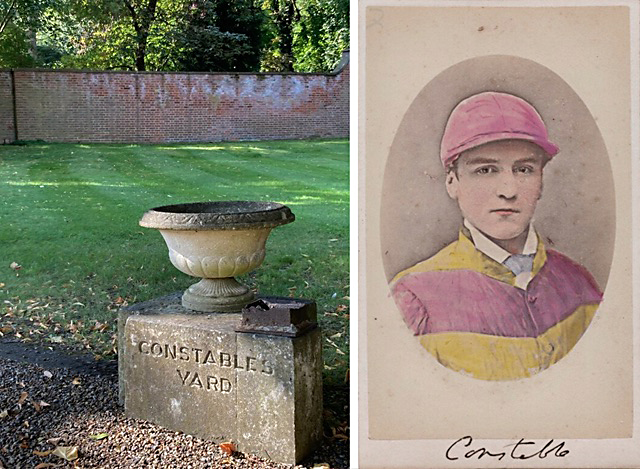 Left: Part of Constables Yard with, in the foreground, the name from a now-lost gate pillar.
Photograph by Andreas von Einsiedel © 2024
Right: Henry Constable (in Lord Rosebery’s colours).
Hand-coloured albumen carte-de-visite, 1874 by Eugenio Martinucci, for Lombardi & Co, published by W A Wright.
Image (NPG Ax199170) with thanks to the National Portrait Gallery, CC BY-NC-ND 3.0
CLICK HERE Part 2 deals with three more horse graves at the Durdans.