
Some Derby trivia
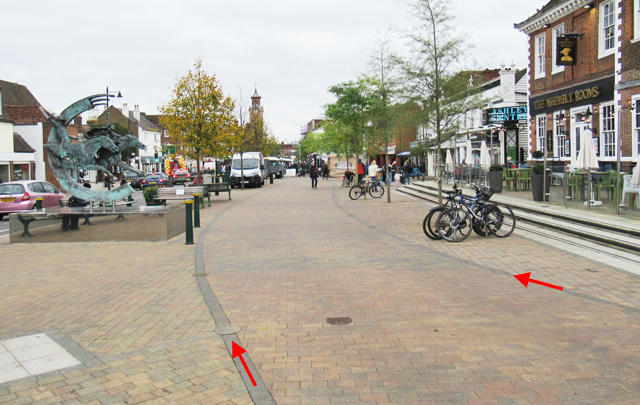 Epsom’s Market Place showing the “Evocation of Speed” and (arrowed) the associated brass plaques.
Photograph by Roger Morgan © 2022
A couple of years ago, I wrote about the 2002 “Evocation of Speed” sculpture that was moved to Epsom’s Market Place as part of the early 2020’s revamp of the pedestrianised area. I noted that this was complemented by an avenue of brass plaques celebrating a number of significant Derbys over the years – not least the winners in 1780 (Diomed) and 2001 (Galileo) as featured in the sculpture.
 The Market Place plaques about Diomed and Galileo.
Photograph by Roger Morgan © 2022
I didn’t give any details of the other 16 plaques. That is remedied here with the emboldened transcriptions of all 18 plaques below. Each is followed by some further background in the indented sections – all, I feel, providing an interesting selection of Derby trivia.
1779 / A toss of a coin between Edward Smith-Stanley, 12th Earl of Derby (later Lord Derby), and Sir Charles Bunbury gives the name to a new race at Epsom, the Derby.
The coin toss was at a dinner party, hosted by the Earl of Derby at his Oaks estate in Carshalton, to celebrate his win (with his horse Bridget) in the first ever Oaks (named for the Earl’s estate) – for 3 year old fillies – that he and his friends had begun to set up in 1778. The Earl and his guests proposed a new race for 3 year old colts and fillies. The Earl and Sir Charles Bunbury (6th Baronet) – both now seen as crucial figures in the history of horse racing – tossed for the honour of naming the new race, and the Earl won to give us “The Derby”. Both races are among the five British Classics (all for 3 year olds). The others are Doncaster’s St Leger – first run in 1776 – and Newmarket’s 2,000 Guineas and 1,000 Guineas (the latter, like The Oaks, limited to fillies) – first run in 1809 and 1814 respectively.
1780 / Horse: Diomed / Jockey: Sam Arnull / Winner of the first Derby.
Diomed is featured on “The Evocation of Speed”, alongside the 2001 winner, Galileo. His owner was Sir Charles Bunbury, with the win perhaps being some compensation for having lost the 1779 coin toss with the Earl of Derby. Sir Charles also had the winning horse in the 1801 Derby – meriting its own plaque in this series – and in 1813, with Smolensko ridden by Tom Goodison.
1788 / Horse: Sir Thomas / Jockey: William South / The first horse owned by a member of the British Royal Family (George Augustus Frederick, Prince of Wales) to win the Derby.
This was the only Derby winner for the Prince (later George IV).
The only British monarch to have a Derby winner was King Edward VII in 1909 with Minoru ridden by Herbert Jones. That was actually his third Derby winner as he had two when Prince of Wales: in 1896 with Persimmon ridden by John Watts (a win meriting its own plaque in this series) and in 1900 with Diamond Jubilee (born in 1897 and, obviously, named for Queen Victoria’s Diamond Jubilee that year), again ridden by Herbert Jones.
(Queen Elizabeth II came very close to having a Derby winner in 2011 when her horse – Carlton House, ridden by Ryan Moore – started as the 5/2 favourite. Sadly, the colt lost a shoe and finished third.)
1801 / Horse: Eleanor / Jockey: John Saunders / The first filly to win the Derby.
The same horse and jockey also won that year’s Oaks. The owner was Sir Charles Bunbury, the loser of the 1779 coin toss.
1853 / Horse: West Australian / Jockey: Frank Butler / The first Triple Crown Winner.
The English Triple Crown is assigned to the horse that, in one season, wins the 2,000 Guineas (run at Newmarket), Epsom’s Derby and the Saint Leger (run at Doncaster).
1886 / Horse: Ormonde / Jockey: Fred Archer / English Triple Crown winner, retired undefeated.
Ormonde was the fourth winner of the Triple Crown. His string of 16 wins led to his being labelled the “horse of the century” at the time. It has been suggested that Conan Doyle took Ormonde as the model for Silver Blaze in the 1892 Sherlock Holmes short story “The Adventure of Silver Blaze”. In 1897, Ormonde was taken to London to be the guest of honour at a Mayfair garden party celebrating Queen Victoria’s Diamond Jubilee.
1894 / Horse: Ladas / Jockey: John Watts / Shortest odds winner at 2/9.
The owner was Lord Rosebery, and this win achieved one of his great ambitions which he marked by erecting the “Ladas Gates” at the Ashley Road entrance to his Durdans estate. The Derby win was Ladas’s third as a 3 year old, and the record short odds reflected the horse’s very easy win in the Newmarket Stakes only a fortnight previously.
1896 / Horse: Persimmon / Jockey: John Watts / Notable winer: 7 out of 9 races.
The owner was Edward, Prince of Wales, (as noted in connection with the 1788 plaque) who had also bred the horse. Persimmon was highly strung and had made a poor start to the season. He was nearly withdrawn from the Derby – which he then nearly didn’t make thanks to lengthy refusal to board the train for Epsom. Incidentally, the 1896 Derby was one of the first horse races ever filmed – see this link.
1905 / Horse: Cicero / Jockey: Danny Maher / Derby winning record time of 2 minutes 39.5 seconds.
Cicero was Lord Rosebery’s third Derby winner: following his 1894 win with Ladas noted above, he won in 1895 with Sir Visto ridden by Sam Loates. All three horses were eventually buried at The Durdans, where they joined Amato, winner of the 1838 Derby who belonged to the former owner of the Durdans, Sir Gilbert Heathcote.
1933 / Horse: Hyperion / Jockey: Tommy Weston / The most successful British bred sire of the 20th century.
Hyperion also won that year’s St Leger, but his racing career was as nothing to his success as a sire. He was retired to stud in 1935 and, in the 25 years until his death in 1960, sired the winners of 752 races. In six of those years, he was named “the leading sire in Great Britain and Ireland”, being the one whose offspring won the most prize money in those countries during the flat racing season.
1935 / Horse: Bahram / Jockey: Freddie Fox / Triple Crown winner and undefeated in 9 races between 1934 and 1935.
The horse was bred and owned by HH Aga Khan III, who named the colt in honour of his cousin who had been killed when the cross-Channel ferry, SS Sussex, was torpedoed during WW1. This 1935 success was the Aga Khan’s second of a record-equalling five Derby wins.
1954 / Jockey: Lester Piggot / Horse: Never Say Die / Piggot wins his first Derby aged 18. He would go on to win 9 Derbys.
Over his long and highly successful career, Lester Piggott also rode the winners in six Oaks and an unprecedented nine Coronation Cups (a race for horses of 4 or more years, instituted at Epsom in 1902 to mark the Coronation of Edward VII).
1965 / Horse: Sea-Bird / Jockey: Pat Glannon / Trained by Etienne Pollet at Chantilly, Epsom and Ewell’s twin town, and winner of the Prix de l’Arc de Triumph and Derby in the same year.
This French horse won all his five starts in 1965. Of his Derby victory, Timeform commented: “Sea-Bird’s performance at Epsom had to be seen to believed. He beat his twenty-one opponents without coming off the bit.”
1970 / Horse: Nijinsky/ Jockey: Lester Piggott / Lester Piggott and Nijinsky clinch the third leg of the Triple Crown at Doncaster.
The now-legendary Nijinsky nearly did not start in the Derby, but recovered from a bout of colic just in time. Indeed, his winning time of 2 minutes 34.68 seconds was the fastest since 1936. His Triple Crown was the first since Bahram in 1935. Nijinsky was retired to stud in late 1970, where he proved an excellent sire. His offspring included three Derby winners: Golden Fleece in 1982; Shahrastani in 1986; and Lammtara in 1995 – this last meriting its own plaque in this series.
1971 / Jockey: Geoff Lewis / Horse: Mill Reef / The first Epsom-based jockey to win the Derby.
In 1971, Geoff Lewis and Mill Reef also won the Eclipse Stakes at Sandown, the King George V1 and Queen Elizabeth Stakes at Ascot, the Eclipse Stakes at Sandown and the Prix de l’Arc de Triumph at Longchamp. (Geoff Lewis also won the 1971 Oaks, riding Altesse Royale.) After a successful career as a jockey, Geoff Lewis became a trainer at Third Acre Barn, just to the south of Epsom Racecourse. (More details of Geoff Lewis’s career can be found in Bill Eacott’s A-Z of Epsom Racehorse Trainers.)
1995 / Horse: Lammtara / Jockey: Walter Swinburne / Derby winning record time of 2 minutes 32.31 seconds.
This was Walter Swinburne’s third Derby win: he rode the legendary Shergar in 1981 and Shahrastani in 1986. Lammtara was, like Shahrastani, sired by the 1970 Derby winner, Nijinsky – and beat his record time by 1.37 seconds. (This new record was not beaten until 2010 when Workforce, ridden by Ryan Moore, won the Derby in 2 minutes 31.33 seconds.
1996 / Jockey: Alex Greaves / Horse: Portuguese Lil / The first female jockey to ride the Derby
Alex Greaves was not placed in this race, but was the first woman to win Group 1 race when she dead-heated in the 1997 Nunthorpe Stakes at York. Over her 15 year career, she rode some 300 winners.
2001 / Horse: Galileo / Jockey: Michael Kinane / Champion sire 11 times and has sired a record 5 Derby winners.
Galileo is featured on “The Evocation of Speed”, alongside Diomed, winner of the first Derby in 1780. During Galileo’s year-long racing career, he won six of his eight races, leading him to be named 2001’s Champion 3 year old Colt. He was retired to stud in late 2001 and became one of the most sought-after sires in the world. The 2001 Derby win was Michael Kinane’s second: he had won with Commander in Chief in 1993; and went on to win a third time in 2009 with Sea the Stars.
Roger Morgan © 2024