
Kenneth Wolstenholme DFC & Bar (1920–2002)
The Voice of English Football
Kenneth Wolstenholme – a resident of the Borough for many years – was one of the UK’s most iconic and celebrated football commentators of all time. His distinctive voice and passionate delivery captured the hearts of millions of listeners and viewers around the world. He was best known for his commentary on the 1966 World Cup final, when England defeated West Germany to win their first and only major international trophy.
Wolstenholme was born at Cavendish House, Cavendish Road, Worsley, near Manchester, on 17 July 1920, the son of Thomas Wolstenholme, a cotton merchant, and his wife, Euphemia, née Redgrave. He went to Cromwell Road council school, Swinton, before winning a scholarship to Farnworth grammar school, Bolton, in 1933. In 1937 he left school and studied typing and shorthand at Pitman College before joining the Manchester City News.
In June 1939 he joined the Royal Air Force Volunteer Reserve and during World War II he served as a bomber pilot in the RAF flying Bristol Blenheims. In May 1942 he was commissioned as a Pilot Officer and retrained on Mosquitoes. Later he was promoted Flight Lieutenant. By the age of 23 he had flown 100 missions and received the Distinguished Flying Cross and Bar. His last post in the RAF was in public relations. He was demobilized in April 1946.
Kenneth married Joan Brownhill the daughter of Albert Brownhill an advertising agent, of Eccles, Lancashire on 31 July 1944. They had two daughters.
After the war, he returned to journalism, working for the BBC making his his first televised football commentary in 1948. He quickly established himself as one of the BBC’s leading commentators, covering major matches such as FA Cup finals and England internationals.
By 1957, Kenneth, Joan and family were living at 75 Salisbury Road, Worcester Park. He and Joan remained in the Borough for over 40 years, living at various addresses in Ewell. At the time of Joan’s death in 1996, they were living in the modest bungalow at 21 The Mount, Ewell.
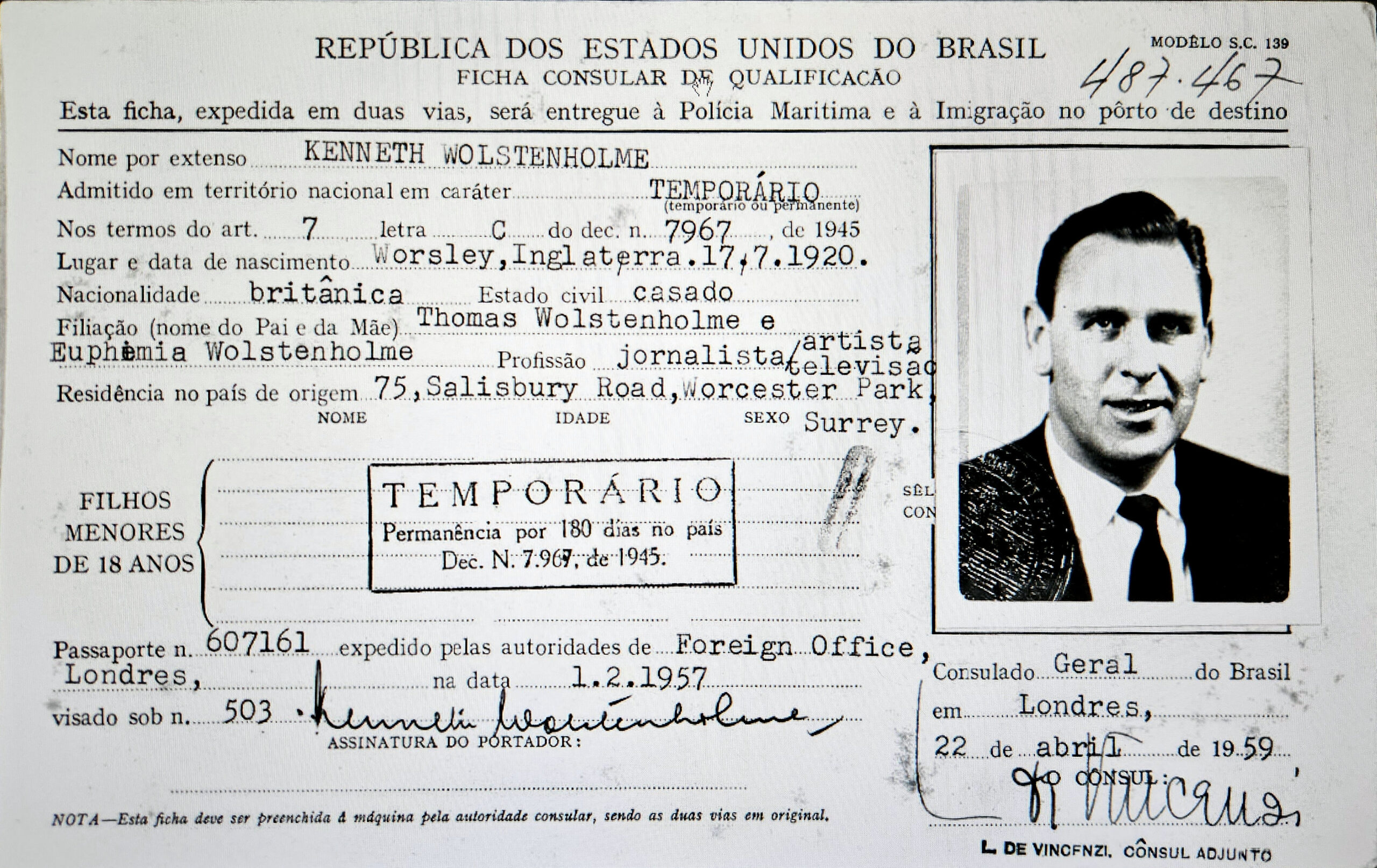 A 1959 Brazilian Immigration Card
In 1966, Wolstenholme was the BBC’s lead commentator for the World Cup, which was being held in England for the first time. He was in the broadcasting booth at Wembley Stadium on July 30, 1966, when England defeated West Germany 4-2 in the final.
Wolstenholme’s commentary on the final is now legendary. His most famous line came after Geoff Hurst scored England’s fourth goal in extra time. Wolstenholme cried: “Some people are on the pitch, they think it’s all over… it is now!”
Wolstenholme’s commentary captured the drama and excitement of the moment perfectly. His words became synonymous with England’s greatest sporting achievement.
After the 1966 World Cup, Wolstenholme continued to commentate on football for many years. He covered a further four World Cups, as well as numerous other major tournaments. He also became a popular television presenter, hosting shows such as Sportsnight and Match of the Day. However shortly after the 1970 World Cup the BBC replaced Kenneth in favour of David Coleman, leaving Kenneth feeling badly treated.
After leaving the BBC, Wolstenholme worked for British Caledonian and became secretary of the Anglo-American Sporting Club. He also worked for Tyne Tees television and Channel 4 and wrote many books. Kenneth retired from broadcasting in 1987 and his final years were spent living in Galmpton, near Brixham, Devon.
He died, aged 81, of kidney, liver, and heart failure on 25 March 2002 at Mount Stuart Nursing Home, Torquay and is interred at Randalls Park Cemetery and Crematorium, Leatherhead. He was survived by his daughter, Lena.
Wolstenholme is remembered as one of the greatest football commentators of all time. He was known for his elegant and articulate commentary style. He avoided the use of clichés and jargon, and instead focused on providing clear and informative descriptions of the action. He was also a shrewd analyst, and his insights into the game were highly respected by players and managers alike.
Wolstenholme was a true gentleman of the sport. He was always respectful of the players and officials, and he never resorted to personal criticism. He was also a passionate advocate for fair play and sportsmanship.
Wolstenholme’s Legacy
Wolstenholme’s legacy is immense. He inspired a generation of football commentators, and his standards of professionalism and integrity remain the benchmark to this day. His commentary on the 1966 World Cup final is still widely regarded as the greatest piece of football commentary ever produced.
In addition to his work as a commentator, Wolstenholme was also a respected journalist and broadcaster. He wrote and presented numerous books and documentaries on football and other sports. He was also a regular contributor to newspapers and magazines.
Wolstenholme was a true icon of English sport. He was a role model for commentators and sports fans alike. He was also a passionate advocate for fair play and sportsmanship. His legacy will continue to inspire generations to come.
Based on text produced by Google AI program Bard