
BEAMS, William Leslie, WW1 veteran (1895-1960)
Driver. T4/237833. Army Service Corps (ASC).
Attached to 2/2 Field Ambulance Royal Army Medical Corps (RAMC).
Some time ago I was given a small book, published in 1919, entitled THE ‘SECOND SECONDS’ IN FRANCE. It dealt with the service of a RAMC unit serving in the Great War. The last pages of the book listed the ‘Names and Addresses of Members’. Appearing in the list was ‘W.L. Beams, Church Street, Ewell, Surrey’. Thus, my interest was roused and hence this article.
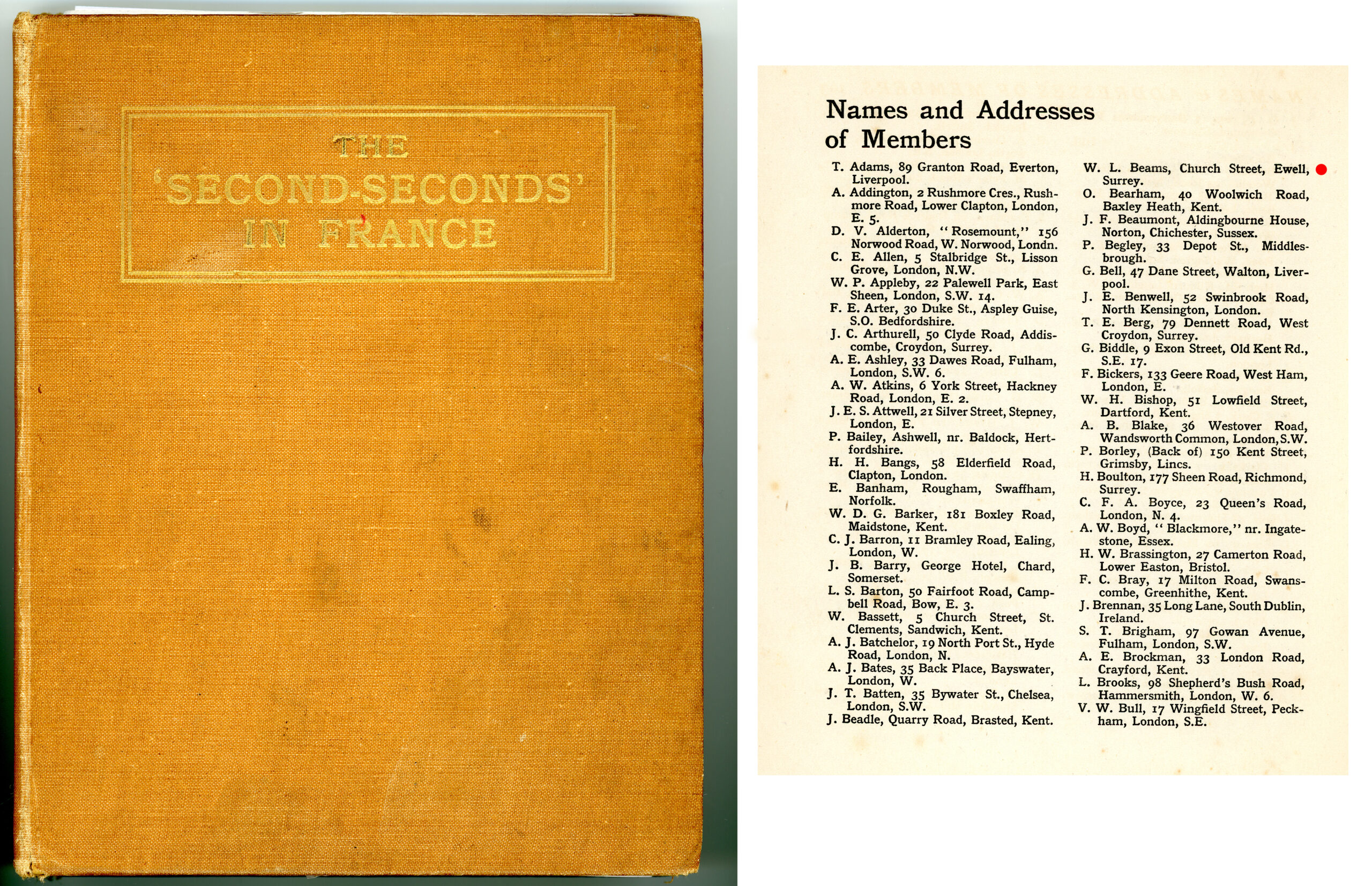 THE ‘SECOND SECONDS IN FRANCE’
Edited by Lieutenant Colonel H.G. Haynes
Click image to enlarge
William Leslie Beams was born in Beddington, Surrey, on 25 April 1895 (GRO reference: Jun 1895 Croydon 2a 310) the son of William and Alice Jane Beams (née Pigden). His parents had married on 25 December 1893 in the St. Saviour Church, Battersea.
William Leslie was baptised on 7 July 1895 in St. Mary’s Church, Ewell. His father was a ‘Plumber’. William’s only sibling Evelyn Alice, also born in Beddington, was born on 30 July 1897, and was baptised on 7 November 1897 in the same church as William. She died aged 91 in 1988.
None of the Beams family have been found in the 1901 census.
The Ewell Church of England School Register recorded that William first attended the school on 22 February 1904 and that the family lived on the London Road in Ewell.
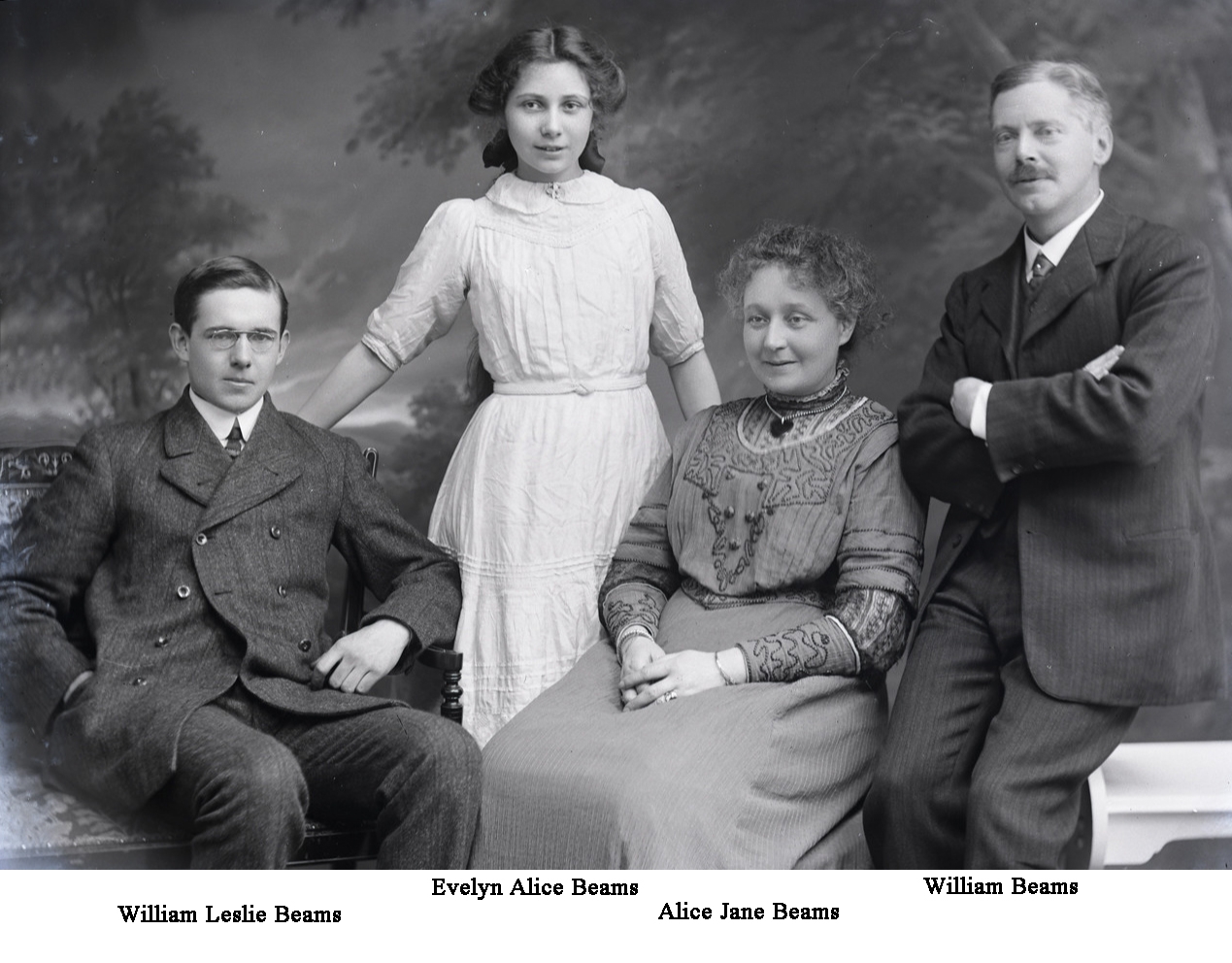 The Beams family 29 February 1912
Image taken from the David Knights-Whittome collection,
courtesy of Sutton Archives © 2023.
In 1911 William aged 15, an ‘Apprentice Stationer’, was living with his parents and 13 year old sister Evelyn in Warwick Cottage, Church Street, Ewell. His father William was a 46 year old ‘Farrier‘. His mother Alice aged 46, stated that she had been married for 17 years and that both her children were still living.
The 1921 census records the family living at 10 Kingston Terrace, Kingston Road, Ewell. William, the 26 year-old head of the household was a ‘House Builder and Decorator’. His wife, 27 year-old Elsie was employed on ‘Home Duties’. Daughter Nancy Violet born 1921 was also recorded.
The London ‘Blitz’ of 1940 destroyed about 66% of Great War service records. Those that were not completely destroyed, referred to as the ‘burnt’ records, suffered various degrees of damage caused by fire, smoke and water. Information regarding William’s army service has been pieced together using William’s very difficult to read ‘burnt’ service record papers.
William attested at the RAMC depot in the Duke of York’s School, Chelsea. He has two, badly damaged, attestation forms, both dated 7 September 1914. One has the 18th Battalion London Regiment crossed out with ASC written in. Written below that the Corps he was assigned to, the 2nd City of London Field Ambulance RAMC. The other attestation form also shows him assigned to the 2nd City of London Field Ambulance RAMC but with ASC written below. His address on both documents is Warwick Cottage, Church Street, Ewell.
NOTE: A ‘Field Ambulance’ did not mean a single vehicle. It was a mobile front-line unit of up to 10 officers and 224 other ranks, split into three sections, ‘A’, ‘B’ and ‘C’. Each unit had several vehicles and tents, designed to tend a maximum of 150 casualties, although this number was exceeded when large battles were being fought. Normally ‘Field Ambulances’ came under the control of an army Division, with each Brigade within the Division having a designated ambulance. Each ambulance established a number of posts along the casualty evacuation route. Click here for detailed a description of a Field Ambulance.
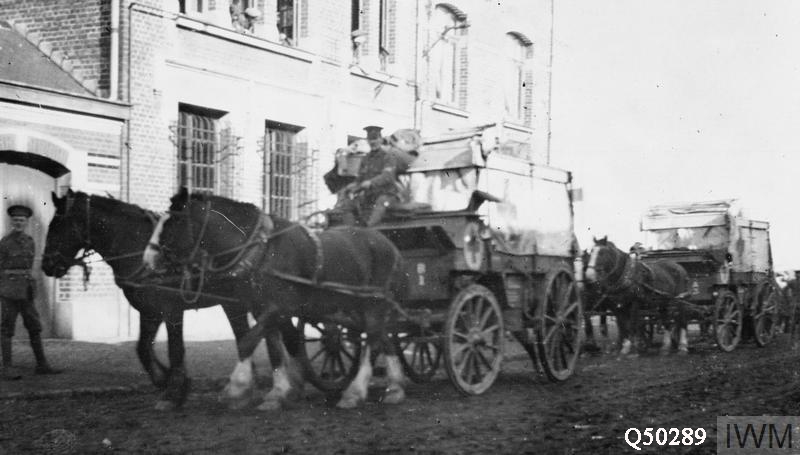 Horse drawn transport
© IWM. Q50289
Whatever the reason for the apparent confusion on his attestation papers, William became Driver number T4/237833 (T4 indicating that he served with horse transport) in the ASC but was attached to and served with 2nd City of London Field Ambulance RAMC. William was 5 feet 5 inches tall and had a chest measurement of 34 inches with an expansion of 3 inches.
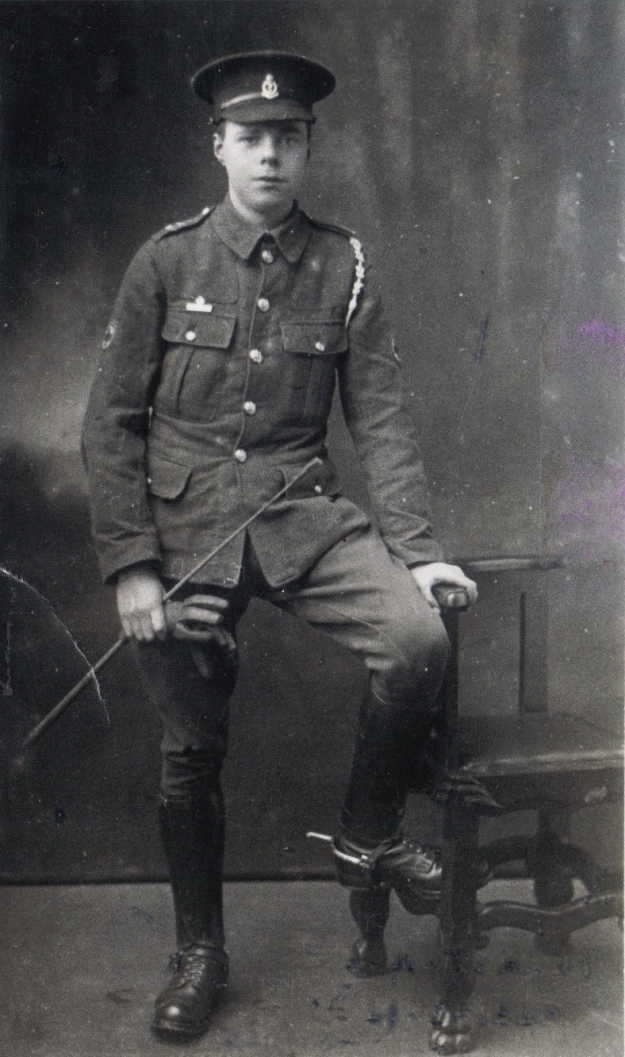 William Leslie Beams in uniform
Ancestry Family Trees
During the last months of 1914 the unit was equipped, including transport ranging from horse drawn coal and bakers’ carts to municipal water-carts. In December 1914 the Ambulance was renamed the 2/2 City of London Field Ambulance and at the end of December the unit was sent to Lindfield for further training.
In June 1915 the Ambulance moved to Norwich and then in July all men who had volunteered to serve abroad went to Ipswich for more training including night manoeuvres on Martlesham Heath. On 27 July whilst on the heath Private Cyril Worland Woodliffe was killed by lightning. By December 1915 foreign service equipment was being issued including a complete change of medical and surgical material, as well as new wagons, comprising horse ambulances, general service wagons, limbers and water-carts.
Christmas 1915 was spent in Ipswich and from January 1916 foreign service leave was granted. Early on 21 February the Ambulance entrained at Ipswich station for Southampton and thence to France. The Ambulance landed at a cold and snowing Le Havre on 22 February, part of the 56th Division. After a very slow, stop-start train journey the Ambulance arrived at its destination, Pont Remy. It then marched to Brucamps where it stayed for two weeks whilst it was issued with its complement of ‘motor ambulance cars, five Sunbeams and two Fords’. The men marched through Doullens and Lignereuil to Liencourt where they ran a ‘Divisional Rest Camp’. The camp comprised of four large ‘Adrian’ huts and a cookhouse where some hundreds of sick men were cared for. On 6 May 1916 the Ambulance left Liencourt bound for St. Amand some three or four miles behind the front line.
On 15 May 1916 a party of men were sent to Hebuterne. In the garden of a house that was being used as a dressing station, the unit was tasked to make dugouts to improve accommodation for the wounded. During the night there had been several casualties, and in the cemetery behind the dressing station fresh graves were dug. The cemetery had long lines of graves marked by simple wooden crosses bearing the name, unit and date of death of every man, except for a few who were unknown.
On 18 June the Ambulance moved to open country between Souastre and Couin and awaited the much anticipated start of the 1 July 1916 Battle of the Somme. A few days before the end of June, ‘A’ and ‘C’ sections moved up the line to Hebuterne. ‘B’ section remained in camp near Couin. During this time the German lines were subjected to a fierce bombardment that was expected to destroy all resistance, a task in which it failed.
At 7.30 on 1 July the infantry attacked Gommécourt Wood. Very soon after the start of the attack large numbers of men had been killed or wounded. The Ambulance stretcher bearers were sent up communication trenches to bring back as many wounded as possible. ‘B’ section was ordered to the front immediately. The huge number of casualties caused chaos in the trenches, the stretcher bearers evacuating as many wounded as possible. They did not have to travel very far in the trenches before they found batches of men lying where they had been left, awaiting evacuation. Three bearers had been wounded and 19 year-old Private Alec Giles was killed by shellfire.
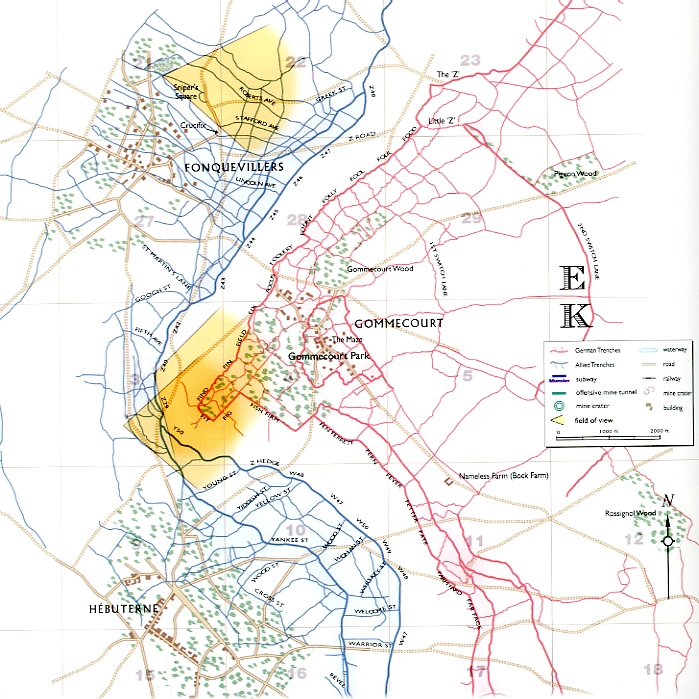 Map showing Hebuterne and Gommécourt Wood
Click image to enlarge
The following is a direct transcription from the book ‘THE ‘SECOND SECONDS’ IN FRANCE’:
As the communication trenches ran directly into the main street of the village (Hebuterne) it was possible, after carrying the wounded down to this street, to use the ‘wheelers’– pair wheel frames on which stretchers could be placed and pushed along far more easily than they could be carried by hand. These wheelers proved very useful here, for, in spite of severe shelling, the roadways were passable and the journey down to the dressing station could be made quickly. This dressing station, on the preparation of which we had been so busy for months before, lay only a few hundred yards from the communication trenches; one of them, indeed, Yiddish Street, ran down that way. Through the village now poured a never-ending stream of this pitiful traffic–helpless men being pushed along on the wheelers or carried through on stretchers, and countless others straggling by with painful difficulty, their heads or limbs in bandages. In front of the dressing station the roadway was lined with stretcher cases, on one side being a number of wounded Germans, for the dugouts themselves could hold only a tithe of the cases. They lay waiting their turns, the din of battle sounding hoarsely in ironic contrast to the beauty of the day. Doctors, dressers and bearers, however, could do nothing more than carry on. The bearer, once he had laid down his burden, could but return for still another of the stricken host; the doctor and his orderlies could only work swiftly on each case as it came before them. The lesser wounded men, the ‘walking wounded,’ would struggle past this dressing station to the one used for their cases, which was situated at the end of the village remote from the line. After being dressed there, and perhaps receiving a cup of tea which the wounded men always associates with Field Ambulances, they walked or rode by motor char-a-banc across the three or four miles of country to the main dressing station near Couin.
Bringing in wounded men continued the next day, 2 July, and in the afternoon an extraordinary event occurred when the Germans arranged a cease fire, for an hour, so that both sides could collect their wounded lying in no-mans-land. The work of the Ambulance continued, caring for casualties of the Somme battle until October 1916. The detail of William’s work is not known but no doubt he would have been busy doing whatever was needed to help as many of the wounded as possible.
William returned to the UK on 20 October 1916. Unfortunately, his very damaged service papers do not provide a reason for his return. However, on 28 October a form, headed ‘112th Battalion Training Reserve’ was completed seeking particulars as to the character of a soldier who had been ‘sent home for any reason’, to be signed by the soldier’s Commanding Officer. It was recorded that he was a ‘Driver and Saddler’, he was sober, reliable, intelligent, had had a short course of instruction as a saddler and had proved a most efficient soldier as a saddler. In other papers mention is made of the 18th Battalion London regiment. Perhaps he asked for a transfer to this battalion?
Army Form W. 3016 was ‘Only for use with Men returned from an Expeditionary Force or from Garrisons Abroad‘. A form W. 3016 dated 5 March 1917 granted William furlough from 10 March 1917 to 19 March 1917. His address on leave was ‘Mostyn’, High Street, Ewell, Surrey’. The form was addressed to the Officer Commanding ‘Depot ASC (Discharge), Southport’ and was stamped 18th BATTN LONDON REGIMENT. It was also stamped FROM DYSENTERY DEPOT and was signed by the Officer Commanding Dysentery Convalescent Hospital, Barton, New Milton, Hants. So, did William ask for transfer to the 18th Battalion London Regiment, but first had to undergo training and unfortunately caught dysentery?
On 1 July 1917 William was again sent to France, returning to the UK on 17 October 1917.
On 12 January 1918 William, aged 22, married Elsie Laura Minter, aged 25, born 24 September 1893, in St. Mary’s Church, Ewell. He was a Rifleman in the 1/18 Battalion London Regiment and lived at ‘Mostyn’ High Street, Ewell. His father William was a ‘Fitter‘. Elsie lived at 9 St. Helens Street, Ipswich. Her father Arthur was a ‘Green Grocer’.
On 2 May 1918 William transferred back to the ASC and on 10 October 1918 he embarked from Glasgow and arrived at Murmansk, Russia on 21 October to serve with the Russia Expeditionary Force, returning to the UK on 26 August 1919.
Note: After the 1917 Russian Revolution a bloody civil war was fought between the ‘Red’ Bolshevik army and the ‘White’ army. In support of the ‘White’ army Australia, Canada, France, Italy, the USA and Britain all sent troops. Britain sent over 14,000 troops, the first arriving in July 1918. Over 500 British troops died.
An Army Form E. 11. ‘PROTECTION CERTIFICATE AND CERTIFICATE OF IDENTITY’ dated 11 September 1919 was issued for William by Crystal Palace Dispersal Unit. William was a Driver in 1123 Company RASC. This company, formed on 8 September 1918 and disbanded on 2 October 1919, provided horse drawn transport and served in North Russia and Siberia. He lived at ‘Mostyn’ High Street, Ewell, his medical category was ‘B1’ and he was entitled to 2 months leave from 11 September 1919 to 8 November 1919.
The 1921 Census records William (an employing “House Builder & Decorator”) and Elsie living at 10 Kingston Terrace, Ewell, with their second child – Nancy Violet born 28 November 1920. Their first child, Iris Evelyn Elsie, had been born Q4 1918 but, on Census nights was staying with her grandparents at “Mostyn”, Ewell. (Their third and last child, Jean A, was born in Q3 1927.)
On 13 November 1923, William had a claim for a disability pension for ‘Poisoned right forearm through GSW’ rejected. He was then still living at 10 Kingston Road, Ewell and, according to Electoral Rolls, remained there until 1931. In 1932, he was at 20 Kingston Road, Ewell. By 1935, he was at 12 Cheam Road, Ewell and then, by 1938, at 18 Cheam Road, Ewell.
18 Cheam Road, Ewell, is where the 1939 Register records William and wife Elsie living. William was a ‘Master Builder and Decorator’, whilst Elsie’s occupation was the conventional ‘Unpaid Domestic Duties’.
William Leslie Beams was still at 18 Cheam Road when he died aged 65 on 7 December 1960 (GRO reference: Dec 1960 Surrey Mid East 5g 224).
Clive Gilbert © 2023