
JOHN EVELYN F.R.S. (1620-1706)
and locally-related extracts from his famous diary
 John Evelyn, aged 67, in 1687.
Portrait by Godfrey Kneller.
Public domain image, via Wikimedia

Following the main article are:
ANNEX 1 – locally-related extracts from John Evelyn’s diary; &
ANNEX 2 – a list of John Evelyn’s other major works.
John Evelyn (1620-1706) was a multi-talented man and prolific writer, perhaps best known today for his diary (although that is less famous than the racier diary of his contemporary, Samuel Pepys – our article about whom also concludes with his diary’s local references). However, our interest in John is not only from occasional local mentions in his diary (of which more in Annex 1 below) but also that he was the brother of Richard Evelyn – who, as described in our article about Woodcote Park, became that estate’s owner on his 1648 marriage to the heiress Elizabeth Mynne.
According to the introduction John wrote for his diary, he was born at “about twenty minutes past two in the morning” of Tuesday 31 October 1620. He was the fourth and penultimate child of the wealthy Richard and Eleanor (née Standsfield) Evelyn. The birth was at the family’s substantial home in Wotton, three miles west of Dorking. In 1625, the nearly five year old John was sent to live with his maternal grandfather in Lewes, apparently because “the pestilence was so epidemical, that there died in London 5,000 a week“: indeed, the young John sickened to the point where physicians despaired – but he survived. He spent his childhood in Lewes, being educated at Lewes Old Grammar School (having refused to be sent to Eton College). He completed his education at Balliol College, Oxford and at London’s Middle Temple.
John was a Royalist, and spent much of the 1642-51 English Civil Wars touring mainland Europe. While in Florence in about 1645, he commissioned the sumptuous John Evelyn Cabinet (now in the Victoria and Albert Museum) which seems certain to be the “ebony cabinet” in which his diaries were found at his home after his death in 1706.
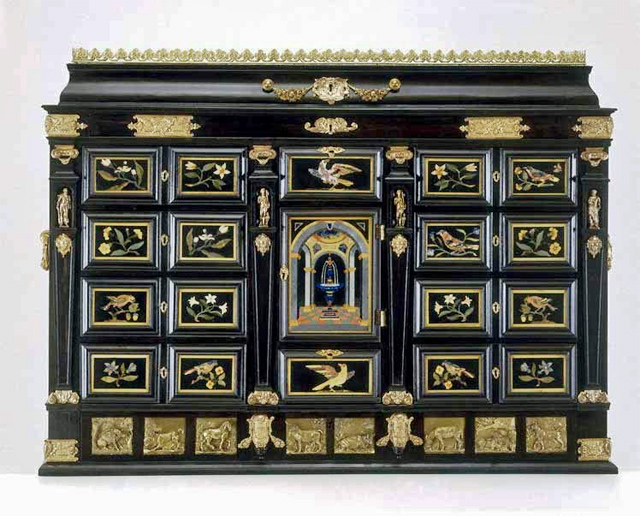 The “John Evelyn Cabinet”.
Photograph with thanks to the V&A, CC BY-SA 3.0
In 1647, John married Mary Browne, daughter of the English ambassador in Paris. During the next few years, the couple travelled back and forth between France and England. With the royalist cause lost in the Civil War, the couple returned to England in 1651 and settled in Sayes Court, Deptford. (On the 1699 death of his older brother, Richard, John inherited the family estate at Wotton – where he had already been living for some years.)
As a royalist, John refused employment in Cromwell’s Commonwealth: indeed, he maintained a cipher correspondence with the exiled and future Charles II. Among John’s wide-ranging interests, the closest was in the world of plants and trees, and he soon began to transform the gardens at Sayes Court. His brother, John – who, through his 1648 marriage to Elizabeth Mynne, had become master of the Woodcote Park estate – subsequently replaced the house with the mansion that is now the RAC’s country home. It is understood that John designed the gardens for his brother’s new mansion.
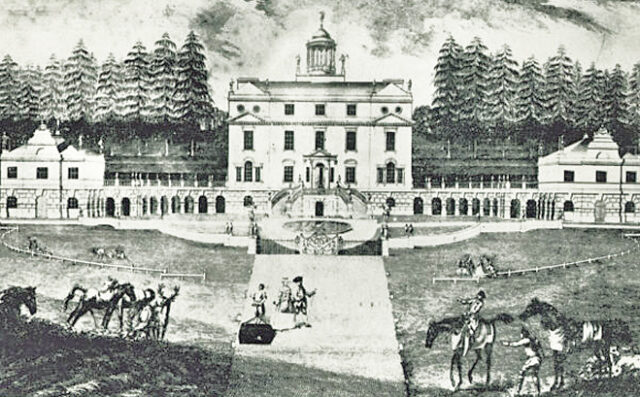 Richard Evelyn’s newly-built mansion in Woodcote Park, for which John designed the gardens.
Image with thanks to the RAC.
It was on the 1660 Restoration that Evelyn’s career really took off, and he enjoyed unbroken Court favour until his death in 1706. He never held any important political office, although he filled many useful and minor posts. In 1660, he was a member of the group that founded the Royal Society. (Another member of that group was fellow diarist, Samuel Pepys – who became the Society’s President.)
John was prolific writer. While now best known for his diaries, his many books (a number being translations from originals in Greek, Latin and French) covered his wide-ranging interests – as listed in Annex 2 below. Foremost among these interests was horticulture and, in his lifetime, he was best known for the 1664 “Sylva, or a Discourse of Forest Trees and the Propagation of Timber in His Majesties Dominions” – being a plea for reforestation aimed at landowners, and credited with transforming the landscape of Leith Hill and Friday Street.
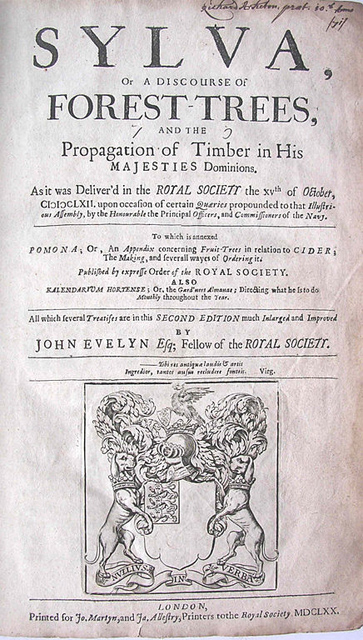 The title page of “Sylva”.
Public domain image via Wikimedia.

At the age of 85, John died at his London home in Dover Street on 27 February 1706. His diaries were subsequently discovered in the previously mentioned cabinet. However, they were not published – in two volumes – until 1818, under the title Memoirs Illustrative of the Life and Writings of John Evelyn. (The principal editor was William Bray, also known for the 1809-14 three volumes on The History and Antiquities of the County of Surrey.)
John’s “diaries” are, as in the original publication’s title, better described as a “memoir”. Unlike the contemporary daily entries in the diaries of Samuel Pepys, months could pass between John’s entries, and it is clear that some of these – particularly from the earlier years – were reconstructed some years after the event. It was interest in the 1818 publication of John’s diaries that led to the 1825 first publication of Pepys’ diaries (he had died in 1703, three years before John), the racier content of which – albeit over a shorter period – led to their significantly eclipsing John’s diaries.
In 1987, Epsom and Ewell Borough Council marked the Golden Jubilee of the Borough’s creation with the installation of a number of plaques commemorating “Notable Residents”. One of these was erected in John’s memory at Woodcote Park. As will be seen below, this noted that John had “resided” there. That significantly overplayed his occasional visits to his brother, and the plaque was subsequently taken down.
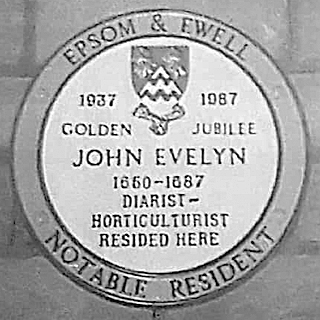 The Borough’s now-lost plaque to John Evelyn.
Image from the Council’s pamphlet about its Golden Jubilee plaques.
A revised plaque (pictured below) has been prepared but has yet to be installed at Woodcote Park.
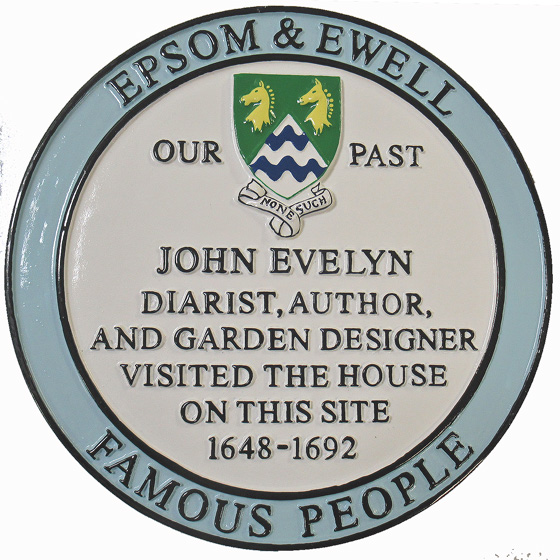 The revised (and yet to be installed) memorial plaque.
Photograph by Roger Morgan © 2023
Roger Morgan © 2023
Annex 1: LOCALLY RELEVENT EXTRACTS FROM JOHN EVELYN’S DIARY
John Evelyn’s diary was first published in 1818, in two volumes. Their full text is, thanks to Project Gutenberg, freely available online and may be accessed via the side-headings below.
A word search of these texts finds locally-related entries as repeated below. All but one of these relate to Epsom, found by word searching the text for “Epsom”, “Woodcot” or “Durdans”. Sadly, searching for “Ewel” provided no hits. Searching for “Non(e)such” provided just the one hit – for 3 January 1666, as included below. (It would seem certain that he visited Epsom and Ewell many more times than shown here, but without recording it.)
VOLUME 1, 1623-1664 (⇐ click to access the volume’s full text)
16th August, 1648. I went to Woodcote (in Epsom) to the wedding of my brother, Richard, who married the daughter and coheir of Esquire Minn, lately deceased; by which he had a great estate both in land and money on the death of a brother. The coach in which the bride and bridegroom were, was overturned in coming home; but no harm was done.
25th July, 1650. I went by Epsom to Wotton, saluting Sir Robert Cook and my sister Glanville; the country was now much molested by soldiers, who took away gentlemen’s horses for the service of the state, as then called.
22d September, 1652. I went to Woodcott, where Lady Browne was taken with scarlet fever, and died. She was carried to Deptford, and interred in the church near Sir Richard’s relations with all decent ceremonies, and according to the church-office, for which I obtained permission, after it had not been used in that church for seven years. Thus ended an excellent and virtuous lady, universally lamented, having been so obliging on all occasions to those who continually frequented her house in Paris, which was not only an hospital, but an asylum to all our persecuted and afflicted countrymen, during eleven years’ residence there in that honorable situation.
1st January, 1654-55. Having with my family performed the public offices of the day, and begged a blessing on the year I was now entering, I went to keep the rest of Christmas at my brother’s, R. Evelyn, at Woodcot.
14th August, 1658. We went to Durdans [at Epsom] to a challenged match at bowls for £10, which we won.
3d July, 1662. My wife met me at Woodcot, whither Mr. Howard accompanied me to see my son John, who had been much brought up among Mr. Howard’s children at Arundel House, till, for fear of their perverting him in the Catholic religion, I was forced to take him home.
1st September, 1662. Being invited by Lord Berkeley, I went to Durdans, where dined his Majesty [ie Charles II], the Queen, Duke, Duchess, Prince Rupert, Prince Edward, and abundance of noblemen. I went, after dinner, to visit my brother of Woodcot, my sister having been delivered of a son a little before, but who had now been two days dead.
VOLUME 2, 1665-1706 (⇐ click to access the volume’s full text)
1st September, 1662. Being invited by Lord Berkeley, I went to Durdans, where dined his Majesty, the Queen, Duke, Duchess, Prince Rupert, Prince Edward, and abundance of noblemen. I went, after dinner, to visit my brother of Woodcot, my sister having been delivered of a son a little before, but who had now been two days dead.
4th August, 1665. I went to Wotton with my Son and his tutor, Mr. Bohun, Fellow of New College (recommended to me by Dr. Wilkins, and the President of New College, Oxford), for fear of the pestilence, still increasing in London and its environs. On my return, I called at Durdans, where I found Dr. Wilkins, Sir William Petty, and Mr. Hooke, contriving chariots, new rigging for ships, a wheel for one to run races in, and other mechanical inventions; perhaps three such persons together were not to be found elsewhere in Europe, for parts and ingenuity.
30th December, 1665. To Woodcot, where I supped at my Lady Mordaunt’s at Ashsted, where was a room hung with pintado, full of figures great and small, prettily representing sundry trades and occupations of the Indians, with their habits; here supped also Dr. Duke, a learned and facetious gentleman.
3d January, 1666. I supped in Nonesuch House, whither the office of the Exchequer was transferred during the plague, at my good friend Mr. Packer’s, and took an exact view of the plaster statues and bass-relievos inserted between the timbers and puncheons of the outside walls of the Court; which must needs have been the work of some celebrated Italian. I much admired how they had lasted so well and entire since the time of Henry VIII., exposed as they are to the air; and pity it is they are not taken out and preserved in some dry place; a gallery would become them. There are some mezzo-relievos as big as the life; the story is of the Heathen Gods, emblems, compartments, etc. The palace consists of two courts, of which the first is of stone, castle like, by the Lord Lumleys (of whom it was purchased), the other of timber, a Gothic fabric, but these walls incomparably beautiful. I observed that the appearing timber-puncheons, entrelices, etc., were all so covered with scales of slate, that it seemed carved in the wood and painted, the slate fastened on the timber in pretty figures, that has, like a coat of armor, preserved it from rotting. There stand in the garden two handsome stone pyramids, and the avenue planted with rows of fair elms, but the rest of these goodly trees, both of this and of Worcester Park adjoining, were felled by those destructive and avaricious rebels in the late war, which defaced one of the stateliest seats his Majesty had.
26th October, 1669. My dear brother [Richard] continued extremely full of pain, the Lord be gracious to him!
3rd March, 1670. Finding my brother [Richard] in such exceeding torture, and that he now began to fall into convulsion-fits, I solemnly set the next day apart to beg of God to mitigate his sufferings, and prosper the only means which yet remained for his recovery, he being not only much wasted, but exceedingly and all along averse from being cut (for the stone); but, when he at last consented, and it came to the operation, and all things prepared, his spirit and resolution failed.
6th March, 1670. Dr. Patrick preached in Covent Garden Church. I participated of the Blessed Sacrament, recommending to God the deplorable condition of my dear brother, who was almost in the last agonies of death. I watched late with him this night. It pleased God to deliver him out of this miserable life, toward five o’clock this Monday morning, to my unspeakable grief. He was a brother whom I most dearly loved, for his many virtues; but two years younger than myself, a sober, prudent, worthy gentleman. He had married a great fortune, and left one only daughter, and a noble seat at Woodcot, near Epsom. His body was opened, and a stone taken out of his bladder, not much bigger than a nutmeg. I returned home on the 8th, full of sadness, and to bemoan my loss.
21st March, 1670. We all accompanied the corpse of my dear brother to Epsom Church [St Martin’s], where he was decently interred in the chapel belonging to Woodcot House. A great number of friends and gentlemen of the country attended, about twenty coaches and six horses, and innumerable people.
13th August, 1673. I rode to Durdans, where I dined at my Lord Berkeley’s of Berkeley Castle, my old and noble friend, it being his wedding anniversary, where I found the Duchess of Albemarle, and other company, and returned home on that evening late.
Annex 2: MAJOR WORKS (other than his diary) by JOHN EVELYN
(with thanks to the Wikipedia article)
Of Liberty and Servitude (1649), a translation from the French.
The State of France, as it stood in the IXth year of Louis XIII (1652), a pamphlet drawn up from personal observations about the royal family, the court, the officials, the military forces, the institutions and customs of France.
An Essay on the First Book of T Lucretius: Carus de Rerum Natura (1656). Interpreted and made English verse. (To his translation, Evelyn attached a commentary based on the writings of Gassendi and other philosophical atomists.)
The Golden Book of St John Chrysostom, concerning the Education of Children. Translated from the Greek (1659).
The French Gardener: Instructing How to Cultivate all sorts of Fruit-Trees, and Herbs for the Garden(1658), translated from the French.
A Character of England, As it was lately presented in a Letter to a Nobleman of France (1659), a satire describing the customs of the country as they would appear to a foreign observer.
The Late Newes, or Message from Bruxels Unmasked, and his Majesty Vindicated (1660), in answer to a libellous pamphlet on Charles I.
Fumifugium: or The Inconvenience of the Aer and Smoak of London Dissipated (1661), in which he suggested that sweet-smelling trees should be planted in London to purify the air.
Instructions Concerning Erecting of a Library (1661), translated from the French.
Tyrannus or the Mode, in a Discourse of Sumptuary Laws (1661);
Sculptura: or the History, and Art of Chalcography and Engraving in Copper (1662), the first account of “A new manner of Engraving, or Mezzo Tinto” – for which John provided an engraving for the title page, see below.
 John’s engraving for “Sculptura”
Public domain image via Wikimedia.

Sylva, or a Discourse of Forest Trees and the Propagation of Timber in His Majesties Dominions to which is annexed Pomona … Also Kalendarium Hortense (1664), the best known of his books, being a plea for reafforestation aimed at landowners.
A Parallel of the Antient Architecture with the Modern (1664), translated from the French, to which was added An Account of Architects and Architecture from Evelyn’s own pen.
An Idea of the Perfection of Painting: Demonstrated From the Principles of Art, and by Examples (1668), a translation from the French.
The History of the three late famous Imposters, viz. Padre Ottomano, Mahomed Bei, and Sabatei Sevi (1669);
Navigation and Commerce, in which his Majesty’s title to the Dominion of the Sea is asserted against the Novel and later Pretenders (1674).
A Philosophical Discourse of Earth (1676), a treatise on horticulture translated from the French – and better known by its later title of Terra: The Compleat Gardener (1693).
Numismata. A Discourse of Medals, Antient and Modern … To which is added a Disgression concerning Physiognomy (1697).
Acetaria: A Discourse of Sallets (1699), the first recorded book on the growth and culinary use of salad plants.