
Derek Potter’s memories of Langley Vale
Spanning some 80 years in the village.
Recorded by Angela Clifford of
Langley Vale WI on 22nd June 2022.
Derek contacted me after buying a copy of the book ‘Langley Vale, memories of a Surrey Village’ produced by the WI for the millennium celebrations in 2000. He has lived in the village all his life and seen many changes. The following are some of his memories as they came to him – not necessarily in date order!
He remembers the village when all the houses had large gardens. He was born in the house built by his grandfather in 1926 – 4, Beaconsfield Road on land sold to him by a Mr Miller. It cost £800 to build (£100 in 1926 is approximately equivalent to £6,512.84 today, (2022) so 8 x £6,500 = £50,000 in round figures).
 4 Beaconsfield Road circa 1930s
Image courtesy of Bourne Hall Museum
The area in Harding Road between Beaconsfield and Grosvenor Roads was known as Miller’s Green – it backed on to a shop owned by a different Mr Miller who, Derek recalled, wore a fawn overall much as the character of David Jason in ‘Open all Hours’. This is the site of the first village hall as mentioned in the book.
Derek remembered stable lads boarding in the village – two with his family. Local trainers would ask for rooms for their lads and would pay for their keep. This may or may not have been deducted from their wages – Derek was too young to be aware of the minutiae of the arrangements. He remembered that his grandmother would make bread puddings and has photographs of some of the stable lads and their horses in their garden while being given refreshment!
His grandfather was the very proud owner of a Singer Le Mans car and Derek has photographs of it.
 4 Beaconsfield Road with the Turner family in sports car circa 1930s
Image courtesy of Bourne Hall Museum
Shortly after the war ended he was proud to carry the flag as the scouts attended a St George’s day parade in Church Street at the United Reform Church. The Rev Allan was scoutmaster and minister at the church. Derek is one of the scouts by the old tin church in the picture in the book
Life in the village was so very different then. Mr Albert Brooks kept the off-licence which faced Langley Vale Road at the bottom of Rosebery Road (now a private house) and he would deliver beer to customers in a van custom-built on to his motor bike!
Mr Martin delivered milk by horse and cart and a Sunday treat was a quart of full cream milk. His mother kept a sharp eye on him to make sure he did not drink all the cream topping! Once all the milk had been delivered, the horse seemed to know he was off home as he would go as fast as possible down the road and woe betide anyone in the way!
Bread was delivered – each loaf wrapped in tissue paper – from a basket carried by the baker.
Unfortunately, Derek suffered from asthma and he remembered being taken by his mother to the hospital to breathe in fumes from the boilers – they made him sick! His doctor sent him to a home run by nuns at Ventnor on the Isle of Wight for four months. Physical exercise was the order of the day – running up and down the local hills, cricket, football, tennis, basketball and hockey. When his mother and grandma visited him after a month, he said his leg muscles were as hard as iron! He was advised to exercise and took up swimming, becoming the first district schoolboy champion from the village school – much to the Head’s delight. He remembers the coke boiler in the classroom too.
School dinners were cooked in the old tin village hall – by ‘The Gap’ leading up to the Downs – by the Bird sisters and eaten at wooden tables and benches. It cost two shillings and sixpence ( about 12p) per week for the meals
Derek’s mother died when he was only ten years old but his father remarried and he has a half-brother to whom he is very close.
Mr R Turner was a village ARP (Air Raid Precautions) Warden. The duties of wardens included enforcing blackout orders and directing residents to shelters if an air raid took place. Several houses had shelters in their gardens and there was one in the school grounds – remembered by original contributors to the book.
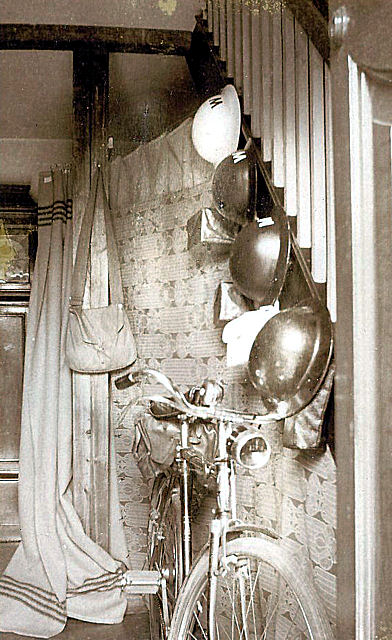 A typical local ARP Post
Images courtesy of Bourne Hall Museum
A Messerschmidt released a ‘doodle-bug’ which hit the top of an oak tree in the Turner’s garden – Derek showed me the remains of the stump which is in the garden of his current house – an ever-present reminder of some of the times he has lived through.
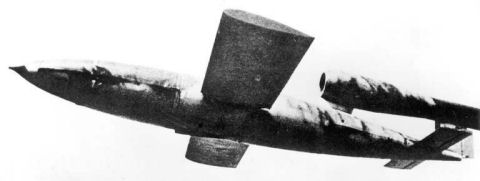 A Doodle-bug or V1 Flying Bomb
There are deep pits on Headley Heath which were dug to contain ack-ack (anti-aircraft) guns.
Re-cycling is not new – the tops on the third of a pint of milk given out at school were collected and re-cycled. (I remember using them to make woollen bobbles for hats! AC).
There was a boot repairer in the village and Derek earned some pocket money delivering the repaired items back to the owners. He also remembers seeing Tory Marks taking her pet sheep for a walk on a lead.
Derek joined the Southern Skirmish Association an American Civil War re-enactment Society and on one trip to the USA saw the recovered ‘Hunley’ submarine. A very sad story as all on board perished and the bodies were found still in their seats. Read the story on the CBC news website.
Derek said that the re-enactment group was told that in the pocket of the Sergeant in charge of crew members was a bent gold coin – it had been in his pocket when he was hit by a bullet during the battle at Shiloh (an American Civil War Battle), and this had prevented his thigh being shattered.
During the visit, the group stood guard over the coffins which were out of the water near the Huntley (kept in a huge water tank to conserve it) and were each given a medal – one of only 300, and a replica of the damaged coin.
The following report of the burial of the crew in 2004 was found on line:
- The procession marched 4.5-miles through downtown Charleston, and ended at Magnolia Cemetery. The Hunley’s eight-man crew was then laid to rest next to others who lost their lives on Hunley test missions. The burial was attended by tens of thousands of people who came to honor the crew and witness this historic moment 17 Apr 2004.
The Re-enactment Association has a site which has been built to represent a ‘Wild West’ township and has been used for filming commercially.
Derek Potter © 2022