
THE WARREN RECREATION GROUND
Langley Vale
The Warren Recreation Ground on Epsom Downs, tucked away off the southeast corner of Langley Vale, is among the lesser-known of the Borough’s many parks and open spaces.
 Aerial view of the Warren in June 1969.
Photograph by Aerofilms and Aero Pictorial Ltd, copyright acknowledged.
The name comes from the hare warren established in the area that, as explained in our article about Langley Farm, was enclosed from the surrounding Downs many years ago. The warren, which appears on maps in the late 1700s (see the example below), is understood to have been established by the Earl of Berkeley when he was living nearby at The Durdans. The Downs had become a popular place for coursing hares, so a warren was a natural development. It was a walled enclosure in which the hares could eat and breed safe from predators – but the wall was set with trapdoors or gates through which the animals would be turned out for dogs and horse riders to chase – and, the hunters hoped, to catch.
 Section of J Cary’s 1789 map of Surrey, showing the “Hare Warren”.
Photograph by Roger Morgan © 2023
In his circa 1825 book, “Some Particulars Relating to the History of Epsom“, Henry Pownall wrote (on page 27), about “the hare warren on Epsom Downs”, noting that it was “now the property of J. H. Durand, Esq., and in right of which he claims the privilege of free chase over several of the adjoining manors.”
While the main text of Gordon Home’s 1901 Epsom handbook makes no mention of hare coursing, he used the image below to illustrate his chapter 7 on how Epsom Downs became famous for horse-racing, noting that it is a photograph of “an old coloured print in the possession of Mr A W Aston“. (It will be seen that the man on the lower right already has one dead hare over his shoulder.)
 Hare coursing on Epsom Downs.
As noted above, from Gordon Home’s 1901 Epsom handbook – in which he explained that “the drawing was made from Tattenham Corner before the Grand Stand was built, and when only the first portion of the Course was enclosed“.
As shown by the 1840s illustration below, The Warren was used as a saddling enclosure for Epsom races – in this case for the Derby.
 The Warren being used for saddling at the Derby.
From the Illustrated London News of 25 May 1844.
At some point, The Warren was provided with a substantial house, as pictured below in 1890.
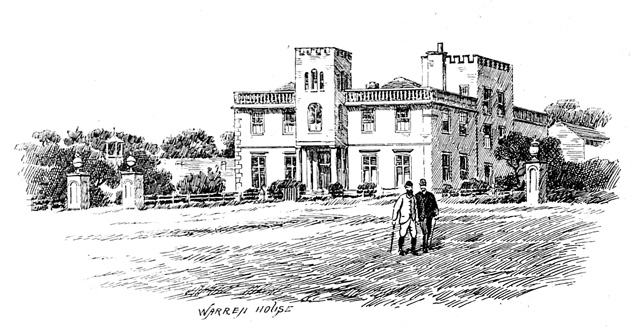 Warren House in 1890
From The Sporting & Dramatic News of 31 May 1890.
The following 1913 and 1932 OS map excerpts show the southeast corner of the Warren. Warren House is coloured red in the 1913 map – which shows the property’s rather odd footprint (presumably intended to minimise disruption of the boundary wall which ran round the estate).
 Extracts from the 1913 (top) and 1932 OS maps in which:
Warren House is coloured red;
The old well is coloured (and, in the 1913 map, also arrowed) blue; and
Warreners Cottage (the larger, southern, portion of which is single storey) is coloured green.
Warren house had been demolished by the time of the 1932 map, but this still shows the small single storey construction (coloured blue) covering the well, with the annotation (in Gothic script to show an ancient structure) “Well House”. Below is an early 1900s postcard of that Well House, which also shows the rear of Warren House.
 An early 1900s postcard of The Warren’s Well House.
Image courtesy of Bourne Hall Museum.
The sign on the Well House reads “WELL HOUSE / FOUNDED 1666 By KING CHARLES II / DEPTH 480 feet.” The attribution to Charles II may be far fetched – and the depth of 480 feet (146 metres) may also be pushing it. The “Ruinous mid C17 well house” is Grade II listed, with English Heritage noting that the well was opened as rival to the original well on Epsom Common. Just how “ruinous” the well house was in the 1960s is shown in the photograph below. (The Warreners Cottage and most of the site of the former Warren House is private property.)
 The derelict wellhead gear in the 1960s.
Photograph courtesy of Bourne Hall Museum.
As an aside, all that remains today of the old Warren House are its gateposts, as pictured below.
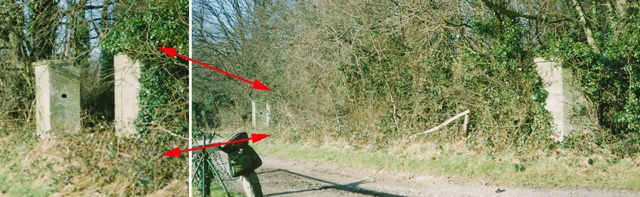 The Warren’s gateposts as photographed in the 1990s.
(These are the three posts, topped by urns/lamps, seen in the 1890 drawing further above.)
Photographs courtesy of Bourne Hall Museum.
The reason for using those 1990s photographs is that, as shown below, they are today much harder to spot among the burgeoning plant growth.
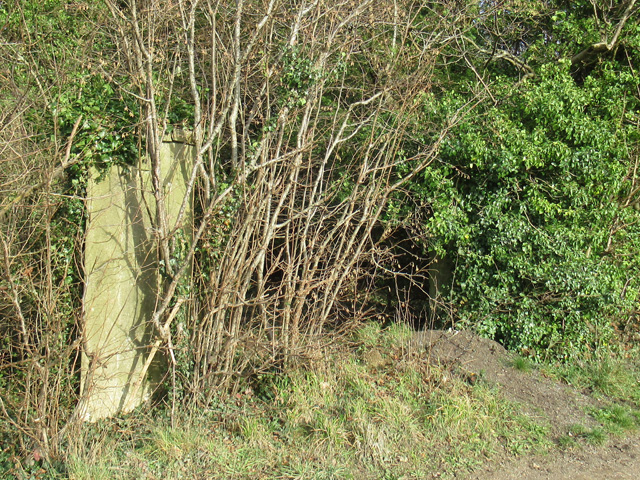 The double gateposts in 2023.
Photograph by Roger Morgan © 2023
However, still standing today is the C18 Warreners Cottage (coloured green in the maps above) which – together with sections of the old wall on each side – is also Grade II listed.
 The rear of the Warreners Cottage.
Photograph by Roger Morgan © 2023
The picture above shows the rear of the building, familiar to walkers over that part of the Downs. As will be seen in the photograph below, the front (nowadays behind a fence and, other than during the winter, shielded by trees) faced into the warren – which is where, of course, the “warreners” did their work looking after the hare warren.
 The front of the Warreners Cottage seen across the park’s fenced area.
Photograph by Roger Morgan © 2023
A third Grade II listed feature of The Warren is the northern 18C wall, with buttresses, being part of the original boundary wall.
 The Grade II listed boundary wall to the north of the Warren, as photographed in the 1960s.
(It is nowadays hidden by shrubbery.)
Photograph courtesy of Bourne Hall Museum.
After that extended background, we turn to the Recreation ground itself. By the nineteenth century, the enclosed Warren had fallen out of use, and it came under the care of the Epsom Grand Stand Association. From 1907 onwards houses were being built at Langley Bottom (Langley Vale after 1938) – and here, as elsewhere, the Council was concerned to save some open space from the developers. In June 1926, the Warren was purchased by the then Epsom Urban District for use as a recreation ground. (It passed to Epsom & Ewell Borough Council when that was formed in 1937.)
The purchase was of some 6 acres (2½ hectares). By 1933 some goal posts had been provided “but the ground not prepared“. The following year, the Langley Vale Improvement Association asked for the ground to be levelled as a cricket pitch as they wanted to form a cricket club. This was refused on the grounds of cost: levelling, rolling and relaying suitable turf would have cost £20.
The grounds never had any special scheme of laying out, due to their remote position and the small number of people that lived nearby. Recommendations were later made to retain the existing football pitch in the top field and add a cricket square lower down, and to add a few additional paths and seats at a cost of £500.
Today, the Vale Primary School – just off the NW corner of the ground – has an area fenced off for sports use. (Fenced successfully against foxes, dogs, deer and badgers – but not against moles.) There is also a basketball practice net, some exercise equipment and a fenced-off area with children’s play equipment.
 The Warren Recreation ground, looking northeast from the children’s playground
Photograph by Roger Morgan © 2023
As marked by a plaque fixed on the brick pillar at the entry to The Warren from the footpath from Beaconsfield Road (that runs alongside The Vale Primary School), The Warren was designated a “Field in Trust” as part of Queen Elizabeth II’s 2012 Diamond Jubilee celebrations. (Beyond the pillar is the continuation of the old boundary wall of The Warren estate.)
 The plaque marking The Warren’s status as a “Queen Elizabeth II Field” (at its northwest corner), beyond which is the continuation of the old estate boundary wall.
Photographs by Roger Morgan © 2023
Roger Morgan © 2023
(extended from Carol Hill’s 2012 text.)