
The tragic deaths by drowning of two friends from Epsom
Arden Avery Shapland and Thomas Brown Westwick
Part 1 – Arden Avery Shapland
Born in South Molton, Devon in 1838 to John Terrell Shapland and Charlotte Francis, Arden Avery Shapland married Anne Rushton Jackson, on 3 October 1865 at Christ Church, Brixton Road, Lambeth, and they had had 4 children. He had followed his father’s profession of Solicitor to establish a practice fron 28 King William Street, London, and lived at Rushton Villa, Cressingham Road, Sutton, Surrey.
The death of Ann Rushton Shapland was registered at Epsom 9/1873 but is believed to have occurred in Sutton following a carriage accident. Subsequently Arden moved to Crawford Lodge, 8 The Terrace, [StationTerrace, Upper High Street,] Epsom.
A friendship became established with the youthful Thomas (‘Tom’) Brown Westwick who lived with his parents on West Hill, Epsom, possibly through Freemasonry – Bro. A A Shapland was a member of Constitutional Lodge No. 55, a Royal Arch and a Mark Master Mason . They spent holidays together in Devonshire at the home of Shapland’s sister, Eve Charlotte Charity, who had married William Allin (correctly, rather than ‘Allen’) Tucker. On 18 September 1875 this led to Arden’s accidental death.
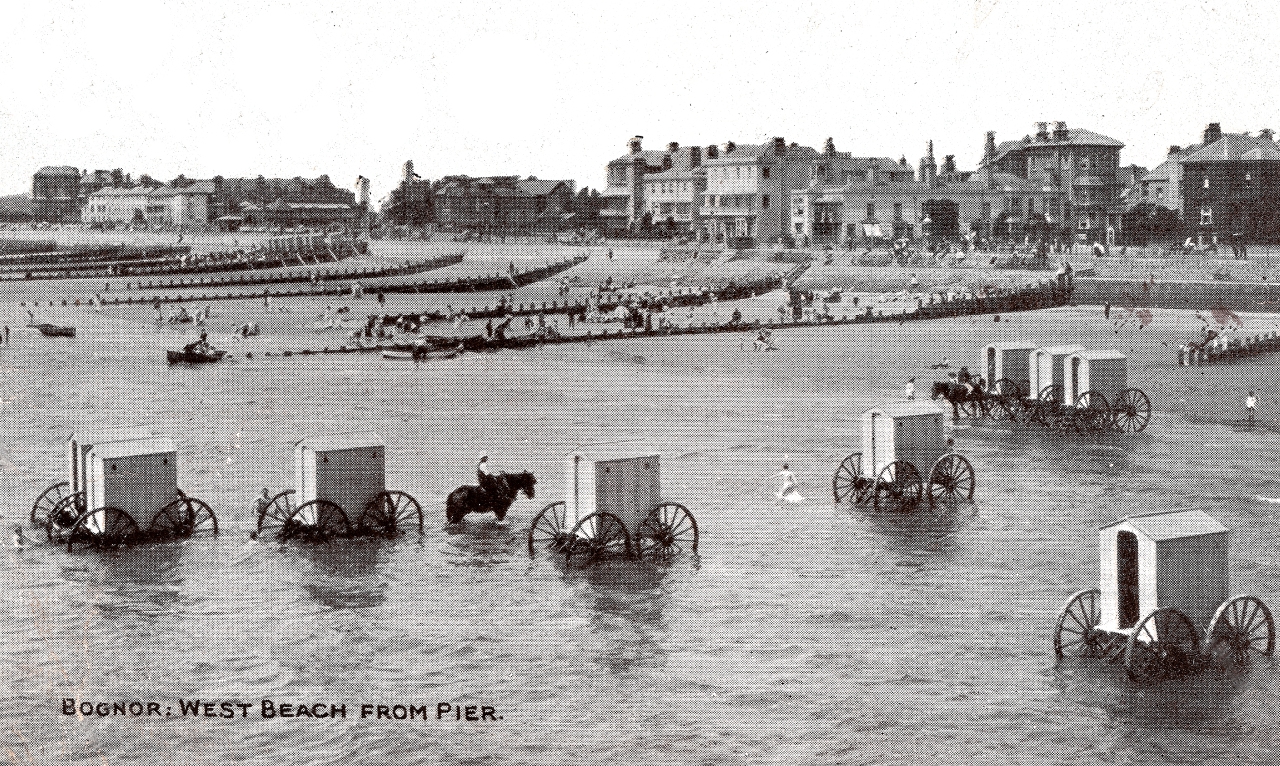 Postcard view of Bathing Machines in Bognor
As reported in East and South Devon Advertiser: –
Saturday 25 September 1875
“TEIGNMOUTH – A Solicitor Drowned At Teignmouth.
A very painful case of drowning occurred at Teignmouth on Saturday afternoon – all the more painful because the life of a gentleman has been lost from want of proper efforts being made to rescue him. The deceased gentleman, MR SHAPLAND, who was 35 years of age, was the son of a solicitor practising at South Molton, North Devon, he himself being also of the profession, practising at Epsom. For the last day or so he and Mr Westwick, a gentleman, of London, had been on a visit to Mr Tucker, of Waye, near Newton Abbot, the latter being a brother-in-law of the former. On Saturday these three gentlemen went to Teignmouth to bathe, but it would seem that only Mr Westwick was able to swim, and he very differently. They went into the water from machines in front of the Den at the time when there was a very rough sea caused by an easterly wind. The deceased gentleman was the first to enter the water and to prevent his being carried out of his depth by the breakers he had the use of a rope. Considering himself thus safe he ventured out up to his shoulders when an ugly breaker carried him off his feet. As he had let go the rope, he was at once at the mercy of the waves. He cried for help, in the meantime struggling as best he could to keep himself afloat. Mr Westwick swam out and laid hold of him. They struggled together for awhile, and it was evident to those on shore, although they were within a stone’s throw of the beach, that without further assistance, if not both of them must be drowned. Mr Tucker was in the water but he could not swim; but there were many ‘old salts’ looking on, and although there was a life-preserver close at hand, provided by the Local Board, not one of them, be it said to their shame, had the courage even to wade through some four or five feet of water with it and then to have thrown it to the drowning men. A coastguard, named Doyle, informed us that he witnessed the painful scene and being unable to swim himself he ran for a boat, and it was a few minutes afterwards, but poor MR SHAPLAND had by this time sank, whilst Mr Westwick himself was struggling hard to keep himself afloat, being every instant carried further out to sea. Mr Westwick was picked by a boat just at the very moment he was about to pay the same penalty as his friend, whose life he had fought so gallantly to save. when brought ashore he was apparently dead. He was taken into one of the machines where three or four men were engaged rubbing him for at least twenty minutes before any signs of animation could be restored. After this he was removed to the Royal Hotel, attended by Drs. Edwards and Lake, and he soon recovered consciousness. The kind attention Mr Collings, the proprietor of the hotel, paid the patient is deserving of especial praise. There were several lady relatives of the deceased in the town at the time, and their emotion can be better imagine than described when they learnt the sad intelligence. This melancholy occurrence, we hope, will teach the local authorities many things, the chief of them being that life-preservers, although kept at the back of the bathing machines ready for any emergency, are useless in a town – a noted bathing town, too – where men accustomed all their life time to the sea have not the courage to reach forth a hand, in water they might almost stand in, to a drowning man. This is not the first instance to our knowledge that the lack of pluck has been displayed by the ‘brave men of Teignmouth’. The body of the unfortunate gentleman was washed ashore and found by the landlord of the Inn at Labrador, near Shaldon, on Friday, in a wretched state, many parts having been eaten away, apparently by fish. An Inquest will be held today (Saturday).”
 A postcard view of The Beach at Labrador Bay Hotel
Saturday 2 October 1875
“TEIGNMOUTH – The Late Fatal Accident At Teignmouth. The Inquest.
An Inquest was held on Saturday at the Crown and Anchor Inn, Shaldon, by Mr H. Michelmore, Coroner, touching the death of MR ARDEN AVERY SHAPLAND, who was drowned whilst bathing at Teignmouth on the previous Saturday. His body was found at Labrador on Friday morning, about a mile from the bathing-ground. Mr Beavan, chairman; Rev. H. Hutchins, Mr H. B. T. Wrey, Mr R. Willcocks, Mr C. H. Collings, members; and Mr W. R. Hall Jordan, Clerk of the Teignmouth Local Board was present. In commencing the proceedings, the Coroner asked the Jury to dismiss from their minds all that they might have heard, or read, about the case, and said a great deal had been written before the Inquest had been held. Mr Thomas Westwick, merchant, of London, residing at Epsom, identified the body of the deceased, who was a solicitor practising in King William-street, London, but residing at Epsom. He was about 35 years of age. John Winsborrow, gardener, and landlord of the Labrador Inn, proved finding the body of the deceased at half past six on Friday morning. Witness was in his garden at the top of the sea beach at Labrador, and saw the body laying on the beach, it being then about half tide. There were bathing drawers on the deceased. He removed the body to high water mark, and about two hours afterwards it was taken to witness’s house, his son by that time having fetched P.C. Cooper. Mr William Allen Tucker, farmer, residing at Waye Barton, in the parish of Ipplepen, said the deceased was his brother-in-law, and he last saw him alive on the 18th of September. Deceased had been staying at witness’s house from the 6th. On the 18th witness drove his wife, a lady friend from South Molton, the deceased, and Mr Tom Westwick, to Teignmouth, reaching there about one o’clock. After putting his horse in at the London Hotel they proceeded to the beach with the intention of bathing. They had separate machines, MR SHAPLAND and Mr Westwick having those nearest the Pier; the machines belonged to a woman named English, whose son was with her. Witness’s machine was further away from the Pier, there being two or three others between his and those of his friends. Witness could swim a little. MR SHAPLAND and Mr Westwick went into the water before witness. He did not see any ropes to the machines, and was quite certain neither MR SHAPLAND nor Mr Westwick used ropes. Witness was cautioned as to the state of the water by George English, who said it was rough, and he must not go out very far. Witness was very nervous in the water, and he seldom went out far. He could not tell exactly, but thought it was about four or five minutes after his friends before he went in. Finding the water was so rough, he only went to the depth of his chest, and then went back to the beach and looked to see where the others were. He saw them a considerable distance out, and he cried ‘For God’s sake help, there are two drowning’. He did not say that to any one in particular. There were several people, and he (witness) became so excited at the loss of his friends that he did not know what happened afterwards. He knew that Mr Westwick could only swim a few strokes, and when he looked about a second time for them he could see neither. he saw some men going out with a boat, and begged them to go on. He did not tell them it was no use to go out, but said it was useless for him to do so, as he could not swim out. There were two or three men in the boat. Witness did not see any rope, or other appliance for saving life. He saw nothing except the boat. When he last saw them they were about three-parts of the length of the pier away. By a Juror: English only cautioned him about the water being rough, but did not say anything about the under current. William Courtenay Snell, boatman, of Shaldon, said that English came to call him at Powderham Terrace, Teignmouth, last Saturday afternoon, and asked whether he had any boats. Witness replied ‘Plenty’, and asking why, English replied, ‘There are two gentlemen drowning’. Thomas Elliott was with witness, and both of them ran down towards the river after a boat, and then met William Symons. They took the boat across the Den, with assistance, and launched it near the battery. Witness, Elliott and Symons were standing by the boat, and Mr Tucker said, ‘Don’t you go, they are gone’. Symons, however, said ‘That be bothered, we will go and see if we can find them or not’. Mr Tucker then said, ‘If you find them anywhere it is out at the end of the Pier’. They rowed out towards the end of the Pier, and when they were about 150 or 200 yards off somebody on shore hollowed and beckoned towards the right. Witness then stood up in the boat, and saw the head of a man in the water (Mr Westwick’s), and witness, on their reaching him, just caught him by the wrist, with his (witness’s) finger and thumb as he was going down the third time. Witness held Mr Westwick up, and they towed him into shallow water, and then took him into the boat. When he caught hold of Mr Westwick he said, ‘I can’t hold on, I am gone’. They did not see anybody else in the water. The sea was very rough. At the time Mr Tucker said ‘Don’t go, they are gone’, witness was standing about ten feet away from him. He was quite sure those were the words that were made use of. The tide was about three hours and a half ebb. It might have been ten minutes from the time English came to him before the boat was launched. By the Foreman: if there had been a boat on the spot he thought they might have saved deceased as well. The depth of the water where they picked up Mr Westwick was about three-and-a-half fathoms. They had no life-buoys. By the Coroner: There was a strong under current. It was very bad at times, and that day it was very strong; much stronger than the top. George English, bathing guide, Teignmouth, said Mr Tucker had several times hired machines from him, and he had seen deceased and Mr Westwick twice before. The tide last Saturday was going out very strong, with the wind heavy from the eastward, and a strong under current. There was a great deal of broken water. He told each of them that if they commenced swimming they would not come back again. The tide was running out very fast. There was a rope to each machine, but the ropes were no use for the distance the gentlemen went out. The ropes measured from twelve to eighteen feet long. The machines were about twelve feet from the water, and they each had to walk over the sand to get to the water. Witness walked up the sands, and about three or four minutes afterwards he heard a cry for help, and saw one head in the water about 100 yards off the sandbank. Witness then fetched the boat. He could swim a little, but never saw a swimmer go so far out as these gentlemen were. There was one large life-buoy provided by the Local Board, which was hung on to the diving-board, but there were no means of saving life, except the ropes to the machines. The life-buoy was so heavy that it could not be thrown far. There would have been no difficulty in the life-buoy being taken out in the boat. When witness found the boat was manned he went for Dr Edwards, who directly, and Dr Cornish also came there. By the Foreman: He taught swimming, but never went out any distance. He practised up and down in front of the machines. The sea that was running was sufficient to drown any man, and his opinion was that no experienced swimmer could have saved the gentlemen. By the Coroner: He had no other gentlemen to wait on, on this occasion, but did not think it necessary to wait and see what these gentlemen did. The Local Board presented a boat called ‘The Shah’ two years ago, to be kept near the machines, but it was too large and heavy. Since that had been removed there had not been any other provided. The boat the men went out in was nearly swamped. A Juror: Was it safe to allow bathing when a boat could not live. Witness: I cautioned the people. Our machines are too near the harbour tide. They ought to be shifted further up, near where the ladies machines are. Occasionally at low water they could get the machines close to the water, but frequently they could not do so. – Mr Thomas Brown Westwick, who resides with his father, and who is a merchant, said he was an intimate friend of the deceased. He got his machine of the last witness, and was in the one that was next to deceased’s. Witness could swim a little. He did not receive any warning at all as to the state of the water, which was very rough. The deceased entered the water first, and came to witness’s machine and asked if he was ready. When witness entered the water deceased was thirty or forty yards out, and still going out. Witness followed, but did not reach deceased. Witness was standing in water to the depth of his chest, when a wave knocked deceased over, and as his head came above the wave again he called out, ‘Tom, give me your hand’. Witness then swam towards him, but the sea carried him further out. Witness was within about another stroke of deceased, when he went down for the last time. Witness called for help to Tucker. When witness tried to swim back he found he was being also carried out. He was brought ashore by Snell and others in a boat, and he had since suffered from the effects of being in the water. He did not see any rope to the machine he used; if there was one it was outside. He thought his machine was about thirty feet from the water. Had he been cautioned as to the roughness of the water, or told that there was any under current, he should not have bathed at all. When deceased was knocked over he was standing in water up to his shoulders, and could not swim. Witness asked English if the machines were to be put nearer the water, and he said ‘No, the sand was so soft they could not be got up again’.
Mr W. R. Hall Jordan, Clerk to the Teignmouth Local Board, produced a copy of the bye-laws relating to the bathing. One provided that the person attending any bathing-machine should, on application from any person desiring to bathe, forthwith let down any machine at the stand which any bather might desire to use and be drawn down into the water two feet deep in every state of the tide when occupied, and another was that every machine should have a hand-rope attached thereto not less than six yards in length, with a cork at the end. On the 4th of October 1873, the Local Board passed a resolution that the following additional bye-law should be made:- ‘The owner or owners of the machines shall provide and maintain a boat with a man in attendance during the usual hours of bathing, for the purpose of saving life and the owner or owners of such of them as the Local Board shall require shall take charge of, and have ready for use implements apparatus or means for saving life as the Board shall direct’. This bye-law was subsequently sent to the Local Government Board for approval, and it was struck out by the Local Government Board,, for the following note being written in the margin ‘Not within the 10th and 11th Victoria, cap. 89, sec. 69’. The machines as at present placed were within the limits of the Board. By the Foreman: The boat provided two years ago was too heavy; the man was only employed for a fortnight, and the Local Board had endeavoured to pass this bye-law, but could not do so. They had no power to pay the expense of a boat. The Coroner here said that Local Boards had full power to provide bathing places, and to secure their privacy, but they had no power to provide the means of saving life. Mr Jordan added that the boat was kept near the machines for two or three months, in charge of English, but the man was only employed by the Local Board for a fortnight. The Coroner then summed up, and, in doing so, said he thought there must be some mistake as to what Mr Tucker said to Snell. He (the Coroner) pointed out to the Jury that the main question for them to decide was Was the deceased’s life lost through any neglect on the part of English? But if he observed the bye-laws it was for them to say there was no person to blame. – The Jury retired for a short time, and on their return the Foreman said they found that the deceased was Accidentally Drowned, and they thought that the bathing-machine man should be censured for committing a breach of the bye-laws, that the machine should have been down to two feet of water, and that it was his duty to stand and watch bathers in time of danger in order to caution them. – The Coroner said he quite concurred with the verdict. He did not think they could have said that the bathing-machine man was responsible for the death of deceased. He then censured English, as requested by the Jury, showed what he was required to do under the bye-laws, and cautioned him as to what he should do in the future, as, if there were another occurrence of this sort, and another breach of the bye-laws, he might have to direct the Jury in another way.”
In Trewman’s Exeter Flying Post, 29 September 1875, it was remarked that Mr Shapland had been a widower and English promised to be more careful in future.
Following his demise, Arden’s elder brother, John Terrell Shapland [1837 – 1894], who had also become a solicitor in London, took over 8 The Terrace, Epsom. He, with his wife Clara Louisa, nee Painter, was enumerated at 8 Station Road, Epsom, for the 1881 Census.
This article continues in Part 2
Brian Bouchard 2022