
The Genuine Memoirs of Joshua Crompton;
Written by Himself in the Cells of Guildford,
After His Unhappy Conviction for Forgery, on the Bank of England;
Who Was Executed on Gangley Common Near Guildford,
on Thursday the 20th of August, 1778.
The putative author and his publicist
A pamphlet headed as above was published about the time of Crompton’s execution by the Rev. John Dyer. The latter then being a curate of St George’s, Southwark, and Chaplain to Surrey County Gaol, who claimed the account had been put into his hands by the prisoner ‘ in his last Moments’ and capable of being authenticated as ‘his own Composition… in his own Hand writing…’ Priced at ‘One shilling’ it was clearly offered as a commercial venture.
In The Crimes of the Clergy; Or, The Pillars of Priestcraft Shaken, 1823, however, it is alleged the the Reverend John Dyer himself committed ‘Crimes of a deep dye’ and one cannot assume that the Crompton account is wholly factual. Dyer had also been Lecturer of St Michael’s, Crooked Lane, London but during 1785 was appointed Rector of Llanbadarn-Fawr, a parish in Rhayader district, Radnor, Wales, and remained incumbent there until his death during 1804. He was accused of misappropriating Church funds and developed a mercenary reputation.The Will of Reverend John Dyer, Clerk, Master of Arts, Rector of the Parish of Lanbadarn Fawr, late Curate of Saint Georges Southwark of Lanbadarn Fawr , Radnorshire, came to be proved 24 April 1804 (PROB 11/1407/245) . It contained substantial legacies for his sons.
A condensed account
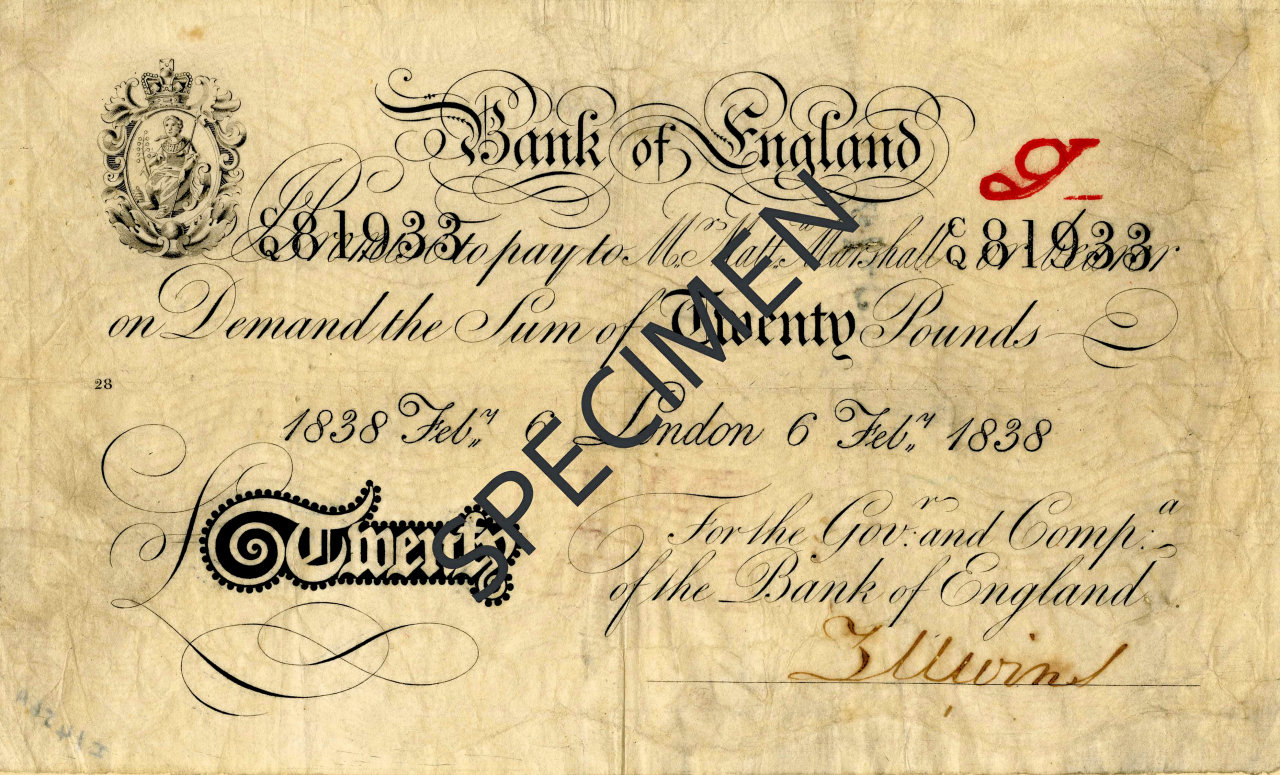 A 1838 £20 Note
Image Courtesy of Bank of England
Joshua Crompton had been the last born child of a family of 15 from Bolton, Lancashire. Having being orphaned aged 10, he moved to Manchester where he found work with a gentleman’s family, eventually becoming their coachman. The master’s wife’s sister, ‘conceived a partiality and tenderness’ for him. A resulting marriage, brought with it a small fortune. Crompton opened up an ironmonger’s shop in Bolton but when that failed, he became a Sheriff’s Officer in Liverpool.
Becoming infatuated with another young woman, they moved to London together to open up a shop on Prince’s Street, Red Lion Square. After separating and giving up the shop, he was sworn in as an officer to his Majesty’s Palace Court (of Westminster?), where he dealt with debtors, but by 1775 he had to give up this position because he was in debt himself to the tune of £1500. He needed to maintain a wife who was ready to ‘lie in’.
He was negotiating for purchase of a position as Sergeant of Mace (historically responsible for the security of the insignia whenever a Mayor wears the chains of office), when events intervened. Meeting with friends in May 1777, visits were planned to the races at Newmarket, Epsom and Guildford Down. Winnings on Epsom Downs were put in his pocket book and two days later he needed to buy some new boots. While in Mr Gaskin’s shop, he was persuaded to purchase four gowns for his wife, giving a twenty pound note for the payment of four pounds, thirteen shillings. Mr Gaskin needed to change the large note at the neighbouring Spread Eagle and after receiving the balance, Crompton returned to London.
On May 20th Crompton set out for Guildford with his friend Richard Wiltshire but the inclement weather tempted them into a Taproom at Ewell. There Mr Peckering, the landlord, spoke of the unhappy experience of his acquaintance Mr Gaskin, in Epsom, who had recently been passed a counterfeit £20 note. The two men continued to Guildford where they arranged a room at the White Horse before drinking in the Red Lion. Hearing next morning of the arrival of the Bow Street Runners in the town, Joshua ordered his horse and returned to London where he told his tale to the landlord of the City of Bristol in Wapping. He managed to board a vessel for Scotland, arriving in Dundee on May 31stonly to be arrested there by the Runners .
In London, Crompton was examined by Sir John Fielding and confined in the new prison at Clerkenwell, before being moved to Newgate prison. He had given testimony against three other men who had assisted him, including a leading Tea-dealer near Tower Hill and his friend Richard Wiltshire, who was apprehended. Prior to his trial in Surrey, where the offence took place, Crompton was moved to the New Gaol, Southwark.
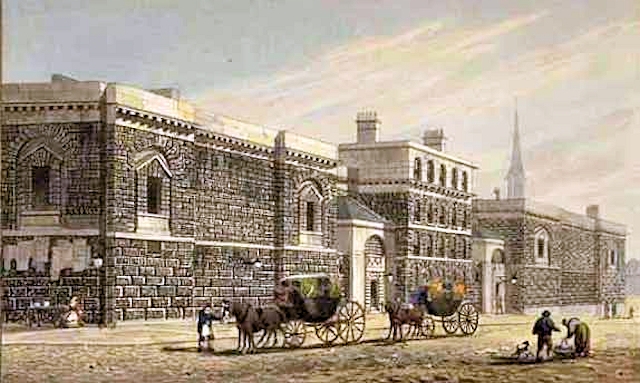 West View of Newgate
by George Shepherd c.1810 via Wikipedia
There his friend, Francis Crooke suggested the possibility of escape. Dressed in woman’s clothing he walked boldly out of the gaol and later he crossed the sea to Flushing in Holland. Subsequently Crooke influenced his return to England, saying falsely that a pardon had been obtained for Joshua.
Crompton was apprehended, by Hall, keeper or under-marshal, to be placed in shackles at the New Gaol, Borough, Southwark. On 29 July 1778, he was taken to Guildford for the trial. Several witnesses gave convincing accounts that he had knowingly presented the note but there was no evidence that he was responsible for the forgery. Crompton was declared guilty and was condemned to death. Exhibiting penitence and offering forgiveness, Joshua Crompton was hanged at Gangly Green, Guildford, on 24August 1778.
Hue and Cry over the uttering of a forged bank note.
Notice issued by the Public-Office, Bow Street, May 23, 1777
“WHEREAS JOSHUA CROMPTON, late a Sheriff’s and Marshalsea Court Officer, stands charged on oath before Sir JOHN FIELDING, on a violent suspicion of FORGERIES, to a very considerable amount. (20 guineas reward was offered both on committal and conviction).
The said Joshua Crompton is a well-looking man about thirty-eight or forty years of age about five feet six inches high, fresh complexioned, roundish faced, grey eyes and dark eye-brows, has a dent in his nose which throws out his nostrils more than common; he is square made, a little round-shouldered and stoops a little in the neck; he walks wide and rather turns in one toe; and is supposed to be dressed in a round bob wig with two curls, or a club wig, a dark chocolate brown fly frock, with large white buttons of a sun pattern, a dark brown and orange striped Manchester velveret waistcoat, with buttons the same colour, a pair of drab coloured cotton denim breeches, with garters of the same, and new boots.”
Verifiable elements of this story
As a Sheriff’s Officer Joshua was himself authorised to exercise warrants with a power of arrest.
It is likely that Crompton had found lodgings at the King’s Head Inn (later Hotel) (eventually 125) High Street, Epsom.
In his Companion from London to Brighthelmston, James Edwards records us that ‘ the most established mercer in this town’ had become Mr Pimm by 1789. His shop appears to have been located in Lehmann’s The Residential Copyholds of Epsom as plot3 C 30, adjacent to the King’s Head on 3 C 32 and possibly Gaskin was a previous shop-keeper there. That Joshua had purchased ‘new boots’ was confirmed by the Bow Street notice above.
One can identify Mr Seager at the Spread Eagle as the then tenant, Henry Saker.
‘Peckering’ in Ewell remains unidentified.
A concise summary of the case as presented in the Newgate Calendar, William Jackson, 1794
“After committing the very worst species of forgery, that of counterfeiting the notes of the Bank of England, he made his escape to France, from the prison to which he had been committed, on suspicion. From whence he was allured to return to England by a false friend, who had assured him of safety. He was immediately betrayed, and again committed to gaol. His trial came on at Guildford, on the 31st of July, 1778. His indictment contained two charges of forgery, and he was convicted on the following:
‘For forging, and uttering the same, knowing it to be forged, a certain instrument in writing, purporting to be a note of the Bank of England, dated the 5th of May, 1773, marked K, No. 56, payable to Thomas Harris, Esq. or bearer, on demand, signed by the Governor and Company of the Bank of England, and subscribed Thomas Grant’.
The testimony of several witnesses leaving little doubt of his guilt, he was condemned to death. He behaved becoming his unhappy situation. At the gallows he acknowledged his crime, and prayed the forgiveness of man, observing that he had firm reliance on, and that he had made his peace with, God. He prayed to God to forgive his false friend, who, he said, artfully drew him back to England, and was the means of hanging him for ten guineas. His unhappy fate was much lamented, while the surrounding crowd heaped execrations on the head of his betrayer.”
Gangly Green, Guildford
Ganghill Common was in the manor of Stoke next Guildford (Surrey History Centre G86/26/13 1 October 1666): it appears as ‘Gangle Common’ on Rocque’s Map of Surrey, c. 1767, a mile or so out of the town between the 1758 Leatherhead to Stoke next Guildford turnpike and the old Portsmouth road. ‘Gang Hill’ is marked on the first O.S. Map of Surrey (1816) in about the same position. Apparently it became part of the Abbotswood Estate, Merrow, an area of high ground overlooking the water meadows of the River Wey.
Article researched by Brian Bouchard 2020