
THE DULLERS
 George Edward Duller
An Ogden’s cigarette card from 1931
Writer’s own collection
Introduction/background
The Dullers formed part of Epsom life for some years, mainly in the horse-racing sphere, but cars, planes, and even greyhounds, also featured. There’s no particular evidence that any of them made big money out of these activities, but they were adventurers of sorts and worked their way out of the regulation scenario of impoverished agricultural labourers with very large families to find their respective niches.
We’ll start with John Duller, born about 1835 in Sawston, Cambridgeshire (the surname could have been Dellow originally, but the family was very much victim to mis-spelling by census enumerators in any case).
John, a labourer, married Harriet Fuller from St Ives in 1863, and by 1871 they had gravitated to West Ham, with four children in tow. It then appears that he died in the North Witchford district of Cambridgeshire in 1872, which is a total mystery, but in any event, Harriet, left presumably destitute with her brood, married one Samuel Forway, a gas labourer, in St Ives district just months (possibly weeks) later. Births continued apace and in the 1891 census we have Mrs Forway in two places at once. She was with husband and children in West Ham and also with her son, George Henry Duller, at another address in West Ham (occupation: laundress). I have no idea what was going on, but at least we know that George Henry was a cab proprietor and presumably on the up.
By 1901 Harriet was still in West Ham, with assorted descendants and boarders, and Samuel Forway was elsewhere, so I assume that the marriage had broken down. In any event, Samuel died in1909 and Harriet in 1916. In the 1911 census Harriet had been on parish relief.
George Henry (‘Hoppy’) Duller
George was known as ‘Hoppy’ because he was considerably lame. He married Ellen Clara Green in about 1890 and children appeared regularly. By 1911, when he was training at Downs Cottage, Burgh Heath Road, (latterly Priam Lodge) we are informed that there had been 12 children, of whom eight were still alive. All of the survivors were at home, ranging in age from 20 (George Edward) to four months. (Maud). Another daughter arrived in 1912.
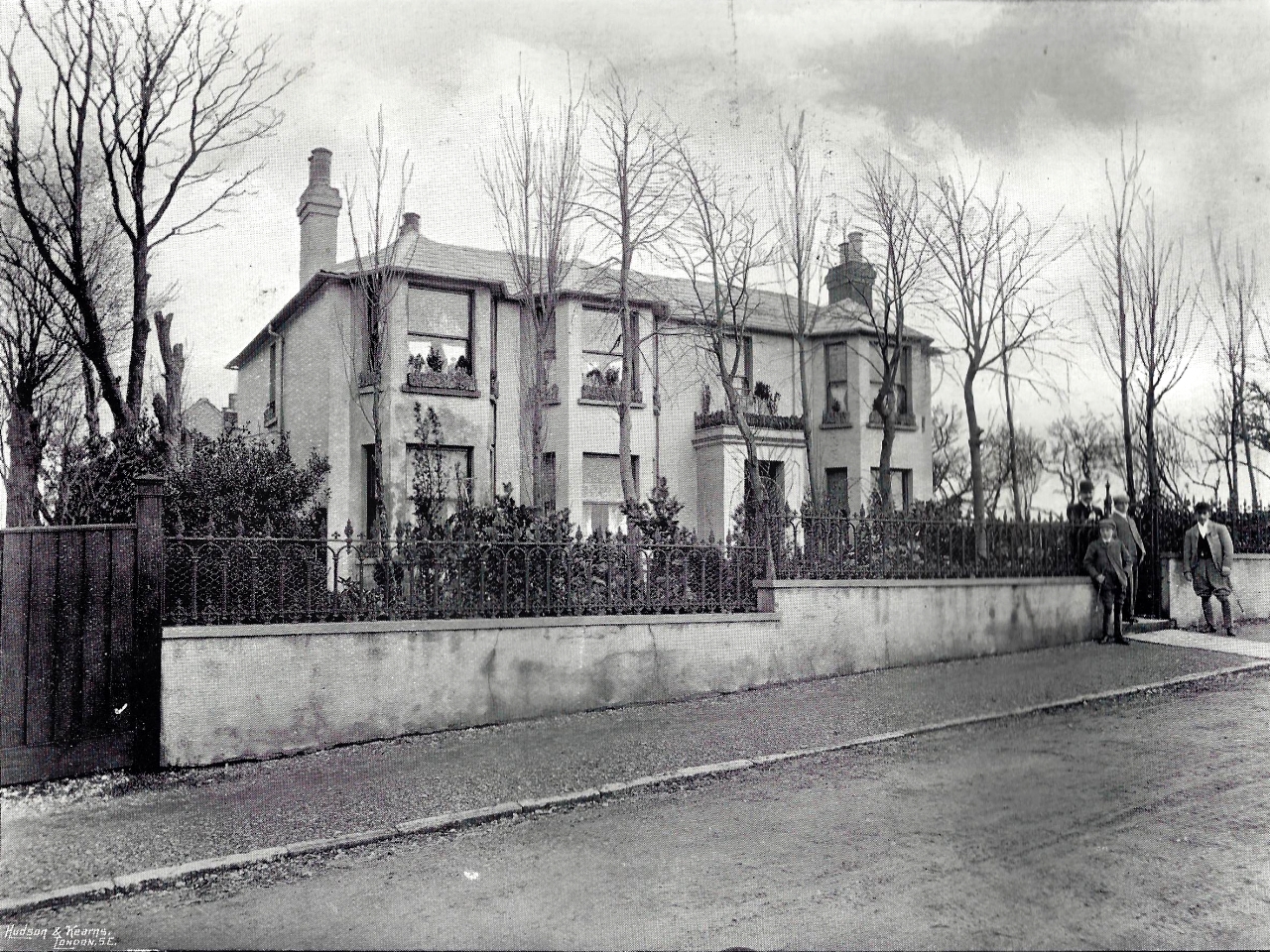 Downs Cottage in its Priam Lodge incarnation
Image courtesy of Bourne Hall Museum
In Sidney Galtrey’s ‘Memoirs of a Racing Journalist’, published in 1934, the author tells us that Hoppy ‘was rough, unsophisticated, and unvarnished in his manners at all times’.
Rather than attempting to tell you about George Henry’s training career, I refer you to Bill Eacott’s dictionary of local racehorse trainers, from which you will see that Hoppy was quite successful but not in the superstar bracket. He and Ellen stayed in Epsom at various abodes until the late 1920s and apparently then retired to Brighton. However, Hoppy died on 17 March 1930 whilst having his greyhounds weighed at Hove Stadium. Ellen subsequently returned to the local area.
Arthur John Duller
Young Arthur looked to have the makings of a good career as a jockey when, in 1914, he was stricken with enteric fever and died at Epsom Isolation Hospital on 27 April 1914. The Sheffield Daily Telegraph of 28 April 1914 carried this report.
|
DEATH OF ARTHUR DULLER The Press Association regrets to announce that Arthur Duller, the jockey and son of the well-known Epsom trainer, George Duller, died at the Epsom Isolation Hospital shortly after ten o’clock last night. The cause of death was enteric fever. Duller had latterly returned from India, where he had met with considerable success in his profession. The deceased, who was born in 1893, was the second son of George Duller. He served an apprenticeship of two years with Frank Hartigan and then became attached to his father’s stable. He was a strong horseman for his weight and in consequence his services were in fair demand. He was not so good a jockey, however, as his elder brother, George, who is now in the front rank of cross-country riders. Duller rode only three winners in this country last season under Jockey Club rules. In 1912 he was successful on twelve occasions, in 1911 he steered sixteen winners, in 1910 eighteen. |
George Edward Duller
You can find information about this George Duller in Bill Eacott’s Racehorse Trainers at Epsom . For obvious reasons, Bill has concentrated on the horse racing, but he does say that George Junior also raced motor cars. This section is mainly about his driving career.
It’s fair to say that if something could move speedily, George Duller would ride it, drive it or fly it, (he was in the Royal Flying Corps during World War I), as appropriate. He was the champion jockey over jumps in 1918 and continued to ride for some years afterwards, but he obviously fancied something with rather more horse power and took up motor racing in 1921. He was one of the ‘Bentley Boys’, a group of well-heeled racing car fanatics, the most famous of whom were probably Tim (Sir Henry) Birkin, Woolf Barnato (the latter won the Le Mans 24 Hour Race in three consecutive years, 1928-30, the only times he entered) and Frank Clement (Le Mans winner in 1924).
 ‘Old Number One’, the Bentley Speed Six in which Woolf Barnato
won the 1929 and 1930 Le Mans Race.
Image source: Wikimedia Commons.
George never won Le Mans but he won other endurance races, competed many times at Brooklands and broke speed records. His results might have been rather better had he not been up against the likes of Malcolm Campbell and Woolf Barnato.
Le Mans 1927
I will not detail the whole of George’s driving career, or we shall be here forever, but we can do a highlight – or lowlight in this instance. The 1927 24 Hour Race was special for Bentleys. Basically, they threw everything at it, with three entries: these were George Duller and Andre d’Erlanger, Leslie Callingham and Frank Clement (the latter having been the 1924 winner in a Bentley) and finally Dudley Benjafield with Sammy Davis. Most of these were ‘Bentley Boys’ and the Bentleys were the favourites going to the start line.
Five hours or so into proceedings a Theophile Schneider, driven by Robert Poitier and Pierre Tabourin, misjudged a curve and ended up stationary, broadside on to the cars behind. Callingham had two options – hit the stationary car or swerve into a ditch. He made the latter choice but was thrown out of the vehicle into the middle of the track. A second Schneider came round the corner, had no time to do anything and collided with both of the other vehicles. Two more cars, including the Bentley of George Duller, then did likewise. Davis, coming behind, realised that something was wrong and reduced speed, but could not entirely avoid the monumental pile-up, so he put his Bentley into a slide; he still hit the wreckage but was able to re-start his engine. Miraculously no one was badly hurt and Davis was able to get into the pits and do some first-aid on his car, known as ‘Old Number Seven”, which eventually won the race.
I should mention that, for copyright reasons, it’s almost impossible to show you contemporaneous images of the cars being mentioned, so I am having to take the ‘near as makes no difference approach’ (car experts need not write in!). Here is a nice photo of a 3-litre 1927 Bentley which is not ‘Old Number Seven’ but it looks pretty similar and is an original car from that date.
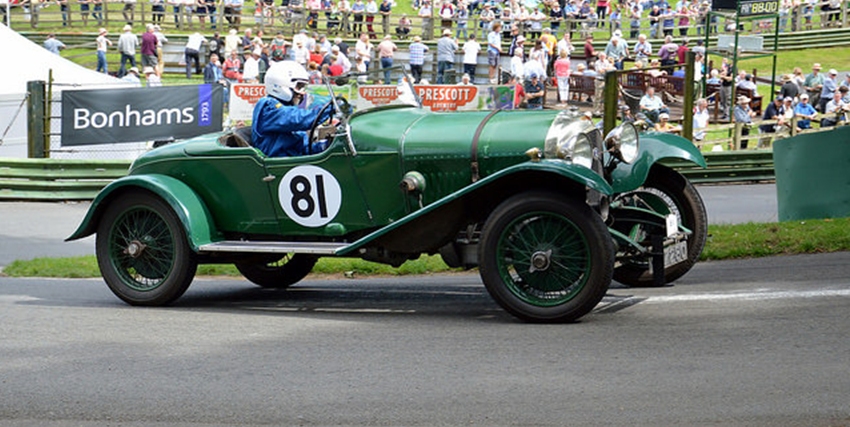 Iain Warner driving his 1927 Bentley in a hill climbing event.
Photo by Dave_S. via flickr.com and licensed under this Creative Commons licence
And, as it happens, there is a good painting of Davis and Benjafield with their winning 1927 car. This could even be the patch-up after the pile-up.
 Painting by Claude Hercent via flickr.com and licensed under this Creative Commons licence
George Duller inspecting his car before a 500 mile race at Brooklands (4 October 1930)
Bessie Duller, George’s then wife, was also involved in the motor racing scene and the social whirl that went with it. The couple had one daughter, Grace Joan.
George died on 6 August 1962, his last address being 78 Hookfield, Epsom.
Victor Duller
 Victor c.1917.
Image source: State Library of Australia (ref: B 46130/49).
Victor was a younger brother of George Edward Duller, and son of George ‘Hoppy’ Duller. He was born in Poplar, East London, on 20 March (precise year uncertain, but it would have been about 1895). In the 1911 census he was with his parents and siblings at Downs Cottage, Epsom.
Australia, the first time
I have no idea how Victor came to be in Australia during the First World War period, but on 26 February 1917, allegedly aged 22, he enlisted in the 43rd Infantry Battalion of the Australian Imperial Force (AIF), which at that time was made up entirely of volunteers. His home town was given as Glenelg, Holdfast Bay, South Australia and his occupation as colt breaker. Victor was latterly a driver with the AIF and was discharged in England on 11 July 1919. Although he did not stay in the UK for many years, we need to tackle this interval, since it brings in the complicated history of his eventual partner (possibly wife), Coralie.
Coralie
Coralie Gwendoline Paddison was born in 1896 in Alverstoke district, Hampshire, but during her childhood she was known variously as Griffiths and Clarke. Her mother was Amy Florence Paddison, who married Howard Clement Griffiths in 1897. Griffiths was a chemist’s assistant and it appears that the marriage was not successful. In June 1900 he was imprisoned for nine weeks, having pleaded guilty to unlawfully assaulting Amy (a more serious charge of feloniously shooting at her with intent to murder her and do her some grievous bodily harm was not proceeded with). He seems to have been in the Argentine during the 1910s. Meanwhile, we can pick up Amy in the 1901 census as proprietor of the Albemarle Hotel in Portsmouth. She is described as married and with her are daughter ‘Coralie Clarke’, aged 5, and two younger Griffiths sons, one of whom died later in 1901. The implication is that Coralie, who was born before her mother’s marriage, did not belong to Mr Griffiths. Howard was staying with a brother in the 1901 census. It appears that Amy never remarried, latterly describing herself as a widow, and remained in Hampshire in various hospitality roles until she (probably) died in 1964, aged 94. What became of her husband is a mystery.
By 1911 Coralie was attending a boarding school in Bishops Stortford, Hertfordshire. An internet source, which looks properly researched, says that she was sent to a convent in Belgium and returned to England because of the war in Europe. We then have Coralie G Paddison marrying William J V Tweedie in 1918 in Epsom district. Investigation shows that this gentleman was William John Vance/Vange Tweedie, a Canadian soldier then stationed in Epsom. However, he was soon repatriated to Canada and, as far as I can tell, never came back. Victor Duller pops up as a 1920 Epsom resident, in Albert Road.
The fog lifts fractionally in 1921, when Jose M G Duller (female) is born in Neath, Glamorgan – mother’s maiden name Griffiths. I can confirm from other research that Jose’s parents were Victor and Coralie, but the Neath part is still a puzzle. Then, Victor Peter (known subsequently as Peter Victor) Duller was born in Epsom in 1924 and again the mother’s maiden name was Griffiths.
Australia, the second time
I cannot find any evidence that Victor and Coralie were married, at least not in England or Wales, but no matter. Victor evidently returned to Australia, to be followed by Coralie and the two children in 1925. Their destination was Adelaide. The following item appeared in The Sport (an Adelaide paper) of 22 February 1934.
|
PATIENCE REWARDED Victor Duller and his wife are to be congratulated for their patience and trouble in curbing the wilful waywardness of Royal Mirth. Duller is a good hand with a wayward or highstrung horse, and sports will wish him further luck with the King of Mirth gelding, who on his Tailem Bend display may prove a thorn in the side of the present-day handicappers and middle-distance performers. Little Alex Cox seems to understand Royal Mirth perfectly and it will be noticed that he rides the gelding with the long rein, almost universally used in England. This is probably more of Victor’s ideas as he is an Englishman and a brother to the illustrious George Duller, the “Arch Priest” of the crouch seat over hurdles and fences in the “Old Dart”*. Motor racing at Brooklands is another sport much indulged in by George Duller. |
*“Old Dart” is an Australian term for England.
And here’s another piece, which appeared in The Referee (Sydney) of 27 August 1936.
|
Riding Apprentice for England A Racing Family Victor Duller, who, with his wife, mixes training racehorses with an occasional trotter in Adelaide, has been waiting with a deal of impatience until his son was old enough to travel back from where his dad came. The other day he paraded the lad before the stewards for them to decide whether the youngster was competent in the saddle to their satisfaction. Little Peter Duller is out every morning on the tracks and, having been practically bred in the pigskin, with his mother and father capable coaches, it was not surprising that he satisfied the officials. Young Peter Duller will not do any riding in Adelaide, his birthplace*, but instead will take an early departure for England, there to join up in the stables of his uncle, the celebrated George Duller, who has a large string at Epsom. George Duller has been just as anxious as his parents to get his young nephew under his wing. This Duller family, especially the one located in South Australia, would be lost if they were not surrounded by horseflesh. It was Vic Duller who brought Silvius to Australia for the late Sir Sidney Kidman and he broke in and assisted to train horses from that establishment. Mrs Duller would sooner be out dressing a horse than inside doing routine domestic work, and an injured leg bears testimony to an accident she had in England while breaking in horses. The more outlawish, the better she likes the horse. She claims to have ridden many racehorses in work on Epsom Downs and also related that she once rode in a race for the pictures, together with Tod Sloan. |
*As mentioned earlier, Peter was actually born in Epsom
Peter did go to Epsom and the News (Adelaide) of 10 May 1941 carried the following item.
|
ADELAIDE JOCKEY JOINS AIR FORCE IN BRITAIN Seventeen-year-old jockey Peter Duller, son of Mr and Mrs Victor Duller of Morphettville, is not only riding winners in England but, according to a letter just received by his parents, is now an airman. Young Duller comes from a noted racing family. His father came from England to South Australia years ago and has since trained many winners here. His uncle, George Duller, was a leading cross-country rider in England for years and lately has been a successful trainer. As a tiny apprentice of 12, Peter Duller left South Australia to become apprenticed to his uncle and he immediately began to ride winners in England. In his latest letter he says that he has given up flat-race riding for events over hurdles and this season has had 20 rides for six wins, four seconds and a third. Writing from his uncle’s training establishment at Epsom Downs, in Surrey, Duller says:- “I am all right, although we have had a lot of bombs round us. They have been very close. In fact, if they had been any closer I would not have been writing this letter. “I have joined the air force. We are all doing well over here and please do not worry too much, because we are not worrying. It is O.K., so keep your chin up because Britain is on top.” |
Note: Whether or not Peter actually served in the air force,
I don’t know, but he was in the Royal Signals, 8th Army.
Peter returned to Australia eventually, but sadly died from a fractured skull after a racing accident, when his mount, called Lucky Rae, fell in a hurdles race at Morphettville on 3 February 1951. A rather different picture of the family then emerged, as revealed in the News (Adelaide) of 4 May 1951.
|
RACE DEATH, £750 AWARD The mother of jockey Peter Victor Duller, 26, who was killed in a hurdle race fall at Morphettville on February 3, was granted £750 compensation in Adelaide Local Court today. Mrs Coralie Gwendoline Duller, of Lawrence Street, Vermont, claimed £900 from Oliver Jones, of Booleroo Whim, owner of Lucky Rae, which fell with Duller. Judge Sanderson found Mrs Duller was the sole partial dependant. Mrs Duller claimed she was totally dependent upon her son’s earnings of about £12 a week. Jones admitted Duller’s death was caused by an accident arising from employment by him, but disputed Mrs Duller’s total dependency on her son. The case came before Judge Sanderson for arbitration. Mrs Duller gave evidence that she had been separated from her husband for some years. She had secured her son’s release from the British Army in 1945 so he could come home to support her. His earnings were about £12 a week and he had given her about £10 or £11, Mrs Duller said. Mrs Duller told Mr J F Brazel, for Jones, that she had supported herself during the war doing munitions work. Her husband was living at Anzac Highway, Plympton. She had made no effort to compel him to support her, she said. “I couldn’t and wouldn’t claim. I would rather starve,” Mrs Duller said when asked if she realised she might have a legal claim on her husband. She had not applied for a Government pension as a deserted wife, she added. |
These final statements again raise the question of whether or not Victor and Coralie were married.
Victor died on 2 April 1973, still a resident of Plympton, followed by Coralie on 17 September 1983. Their daughter, Jose, (Mrs Woodall) died in 2014. There was another son, Edward (Ned), probably born in 1928, but I know nothing about him, other than that he was once a jockey; I believe he passed away in 2019.
Final resting places (either burial or other form of memorial)
| Name | Place | Grave or other reference |
| Arthur John Duller
George Edward Duller |
Epsom Cemetery | A487 |
| George Henry Duller
Ellen Clara Duller |
Epsom Cemetery | A486 |
| Peter Victor Duller
Victor Duller |
Centennial Park, South Australia |
General B, Path 12, Grave 938 |
| RSL, Wall 116, Niche A005 |
There is also a Richard Duller commemorated in Centennial Park by a plaque (reference Derrick Garden of Remembrance. Tree Bed 28, Position 22): the plaque says that this individual died in 1965, aged 58, and was in the Merchant Navy. It’s likely that this was Victor’s younger brother, who seemed to be in the UK up until the 1939 Register, but looks to have emigrated to Australia in 1950.
Linda Jackson 2021